The Art of Subtraction (ROUND 5)
scent of the day: Myths Man, by Amouage
Myths Man (2016, Daniel Visentin, Dorothée Piot, Karine Vinchon Spehner)—a smoky-floral fragrance that evokes not just a high-sun funereal pyre shot through with ferny sharpness but also, given its steady presence of leather and booze, none other than the death-obsessed Dionysian Jim Morrison himself (dancing like a two-spirited shaman in his signature lambskin pants, a lei of yellow and white and violet and salmon mums around his neck, perhaps in oblivious disrespect to the Ganges mourners having to deal with yet another blotter-acid white vomiting fetal-curled drunkenness all over the place)—
begins with a melancholic-mineraloid combo (rooty-powdery orris, which imparts damp-stone texture and violet-like undertone, and bitter-herbaceous chrysanthemum, which imparts chalky-silken texture and menthol-medicinal undertone) calling to mind—especially given the contribution of purse-flask tipple (a rum note that reads like rice wine) alongside fungal-musty elements (old-lady rose, perhaps some unlisted myrrh and patchouli)—a staccato jump-cut progression
from the hospice nightwatchman’s pussy play and Peter-North facials to the ozone-scrubbed embalming table to smooching Grandma’s cold-marble cheek during viewing hours (or, in my case, snuffing the alcoholic bitch in her mummy-ass mouth because she still owes me money, only then—disgusted at the caked-up makeup on my knuckles—clocking her one last time before uncles and cousins swarm me) and finally to the Dudley-Moore-looking lush of a cremation tech pocketing scrap dental gold among the silken powder and bone shards,
this boozy-floral mélange of greyscale purple imparting—especially when coupled with the lemony-pepper sunshine of elemi incense—an alluring ayahuasca-adjacent surreal smell (somewhere between a citrus-eucalyptus urinal cake activated by a flush, on the one hand, and—in part due to what I sense is the same lab chemical, “amberXtreme,” that mars this composition and Opus VII and absolutely ruins Enclave—a hot-toddy take on Thera-Flu menthol citrus-berry tea, on the other) that slowly gives way over the early hours (although the Halls honey cough drop never fully dissolves) to a grave core of rough-yet-plasticky leather and chrysanthemum-boosted cigarette ash
(both the leather and ash mainly a function of musky-snuff labdanum and sooty-tephra Javanese vetiver and both together seemingly meant to convey, if we can smell past the amberXtreme-steroid-pump that sadly overshadows everything, what a Chinese dragon—not nail-salon snatch but literal Chinese dragon—smells like or, since most of these mythological serpents are associated with aquatic-ozonic smells and do not breath fire, perhaps in particular what the volcano-making dragon Fuzanglong smells like)—
the overall result being a cremation-chrysanthemum fragrance that, while bringing forward the various facets of this Caitlin-Doughty-approved death floral (wormwood, tarragon, camphor, pollen, tea), showcases perhaps above all its cold-ash facet, a so-fine-it-is-creamy ash that falls somewhere in the romanticized space between settled pyroclastic dust and the sandalwood ash of an incense cone (still holding its shape next to the mummified home death who lit it over ten years back) but can at times border on a sulfurous-gunpowder aroma that (if only due to the dragon cover art) calls to my mind Chinese dragon dances at the annual Kaifeng Chrysanthemum Cultural Festival where fireworks are set off to frighten evil spirits and clear the way for good fortune;
the overall result being, in other words, a volcano-dragon twist on the iris-leather family (Black Knight, Lover’s Tale, Cuir Cannage, Cuir Mauresque, Cuir Ottoman), a kiln-ash twist that (while arguably bent slightly toward softcore masculinity, as we might expect from the fact that Fuzanglong like most Chinese dragons are at once gentle and yet yang-sun in voltage as opposed to yin-moon) has some strong similarities to Bracken Woman (both giving us smoky-vetiver leather with mint-berry tea and flower-stem greenery in a balance of buzzing-blooming sun and rhizome-rooted solemnity) and brings to bear an androgenous-metrosexual aura placing it squarely as a member of the artsy-dandy trifecta of Chong-era Spring-centric releases: Portrayal Man (incarnated by Oscar Wilde), Imitation Man (incarnated by Jean-Michel Basquiat), and Myths Man (incarnated by Jim Morrison).
The Art of Subtraction —for Rilke and the six Mikes
I isolate. Like my own father before me, it takes everything inside me—no longer promising— to look straight at my son. It has grown worse. I have inherited the need to twist talk away from dreams, the shifty eyes that would bug me enough to keep leaping into their line. I slink through rooms now, hunched. From within I see—in belated empathy for the dead—how hard it is to face the gaze: energized, hopeful. How strange what persists in memory: my boy, his little nose (“Bip it. Bop it.”) in the bathroom mirror, eyes meeting over “Pee-yeeeew” diapers whose numbered days no father wants to face. The nose, all of it, intrudes to this day, vivid as yesterday—too big in the foreground for me to fathom his ascent. To call that the full story— that, if I am honest, would be more vain evasion.
His claustrophobic gab of vigor, a wormhole back
to myself young, has begun to ebb into something
considerate, almost—my hand-me-down squirm,
my body talk of get-a-hint-already, having perhaps
bored into his me-me-me world despite my pains
to muffle it down to subliminal frequency if only
to postpone his coming to see his mercy for Dad
as I did in his shoes: as mercy for Dad. But still—
blazing eyes barging in with ebullience for it all,
for what might be, as I exhale a breather of peace
alone in the bathroom—I look down, look at me,
like an ankle-cuffed criminal ushered into court
for his disgrace. And what do I find? Carved
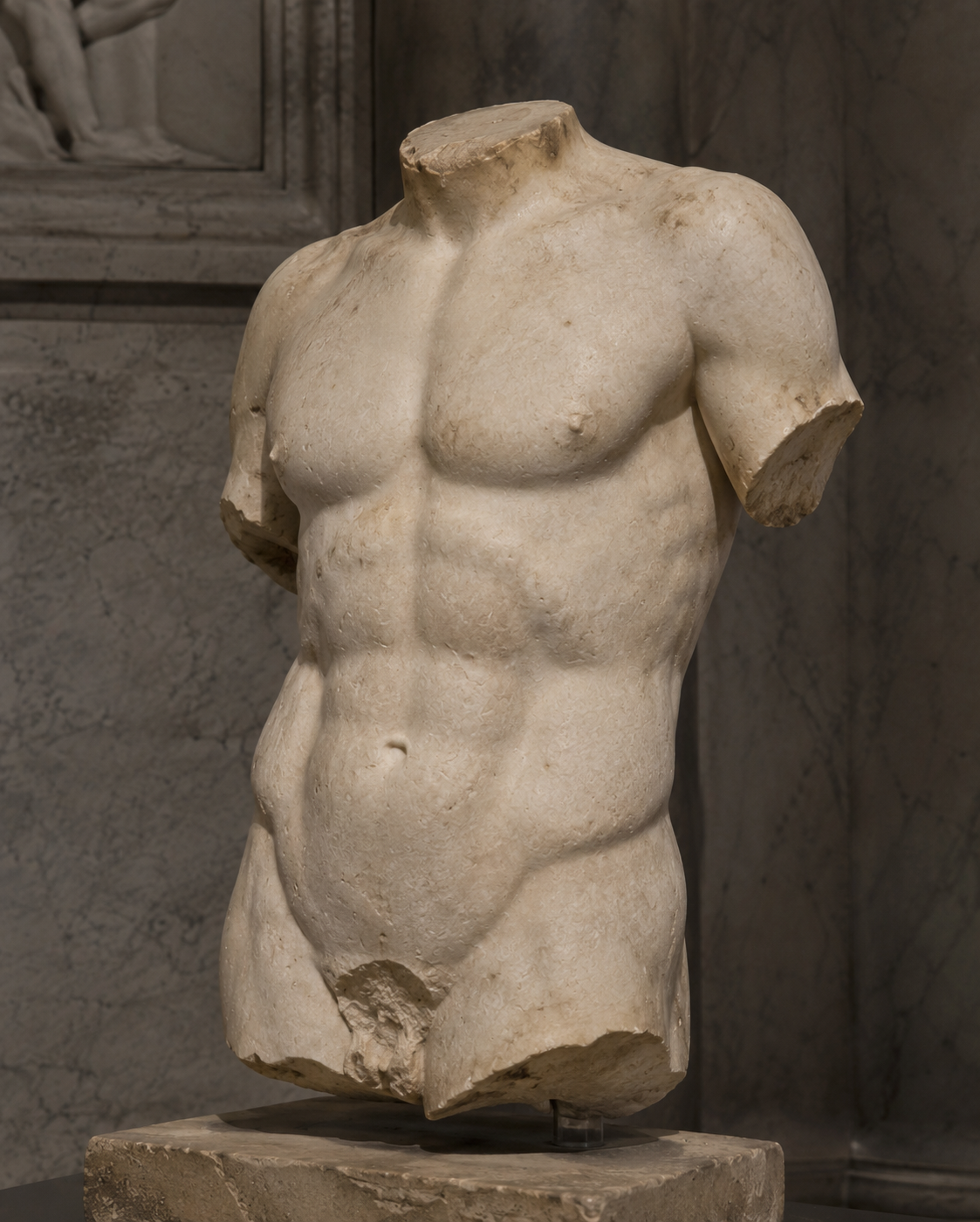
there (how can I look away?) is Apollo’s torso,
marble and mirror, hurling even more dazzle:
“You must change your life”—its demand v-cut
by oblique brutalism: “Face it. Your time is over.”
Standing within that whiplash of injunctions requires no squaring of circles. I know as much. It requires surrender. That surrender, I know too, need not be—no matter my history, my models— to weariness. “Become he who can bear not being the center. Become, even better, he who can sing backstage.” The hidden hinge of reconciliation, dissolving the apparent double-bind, is the call to train the spirit for its final crawl, to apprentice oneself into the erasure awaiting all—to practice, what might be named, the art of subtraction. The image lingers of my father—his head bowed over beer cans stacked high, a flush of bravado— withered before my blaze. I doubt my strength for the other road, freeing as it might be. What I do know is what makes that road harder still— an exit light: if I fail, at least I walk beside him.
“We need books that affect us like a disaster, that grieve us deeply, like the death of someone we loved more than ourselves, like being banished into forests far from everyone, like a suicide. A book must be the axe for the frozen sea within us.”—Kafka (against the safe-space cancel culture pushed by anti-art bullies, left and right)