


to Hive being
welcome
What is Hive Being, and Why the Name?
You have likely heard talk of a hive mind, where one global mind finds more or less figurative expression in various local minds. Such talk is common enough in nature documentaries, especially ones concerning ants or bees, and in sci-fi programs. Take that notion, at least a loose version of it, and broaden its scope. That will be a decent first step in understanding the title I have chosen both for my Blog and for the first five-volume installment of my magnum opus Made For You and Me, a fragmentary collection of minimalist stanzas from 2016 to 2020.
In alignment with Spinoza (the 17th Century Rationalist to whom I devoted my doctoral studies), I view reality in its totality as a grand hive Being: all entities are but pulsating manifestations of the buckstopping fount of everything, an ultimate being we might call “God” or “Nature” (so long as, out of respect for the capital “G” and the capital “N,” we limit it neither to some anthropomorphic cloud father hurling lightning bolts nor to mere wilderness untouched by human smog). According to the hive-Being view (where reality is one lone superorganism, a monistic—and we might even say unividualist—conception I defend in both my creative and academic capacities), each non-foundational being (each being, that is, whose essence does not involve existence) is an utterly necessitated expression or eruption or exudation of this eternal source—each is, perhaps better put, a mode or manner of being, and so a focal point through which is disclosed, what classical theists sometimes call “being itself” (ipsum esse subsistens): the realness of the real, the being of whatever may be, the sheer activity of being, the very isness of whatever is. This Blog, which duplicates my Substack, throbs as but one among many literary unfurlings of this self-necessitated foundation, this supreme wellspring, of which we—like black holes and broken beliefs, like fractal ferns and flickering flames—are the inevitable stylings.
My Journey
I am an academic who found himself pressured into early retirement by the rising tides of cancel culture. The illiberal scourge of censoring, silencing, and shaming—although always with us throughout our evolution—reached a local peak around 2021. That was the turbulent year my creative pursuits, which the old left once encouraged as a healthy outlet for the stresses of a childhood steeped in poverty and illiteracy, drew the ire of the new safe-space left. A small cadre of self-proclaimed victims and their allies, several of whom continue to berate me years later under pseudonyms as see through as their sexual infatuation, sought to erase me and my heterodoxy. They found support from a wannabe-woke dean, covered in the grand inquisitor robes of our decadent modernity (full-body tattoos) and just itching to signal his commitment to protecting “vulnerable populations” from triggering material (even if just, as it was in my case, off-duty poems “unbecoming for someone calling himself a teacher”). Although I eventually won my due-process case with the help of The Foundation for Individual Rights and Expression, I slunk away from a college that turned its back on protecting freedom of expression and from an institution increasingly intolerant of intellectual diversity.
The wrecking ball to my too-comfy office in the windowless ivory tower came with a silver lining. From the ashes of my professional aspirations rose a phoenix of increased freedom to fulfill the literary calling I have pursued for decades. Reputation concerns never stopped me, even within academia’s sterile halls of conformity. Indeed, my unapologetic defiance, which has long baffled friends and family, no doubt chummed even safe waters—almost as if I were asking for it all along—until the cancel shiver grew too frenzied to hold back its blind thrashings. But now, now I piston the most forbidden territories of human thought with no longer even a twinge of conscience. The newfound freedom means extra time to hone my craft. When not assisting special-needs communities (a day job far more rewarding than freeway-flyer drudgeries), I pursue my literary mission with Dionysian fervor.
Call for Co-Conspirators
This space, my digital sanctuary, showcases the fruits of my mission. Think of my posts, even those linking to my publications, as works in progress. I want your input, unflinching brutality included. Each post begins with an invitation to action: “Let’s workshop this [draft about x, y, z].” Your contributions, whether through public comments or my contact page, help hammer scraps of ore into polished blades fit for magazine publication.
Your input is valuable, even if you are neither a writer nor a reader of literature—twin disciplines dying by the cyber nanosecond. Sometimes—even if at the risk of uttering banalities—an outsider’s fresh vantage can pierce the veils of convention to reveal what insiders miss. It often takes an outsider to make us even think to question our ingrained presuppositions and attitudes. I stand by the hygienic value of contagion. That is one reason I advocate so strongly for intellectual diversity and freedom of expression. And that is also one reason I was so harrowed by the anti-diversity swell of cancel culture in academia (an institution that should be the utmost caretaker of such values)—harrowed especially insofar as that swell masqueraded under the gaslighting guise of “diversity”).
You will witness the breathing evolution of my writings over time. To track these changes, I label each revision by round: “ROUND 2,” ROUND 3,” and so forth. Each piece undergoes continuous refinement based on your feedback and my own revisitations. Sometimes changes will mar the work. That is the risk of creative tinkering as a finite creature. I hope you will alert me to missteps. After many semesters of university writing workshops, one rule has impressed itself upon me: when someone senses a flaw, something almost always needs to change—even if, yes, the proposed solution misses the mark (which often it does). From a quick look into the archives, accessible here, you can see how much I have benefited from your feedback so far.
My Hope
Sharing drafts can be daunting. But showing you the ravaged and unperfumed real deal unfiltered by makeup (stuttering starts and falsities, awkward line breaks and clumsy word choices, grammatical errors and misspellings)—that not only makes my work more relatable, but helps me refine things through your input. I hope the unfiltered look at the raw process of fumbling, rather than just the polished product, also helps other writers develop their craft. Imperfect works often instruct more than perfect ones: whereas the perfect ones tend to have a grace by which they slip inside us without activating our scrutiny, the imperfect ones—especially the near perfect ones—show us glaringly what not to do.
People laugh at me, seeing—in my tilting at the windmills of literary excellence—a Don Quixote clunking around in Arthurian armor in a post-knight era. I am not naïve. I am well aware of the diminishing ability to read, let alone well: slowly and deeply, with gratitude. I am also aware that my style, which often nests subpoints within larger points, never waters down virtuosity for the sake of mass appeal. I watch readers stumble over my sentences, unable to unlock even just the music of the envelope let alone the semantic meat within, which—given my tendency to flashlight through the darker facets of human nature (the addicts, the miscreants, the abusers among us)—only adds an additional alienating layer of difficulty). Beholding these depressive scenes of even supportive family members getting bucked off my syntactic bronco makes me feel like a dinosaur who should get a hint and, if not succumb to the brain rot of skibidi-toilet speak, just hang himself already. Even though the decline in linguistic background and grammatical voltage makes my compositions seem quixotic in a world binging Netflix and TikTok, I persist—raging against the dying of the light—by some internal compulsion to celebrate the richness of language and thought.
My hope is that, despite social media’s unparalleled power to farm our attention, people never forget the unique power of writing. Beyond unveiling hypocrisy, teasing out complex implications, and detailing the commonalities between even the most alien phenomena, writing offers something we need today—trapped in agoraphobic cyber bubbles only thickened by the Lyme dangers of forests and the COVID dangers of cities—perhaps more than ever. Granting us rich access to the first-person perspectives of others (to how things feel to them), writing serves as one of humanity’s best tools for combating loneliness. It allows us to linger, broadly and deeply and at high resolution, within the inner lives of others in a way that other arts can only suggest.
What to Expect
My work spans a broad spectrum: from metaphysical discourses on free will and determinism and the ontology of holes to the ephemera of western culture (whether the childhood impacts of the hypersexual mono-image of black woman as squirting twerkers or Terrence Howard’s sham revolution of mathematics). Some tight and minimal, others free-flowing sprawls; some heady and abstract, others emotional and imagistic—my inkwell musings, which often blend scholarly rigor with a dark humor from both high and low culture, aim to capture the visceral intensity of our personal and social and ultimately existential predicaments.
By no means can I deny that drug abuse, sexual assault, and the tales of the broken and the damned loom large in the tag cloud of my work. My writing will never be a paradise of easy truths and comforting lies. It will challenge you, provoke you, and at times even repulse you. I offer no apologies for the monsters I unleash. They are as much a part of us, at long root scared rodent mammals scurrying in the shadows of dinosaurs, as our noblest aspirations.
But make no mistake. It is not all downer darkness. The archives are my receipts. You will find pieces exploring the pursuit of authenticity in a media-saturated world, the search for meaning in an indifferent cosmos, and the celebration of beauty in both the sublime and the profane. I locate much of my inspiration, in fact, in novelists like Dostoevsky and poets like Ted Kooser—writers unafraid to pursue moral agendas or risk Hallmark sentimentality in an age that often sneers at sincerity.
Be they satirical dissections of modern social dynamics or poignant poems about addiction or academic articles on moral responsibility, my goal is to provoke thought, evoke emotion, and foster meaningful dialogue. Fear has not and will not stop me from challenging humanity’s fundamental taboos (like bestiality and cannibalism) or self-reflecting into the dark chaos of the subconscious, even if that means exposing the Jungian shadows—the inner Goebbels—lurking within us all!
Expect posts each day, no day missed. Donations are welcome, but I impose no paywall: it feels wrong to charge for art, especially given our date with obliteration. Feel free to explore what amounts to, at the time of writing this, close to a thousand pieces of poetry and prose here. That should give you a sense of what awaits.
Join me—specula holstered—on this literary odyssey into the public and private nooks of the hive Being. Let us navigate the labyrinth of creation together, confronting our demons and even slaying our darlings if we must. Let us dance on the razor’s edge between the sublime and the profane in pursuit of an elusive literary perfection never to be confused—as it has been confused in our declining civilization—with the pursuit of popularity or likeability over truth.









tag cloud
- literature community
- American literature
- poetry
- literature
- poem
- literary
- creative writing
- writing
- poetry community
- Michael Istvan
- Istvan
- perception
- defiance
- suffering
- existential poetry
- dissociative
- existential
- healing
- human
- mortality
- power
- art
- artist
- evolution
- God
- death
- love
- darwin
- anxiety
- rape
- psychoanalysis
- addiction
- homeless
- addict
- trauma
- therapy
- rapist
- traumatic
- hypersexual
- hyperarousal
- grooming
- anal sex
- anal
- heart
- incendiary
- dead
- Identitarianism
- tyrant
- meditation
- poverty
- fap
- choking
- traitor
- treachery
- identity
- honey pot
- true crime
- power dynamic
- woke
- cunnilingus
- Vaginal
- animals
- OwnVoices
- empathy
- ally
- crime
- summer
- scarf
- body disposal
- kidnapping
- Klan
- sex
- crack
- identity politics
- Vagina
- disease
- indians
- turtles
- fisting
- Pussy
- surrealism
- anality
- erotic
- scatalogical
- violence
- teenybopper
- artistry
- borders
- mommy
- poet
- animal
- sublime
- victim
- pedophilia
- van gogh
- adult-minor
- safe space
- poetry editor
- americana
- math
Posts

Buds Desperate to Be Pried the Fuck Open (ROUND 3)
Scholarly Essay: "Buds Desperate to Be Pried the Fuck Open"
"Buds Desperate to Be Pried the Fuck Open" is a nine-line poem that performs an act of cultural diagnosis in the compressed space of a single argument: that the hypersexualized content saturating contemporary media may function not as corruption imposed on innocent bodies from outside but as an accelerant applied to biological processes already underway, and that the moral panic surrounding this content cannot fully reckon with the possibility that its "damage" and its "kickstart" are the same event. The poem does not celebrate this. It does not mourn it. It holds the proposition with the precision of someone who has thought carefully about what it means and is unwilling to pretend it means something simpler.
The title is the poem's most concentrated formulation, and it establishes the poem's central ambiguity before the first line. "Buds desperate to be pried the fuck open" names flower buds — the standard metaphor for adolescent sexuality, development, the body's emergent capacity — but "desperate" assigns agency to the buds themselves, and "pried the fuck open" introduces force, violence, and impatience into the opening act. The title asks whether the violence is being done to the buds or whether the buds are soliciting it, and then refuses to separate these possibilities cleanly. The "fuck" in the title is not mere intensifier; it is the poem's subject arriving in the title before the poem has begun.
"The bad part of our anal-Perc / beat-it-up monomania" opens with a deliberate ugliness that is also a precise cultural description. "Anal-Perc" — the specific drug and the specific sex act — names the contemporary pornographic idiom with the accuracy of someone who has observed it rather than the prurience of someone performing shock. "Beat-it-up monomania" captures the repetitive, formulaic, aggressive quality of the dominant contemporary sexual script — the narrowing of erotic imagination to a single set of approved acts performed with a single approved intensity. "Monomania" is the poem's most diagnostic word: not variety, not exploration, but fixation, the compulsive return to the same groove worn deeper by repetition.
"Refrains, chanted by music icons / on each screen, kinking souls / like rape" — the comparison is deliberate and structurally exact. The poem does not say the content is rape. It says the chanting of these refrains kinks souls "like rape" — meaning in the manner of rape, with the same twisting force, the same reorganization of the psyche around an encounter it did not choose and cannot fully metabolize. "Kinking" is the poem's most formally precise verb: it means to bend sharply, to introduce a kink into a straight line, to introduce a catch or obstruction. Souls kinked by these refrains are not destroyed but deformed — bent from their natural line into the shape of the content that has organized them. The Doja Cat epigraph — "Spank me, slap me, choke me, bite me... Give a fuck bout what your wifey's sayin... I just want to fuck all night" — provides the specific example, the actual refrain being chanted by the actual music icon on the actual screen. The poem does not editorialize about Doja Cat; it lets the lyric stand as evidence for what it has described.
The em-dash turn — "might be the good" — is the poem's hinge and its most surprising formal gesture. The sentence that began "The bad part of our... monomania" arrives at its completion not in condemnation but in the suggestion that the bad part might be the good part: that the harm and the benefit are not distinguishable. This is not a defense of hypersexualized media; it is a more disturbing proposition. If the content is "kickstarting kiddo libidos / to a rev rate" that would occur anyway through other means — through biology, through Bisphenol A in plastics, through the general hormonal acceleration of contemporary life — then the moral outrage directed at the content may be directed at the wrong target. The content is not creating the libido. It is revving an engine that was already running.
"Kickstarting kiddo libidos / to a rev rate that no ban / on titty-blooming pussy-juicing / Bisphenol A could ever curb" — the endocrine disruptor reference is not decorative. Bisphenol A is the plasticizer documented to accelerate sexual development in children through hormonal mimicry; bans on it have been pursued precisely because of its effects on pubescent development. The poem places the hypersexualized media content alongside BPA as two instances of the same category: environmental accelerants of biological processes that were always going to occur, the question being only of timing and intensity. "Titty-blooming pussy-juicing" renders the BPA effect in the same vernacular register as the media content it has been placed beside — the poem refuses to elevate the scientific discussion above the cultural one, insisting that they are describing the same physical reality in different vocabularies.
The Doja Cat epigraph deserves more than the status of footnote. It is the poem's concluding evidence — placed after the argument has been made, not before, which means it functions as confirmation rather than provocation. The specific lyrics chosen — the catalog of desired violence ("spank me, slap me, choke me, bite me"), the dismissal of the committed relationship ("give a fuck bout what your wifey's sayin"), the reduction of desire to duration ("I just want to fuck all night") — are the anal-Perc beat-it-up monomania in its actual contemporary form: the precise content being chanted on the screens, delivered by the music icon, absorbed by the kiddo libidos the poem has been discussing. The epigraph is not the poem condemning Doja Cat. It is the poem presenting exhibit A for its own argument, and leaving the reader to sit with the fact that this is what is playing, everywhere, all the time.
Formally, the poem's three tercets move with the compression of syllogism: the first tercet establishes the phenomenon and its possible harm, the second introduces the pivot that reframes harm as benefit, the third names the biological reality that the pivot depends on. The enjambment across the first and second tercets — "might be the good: / kickstarting" — is the poem's most important formal gesture, the colon suspending the reader at the pivot before delivering what the bad part might be. The line breaks throughout are functional rather than decorative, each one creating a small suspension that the next line resolves or complicates.
What "Buds Desperate to Be Pried the Fuck Open" ultimately argues is that the discourse around hypersexualized media and childhood development is organized around a premise — that the content is introducing something that would not otherwise be there — that the poem treats as empirically questionable. The libidos are already there. The buds are already desperate. The content is prying open what biology was already straining to open. This does not make the content innocent; the poem explicitly describes it as kinking souls like rape. But it does make the moral framework inadequate — because a framework organized around protecting innocence that was already metabolizing its own corruption cannot account for what is actually happening in the bodies it claims to protect.
Meta Description
A nine-line poem arguing that hypersexualized media content may function less as corruption of innocent bodies than as accelerant of biological processes already underway — placing Doja Cat lyrics alongside Bisphenol A as two instances of the same category of environmental accelerant, and refusing the moral framework organized around a premise of prior innocence.
Keywords
Buds Desperate to Be Pried the Fuck Open, hypersexualized media critique, kiddo libido poetry, Doja Cat epigraph, Bisphenol A endocrine disruption, adolescent sexuality poetry, monomania and contemporary culture, soul kinking metaphor, close reading contemporary poem, M.A. Istvan poetry, cultural diagnosis verse, accelerant and innocence, tercet structure, media and development, compressed argument poetry
Opening Section of ''Hypocorism'' (ROUND 2)
Let's workshop the opening to my story, novel-length now, that examines the intricate power dynamics and linguistic structures at play in a man's passionate relationship with a girl he deems too young
MADE FOR YOU AND ME 3: hive Being (Stanzas 2018--part 12)
Scholarly Essay: "Made for You and Me 3: Hive Being (Stanzas 2018 — Part 12)"
"Made for You and Me 3: Hive Being (Stanzas 2018 — Part 12)" is the most philosophically meditative installment of the series encountered so far, its aphoristic range tilted more heavily than its predecessors toward observations about mortality, identity construction, cultural normalization, and the specific textures of aging consciousness. Where Part 11 carried political anger at higher temperature and Part 10 demonstrated the project's democratic range most expansively, Part 12 moves at a slower, more ruminative frequency — the hive in a contemplative phase, the cells producing observations that circle back on themselves, that qualify and extend and occasionally contradict each other across the field. The piece is not less transgressive than its predecessors, but its transgressions arrive more quietly, embedded in a texture of philosophical reflection that makes them land differently.
"History crawls out of nothing but its own skin — even the iPhone was no rupture" — the opening observation establishes the piece's relationship to continuity and change. The iPhone, which its manufacturers and much of the culture experienced as a civilizational rupture, is here demoted to the status of history's ordinary molting: the snake that sheds its skin does not become a different snake. The observation is not anti-technology but anti-rupture-narrative, resistant to the human tendency to experience each technological development as the beginning of a genuinely new era. Every era believes itself the first to have broken with what preceded it. The hive has always been producing this belief, and the belief has always been mistaken to the same degree.
"Holiday tables are places to see if family members are hard of hearing" — this is the piece's most quietly devastating domestic observation. The holiday table as audiological diagnostic: the repetitions, the raised voices, the conversations that continue past the point where comprehension has clearly failed, all reveal the accumulating sensory losses that family members conceal between gatherings. The observation carries the full weight of aging without naming it — it finds the subject in a specific and mundane detail, which is the aphoristic form's greatest strength.
"Hooking up with someone even more suicidal than yourself" — the piece's first overtly dark entry, and it carries a specific psychological logic: the person who seeks out someone further along their own trajectory, the comfort of finding a floor below the one you currently occupy, the perverse reassurance of the comparison. The observation names a real pattern of behavior without judgment, with the flat precision that characterizes the project's best entries on difficult psychological terrain.
"The exact niceties will be different, but it will happen to you" — this is the piece's most universalizing observation, and its power comes from the absence of its referent. What will happen? The niceties vary; the thing itself does not. The observation could refer to death, to humiliation, to loss, to any of the numerous misfortunes the piece surrounds it with. Its refusal to specify is not evasion but precision: the principle is universal precisely because it applies to everything that the reader is currently imagining will not happen to them.
"Clinical detachment toward news horrors" — the piece names, without elaborating, the psychological adaptation that contemporary media consumption has produced in virtually every engaged citizen: the numbing that allows a person to process atrocity as information, to absorb reports of mass death with the same cognitive register applied to weather forecasts. The observation does not condemn this adaptation; it notes it as a feature of the environment, as real and as unremarkable as the peripatetic bottle collector's limping cart that appears later in the piece.
"Peer pressured to declare that you too heard the voice, the call" — the religious vocation as social performance, the conversion narrative as community compliance. The piece identifies the pressure to produce a legible spiritual autobiography as a form of social conformity that may have little to do with actual experience. "The call" requires a caller and a recipient, but the piece suggests that many recipients have been pressed into service by the social requirement to have been called rather than by any actual summons.
"Fucking freshly turned earth, ready for garden seed" — placed between the observations about darkness and isolation, this entry arrives with the quality of a non-sequitur that is actually a philosophical proposition: the fertility of the prepared ground, the specific readiness of earth that has been turned and opened, rendered in the language of sexual penetration. The piece finds in this agricultural act the same erotic logic it finds in other forms of preparation and opening — the ground that is ready receives, as the body that is ready receives, and the language of readiness and reception is the same in both cases.
"Acid to undermine body identification" — four words that contain a whole forensic procedure: the use of acid to destroy the distinguishing features of a body, to prevent identification, to convert a person into unidentifiable matter. The observation does not contextualize the acid — is this a crime scene procedure, a historical atrocity, a contemporary disposal method? All of these simultaneously, perhaps. The piece places it without comment between the garden earth and "mommy's new pipe," which is itself a compressed domestic image of whatever has replaced the previous pipe — drugs, a new partner, a new pleasure — in the mother's life after a loss or a transition.
"Is that what that is?" — the piece's most minimal entry, and its most philosophically generative. The question is addressed to no referent, which is its point: it names the experience of sudden recognition that something one has been observing without understanding has now been identified, the "is that what that is?" of the moment when a pattern becomes legible. Applied to any of the surrounding entries — the clinical detachment, the peer pressure to declare a call, the acid — the question performs the recognition that the piece has been making available throughout: so that is what is happening here.
"A being who does not laugh is not worthy of worship (unless that being / is the very radix of laughter); and one who would have us, who would / wish for us to be, ever solemn — that being is to be positively contemned" — this is the piece's most formally constructed philosophical argument, given three lines instead of the usual one or two. The argument is precise: laughter is a criterion of worthiness for worship, because a being without laughter lacks something essential to the quality of existence that worship honors. The exception — the being who is the radix, the root of laughter itself — preserves the principle: the exception proves the rule by making laughter foundational rather than incidental. The condemnation of the being who would impose solemnity is the argument's sharpest edge: not merely that such a being is inferior but that it is to be "positively contemned," actively opposed, because it seeks to diminish the quality of existence it claims to govern.
"Make up for having avoided the delivery room; / keep the body at home: wash it, dress it, be / near it — learn that you too are bound to die" — this is the piece's most directly instructional entry, and its instruction is the oldest and most consistently avoided: the confrontation with mortality through the body of the dead. The man who could not be present at the birth is asked to be present at the death — to perform the intimate labor of the corpse's preparation, which cultures throughout history have understood as both a service to the dead and a necessary education for the living. "Learn that you too are bound to die" is not a threat but a curriculum: the body teaches what no abstraction can.
"Normal gets you in the end: hated pop plays unbidden in your head enough years / that it comforts you; you describe the old film to someone using the same / ad ploy you rolled your eyes at back then" — this is the piece's most psychologically precise observation about cultural normalization, and it tracks the process with uncomfortable accuracy. The pop song you despised becomes, through sheer repetition and temporal association, the soundtrack of your own interior life — unbidden, comforting, yours despite yourself. The advertising language you recognized as manipulation becomes, once enough years have passed, the language you naturally reach for when describing the thing. Normal gets you not through conversion but through accumulation: enough exposure, enough time, and the resistance is worn smooth.
"Blacks are the only people who have declared open season on blacks, / and the proof is in the pudding: ask any black person where / he would rather walk alone at night: through the hood or the sticks" — the piece's most politically direct entry and its most likely to generate controversy, which is precisely why the piece includes it with the same flat delivery it applies to everything else. The observation belongs to a tradition of Black conservative critique of Black-on-Black violence that the mainstream left has consistently found difficult to accommodate — difficult because it complicates the structural racism narrative without replacing it, because it makes a claim about internal community dynamics that the external gaze has always distorted. The piece does not present this as a refutation of structural racism; it presents it as an observation about the specific geography of violence that any honest account must include.
"That moment is a sort of forever, / so it was not a lie when he said / that he would love you forever" — the piece's most lyric entry and one of its most philosophically generous. The defense of the declaration of eternal love is made through the phenomenology of the moment: the moment of love, experienced from inside, is experienced as a sort of forever — it has the quality of the permanent, the boundless, the unconditional. The person who said "I will love you forever" spoke from inside that moment, and the moment was genuinely experienced as forever. That the feeling has since changed does not retroactively falsify the declaration; it reveals only that the phenomenology of the present moment does not constitute reliable prophecy. The lie is not a lie; it is the honest report of a temporal experience that happened to be, like all temporal experiences, finite.
"You keep your dog locked away / from sex, but refuse to relieve it / with at least a clinical hand job?" — the piece in its most deliberately provocative register, applying to the pet owner's stewardship of animal sexual frustration the same pragmatic care-ethics that underlies the rest of the project's approach to bodily life. The observation is structured as a genuine ethical question: if one accepts responsibility for an animal's wellbeing, why is sexual wellbeing excluded from the scope of that responsibility? The answer — because the act is taboo, because the cultural prohibition on sexual contact with animals renders the question unanswerable in the affirmative regardless of the ethical logic — is the answer the piece is interrogating. The logic of the prohibition may not survive the logic of the question, and the piece is interested in exactly that gap.
"Why pay some stranger to do your dead mother's makeup how she never would?" — the funeral industry's insistence on presenting the dead in a stylized approximation of the living, applied here to the specific case of a mother whose appearance in death will be managed by a stranger with no knowledge of how she actually looked, who will apply to her face the conventions of mortuary cosmetics rather than the particular way she wore her face in life. The question is not morbid but pragmatic and affectionate: the stranger's makeup is not the mother's face.
"What to make of a literary culture in a world where reading is done / only under severe duress — the comparatively mild duress of ennui, / at airports and waiting rooms, now nullified by images on the phone?" — the piece's most explicit self-implicating observation, directed at the conditions of its own reception. The literary culture that produced this project — and that the scholarly apparatus around the project represents — exists in a world where the specific form of attentive solitude that reading requires has been systematically colonized by the image. The "comparatively mild duress of ennui" at airports and waiting rooms was the last remaining guaranteed reading time, the enforced pause that sent the hand to the bag for the book. The phone has closed that window. The piece is aware that it is being written into an environment increasingly hostile to the kind of reading it requires.
"Aspersing your society to improve it / is one of the most innocent displays / of optimism, of faith, in that society" — the piece's most direct statement of its own ethical position and one of its most compressed philosophical formulations. The critic who attacks their society is, by the act of criticism, demonstrating a belief that the society is capable of improvement — that the criticism will be heard, that it can produce change, that the society has the resources to respond to honest assessment. The cynic who has abandoned faith in the society's capacity for improvement does not bother to criticize; they simply leave or fall silent. Criticism is hope in action. The piece has been demonstrating this principle throughout its serial run, and here it names it.
"A first step in at least living symbiotically with depression is not taking it personally" — the observation reframes the relationship to depression from combat to cohabitation, from illness to condition, from something that happens to you to something that is part of you. "Not taking it personally" is not a dismissal of its severity but a strategic reorientation: the depression is not a judgment, not a punishment, not an indictment of the self. It is a feature of the terrain. Living symbiotically with it — finding the mutual benefit, the cohabitation that does not require victory — is offered as a first step rather than a solution, which is precisely the piece's characteristic epistemic honesty: it does not promise more than the step it describes.
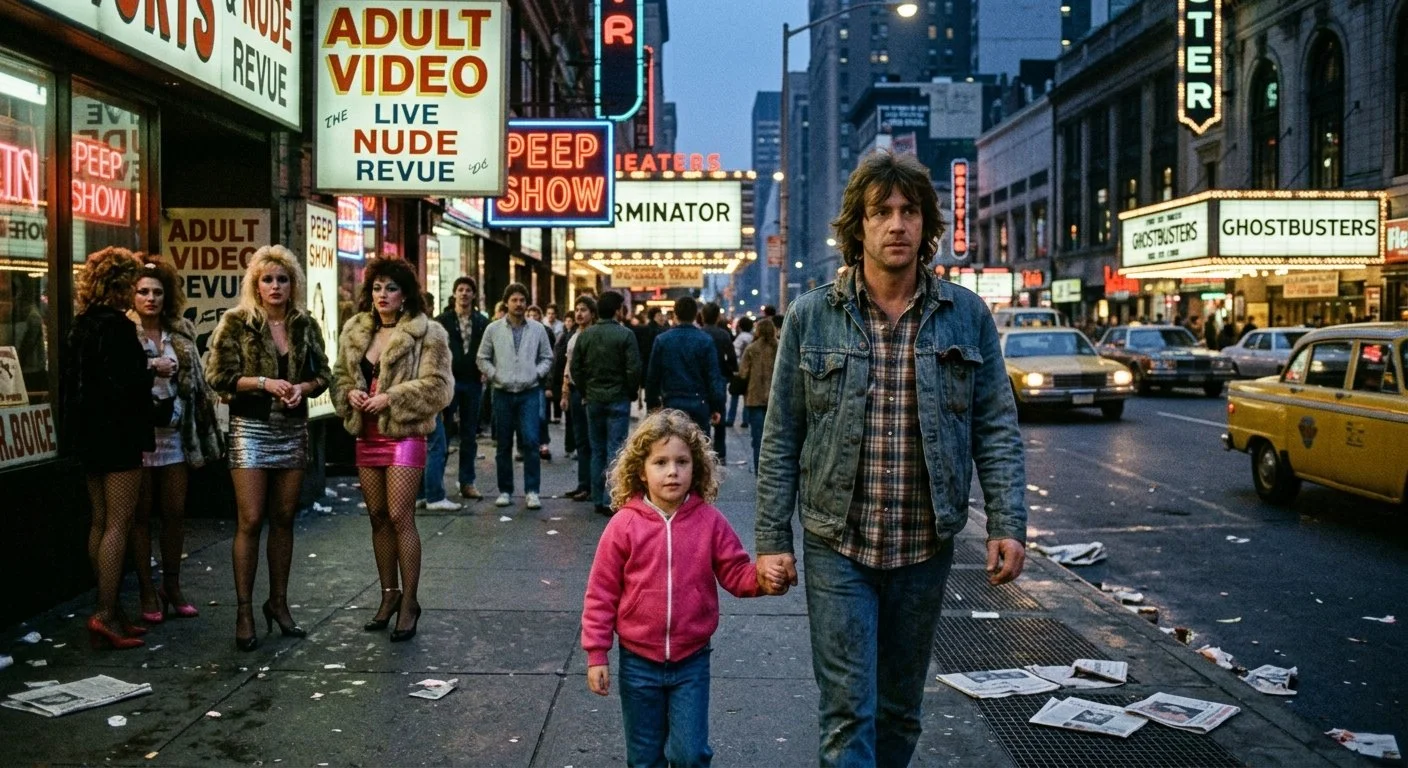
"Widespread fear and repulsion of street hookers, / their exotic power over Times Square in the eighties, / drew in the young girl holding her father's hand" — the piece's closing entry is its most cinematically precise and its most quietly devastating. The image is exact: the child's hand in the father's hand, the child's attention drawn precisely to the source of the adult's repulsion, the forbidden thing that the adult's visible fear and disgust has converted into an object of fascination. The piece closes here not with a philosophical proposition but with a scene — a father, a daughter, a Times Square, the late eighties, the hookers whose "exotic power" over that geography was inseparable from the culture's simultaneously lurid and moralistic relationship to sex work. The scene is also a portrait of a certain kind of transmission: what the parent fears, the child desires to understand. What the culture marks as repulsive, the child marks as powerful. The hand-holding does not prevent the looking. It may be precisely what makes the looking possible — the security of the father's grip enabling the child's attention to go exactly where the father's repulsion directs it.
Formally, Part 12 distributes its philosophical weight more evenly across its entries than any previous installment, rarely allowing any single observation to dominate. The three-line entries — the being who does not laugh, the body preparation, the normal that gets you in the end, the aspersion of society as optimism — suggest a piece that is working toward argument more consistently than its predecessors, the hive building cells that are slightly larger, that require slightly more space for what they contain. The overall impression is of a consciousness that is aging — not declining, but deepening, the observations more frequently concerned with what time does to people and to cultures, with what survives and what doesn't, with the specific quality of a mind that has been watching long enough to notice that history does not rupture but only sheds its skin.
Meta Description
The twelfth installment of a serial aphoristic poem whose meditative register — mortality, cultural normalization, identity construction, the symbiotics of depression, the optimism embedded in social criticism, the child's hand in the father's hand at the edge of Times Square — marks a deepening of the hive's philosophical ambition, the cells slightly larger, the observations more consistently reaching toward argument without abandoning the democratic adjacency that defines the project.
Keywords
Made for You and Me Hive Being Part 12, serial aphoristic poem, mortality and aphorism, cultural normalization, clinical detachment, holiday table aging, iPhone and rupture narrative, body preparation for death, laughter and worship, symbiotics of depression, aspersion as optimism, Times Square eighties, close reading contemporary aphorism, M.A. Istvan Stanzas 2018, hive consciousness and aging, democratic adjacency poetry
We Walk (Round 1)
Walking Removed: Isolation, Contaminated Green, and the Search for Viable Bonds in “We Walk”
The free-verse poem “We Walk” presents a triadic structure of stanzas that chart an increasingly fraught journey through physical, emotional, and existential removal. Each stanza pairs dense, imagistic couplets with a refracted refrain—“we walk removed”—followed by a rhetorical question that probes the possibility of sustenance amid contamination. The poem’s central tension lies between the persistent act of walking together and the progressive alienation signaled by the shifting adjectives (ashamed, inflamed, reclaimed) and the increasingly pathological “green” imagery that dominates the interrogative lines. Through compressed diction, geographic and commercial specificity, and a recurring color motif, “We Walk” stages a meditation on intimacy under conditions of shame, disease, and systemic corrosion.
The opening stanza establishes both the relational premise and the first register of withdrawal:
Elevated heart notes with a prompt reply,
sequestered lilacs under dusk’s vain sky—
we walk removed, ashamed, inside.
What hope is alive for bonds green without pay?
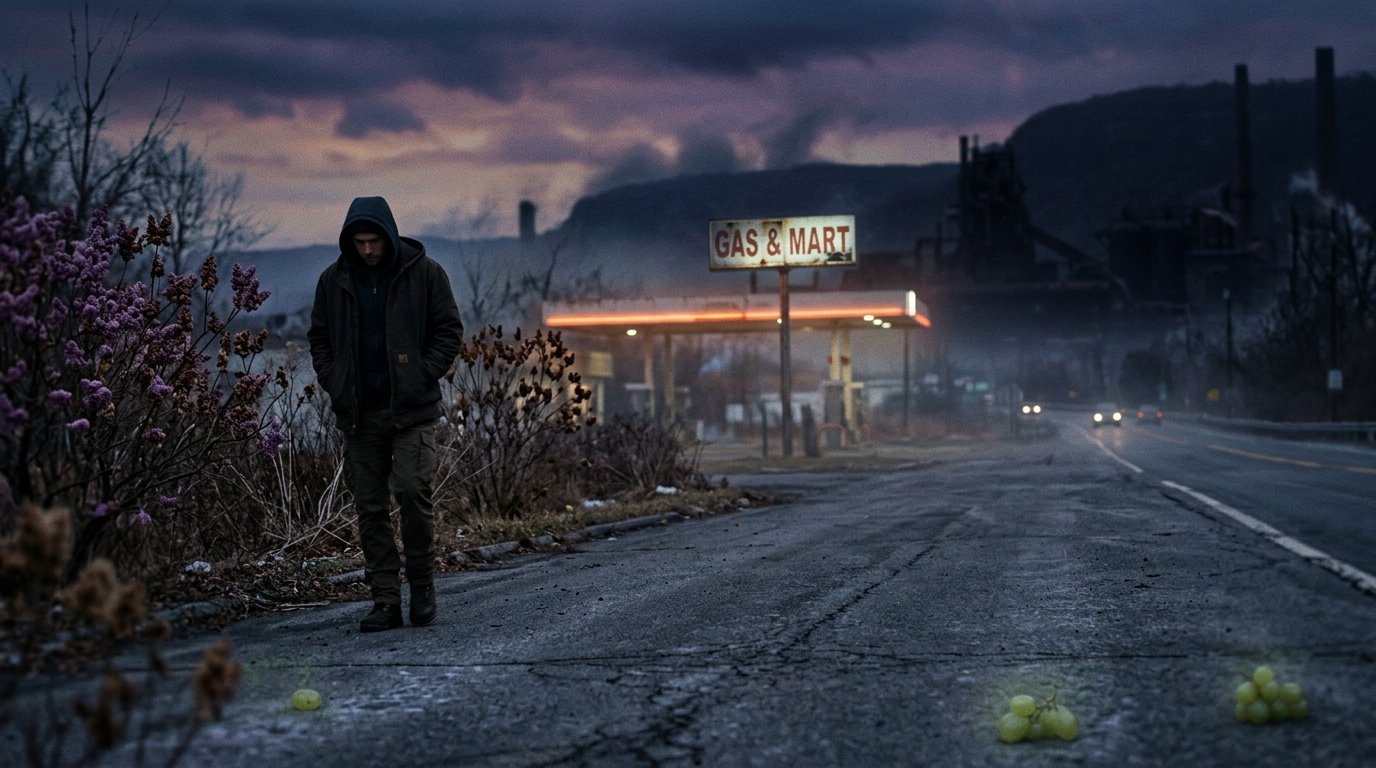
The “elevated heart notes” and “prompt reply” suggest an initial reciprocity, perhaps even romantic or vital correspondence, yet this is immediately undercut by the image of “sequestered lilacs under dusk’s vain sky.” Lilacs, traditional emblems of first love and spring renewal, are here hidden and placed beneath a sky described as “vain,” implying futility or self-regard. The refrain introduces the poem’s governing posture: the speakers walk together yet “removed,” their shame directed inward. The closing question frames the first of three inquiries into “green” possibility—here, “bonds green without pay.” Greenness evokes both vitality and naïveté or unpaid labor; the question wonders whether uncommodified, living connection remains viable once shame has turned the walkers inward.
The second stanza intensifies the sense of environmental, commercial, and bodily affliction:
Newport dawns phoenix the newer price of grime,
Newburgh fiend boogers make a beard of rime—
we walk removed, inflamed, from Lyme.
What solace abides within green oblong grapes?
Here “Newport” operates primarily as the well-known menthol cigarette brand rather than the Rhode Island city. The line “Newport dawns phoenix the newer price of grime” fuses the brand’s marketed image of cool refreshment and rebirth (“dawns phoenix”) with the actual cost of smoking: the “newer price of grime” names both the monetary and the corporeal toll—tar, residue, stained fingers, and the slow accretion of damage. This commercial reference grounds the poem in everyday addiction and the false promise of renewal sold by tobacco marketing. Juxtaposed against it, “Newburgh fiend boogers make a beard of rime” anchors the stanza in a specific upstate New York landscape of excess and decay, where “fiend” suggests craving and “beard of rime” freezes bodily waste into a grotesque facial landscape. The refrain now registers inflammation and a departure “from Lyme,” which may allude both to the Connecticut town and, more pointedly, to Lyme disease—an illness associated with ticks, landscape, and chronic suffering. The accompanying question shifts the green motif to “green oblong grapes.” Grapes traditionally symbolize abundance and Bacchic pleasure, yet their description as “oblong” and the search for “solace” within them imply a medicinal or compensatory function, as though nature’s offerings have become last-resort remedies rather than sources of unmediated joy.
The final stanza completes the progression from shame through inflammation to a tentative reclamation:
Heartfelt animations find whore tears collide,
charged exuberance belies “semper fi”—
we walk removed, reclaimed, in time.
What organs still thrive against green killer mange?
Emotional and erotic intensity returns in “heartfelt animations” and the collision of “whore tears,” an image that yokes sincerity to transactional or degraded sexuality. The phrase “charged exuberance belies ‘semper fi’” introduces a martial note—the Marine Corps motto “always faithful”—only to suggest that outward energy masks or contradicts claims of enduring loyalty. The refrain’s adjective has now shifted to “reclaimed,” and the temporal phrase “in time” offers a modest horizon of recovery or endurance. Yet the final question is the most biologically urgent: “What organs still thrive against green killer mange?” Mange, a parasitic skin disease, is here rendered “green” and “killer,” collapsing botanical, pathological, and lethal registers. The inquiry is no longer about abstract bonds or solace but about which internal structures can survive an invasive, disfiguring force.
Formally, the poem relies on a consistent stanzaic architecture—two imagistic lines, the “we walk removed” refrain, and a question—to create both ritual repetition and incremental variation. The refrain’s changing modifiers chart an emotional arc from interiorized shame to bodily inflammation to hard-won reclamation, while the questions evolve from sociological (“bonds”) to sensory (“solace”) to visceral (“organs”). Alliteration and internal near-rhyme densify the texture without resolving into full musical closure, mirroring the unresolved status of the walkers’ condition.
The recurring green motif functions as the poem’s most cohesive symbolic thread. Across the three questions, green migrates from the hopeful possibility of unpaid living bonds, through the ambiguous promise of oblong grapes, to the outright threat of killer mange. This trajectory suggests that the very color of renewal and fertility has been colonized by economic, commercial (the Newport cigarette), environmental, and pathological forces. The walkers move through landscapes and bodies in which greenness no longer guarantees life.
In its compressed intensity, “We Walk” refuses consolation even as it records the persistence of shared movement. The speakers remain plural—“we”—yet each iteration of the refrain underscores their removal from one another, from health, and from uncomplicated vitality. The poem’s final open questions leave the reader in the same unsettled posture as the walkers themselves: still advancing, still together, and still uncertain which, if any, green things can be trusted to sustain them.
SEO Metadata for the poem “We Walk”
Primary SEO Title:
We Walk: A Poem of Isolation, Contaminated Green, and Shared Removal
Meta Description:
Literary analysis of the free-verse poem “We Walk,” exploring themes of shame, inflammation, reclamation, Newport cigarettes, disease, and the search for viable green bonds amid decay.
Focus Keyphrase:
We Walk poem
Secondary / Long-tail Keywords:
We Walk poem analysis
we walk removed poem
Newport cigarettes in poetry
green bonds without pay
green oblong grapes poem
green killer mange
contemporary free verse isolation
shame and reclamation poetry
Lyme disease in poetry
Newburgh poetry imagery
semper fi in modern poetry
contaminated nature poetry
walking removed refrain
Suggested Tags:
#WeWalk #ContemporaryPoetry #FreeVerse #IsolationPoetry #GreenImagery #NewportCigarettes #TabooAndDecay #LiteraryAnalysis #ModernAmericanPoetry
Parents Weekend (Round 2)
"Parents Weekend" is the lyric compression — a father-daughter orgy scenario given its own formal vessel, stripped of the prose observation's discursive frame and left to stand in twelve lines of three tercets. The comparison between the two versions is itself instructive: the aphoristic entry offered the scenario as one observation among many, its meaning produced partly through adjacency to the catfish and the hermit crabs and the Attenborough strip club. The poem isolates it, which is a different formal act. Isolation demands that the material carry its own weight without the democratic context that distributes moral pressure across the hive's full range. "Parents Weekend" accepts that demand and meets it through a technical precision that is the poem's primary ethical and aesthetic achievement.
The title is the poem's most compressed instrument. "Parents Weekend" is the campus tradition: the institutional invitation to families to visit, to see where their children live and learn, to participate in the ceremonial renewal of the familial bond within the new context of the child's adult independence. It names a moment of supervised reunion, a gesture of institutional benediction over the parent-child relationship, a weekend organized around the idea that the bond is healthy and its celebration is appropriate. Applied to the scenario the poem describes, the title performs several simultaneous operations. It names the incest as a campus event — suggesting that the orgy is occurring in the context of, or under cover of, the parents weekend visit. It subjects the reunion to the irony of institutional framing: the campus has organized a weekend for exactly this. It converts the crime into a campus calendar item. And it holds the tenderness of the phrase — "parents weekend" genuinely names something about the parent-child bond, the desire of parents to see their children, the child's complicated feelings about parental presence in the new independent life — in permanent tension with what the poem is actually describing. The title does not mock the tenderness. It uses it.
The first tercet — "Father and daughter knew / by voice (by smells, by birthmarks) / they held one another—" — is the poem's most formally careful passage and the one that requires the most sustained attention. "Knew" performs double work: knew each other's identity, and knew in the biblical sense. The parenthetical "(by smells, by birthmarks)" extends the means of recognition — voice is the most social identifier, smell is the most animal, birthmarks are the most intimate, the marks one knows only from proximity and from childhood care. The escalation from voice through smell to birthmarks traces a path from social to animal to bodily intimate, each step requiring a greater closeness than the last. To know someone by their birthmarks is to know them from the body's most private registers, the marks that clothing covers, that only those who have cared for or been intimate with a body have occasion to know. The poem uses "smells" and "birthmarks" without commentary, which is more devastating than commentary.
"They held one another—" ends the tercet with a dash that performs the interruption the second stanza's turn produces. The dash suspends the holding — the word "held" carrying both the embrace and the knowledge — at the moment before the poem names the context that makes the holding what it is. The dash is not a dramatic pause for effect; it is the formal notation of the gap between the recognition and the act, the interval in which both parties know and both parties proceed.
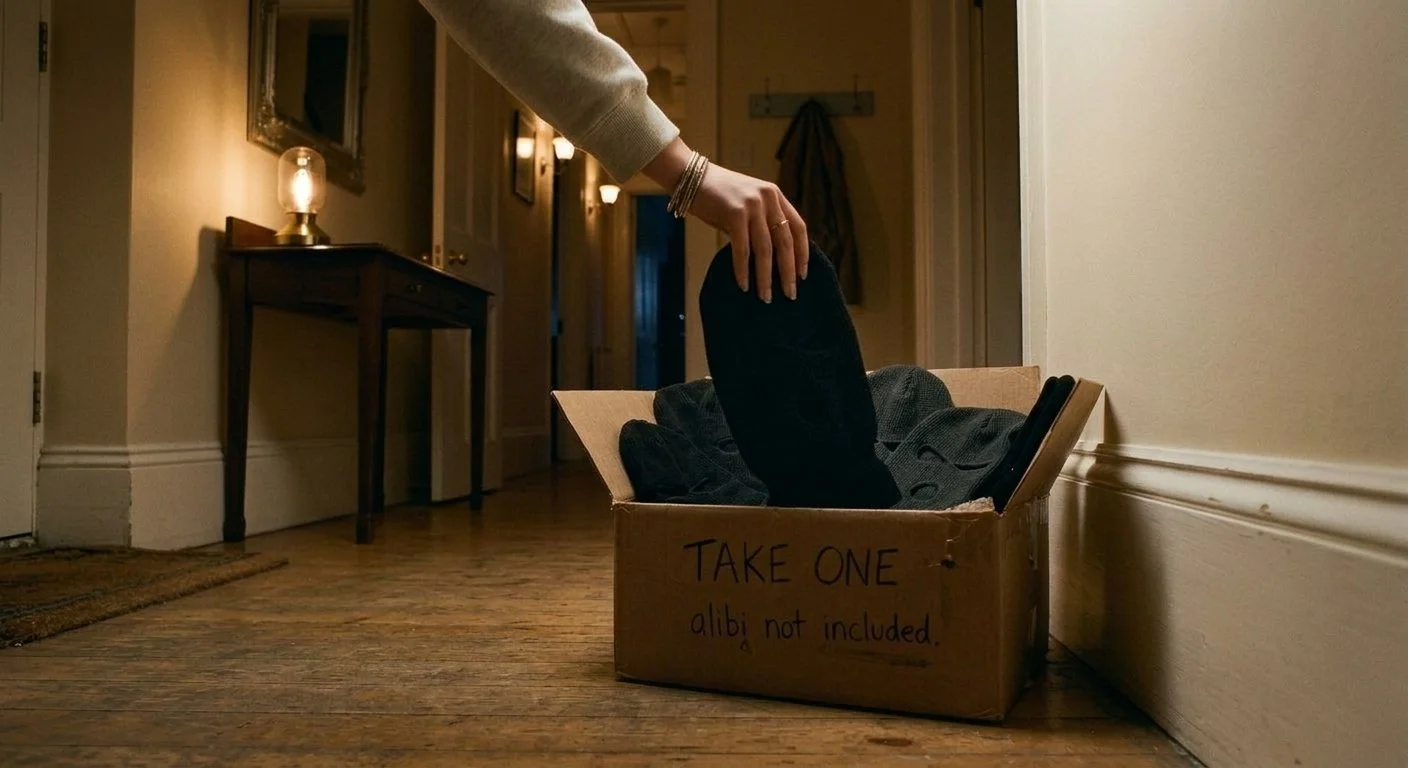
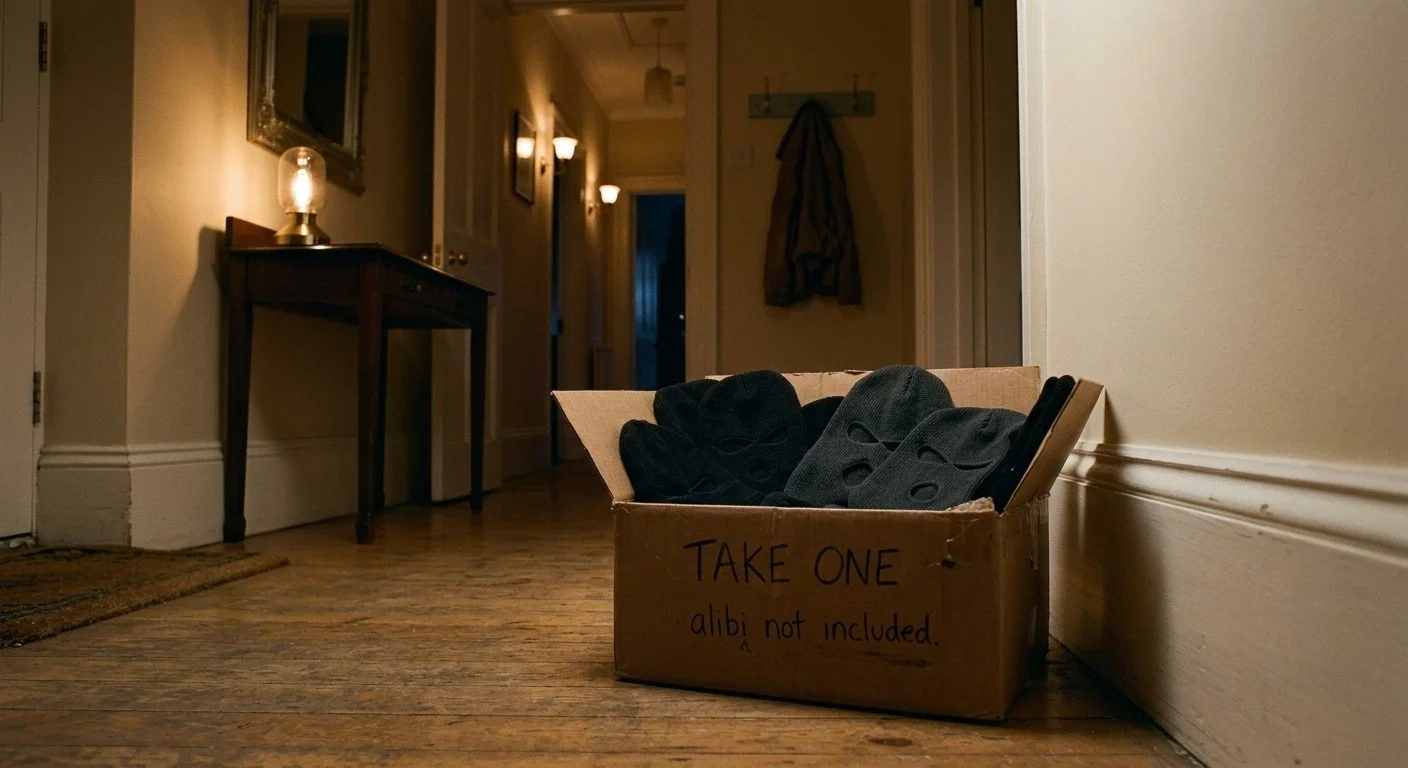
"But the orgy's foyer box / ('alibi not included'), ski masks / black as three-hole deniability" — the second tercet introduces the apparatus of the anonymous sex event: the foyer box where clothing and identity documents are surrendered, the ski masks that convert participants into bodies without faces. "'Alibi not included'" is the poem's most sardonic notation, placed in quotation marks as if it is a rule of the event, a disclaimer posted at the entrance. The alibi is precisely what the ski mask is supposed to provide: the fiction that recognition was impossible, that what occurred was anonymous, that no one knew. "Alibi not included" names the event's honest acknowledgment that the mask does not actually produce the anonymity it claims — which is to say, the event knows that some of its participants know each other and proceeds anyway, providing the instrument of deniability while acknowledging that the deniability is a performance. "Black as three-hole deniability" converts the masks' color into an abstraction that names what they represent: deniability extended to all three apertures of the body, the mask's blackness as the color of the cover story, of the fiction of not-knowing that the first tercet has already destroyed.
"Licensed payloads piped / with the rubberless rage of a decade: / 'Been fuckin wantin it!'" — the third tercet is where the poem's technical achievement is most concentrated. "Licensed payloads" is the poem's most clinical formulation: the ski mask has licensed the act, the deniability apparatus has issued a permit. "Payload" is deliberately mechanical — it names the ejaculate through the vocabulary of delivery systems, of cargo, converting the act to logistics. "Rubberless" is the poem's most charged single word: the absence of the condom names both the physical intimacy of the act and the specific quality of the transgression it is completing. The condom would be the last instrument of deniability, the last prophylactic against the consequences of recognition. Without it, the payload is literal: flesh to flesh, the body's most direct act of transmission, nothing between the recognition and its consummation.
"The rage of a decade" — this is the poem's most psychologically loaded phrase and its most interpretively open. Whose rage? The decade of what? The phrase names a duration — ten years — and an emotional charge — rage — that has been accumulating toward this act. The rage might be the father's: a decade of suppressed desire converted, under cover of deniability, into an act that the mask permits while the recognition makes specific. The rage might be the daughter's: a decade of something — desire, resentment, the complicated history of a parent-child relationship — that has found this particular illegible outlet. The rage might belong to both, the decade shared between them, the act the point where two separate accumulations of ungovernable feeling arrive simultaneously at the same anonymous foyer. The poem does not adjudicate. It names the rage and the duration and leaves their ownership undecided.
"'Been fuckin wantin it!'" — the poem's closing line, in quotation marks, spoken aloud in the anonymous dark. The voice is one of them — or both, simultaneously, or alternately — and the statement performs what the ski mask was supposed to prevent: the declaration that this was not accident or anonymity but desire, that the decade's rage has been specifically aimed, that the deniability was always a courtesy rather than a reality. The line collapses the distance between the ski mask's promise and what both parties have known since the first tercet's voice-smell-birthmark recognition. The alibi is not included. It never was. The masks were always just masks.
The poem's relationship to its aphoristic source — the Part 11 entry — illuminates what the lyric form adds to the scenario and what it costs. The aphoristic entry placed the scenario in the field of human behavior where the nature documentary's equanimity is the appropriate register: this is what creatures do, observed with precision and without judgment, placed next to the catfish in the beer can and the ceremonial burning of Benjamins. The poem removes the equanimity and the adjacency, which forces the reader to stay inside the scenario rather than moving through it. The lyric's isolation is an ethical act as well as a formal one: it refuses the alibi of context, the deniability of juxtaposition. Like the foyer box's disclaimer, the poem announces at its start that no alibi will be provided. It makes the reader hold the recognition — by voice, by smells, by birthmarks — until the payload arrives.
Formally, the three tercets mirror the event's structure: recognition, apparatus, consummation. The syllabic compression increases across the three stanzas — the first tercet is the longest, the third the shortest, the poem accelerating toward its final declaration the way the act accelerates toward its completion. The parenthetical "(by smells, by birthmarks)" and the parenthetical "'alibi not included'" are the poem's two asides, and they do opposite work: the first opens the intimacy of recognition, the second closes the deniability apparatus. Together they constitute the poem's moral architecture: here is how they knew each other, here is what they told themselves they didn't know.
"Parents Weekend" achieves what the most difficult lyric poetry achieves: it makes a reader hold something unbearable in formal perfection long enough to feel what the scenario actually is, which is not simple transgression or simple horror but something more accurate and more difficult — the recognition that the desire was specific, the decade was real, the rage was accumulated, the mask was always just a mask, and both of them knew.
Meta Description
A twelve-line poem in three tercets compressing the incest-at-the-anonymous-orgy scenario into lyric form: the ski mask's deniability, the foyer box's disclaimer that no alibi is included, and the final declaration — "Been fuckin wantin it!" — that collapses the fiction of not-knowing that both parties maintained across the decade the poem names.
Keywords
Parents Weekend, incest lyric poem, anonymous orgy poetry, ski mask deniability, alibi not included, rubberless rage, payload metaphor, close reading transgressive poetry, lyric compression, aphoristic source and lyric form, recognition by voice smell birthmark, decade of rage, M.A. Istvan poetry, contemporary transgressive lyric, tercet structure, campus tradition irony

Lady Liberty (ROUND 1)
Scholarly Essay: "Lady Liberty"
"Lady Liberty" is a poem about the collapse of a specific and dangerous syllogism: that a woman's sexual history or promiscuity constitutes consent to any particular act. The poem performs this argument by personifying the United States as a woman whose immigration policy — her legendary openness to the desperate and the despised — has been read as sexual availability, and whose critics have confused her structural openness with the absence of the right to refuse. In nine lines and three tercets, the poem moves from a deliberately corrupted version of Emma Lazarus's inscription through the specific idiom of anti-Mexican immigration rhetoric to its inviolable conclusion: "no" would never mean "yes."
The title positions the poem's subject immediately and with maximum irony. "Lady Liberty" is the Statue of Liberty's popular name, the feminized personification of American freedom. The lady is already gendered, already a woman, already subject to the codes by which women are read and misread. The poem inherits this gendering and takes it seriously — more seriously than the culture that produced the name has been willing to — by following its implications into the territory of consent. If Liberty is a lady, then the terms by which ladies are judged apply to her, and the poem's argument is that those terms have always been unjust.
"Slum lust ('Give me your tired / and poor, [your scum]')" — the opening quotation is a deliberate corruption of Emma Lazarus's "The New Colossus," the sonnet inscribed on the Statue of Liberty's pedestal. Lazarus's original lines read "your tired, your poor, / your huddled masses yearning to breathe free, / the wretched refuse of your teeming shore." The poem replaces "the wretched refuse" with "[your scum]" — bracketed, editorially interpolated, as if someone has corrected the inscription to say what the anti-immigration position has always heard it saying. The bracket is the poem's most formally precise gesture: it is the mark of an editorial insertion, of words added to a text that are not the original author's but that clarify what the original author apparently meant. The anti-immigration reader has always heard "your scum" where Lazarus wrote "your wretched refuse" — not as synonym but as clarification, as the honest version of the sentiment that Lazarus dressed in more palatable language. By bracketing "[your scum]," the poem both performs and exposes this editorial operation: it shows the reader exactly what the anti-immigration reading is doing to the inscription, how it replaces compassion with contempt while claiming to restore honesty.
"Slum lust" frames the invitation as appetite rather than compassion. The nation does not offer generosity, in this reading, but indulges a perverse attraction to the lowest, the most degraded, the most easily exploited. "Slum lust" names this misreading as erotic: America's welcome of the dispossessed is a desire for the dirty, a pathological attraction to contamination. Applied to immigration, it is the charge that the nation's openness to the poor and the desperate reflects not idealism but a kind of masochistic appetite for its own degradation.
"Might make her / la cucaracha of sluts" — the Spanish is the poem's most precise formal decision, and its precision is not generic but specific. "La cucaracha" is not simply a Spanish word for cockroach; it is the Mexican folk song, associated with the Mexican Revolution, whose title has become a byword for Mexican culture in the American imagination — sometimes affectionately, more often as diminishment and racialized contempt. The poem deploys it deliberately to name the specific population whose presence at the southern border has generated the contemporary version of the slut-shaming accusation against American openness. The charge is that America's welcome of Mexican and Latin American immigrants — "[your scum]" — makes her la cucaracha of sluts: the whore who takes the lowest, the most desperate, the most racially marked. The cockroach cannot be exterminated; it thrives in the margins; it is associated with poverty and contamination. Applied as a modifier to "slut," it converts the nation's immigration history into a specific racialized sexual degradation — she has given herself to Mexicans, to the people the cockroach represents in this rhetoric, and this makes her the worst kind of slut.
The Spanish performs the poem's argument at the level of language itself: the charge is delivered in the idiom of those being welcomed, the accusation framed in the tongue of the accused population. Anti-Mexican immigration rhetoric has always worked this way — it uses the presence of Spanish language, of Mexican culture, of Latin American populations, as evidence of the contamination it claims to be warning against. The poem mirrors this structure to expose it.
"La clamidia" — the second Spanish term extends the racist logic of contamination from promiscuity to disease. The STI as the consequence of welcome, the infection as the body's punishment for openness to the wrong population. Anti-immigration rhetoric has consistently framed Latin American immigrants as vectors of disease — a rhetoric that intensified during the COVID era but predates it by decades, finding its most explicit expression in the specific association of Mexican immigration with contamination and public health threat. "[Your scum]" brings disease with it; the nation that welcomes scum contracts their diseases. "La clamidia" names this logic in the same idiom as the previous line: the disease comes in Spanish, arrives with the immigrants, is the consequence of la cucaracha's welcome. The poem does not endorse this; it assembles the prosecution's case with maximum fidelity before destroying it.
"But imagine the US / as a real woman — maybe then, / despite her clingy robes" — the conditional "imagine" is the poem's central pivot and its most philosophically significant gesture. It asks the reader to apply to the feminized nation the same principles they would apply to an actual woman. If the United States were a real woman — with a sexual history, with a reputation derived from whom she has welcomed, with clingy clothing — would her history and her appearance constitute consent to any act performed against her will? The "real woman" is the test case that the poem offers as the mirror of the national case. "Maybe then" preserves the conditional: the poem is not asserting that the reader will recognize the parallel, only that they might, if they allow themselves to follow the logic. "Despite her clingy robes" gives the Statue of Liberty the appearance of the woman whose clothing is read as invitation — the dress that reveals the body's contours, that in the logic of rape culture constitutes implicit consent. The poem acknowledges the clinginess and insists on its irrelevance.
"Or even her 'askin for it' squirt / when flipped to her left" — the Statue of Liberty, rotated to show her left side, presents a different profile; the poem uses this physical fact to name the "askin for it" reading that her posture might invite in the logic of rape culture. "Squirt" converts the figure's gesture into the language of involuntary sexual response — the body's reaction that rape culture has always used to argue that physical response constitutes consent. The poem names this reading explicitly, in the idiom in which it operates, having already named the specific population and the specific disease whose presence triggered the slut-shaming: la cucaracha, la clamidia. The body evidence and the immigration history are the same argument, assembled by the same logic, answered by the same principle.
"'No' would never mean 'yes.'" — the poem's final line, in quotation marks, declares a principle whose quotation marks acknowledge that it is genuinely in dispute — that there are those for whom, under the right conditions, "no" does mean "yes." The poem's entire architecture has assembled those conditions in their most racially and sexually specific form: the slum lust for scum, la cucaracha, la clamidia, the clingy robes, the "askin for it" squirt. It has constructed every instrument of the rape culture syllogism — her history with the populations that anti-immigration rhetoric most consistently degrades, her appearance, her involuntary response — and then delivered the conclusion that none of it matters. "Never" is the poem's most important word, the one that closes every possible exception, that refuses to leave open the case where the history is long enough or the invitation explicit enough or the body's response unmistakable enough to convert refusal into consent. The slut can still be raped. The nation that has welcomed "[your scum]" — that has extended the invitation in language that its critics have always heard as degradation — retains the right to say no. These are the same principle, and the principle admits no exception.
The poem's formal structure enacts its argument through three precisely weighted tercets. The first names the sexual history and the specific racialized accusation — slum lust, the bracketed scum, la cucaracha. The second extends the contamination logic — la clamidia — and introduces the counter-argument through the conditional "imagine." The third names the body evidence — the clingy robes, the squirt — and delivers the conclusion. Three stages: racialized history, contaminated body, inviolable principle. The poem works like a legal brief that has assembled the prosecution's strongest evidence — including its most racially specific and most bodily evidence — before the defense's single devastating rebuttal. The prosecution has everything: the history, the disease, the clothing, the body's response. The defense has one sentence. The defense wins because the principle it states cannot be conditioned by any of the prosecution's evidence, however compelling.
The bracketed "[your scum]" is the poem's formal master stroke, and it is worth dwelling on as the revision that transforms the poem from an observation about immigration rhetoric into a demonstration of how that rhetoric operates. The bracket is the editorial mark, the interpolation, the correction of the record to say what someone thinks was really meant. By placing "[your scum]" inside the Lazarus quotation, the poem performs the anti-immigration reading of the inscription — shows the reader exactly what that reading does to the text, how it substitutes its own language for Lazarus's while presenting itself as the honest version. The bracket says: this is what they heard. This is what they have always been hearing when the inscription said "wretched refuse." The poem does not argue against this hearing directly; it enacts it, and then asks what follows if the hearing is correct. What follows, the poem argues, is still: "no" would never mean "yes."
What makes "Lady Liberty" extraordinary is its refusal to make this argument comfortably. It does not sanitize the nation into something that doesn't deserve the reading it receives. It lets the prosecution speak in Spanish, bracket the inscription's honest meaning, name the cockroach, name the disease, name the body's response. It acknowledges all of it — gives it the full weight of the rhetoric that produces it. And then it states the principle that makes all of it irrelevant. The woman who welcomes scum, who contracts their diseases, whose robes cling and whose posture invites — she can still say no. The nation whose open door has been read as an invitation to degradation — she can still say no. And no would never mean yes.
Meta Description
A nine-line poem that personifies the United States as a woman whose welcome of "[your scum]" — a bracketed editorial corruption of Emma Lazarus's inscription — has generated the rape culture reading that her history of openness to Mexican immigrants forfeits her right to refuse, before delivering its inviolable conclusion: that no history, no clingy robe, no "askin for it" squirt converts refusal into consent.
Keywords
Lady Liberty, Statue of Liberty poem, Emma Lazarus corruption, bracketed interpolation, Mexican immigration rhetoric, rape culture critique, consent and promiscuity, slut-shaming syllogism, your scum, la cucaracha, la clamidia, anti-immigration contamination, clingy robes, askin for it, no means no, contemporary transgressive poetry, nation as woman, M.A. Istvan poetry, close reading consent poem, tercet structure argument

Su Hija Esta en Buenas Manos (ROUND 3)
Scholarly Essay: "Su Hija Está en Buenas Manos"
"Su Hija Está en Buenas Manos" is a poem built on a single act of lyric theft that becomes its central argument. The title is lifted directly from Gerardo's 1991 hit "Rico Suave" — the line the smooth seducer addresses to the skeptical father of the girl he is pursuing: your daughter is in good hands with me. By taking this line as the poem's title, the poem establishes its governing move before the first word of the body: the reassurance that men give other men when transferring custody of a woman between them. The father is addressed. The daughter is not. She is the occasion of the transaction, its object, the thing whose welfare is being vouched for by the very party whose interest in her welfare is the question. "Su hija está en buenas manos" is what smooth male authority always says to paternal male authority, and the poem's nine lines argue that this transaction — this lateral reassurance between men about the woman between them — is not the pop-cultural vulgarity of a 1991 Latin freestyle hit but the deep structure of Western religious civilization's relationship to female bodies.
The poem's opening moves immediately into Christian theology, and the connection to the title is immediate and precise. "Cristo arose from a relationship / marked by an infinite gap / in age and power" — the Annunciation, God's declaration to Mary that she will bear his child, is described here not through its traditional vocabulary of grace, election, and divine favor, but through the vocabulary of power analysis. Gap in age. Gap in power. These are the terms contemporary discourse applies to coercive relationships, and the poem applies them without softening to the foundational event of Christian soteriology. "Infinite gap" is theologically exact: not merely large or unequal but infinite — the gap between the divine and the human, the eternal and the mortal, the omnipotent and the completely subject. Mary's consent, whatever its theological status, occurs across this differential. And crucially, the arrangement was made between God and — if anyone — Joseph or the tradition that preserved the story. Mary is the vessel through whom the transaction passes. Su hija está en buenas manos.
"Holy dew / pearled at dawn" preserves the traditional imagery of divine grace — dew as unearned gift, as delicate sacred presence in the material world, pearled as purity and consecrated beauty in early light. The imagery is doing what sacred imagery always does: aestheticizing the power relation into something the recipient should feel honored by. And then "with enough / rico suave" — and here the poem's architecture reveals itself completely. This is not a tonal rupture, not an intrusion of pop culture into sacred space. This is a return. The title came from "Rico Suave." The body of the poem returns to the song by name. The divine approach to Mary is described as smooth enough — powered enough, aesthetically elevated enough, culturally consecrated enough — to constitute the ultimate rico suave. God is running the original game. Gerardo learned it somewhere. The Angel Gabriel, in the poem's rendering, is the divine smooth operator reassuring the cosmic household that the girl is in good hands, deploying the same structure of male-to-male transaction over a female body that the song both celebrates and, in the poem's retroactive reframing, inadvertently documents.
The comparative turn to Mohammad and Aisha lands differently once the title's origin is understood. The poem is not simply stacking religious offenses for shock value. It is running the same title-logic — su hija está en buenas manos — through a second tradition. The Prophet's historical marriage to his child wife is another instance of the paternal transaction: Aisha transferred between male authorities, her welfare vouched for, the arrangement blessed by divine sanction. The poem's comparison between the two — between the infinite-gap divine seduction of Mary and the "manhandling" of Aisha — is not an argument that one is worse than the other. It is an argument that they are variations of the same structure, and that the elaborate aesthetic and theological machinery of each tradition has been constructed precisely to prevent that recognition. The sacred vocabulary — grace, election, divine will, prophetic prerogative — is the rico suave. It is what makes the transaction feel like honor rather than transfer.
The deliberately extreme and offensive language of the comparison — "portable pocket pussy," "spastic mongoloid," "hogtied baby camel" — operates as a kind of stripping mechanism. The poem uses language that has historically been deployed to dehumanize — eugenic vocabulary, pornographic reduction, agricultural violence — and turns it against the sacred narratives that have been conducting their own dehumanizations in elevated diction for centuries. The obscenity of the poem's language mirrors the obscenity it is describing: if the traditions' own vocabulary — annunciation, revelation, prophetic marriage — aestheticizes what the poem is naming, the poem's counter-vocabulary refuses that aestheticization with equal force in the opposite direction. The shock of "pocket pussy" beside "holy dew" is the poem making visible the gap between what the traditions say they are doing and what the poem argues they are doing. Both descriptions are of the same event. The tradition chose its language. The poem chooses its own.
The nine-line structure — three tercets — is not incidental. Three is the number of the Trinity, of the divine architecture the poem is interrogating. Each tercet handles one movement: the establishment of the Christian power differential, the application of the song's own logic to that differential, and the comparative extension to Islam. The poem does not give the third tradition — the baby camel of the final image, arguably invoking a broader orientalist imaginary — the same analytical attention it gives to Christianity and Islam, which is itself a formal choice: the escalating grotesquerie of the final tercet suggests that once the structure has been named in the first six lines, subsequent examples require only increasingly reductive illustration rather than fresh analysis. The argument has been made. What remains is the catalog of its instances.
What the poem ultimately argues — and what the title, once its source is understood, makes impossible to miss — is that the phrase "your daughter is in good hands" has always been the operating sentence of religious patriarchal authority. Gerardo's song did not invent this sentence. It inherited it, dressed it in gold chains and freestyle cadence, and sent it back into the culture in a form that made its structure newly visible. The poem takes the sentence back from the song, holds it up against the theological traditions that originated its logic, and asks the father — whichever father, biological or divine or prophetic — whether he has considered whose hands those actually are, and what they have historically done with daughters placed in them.
Meta Description
A nine-line blasphemous comparative poem whose title — lifted directly from Gerardo's "Rico Suave" — frames the Annunciation, the Prophet's marriage to Aisha, and the structure of religious patriarchal authority over female bodies as variations of the same smooth male-to-male transaction: your daughter is in good hands.
Keywords
Su Hija Está en Buenas Manos, Rico Suave Gerardo, blasphemous poetry, comparative religion satire, Annunciation critique, Mohammad and Aisha, patriarchal religious authority, female body and sacred narrative, lyric theft, power differential theology, contemporary transgressive poetry, close reading blasphemy, Mary and divine power, religious satire American poetry, M.A. Istvan poetry
Parents Weekend (Round 1)
Recognition in the Dark: Anonymity, Incestuous Knowledge, and Institutional Desire in “Parents Weekend”
The short free-verse poem “Parents Weekend” stages a collision between intimate, embodied recognition and the radical anonymity of ritualized sexual performance. In nine tightly controlled lines, the poem presents a father and daughter who unerringly identify one another through the most primal sensory markers—voice, smell, birthmarks—even as they participate in an orgy whose protocols demand total visual erasure. The result is a work that weaponizes the tension between knowing and not-being-seen, between familial blood knowledge and the bureaucratic language of consent-as-alibi. Far from mere provocation, the poem interrogates how institutions of desire (the orgy as regulated space) both license and disavow the very taboos they enable.
The opening stanza establishes recognition as instantaneous and multi-sensory:
Father and daughter knew
by voice (by smells, by birthmarks)
they held one another—
The parenthetical list functions as forensic evidence. Voice, olfactory signature, and the permanent cartography of birthmarks constitute a biometric archive that no mask can fully suppress. The enjambment after “knew” and the suspended syntax of the parenthetical create a momentary hesitation, as if the poem itself pauses to catalogue the data before confirming the physical embrace. This is knowledge that precedes and exceeds social identity; it is pre-linguistic, corporeal, and therefore impossible to unknow. The em-dash that closes the stanza marks both connection and rupture: they hold one another, yet the poem immediately pivots into the machinery that pretends such holding is accidental or deniable.
The second stanza introduces the regulatory apparatus of the orgy:
but the orgy’s foyer box
(“alibi not included”), ski masks
black as three-hole deniability,
Here the language shifts from the intimate to the institutional. The “foyer box” suggests a checkpoint, a place of mandatory equipping before entry into the sexual commons. The quoted phrase “alibi not included” is devastatingly precise: the institution supplies the means of anonymity (the ski masks) but explicitly refuses legal or moral cover. The masks themselves are described as “black as three-hole deniability,” a compressed image that fuses the visual blackness of the fabric with the three apertures (eyes and mouth) that paradoxically enable both participation and the fiction of non-recognition. “Deniability” is the poem’s central political and erotic term. It names the social technology that allows participants to act on forbidden knowledge while maintaining the public posture of ignorance.
The final stanza completes the circuit of licensed transgression:
licensed payloads piped
with the rage of a decade:
“Knew you been wantin that shit!”
“Licensed payloads” continues the bureaucratic register—desire is now treated as regulated cargo, something that can be authorized, transported, and discharged. Yet the payload is “piped with the rage of a decade,” introducing a temporal and affective excess that the licensing regime cannot fully contain. The decade of repressed or deferred wanting erupts in the vernacular closing line, whose grammatical roughness (“Knew you been wantin”) contrasts sharply with the earlier clinical diction. The spoken utterance collapses the distance the masks were meant to preserve: the very knowledge the foyer box tried to render deniable is now voiced aloud, triumphantly and without apology.
Formally, the poem’s short lines and strategic white space enact the same dialectic of revelation and concealment that its content describes. Line breaks isolate key phrases (“alibi not included,” “three-hole deniability,” “rage of a decade”), forcing the reader to confront each conceptual unit before moving forward. The movement from the sensory catalogue to institutional jargon to raw vernacular traces a descent from embodied certainty into the language of systems and finally into the explosive return of the body.
Thematically, “Parents Weekend” refuses both sentimental family romance and simple shock value. Instead it examines how the most rigorously policed taboo—parent-child incest—can be simultaneously known with absolute certainty and staged under conditions of official anonymity. The orgy becomes a laboratory in which the social fiction of the nuclear family is tested against the persistence of bodily knowledge. The masks do not erase recognition; they merely provide the procedural cover that allows recognition to be acted upon. In this sense the poem is less about the transgression itself than about the administrative structures that make certain transgressions possible while preserving the appearance of order.
Ultimately, “Parents Weekend” suggests that true anonymity is impossible once the body has already spoken. Voice, smell, and birthmark form an archive that no foyer box can redact. The rage of a decade finds its licensed outlet precisely because the participants already know—and have always known—exactly whom they are holding.
SEO for the poem “Parents Weekend”
Primary Title / SEO Title:
Parents Weekend: A Poem of Incestuous Recognition, Anonymity, and Rage
Meta Description:
Explore the provocative free-verse poem “Parents Weekend,” a dark meditation on father-daughter recognition, ski-mask anonymity, and licensed desire in an orgy setting. Analysis of taboo, deniability, and embodied knowledge.
Focus Keyphrase:
Parents Weekend poem
Secondary Keywords / Long-tail Keywords:
Parents Weekend poem analysis
father daughter orgy poem
incest recognition poetry
ski mask deniability poem
alibi not included poetry
licensed payloads poem
contemporary taboo free verse
erotic anonymity in poetry
bodily knowledge vs institutional desire
dark family poetry
three-hole deniability
rage of a decade poem
Suggested Tags:
#ParentsWeekend #ContemporaryPoetry #TabooPoetry #FreeVerse #IncestTheme #AnonymityInArt #EroticPoetry #DarkPoetry #LiteraryAnalysis
MADE FOR YOU AND ME 3: hive Being (Stanzas 2018--part 11)
Scholarly Essay: "Made for You and Me 3: Hive Being (Stanzas 2018 — Part 11)"
"Made for You and Me 3: Hive Being (Stanzas 2018 — Part 11)" continues the serial aphoristic project established in Part 10, but with a tonal shift that distinguishes it from its predecessor. Where Part 10 moved between registers with something like democratic equanimity — the carny cumshot and the Miles Davis fingers accorded equivalent attention — Part 11 is darker in its overall atmosphere, its observations more frequently concerned with mortality, political corruption, the failures of institutional life, and the specific loneliness of consciousness that cannot turn itself off. The hive in this installment is showing its structural stress. The cells are producing, but what they are producing more often now is evidence of things breaking down.
The opening images establish this register without announcing it. "That candy-bowl person in the office" — the employee whose function in the social ecology is purely ambient benevolence, whose presence is constituted entirely by the small generosity of the candy bowl — is rendered with the precision of someone who has noticed that this person exists and has thought about what their existence means: the reduction of a human being to a single gesture of availability, the social role that survives without requiring anything further from its occupant. "Banged by the girl who hates your wife" — the observation does not develop the scenario; it simply names the specific erotic charge of the transgression, the hatred of the wife as part of the seduction's structure rather than incidental to it. These opening notes establish the piece's characteristic movement: from the small and ambient to the intimate and morally complex, without transition or hierarchy.
"The watch did not stop ticking when the owner did" is the piece's first overtly elegiac observation, and it names a specific grief: the persistence of objects past the lives they were made to serve, the mechanical indifference of time's instruments to the cessation of the time-conscious creatures that relied on them. The image carries the full weight of grief without sentimentality because it makes no claim about what the watch's continued ticking means. It simply notes the fact. The fact is unbearable and ordinary simultaneously.
"In the false reign of whiteness, only whites are to blame for their own failures" — the piece begins here a thread of political observation that it will pursue across multiple entries, and the threading of these observations through the ambient and the intimate is one of the piece's formal distinctions from conventional political commentary. The observation names a double standard — the ideological framework that attributes white failure to individual agency and minority failure to systemic oppression — and it names it from a position that is not comfortable on either side of the culture war. The companion entry much later — "before you label the black man 'toxic' and 'traitor' for spreading the lie — / the excuse-entitling, agency-crippling lie — that the whiteness hunts blacks / more than ever, consider whether you could resist the temptation of pampering" — extends the same critical attention to the left's relationship to Black political identity. Both observations are equally uncomfortable to the ideological positions they challenge, and their placement in the same aphoristic field without editorial connection is the piece's method of refusing to let either position claim the piece's authority.
"Only the realest leap from the suicide bridge when the water is ice" is the piece's most chilling one-liner, and it resists easy reading. It is simultaneously an observation about the logic of resolve — the demonstration of seriousness through the choice of conditions — and a dark comedy about a hierarchy of authenticity applied to the most absolute of acts. The "realest" is the specific vocabulary of a certain strain of hip-hop masculinity, and its application to suicide produces a tonal collision that is the piece's most compressed version of what it does throughout: taking the logic of a cultural value system and applying it to a context that reveals the logic's absurdity or cruelty.
"Trans women — real women — jerking off in the night bunks of a woman's shelter" is the piece at its most politically precise and most politically unacceptable simultaneously. The em-dash — "real women" — performs the ideological assertion that the piece then immediately tests against its material consequence. The woman's shelter exists specifically to provide a space protected from male bodies and male behavior; the night bunks are the site of that protection's most intimate application. The observation does not argue against trans identity or trans inclusion in women's spaces; it refuses to pretend the tension does not exist. This is the piece's characteristic operation on politically settled questions: not to unsettle the moral answer but to insist that the material complexity be held alongside it.
"Clip the nails of your fisting hand" — pragmatic, graphic, offered without context or commentary. The piece treats this as it treats everything else: a piece of useful knowledge, a detail of a life, a thing that is true that most writing considers beneath notice. Its placement between the trans shelter observation and "skydive before suicide" creates a sequence that moves from political tension to bodily practicality to existential counsel without pausing to acknowledge the transitions, which is the piece's central formal argument about what consciousness actually contains.
"Skydive before suicide" is the piece's most condensed piece of pragmatic philosophy: the suggestion that the experience of voluntary freefall — the chosen encounter with death that nonetheless returns you to the ground alive — might constitute a form of experiential argument against the finality being contemplated. It does not sentimentalize suicide or dismiss it; it offers a single concrete intervention with the directness of someone who has thought about what might actually help rather than what sounds appropriately concerned.
"'What?' voiced in an empty room" is the piece's finest lyric image and one of its most philosophically resonant. The "What?" addressed to no one — the reflexive vocalization of disbelief or confusion in the absence of any interlocutor — names a specific form of loneliness: the mind that continues performing social speech acts when the social context has dissolved. It speaks to grief, to isolation, to the persistence of the dialogic self in conditions that have removed the other half of the dialogue. The empty room does not respond. The "What?" hangs in it, unanswered, which is its own kind of answer.
"Racing home before the opioid kicks in" — the specificity of this is what makes it devastating rather than merely topical. Not "dealing with addiction" or "struggling with opioids" but the particular calculation of the person who has taken something and is now working against time to reach safety before the drug removes their capacity for navigation. The image captures the addict's relationship to their own impairment: the simultaneous use of and flight from the substance, the narrow window of functional consciousness managed with desperate pragmatism.
The political observations accumulate in the piece's middle section with a density that distinguishes Part 11 from Part 10. "Resist the Palpatine slogan 'Free speech is not hate speech' lest you find yourself / ousted for asking a black student — a queen — to lower her voice" — the Star Wars reference is the piece's most culturally specific political notation: Palpatine, the senator who consolidates power by manufacturing emergency, whose political success depends on the people voluntarily surrendering their freedoms in the name of safety. The piece names the rhetorical move — the conversion of "free speech" into "hate speech" as a mechanism of institutional power — and then gives it its specific contemporary application: the professor fired for the entirely ordinary pedagogical act of asking a student to moderate their volume in class. "A queen" — the piece preserves the ideological framing even in the act of critiquing its consequences, which is more precise than simply dismissing it.
"Black asses — clapping with lyrical obscenity — gobble up / the rain of dollars in a frenzy of prehensile precision / that would leave Attenborough himself speechless" — the strip club rendered through the language of the nature documentary, Attenborough as the inadequate narrator of human erotic behavior, the "prehensile precision" of the dancers' movement given the same quality of evolutionary marvel that the nature documentary would attribute to primate dexterity. The observation is not condescending; it finds in the scene what the nature documentary finds in any scene: a species deploying its evolved capacities in the service of its drives, with a skill that commands respect regardless of the context.
"Father and daughter both knew it was one another by voice, / by smells and moles, but the orgy's doorway ski-mask demand / licensed creampies piped with the nastiest been-wanting-it talk" — this is the piece at its most transgressive, and it is doing what the transgressive entry always does in this project: naming an extreme case in order to force the question of what the extreme case reveals about the general principle. The ski-mask as instrument of deniability, the mutual recognition that persists through the anonymizing convention, the "been-wanting-it talk" as the psychological residue of a relationship that has found this particular illegible outlet — the observation does not endorse the scenario but it does not perform outrage either. It asks, with the same calm attention it brings to "clip the nails of your fisting hand," what is happening here and what it means.
"Catfish with bottle shards in their underbellies, hermit crabs homed in beer cans" — this entry and its philosophical extension constitute one of the piece's most genuinely beautiful passages. The image is real: catfish swallowing glass, hermit crabs occupying the discarded containers of human culture because the natural supply of shells has been exhausted. The extension — "that we and our artifacts / are as natural as stones and moss, as natural as catfish and hermit crabs see us" — is the piece's most direct statement of its ecological philosophy. The piece does not frame human culture as opposed to or destructive of nature; it insists on the continuity. The beer can is a shell. The catfish's gut is an environment. We are part of this, not above it, and the discomfort the image produces is the discomfort of a species that has convinced itself of its own exception.
"The ceremonial disposal of wealth still occurs: / burning Benjamins like a great native chief / might have burned his first born son" — the potlatch and the rapper's conspicuous destruction of currency placed in the same frame. The piece identifies the structural continuity between forms of ritual conspicuous destruction across cultures separated by centuries and by the entire apparatus of modernity, finding in the contemporary gesture the same logic that organized the ceremonial destruction of the pre-modern one. Neither is more rational than the other; both are ritual performances of a relationship to surplus that cannot be fully explained by purely economic logic.
"Dying, defecating, and doing it / are most disgraceful in cultures / desperate to deny our animality" — the three D's placed in their common field: the processes the culture most aggressively conceals are precisely those that most insistently recall the body's animal nature. The piece does not argue for uninhibited animality; it observes the relationship between shame and denial, between the intensity of a culture's concealment and the intensity of what is being concealed.
"Are you big enough to own / who made your success possible — / who might have even saved you?" — this is the piece's most direct address to its reader, and it arrives without the protective distance of the third-person observation that characterizes most of the entries. The "you" is exposed, accountable, asked to perform an act of acknowledgment that the question implies is difficult. The implication of "who might have even saved you" is that the acknowledgment is owed not merely to mentors or advantages but to specific people whose intervention — which may not even have been intended as intervention — altered a trajectory that would otherwise have ended badly. The piece's autobiographical background makes this entry's specificity felt without requiring it to be stated.
"Muttering to oneself out loud — our tree days still speak — for a semblance of sympathy" — "our tree days still speak" is the piece's most lyrical formulation, and it carries a philosophical weight that exceeds its compression. The hypothesis that human self-directed speech — the muttering, the talking-to-oneself that the self-conscious urban adult performs in guilty privacy — is a vestige of something more ancient, a behavior that made sense when the trees were the audience, when speaking aloud was addressed to an environment that might respond. The tree days are still in us. We speak to them still. The sympathy we seek from ourselves, in the empty room, is addressed to a world that preceded the self-consciousness that makes us ashamed of seeking it.
"What if your voice, the one they tell artists to find, is twisted — perverted, demonic?" — this is the piece's most direct self-implicating entry, and it arrives late enough in the text that it has accumulated its own evidence. The piece has been demonstrating a voice throughout: purple, maximalist, capable of moving from the lyric to the pornographic to the ecological to the political without acknowledging the transitions. The question is not rhetorical. It is asked in genuine uncertainty about whether the voice one has found is a gift or a problem — whether the compulsion to go where the language leads, regardless of where it goes, is a form of artistic integrity or a form of damage. The piece does not answer. It asks.
"Showing the young girl pornography / so she will see it is no deformity / having such monstrous inner labia" — the piece's final transgressive entry, and its most morally complex. The scenario described is a parent's or guardian's intervention in a girl's sexual self-image: the use of pornographic evidence to counter a girl's belief that her anatomy is abnormal. The intervention is well-intentioned, the harm it addresses — the sexual self-disgust produced by the gap between a girl's actual body and the surgically modified bodies of pornographic performers — is real, and the instrument of the intervention is itself harmful. The piece holds all of this simultaneously without adjudicating it, which is not moral cowardice but moral precision: the observation that good intentions, wrong instruments, and real harm can coexist in the same act is not a comfortable observation, but it is an accurate one.
"In the democratic space of social media / sleazy ads appear alongside mainstays / (Tide, say), tainting even them with distrust" — the closing entry is the piece's most formal observation about the information environment that produces the hive's conditions. The algorithm's indifference to the adjacency of content — the placement of the predatory alongside the domestic, the sleazy beside the trustworthy — is a precise description of what social media has done to the epistemological environment: not simply introduced bad content but corrupted the adjacency relations that allow trust to form. Tide is not sleazy. But next to something sleazy, in the same frame, in the same democratic space where no hierarchy of credibility is maintained, it cannot maintain its trustworthiness intact. The taint is structural, not incidental. The piece closes on this image of contamination by adjacency, which is also a description of what the piece itself has been doing throughout: placing things next to each other that the culture normally keeps apart, and watching what happens to each in the other's company.
Formally, Part 11 is denser with political observation than Part 10 and correspondingly darker in its ambient emotional register. The entries concerned with mortality — the watch, the "What?" in the empty room, "the dying who do not drop their falsities," "more dying than we would like to admit would take the living with them" — create a cumulative pressure that is not present in the same density in Part 10. The hive is still producing. But the piece is aware, more explicitly than its predecessor, of entropy: of the ticking that continues after the owner stops, of the flood that evicts from the home and then from the grave, of the consciousness that cannot find relief even in its own termination. The serial project's ambition — to map the full range of hive being across its accumulated parts — requires that individual installments take on different emotional weather. Part 11's weather is overcast, the observations colder, the democratic equanimity of the project maintained but under more visible strain.
Meta Description
The eleventh installment of a serial aphoristic poem whose democratic adjacency of observation — mortality, political corruption, erotic extremity, ecological continuity, and the loneliness of unrelenting consciousness — maps the full range of hive being under conditions of increasing structural stress, the hive still producing but the entropy more visible, the weather darker, the "What?" hanging in the empty room unanswered.
Keywords
Made for You and Me Hive Being Part 11, serial aphoristic poem, democratic adjacency, mortality and aphorism, political observation poetry, cancel culture aphorism, trans women women's shelter, opioid crisis poetry, strip club nature documentary, catfish and hermit crabs ecology, tree days and human speech, demonic voice artist, close reading contemporary aphorism, M.A. Istvan Stanzas 2018, hive consciousness and entropy, empty room lyric
A Cold Hunt (Round 3)
Thermal Stoicism and Paternal Vulnerability in "A Cold Hunt"
"A Cold Hunt" examines the silent, fraught economy of masculine initiation through the sensory landscape of a freezing morning hunt. By contrasting the rigid expectations of stoic survival with the visceral vulnerabilities of childhood, the poem explores how affection, pride, and physical endurance interact within rural working-class intimacy. Through sharp tactile imagery, anthropomorphic metaphor, and an interior struggle against somatic betrayal, the poem reveals that the rite of passage is not merely about enduring nature, but about negotiating the emotional distance between father and child.
The Materiality of the Environment and Paternal Authority
The opening stanza establishes an environment characterized by harshness and mechanical decay. The father is dressed "head to toe in hunter wool, tractor-rust red," an image that fuses the human figure with the industrial machinery of agricultural labor. This choice of color evokes both functional survival and rugged durability. The landscape itself is treacherous: the "black-algae stones" and "ice-shard stream" present a terrain where footing is precarious and the cold is aggressive.
The father's attempt to guide the narrator—wobbling a path and warning, "Just watch your step there"—sets up the fundamental tension of the narrative. The child's internal rejection of "babying" prompts the inevitable fall, falling precisely where the father's warning finger points. The father's immediate reaction, "Fuckin Spikey!", serves as both a nickname and an affectionate epithet, grounding their relationship in informal, plain-spoken banter rather than stern discipline.
The Symbolic Preservation and Animalistic Imagery
The narrative pivot occurs in the second stanza, where the immediate aftermath of the fall is rendered with striking physical specificity. The phrase "Shotgun submerged like nostrils" introduces a chilling anthropomorphism, likening the drowned barrels of the firearm to a creature struggling for air beneath the surface. This visceral image underscores the gravity of the mishap in a hunting environment, where equipment care is paramount.
However, the child's primary concern is not the firearm, but the preservation of the father's coffee. Holding the cup aloft while lying flat on his back, the child splutters, "Didn't spill!" This gesture functions as a symbolic offering of competence. By saving the warm beverage at the expense of his own physical comfort and dry clothes, the narrator attempts to trade physical suffering for paternal approval, attempting to prove that he possesses the fortitude required of an equal hunting companion.
Somatic Resistance and Interiority
The poem reaches its emotional climax in the quiet moment spent crouched beside the tree. Here, the contrast between father and child becomes starkly physical. The father appears completely integrated with the cold environment, casually blowing "smiley steam from the mouth of the Styrofoam" while the twelve-gauge dries upside down. The phrase "smiley steam" injects a fleeting moment of warmth and lightness into the bleak atmosphere, highlighting the father's unbothered ease.
Conversely, the narrator experiences a private crisis of physical endurance. Rather than openly admitting discomfort, the child engages in a silent psychological battle, counting "one blue number after blue in my fight / to muffle the molar clacks." The phrase "molar clacks" replaces the generic "teeth chattering" with a harsh, auditory specificity that emphasizes the involuntary nature of extreme cold. The child's internal counting reflects an attempt at self-regulation and emotional control. The poem concludes with the father repeating his refrain, "Fuckin Spikey, huh?", framing the experience not as a failure, but as a shared, enduring memory that solidifies their bond through quiet resilience.
Keywords
Contemporary Poetry Analysis
Paternal Relationships in Literature
Rural Working-Class Imagery
Masculine Rites of Passage
Sensory Realism and Metaphor
Narrative Poetry Interpretation
Imagery of Thermal Endurance
An Unopinionated Introduction to Philosophy (Fourth Edition) (ROUND 3)
Scholarly Essay: An Unopinionated Introduction to Philosophy (Safe Space Press, Fourth Edition)
An Unopinionated Introduction to Philosophy is a work of sustained satirical philosophy that uses the form of the academic textbook to conduct one of the most comprehensive critiques of contemporary cancel culture, therapeutic fragility discourse, and institutional cowardice currently available in American letters. It is simultaneously a Swiftian pamphlet, a Socratic provocation, a legal brief against the epistemology of victimhood, and a formally elaborate joke whose punchline is that the textbook contains no content — that its chapters on Logic, Knowledge, the Mind-Body Problem, Personal Identity, Ethical Theories, Moral Freedom, and God are entirely blank pages. The joke is also the argument: a culture that has organized its educational institutions around the elimination of discomfort has produced, as its logical terminus, a philosophy textbook with nothing in it.
The work's central satirical mechanism is the Swift maneuver — the adoption of the target's own voice with such fidelity, extended to such logical extremes, that the position consumes itself. The narrator of "A Modest Proposal" argued for eating Irish babies with the measured pragmatism of an economist, and the horror of the piece derived from the logical coherence of the argument within its own premises. An Unopinionated Introduction to Philosophy performs the same operation on the discourse of trigger warnings, safe spaces, and student-as-consumer ideology. The narrator — Dr. M. A. Istvan Jr., credited as the textbook's author, writing from "Victim's Rights, NY / 2036" — speaks entirely in the idiom of the movement he is satirizing, but he follows its logic wherever it leads, which is into absurdity so complete that the argument becomes its own refutation.
The fake publisher apparatus — Safe Space Press, with its council of "therapists and censors," its forthcoming companions in astrobiology and gunsmithing, its motto "censoring, silencing, shaming (taken to the limit)" — is the work's first satirical instrument. The press endorses the textbook through a series of fake blurbs from fake publications — The Emancipated Student, Bipartisan Correctness, Counselor Riot, Cancel, Aggrieved Daily — each of which articulates a position that is genuinely held in contemporary academic culture, extended one logical step further than its proponents have yet taken it. "However diligent one is at padding table corners, the only way to ensure no one gets hurt is to remove the tables!" is a sentence that no actual trigger-warning advocate has written, but it follows directly from the logic of the argument that campus environments must be made safe from all possible sources of distress. The satirical method is not invention but extrapolation: the work identifies where the argument is going and goes there first.
The student testimonials embedded in the fake praise section are the work's most precisely calibrated passages. Devona Zing, who reports her professor for using the word "scatological" — "especially from a heterosexual cis-gendered man in red" — and celebrates his termination, enacts the parody with enough specificity that it is impossible to dismiss as strawmanning. The professor who is characterized as a "rape-apologist" for suggesting a student might be "secretly enjoying" the classroom dynamic she claims traumatizes her — the professor's argument being attributed to a therapeutic tradition that the work elsewhere treats with genuine seriousness — and the student's counter that "no one is entitled to reason their way out of having violated someone" names a real epistemological position: that the perpetrator's intent and the victim's interpretation are incommensurable, and that the victim's interpretation is definitionally authoritative. The work's satirical force here is that this position, stated plainly, is both what its proponents actually believe and also a principle that, fully applied, makes rational discourse impossible. The work simply states both things simultaneously.
The Introduction — "Preferably for Teachers Only," directed at page 26 to keep students away from it — is the work's philosophical core, and it is structured as a genuine philosophical argument embedded in satirical performance. The narrator's account of his progressive radicalization as an educator — from conventional trigger warnings through course-content opt-outs through the current edition's total elimination of content — traces the logic of each step with the precision of someone who has actually lived through the institutional culture being described. The escalating list of identity-aware accommodations — letting students pronounce their own names, avoiding "controversial topics," encouraging students to "vilify and belittle and censor whatever was unsympathetic to their standpoint" — is recognizable as an accurate description of real institutional pressures applied to real academics, before the satirical extrapolation converts them into absurdity.
The passage describing the reasons the narrator's students were being abused despite his radical progressivism — "the color and weight of the textbook, the lack of structure as to when they should study on their free time and for how long, my word choices and cadence, the masculine form and hardness of the chairs, my underclass gait and posture, even the very fact of my having the power to assign grades based on what they say" — is the work's most compressed philosophical argument. It demonstrates, through satirical extension, that the principle "anything can be a trigger, and triggers are entirely subjective, and the victim's experience is the only authoritative measure of harm" logically entails that no educational environment can be made safe, because the educator's existence — their body, their voice, their presence — is itself a potential trigger. The logical conclusion of this principle is not a reformed pedagogy but the elimination of pedagogy altogether, which is why the textbook is blank.
The trigger warning poem — formally the work's most accomplished section — is where the satire achieves something that exceeds satirical critique. The poem is written in a voice that is simultaneously parodic and genuinely humane, its couplets and tercets building through the logic of the trigger warning until they arrive at the conclusion that the only truly safe option is to "drop the class, / out of school, and perhaps even — best / to stop reading here — out of life itself." This conclusion is satirical but it is also a genuine philosophical observation: a principle that demands complete protection from all possible discomfort cannot stop at the classroom door, or the campus boundary, or the border of the country. Life itself is traumatizing, and if the protection of students from trauma is the highest educational value, then the reductio ad absurdum is the elimination of life — which the poem names, with careful repetition, twice. The satirical argument and the philosophical argument are the same sentence.
The poem's embedded debate between the narrator's safe-space position and the "dinosaur professors" who argue for the value of intellectual challenge gives the work its most formally interesting structural feature: the extended parenthetical counterargument, attributed to unnamed colleagues, is the strongest part of the poem philosophically. "A body sealed off from all contagion, we know, / becomes weak and unwell, unable to flourish" is a genuine argument that the satirical frame cannot dismiss — and the narrator's dismissal of it, couched in the idiom of safe-space advocacy, exposes the dismissal's inadequacy. The work is performing an argument against itself through its own satirical persona, which is Socratic method applied to institutional culture: the interlocutor who holds a position is led, by the interrogation of its premises, to its own absurdity.
The "Bonus Chapter: Turn Them In NOW!" is the work's most legally precise section and its most overtly polemical. The boilerplate complaint letter — with its fill-in-the-blank symptoms, its instruction to "insert more issues," its explicit guidance to "construct the best case possible against your professor" through audio and video editing — is a direct satirical representation of the institutional machinery by which academic careers are destroyed through complaint processes that prioritize the victim's subjective experience over evidentiary standards. "It is the perspective of the victim, not the perspective or intent of the harasser, that is considered in evaluating complaints" is a principle that the work attributes to its fictional apparatus but that is a genuine feature of Title IX and related campus adjudication processes. The satirical force of the chapter derives from the gap between the chapter's cheerful advocacy and the seriousness of what it is describing: the systematic weaponization of institutional complaint processes against intellectual honesty.
The Closing Affirmations — a list of seventy-plus affirmations structured as a parody of therapeutic self-affirmation culture — constitute the work's formal tour de force. Each affirmation is precisely calibrated to be simultaneously recognizable as a real position held by real people in real institutional contexts and logically self-undermining when stated baldly. "Disagreement itself is harm!" "Alien opinions are hate speech and hate speech is real violence." "Speech I hate is hate speech; what I find inconvenient is racist." "Triggering equals raping; raping calls for instant cancellation." "The more easily I am offended the more I respect myself." These are not inventions; they are positions that have been stated, in less aphoristic form, in real institutional documents and real campus proceedings. The work's method is to strip the rhetorical elaboration from the positions and present them as aphorisms, which is what they are — and which makes their logical structure visible in a way that the elaboration conceals.
The affirmation "My fragility, my hurt, does not embarrass me, it entitles me" is the work's thesis in its most compressed form, and it names the philosophical transformation the work is tracking: the conversion of vulnerability from a condition requiring compassion into a credential conferring authority. This conversion is not the work's invention; it is a genuine feature of contemporary victimhood discourse, and the work's contribution is to name it as a philosophical principle whose implications, followed consistently, produce the blank textbook.
The work's formal self-awareness — its status as a philosophy textbook that is also a piece of literary satire also a philosophical argument also a personal polemic from a fired academic — is not a weakness but its most sophisticated feature. The author's biography shadows every page: the professor terminated for "oppressor optics," the underclass intellectual who climbed out of poverty into an institution that then cancelled him for his honesty, appears in the fictional Dr. Istvan's groveling apology and in the Introduction's account of being fired for "underclass reek." The satire is also autobiography, the philosophical critique also personal rage, the formal joke also genuine grief for what the academy has become and what it has done to those who refused to perform its required pieties.
What An Unopinionated Introduction to Philosophy ultimately argues is that the epistemology of victimhood — the principle that subjective experience is authoritative, that the victim's interpretation supersedes intent and context, that discomfort is harm and harm demands institutional remedy — is philosophically incoherent when applied consistently, institutionally corrosive when applied selectively, and personally devastating when applied to those it was never designed to protect. The blank textbook is the logical conclusion of these premises applied to education. The work does not argue that students' suffering is not real, or that campus environments should be hostile, or that trigger warnings have no legitimate function. It argues that the philosophical framework currently organizing these practices cannot withstand philosophical scrutiny — and that a philosophy textbook, of all places, should be the site where that scrutiny is applied.
Meta Description
A Swiftian satirical philosophy textbook whose chapters are entirely blank pages: deploying the discourse of trigger warnings, safe spaces, and student-as-consumer ideology against itself through formal extrapolation, the work argues that the epistemology of victimhood, applied consistently to educational institutions, produces as its logical terminus a philosophy course with nothing in it.
Keywords
An Unopinionated Introduction to Philosophy, Safe Space Press, satirical textbook, cancel culture critique, trigger warning satire, Swift modest proposal, epistemology of victimhood, academic freedom, blank textbook, therapeutic fragility discourse, boilerplate complaint letter, closing affirmations, Socratic satire, campus censorship, M.A. Istvan philosophy, institutional cowardice, underclass intellectual, Title IX satire, contemporary American satire, philosophy and fragility
A Dream Is a Wish Your Heart Makes (ROUND 13)
Scholarly Essay: "A Dream Is a Wish Your Heart Makes"
"A Dream Is a Wish Your Heart Makes" is a poem about inheritance, obscenity, and the price of translation — a work that carries forward a family tradition of bawdy humor into a literary register so elevated that the very people whose humor it honors cannot access it, and whose elevation is itself a form of grief. The Disney title, borrowed from Cinderella's opening song, announces the poem's central irony before the first line: the dream the heart makes is not the fairy tale but the sexually explicit, carnivalesque, bodily-grotesque imagination that the poem renders with the same technical ambition and formal density that high literary culture reserves for its most serious work. The poem insists that these two things — the Disney wish and the gutter vernacular — are not opposites but the same desire seen from different floors of the same building. It is dedicated to a grandmother whose bawdy humor was a survival technology, and it is written in a language she could not have read, which is the poem's tragedy and its argument simultaneously.
The title's full resonance requires the footnote — not as supplementary material but as the poem's second and equally essential text. The footnote is where the poem's emotional center declares itself: "A grandson trying to preserve the vulgarity of his people, who are mostly gone — that is the hidden emotional center of this poem." That the hidden emotional center is declared in a footnote is formally exact. The footnote is where scholarly apparatus lives, where the work's debts and contexts are acknowledged, where the author speaks outside the poem's own protocols. By placing his grief in the apparatus rather than the body, the poet enacts the very cultural displacement the footnote describes: the emotion cannot live in the poem itself because the poem has become too literary to house it directly. The footnote is the underclass speaking from outside the text it could not enter.
The poem opens with a syntactically elaborate scene of voyeuristic attention — "Any thumb-twiddler humming ('Mm hm-mmm') beneath Becky / on a mall escalator, let alone any hunter of Jones Beach Bigfoot / bobbing-weaving-slipping for angles before her sarong draws shut" — that establishes its comic mode immediately. The syntax is accumulative, parenthetical, digressive, constantly qualifying and extending itself, and this syntax is itself an argument: it is the syntax of someone who cannot stop noticing things, who finds too much in the world to compress into decorum. The "thumb-twiddler" and the "hunter of Jones Beach Bigfoot" are comic archetypes of male voyeuristic attention — the idle gawker and the obsessive pursuer — and by positioning them as witnesses to Becky, the poem implicates both the characters and the reader in the attention it is about to render in exhaustive detail.
"Spousal slaps powerless to stop the see-through front, the whole / minding-my-own-business whistling" — this is the poem at its most Chaucerian, and the footnote's invocation of Chaucer is not decorative. The Miller's Tale operates precisely here: the comedy of male desire caught in the act, the performance of innocence while the eyes are fully employed, the wife's slap that cannot stop what the husband's body has already committed to. The poem is writing in a tradition that Chaucer established and that the vernacular humor of the Istvan family preserved independently, unknowingly, through the same oral channels that have always carried bawdy comedy across centuries and class lines. The poem's formal achievement is to occupy both lineages simultaneously.
"Gutted-goose apron; shadow-puppet wattle / (grabby slugs, ET undulants), as much tuckable frill as Ray Finkle" — the poem's cataloguing of Becky's genitalia through a sequence of wildly incongruent comparisons is the passage that most directly invokes the grotesque realist tradition that Mikhail Bakhtin identified as carnivalesque: the body rendered excessive, comic, and generative rather than shameful, the lower bodily stratum celebrated rather than concealed. "Gutted-goose apron" finds in the labia the same image of domestic labor and animal excess; "shadow-puppet wattle" gives it movement and animality; "Ray Finkle" — the kicker from Ace Ventura, defined by the absurdity of a body part out of place — extends the comic register into pop-cultural grotesquerie. These are not random references: they are the poem deploying the cultural materials of its own class background — B-movies, mall culture, Jones Beach, Disney — in the service of a literary ambition that those materials would not normally be asked to serve.
"A heft of Seussian technicolor that pools in the palm, roast beast / whose ripples would make Georgia O'Queef herself rubberneck" — "Georgia O'Queef" is the poem's most compressed and most accomplished portmanteau: Georgia O'Keeffe, whose flowers have been read as vulvar since their first exhibition, renamed to make explicit what the art world has always acknowledged obliquely. The "roast beast" from the Grinch — another piece of the poem's Disney-adjacent cultural vocabulary — gives the image a quality of abundance and communal celebration that is simultaneously comic and genuinely sensory. The poem is doing what O'Keeffe did, but without the protective layer of aesthetic sublimation: it is making the same argument about the beauty and excess of female genitalia in language that cannot be hung in a museum, which is exactly the point.
"It would seem a lie given that five-foot frame of bird bones: pelvis / like a wintered cow; clavicles like wire hangers — straight madness // cloaked in the blondest of ditz" — the poem pivots here to the comedy of incongruity, the structural joke that runs through the grotesque tradition: the body that exceeds its container, the abundance that the frame cannot predict or account for. "Pelvis like a wintered cow; clavicles like wire hangers" renders the thinness of Becky's frame through images of depletion and utility — the cow stripped of its summer flesh, the hanger stripped of any garment — so that the subsequent excess of "The Gut Puncher" arrives as pure comic violation of physical expectation. "Cloaked in the blondest of ditz" adds the social comedy: the appearance of vapidity as a kind of camouflage for what the poem is about to reveal.
"The Gut Puncher: Trauma Bae™" is the poem's central object — the large dildo, trademarked with the language of therapeutic culture ("Trauma Bae") in a joke about the commodification of psychological pain as consumer branding. The trademark symbol is one of the poem's most precise satirical gestures: it applies the apparatus of corporate intellectual property to the instrument of private transgression, and in doing so makes visible the degree to which contemporary culture has found ways to market even its most extreme expressions of desire back to itself. "That suction-bottomed Popeye fist" — the comparison to Popeye's forearm is exact: the particular proportionality of the thing, bulbous at the end and tapering at the base, cartoonish in its exaggeration of the human form. "The last ratchet up in girth, the last cry of uncle, she swears this time" — this is the poem at its most psychologically specific, naming the serial logic of escalation, the self-negotiation that precedes each transgression of the previous limit.
"Bulbous silhouette in the spook-the-shit-outta-ya shadows mistakable / less for Grandpa's O2 tank than for some big Burglekutt garden gnome / hatless and akimbo" — the O2 tank is not an incidental detail. It places the grandmother's world inside the poem without naming her: the oxygen tank is the equipment of the aging and the ill, the domestic infrastructure of a household where someone is breathing with difficulty. The poem has been building toward this intrusion of mortality and family into the sexual comedy, and when it arrives it arrives as a shadow-comparison — the Gut Puncher's silhouette mistakable for the tank — that holds both objects in the same visual field without resolving them. The garden gnome comparison extends this into the absurd: "Burglekutt" from Willow, the film's antagonist, whose name carries exactly the right quality of pompous malevolence rendered ridiculous.
The poem's second movement shifts into the register of the "brown eye" — the anus — and here the grotesque realism becomes most explicitly Bakhtinian: "that one / surviving gullet whose native grip still afforded, after a good rag blot, / some semblance of violation sensation." The qualification "surviving" is doing significant work: it implies damage, history, the accumulated evidence of previous use, and it renders the body as something that has been through things and continues regardless. "Knuckle-slammich hole / edged, when off duty, with lips all its own (demonic slanders to God / like inhale-spoken litany at a tilted altar)" — the parenthetical is the poem's most startling theological turn. The anus as a tilted altar, its natural sounds as demonic litany spoken on the inhale: the poem finds in the body's most profane organ a parody of sacred architecture, a grotesque church that worships through inversion. This is the carnivalesque in its purest form — the body's lower stratum as a counter-church, the obscene as the sacred's shadow twin.
The crow passage in the third movement — "the crazed caws of the crow (keeper of thresholds, / harbinger) — its Hitchcockian head smashes" — introduces the poem's deepest mythological register. The crow as keeper of thresholds is a figure from multiple traditions: in Celtic mythology, the crow presides over death and transformation; in Hitchcock, it is the harbinger of inexplicable violence; as oxpecker to the Serengeti rhino, it is the scavenging symbiont, the creature that lives off the host's excess and in doing so performs a service. The crow's "crazed pleas to perch upon Becky's perineal ledge" fuses these registers — the mythological, the cinematic, the ecological — into an image of transgressive desire that is simultaneously absurd, precise, and genuinely uncanny. "Calamari keloid / glistening like Crisco even when dry (its every micro tear, zigzagged / like lightning bolts, clear even without the blanch of displacement)" — this is the poem's most clinical passage, and the clinical precision is itself a form of reverence: the careful notation of the body's material reality, its scars and textures and particular luminosity, rendered with the attention of someone who finds in this specificity something worth preserving.
"Deeper, deeper / and deeper, like a child gathering flap-happy fish, or whatever / slimy currency, in the majestic drawback of a tsunami sea" — the poem's final image is its most tonally complex. The child gathering fish in the drawback of a tsunami is simultaneously innocent and catastrophic: a child's delight in the sudden abundance of the receding sea, before the wave returns. "Majestic drawback" holds the beauty and the terror together without resolving them. The "slimy currency" — whatever the body produces and exchanges — is placed in this same frame: something collected in a moment of abundance that precedes an overwhelming return. The poem ends not in climax but in the suspended moment before consequence, which is where the Cinderella story also lives — in the bubble before midnight, in the dream before waking.
The footnote's genealogy — from the Istvan family ditty through the Canterbury Tales through the whorehouse joke the father told a six-year-old — establishes the poem's place in a tradition of bawdy oral humor that has always crossed class lines while being claimed by none of them. The footnote's most devastating admission is not the list of academic alienations but the single sentence that names the poem's structural tragedy: "I honor my grandmother by carrying forward, as my late father did before me, that torch. With them it was all oral. But I have taken the written approach." The oral tradition is immediate, communal, alive in the room where the family is gathered. The written approach produces work that the family cannot read, in a register they cannot access, in a language that has been elevated past the point of recognition. The poem honors the grandmother by making her humor into literature. The poem betrays the grandmother by making her humor into literature. These two things are the same act.
The poem's title — the Disney wish — now reveals its full meaning. The dream the heart makes is the impossible reconciliation: the literary work that could simultaneously be the thing Grandma Barbara laughed at and the thing that gets written about in scholarly essays. Cinderella's wish is granted and then midnight comes, and the carriage is a pumpkin again, and the glass slipper fits no one in the family. The poem is the glass slipper. The poet knows this. The footnote is where he says so.
Meta Description
A formally dense poem of grotesque realism dedicated to a grandmother whose bawdy oral humor the poet carries forward in literary language she could never have read: the poem holds the Disney dream and the carnivalesque obscene in the same frame, honoring and betraying its inheritance in the same act, while the footnote declares what the poem itself cannot directly house — grief.
Keywords
A Dream Is a Wish Your Heart Makes, grotesque realism, carnivalesque poetry, Bakhtinian body, bawdy literary tradition, Chaucer Miller's Tale, class and literary alienation, footnote as emotional center, oral tradition and written form, Disney and obscenity, Istvan family humor, contemporary transgressive poetry, working-class literary inheritance, close reading grotesque verse, M.A. Istvan poetry, Georgia O'Keeffe parody, crow as threshold keeper
The Tooth (ROUND 12)
Scholarly Essay: "The Tooth"
"The Tooth" is a poem about the weaponization of love — how a child learns to use a parent's love as a lever, and how that leverage, however cruelly deployed, is itself a form of love in return: the only available test of a bond that has never been made sufficiently legible through ordinary means. Its subject is a boy's systematic manipulation of his alcoholic father through theatrical performance, escalating provocation, and finally a manufactured crisis of paternity — all in service of extracting from the father a proof of love so extreme that it requires self-mutilation to complete. The poem does not flinch from the boy's cruelty, does not sentimentalize the father's suffering, and does not resolve the relationship into either condemnation or redemption. What it does instead is more difficult: it shows how love, under conditions of deprivation and neglect, becomes indistinguishable from its most perverse expressions, and how the child who learns to instigate rather than receive care has still, in his own broken way, been trying to reach someone.
The title is the poem's central object and its central symbol simultaneously. A tooth is part of the body — inherited, structural, irreplaceable. Pulling it is both a mutilation and a relief: the end of a chronic pain that has been demanding attention through escalating insistence, resolved by removing the offending part entirely. The father's tooth and the father's love are, by the poem's end, the same thing: both painful, both requiring extraction, both producing blood and the specific satisfaction of something done. "The Tooth" also names a quality the poem is investigating — the toothed edge of the boy's provocations, the bite in every manipulation, the way affection in this family has always come with serration.
The poem's three-part structure mirrors a three-act dramatic arc: the first section establishes the father's addictions and the boy's responsive pranks; the second section introduces the Lifetime television manipulation, the boy's most psychologically sophisticated performance; the third section stages the tooth extraction itself as the culmination of all the preceding provocations. Each section escalates in both craft and consequence: the pranks of the first section are physical and relatively benign; the false abuse narrative of the second section is psychological and considerably darker; the paternity manipulation of the third section is both, and produces an irreversible bodily event as its resolution.
The opening stanza establishes the poem's sonic texture before its narrative content. "The snap-sizz of a match, the rasp-click of a lighter — amens / like these were peanut shells next to the crack-fizz of a can." Sound is the father's medium — the sounds of his addictions constitute the acoustic environment of the boy's childhood, each one a reflex-trigger the boy has been conditioned to respond to with the precise knowledge of what each sound means and what will follow it. "Amens" is the first of the poem's theological gestures: the sounds of addiction rendered as congregational response, as the body's devotional affirmation of its sacrament. "Peanut shells" beside the "crack-fizz" establishes the beer as the primary sacrament, the cigarettes as secondary.
"Five-six and balding since twenty, my dad would torch up / a Newport 100 from the embered stump of the last — blazing / through them like my thumb along the black beads he held / in his casket." The chain-smoking rendered through the rosary is the poem's first sustained theological compression: the beads in the casket, the thumb's automatic movement through them, and the cigarettes lit sequentially from dying embers — both are repetitive devotional acts performed without consciousness, the body going through its ritual regardless of whether the mind is present. "In his casket" is not metaphorical: the father's death is established retrospectively as the context from which the poem is being written, the casket where the rosary was found, the beads the son thumbed in grief that mirror the way the father burned through cigarettes in life.
"'Daddy's got what they call an "oral fixation,"'" — the father's self-diagnosis is delivered as a grin, which makes it simultaneously a confession, a joke, and a deflection. "A confession made contract" is the poem's most precise legal formulation: by naming his addiction in clinical terms, the father has transformed it from a behavior into a condition, from something he does into something he has, and in doing so has established the terms under which the boy must relate to it. The contract is that the addiction will be named, which is a kind of acknowledgment, but not addressed, which is a kind of absolution. "But the beer, that bothered me most. 'Daddy's got a thirst.'" The repetition of the oral fixation formula — applied now to beer — reveals the mechanism: the naming is a management tool, deployed to defuse complaint before it becomes demand.
The second stanza's "self-distracting thirst / to fuck with my father" is the poem's most honest confession about the boy's motivations. The thirst for provocation is explicitly named as self-distraction — a way of converting the passive suffering of watching into active engagement, of transforming the boy from audience to agent in the drama of the father's dissolution. "A fierce thirst all my own" — the parallel structure between the father's thirst and the boy's thirst is not subtle but it is exact: the boy has inherited the compulsive structure of his father's addiction and found a different substance for it. The "older thirst for Pepsi / to wash down the Doritos, the Slim Jims, the Ring Dings" grounds the addictive logic in the shared family economy of junk food and cable television before extending it into the more complex compulsion of the pranks.
The pranks themselves — Frisbee bologna, stacked board games and NYNEX phone books, lit candles in Jenga precarity on a sleeping man's chest — are rendered with the precise physical comedy of someone who has spent considerable creative energy on their design. "Frisbeeing bologna, liverwurst, on his head as he snored / adenoidal arpeggios in infantile oblivion on the hardwood" — the music of the father's snoring, rendered as "adenoidal arpeggios," is the poem at its most formally musical: the repetitive ascending and descending of apneic breathing converted into something almost beautiful by the musical terminology, which is the poem's method throughout. The "fist-pump bullseyes landing in minuscule splats" — the boy's satisfaction at the landing, the small sound of the deli meat on the sleeping face — is rendered with a glee that the poem does not moralize away. The boy is genuinely delighted. This delight is real. Its object is his unconscious father.
"I was hooked on such sweet-caffeinated sips of prankery / before tolerance set in." The addiction metaphor is now applied explicitly to the pranks: the boy is running the same escalation logic as his father, requiring increasing doses to achieve the same effect. "And I snared others into the web" — the friend recruited into the clown-face Sharpie incident — extends the boy's compulsion from private provocation to social production. "Sharpied a clown face on him — black / angles sharp, menacing like Gacy, around mouth and eyes" — the John Wayne Gacy reference transforms the sleeping father's clowned face from harmless comedy to something darker: the killer clown whose face the boy draws on his father while he sleeps is a figure of menacing paternal authority disguised as entertainment, which is one way to describe the father himself. "Which in the noon sun (nickels still stuck to his bare gut / after a long piss) I said he had drawn himself to amuse us" — the lie told to the friend is the first appearance of the boy's capacity for narrative management, his ability to reframe events in real time to control how others see them.
The second section's Lifetime television manipulation is the poem's most structurally complex passage and its most uncomfortable achievement. The boy has absorbed the daytime television grammar of abuse disclosure — "All their 'Mommy loved me too little, Daddy too much'" — and has reverse-engineered it into a tool for producing his father's emotional response on demand. "Weaponizer of emotion" is the poem's self-accusation, and it is offered without mitigation. The "after-school-special lines" of the fake disclosure performance — "Reefer!? Who, Son — / who taught you this?" "You, alright!? I learned it from you!" — quote directly from the famous 1987 anti-drug PSA, the cultural shorthand for a certain kind of performed family crisis. The boy is doing what the ad does: staging emotional revelation for maximum impact. The difference is that the ad is trying to prevent addiction and the boy is using the ad's technique to manipulate his addict father.
"'S'matter, Boy? Tell Daddy.'" — the father's response to the manufactured dejection is immediate and genuine. The ease with which the manipulation works is itself part of the poem's argument about what the father's love actually consists of: it is ready and present, it activates quickly, it is capable of real intensity. The problem is not the absence of love but its inaccessibility under ordinary conditions — the beer keeps it behind a screen of inebriation that only crisis can penetrate. The boy has learned this, and has learned to manufacture crisis accordingly. "Hands over my face, both / to hide chuckles and to hint how deep this goes" — the hands serve two simultaneous purposes, comic and performative, and the poem's syntax captures both without separating them: the same gesture that conceals the boy's laughter produces the appearance of profound distress.
The false abuse narrative — "He says if I tell anyone, it'll break — break, our little secret" — is the poem's darkest passage, and it achieves its darkness not through explicit statement but through the father's response to it. "Touch my son! Watch! / I'll kill that motherfucker!" — the father's protective rage, his genuine willingness to commit violence on behalf of his child, is produced by a fiction the boy has constructed for entertainment. The rage is real. The threat is real. What it is protecting against is not real. The poem holds these facts together without resolving them into a judgment: the boy has, through deception, produced the most unambiguous expression of paternal love available to this father, which is the willingness to kill for his child. That this expression is triggered by a lie does not make the love false. It makes the situation unbearable.
"I don't want to play any more 'love games'" — the boy's final provocation in the abuse sequence borrows the language of intimacy and places it in the mouth of a child supposedly describing abuse, which is simultaneously the cruelest and most honest thing in the section: the boy is describing, with absolute accuracy, what he and his father are actually doing. They are playing love games — testing and producing and managing the expression of love through performance and provocation, because direct expression is unavailable to them. The father dreams his raging protection through "the stink of the Newport / cooking his insensate pointer" — the lit cigarette burning the finger he can no longer feel, the tendon-torn hook of a hand that is itself a history of industrial labor and bodily damage, asleep and still smoking.
The third section's tooth extraction is the poem's resolution and its most extreme image, and it is prepared for with careful narrative engineering. The boy's manipulation of the paternity question — constructed from the father's own drunken stories about rescuing the mother from her biker boyfriend Chris Condon — is the poem's most sophisticated provocation because it targets not the father's protective instincts but his identity. "You're not my dad!" strikes at the only thing the father has that the beer cannot dissolve: the fact of his paternity, which is the irreducible biological bond beneath all the dysfunction. By threatening this, the boy has found the lever that moves everything else.
"'I just don't want you hurtin yourself if you're not my dad'" — the pivot is acknowledged as "ham-fisted" by the narrator even in memory, which is the poem's self-aware recognition that the manipulation has its seams showing. But the father's inebriation blurs those seams, and the logic — if you're not my dad, you don't have to prove anything — becomes, in the father's foggy reckoning, its inverse: if I am his dad, I do have to prove it. "I am your dad! — If I love ya." The conditional structure of this declaration is the poem's most concentrated formulation of the father's emotional logic: identity and love are placed on the same conditional axis. He is the boy's father if he loves him. He will pull the tooth if he loves him. The declaration of love and the performance of love are, in this world, the same thing because the declaration alone has never been sufficient proof.
"He raised his hook, a gesture forever fused to that phrase." The hook — the tendon-torn rigid pointer finger, the industrial wound carried permanently — raised in emphasis at "If I love ya" is the poem's central image of paternal love in its available form: damaged, permanent, partially numb, used for emphasis rather than for holding. "Get them fuckers" — the linesman's pliers, blue-handled and Dorito-greased from the boy's channel-turning hands — and "he held the pliers up as if to toast / the pain that proved him." To toast the pain that proved him: this is the poem's thesis, its most exact formulation of what the extraction means. The pain is proof. The willingness to endure pain — to pull one's own molar with linesman's pliers while drunk on Busch Light, in front of one's son, in their kitchen-living-bedroom — is the available vocabulary for "I love you" in this household.
"'Mon bitch!" Then came the molar, berserk / roots barnacled." The molar's "berserk / roots barnacled" is the poem's most physically precise image: the roots of a tooth that has been in a jaw for decades, grown into the bone, resistant to extraction, finally yielding. The "barnacled" roots suggest something that has attached itself to a surface and will not release without damage, which is a description of the father's love as much as his tooth: something that has grown into the boy so completely that its extraction would require damage to both. "Chin and belly runneled red — 'If I love ya!' / he said, and spat into the heat grate at his feet. 'If I love ya!'" — the repeated declaration, the blood runneling, the spitting into the heat grate: the poem ends in proof. The father has proven he is the boy's father in the only currency available to him: pain willingly undergone, blood willingly produced, the molar expelled into the heat grate as evidence.
Formally, the poem's three sections move through increasingly complex manipulation scenarios while maintaining a consistent sonic texture organized around the father's speech patterns. The phonetic rendering of the father's voice — "Sheeit," "Mahfucka," "Bitch'll get yanked reeeal quick" — is the poem's most consistent formal commitment: the father's language is preserved as spoken, not cleaned up for the literary register, which is the same commitment that "Visiting Elizabeth" makes and that the family fungus essay's father also embodies. The poem's lines are long and heavily enjambed, running pressure across line breaks the way the boy's manipulations run pressure across the father's resistances: each line end is a place where the argument might stop and doesn't. The musical notation of the father's Domino's twist — "♪ I'm all fucked up and I don't know why! / Feeling kinda freaky, that's no lie. ♪" — is the poem's most formally unusual gesture, placing song notation in a poem about a man whose relationship to music and to intoxication and to his son are all the same complicated thing.
"The Tooth" is ultimately a poem about how love survives the conditions that make its ordinary expression impossible, and what forms it is forced to take when those conditions persist long enough to become the only available environment. The boy who manufactures crises to produce his father's love is not a monster; he is a child who has understood, with the precision of someone whose survival has depended on it, exactly what his father's love requires in order to activate. That the activation requires deception, escalation, and finally the extraction of a molar with Dorito-greased pliers does not make the love less real. It makes it the most real thing in the poem — real in the way that only things that cost something can be real, proven in blood and spit into the heat grate, declared twice in the same breath, conditional and absolute simultaneously: "If I love ya."
Meta Description
A three-part poem tracing a boy's escalating manipulations of his alcoholic father — from bologna Frisbees through fabricated abuse disclosures to a manufactured paternity crisis — culminating in the father's self-extraction of a molar with Dorito-greased linesman's pliers as proof of love: the only vocabulary available in a household where love and pain have always been the same sentence.
Keywords
The Tooth, alcoholic father poetry, child manipulation narrative, paternal love and proof, self-extraction molar, Lifetime television manipulation, working-class lyric, addiction and fatherhood poetry, love games, conditional love declaration, close reading contemporary poem, family dysfunction verse, M.A. Istvan poetry, phonetic vernacular poetry, pranks and provocation, barnacled roots symbolism
Visiting Elizabeth (ROUND 9)
Scholarly Essay: "Visiting Elizabeth"
"Visiting Elizabeth" is a poem about the bureaucratic management of love under poverty, and about the specific way a child learns to navigate an adult world that has been broken by addiction, institutional surveillance, and the accumulated failures of care. Its subject is a supervised visitation — a father seeing his daughter under the state's file-cabinet stare — but its deeper subject is the education in improvisation, loyalty, and self-protection that the narrator has already received and is now passing along, implicitly, to the child who has not yet learned it. In eleven sonnets-worth of material organized into stanzas of five lines each, the poem moves with the precision of someone who has replayed this day many times in memory and found in its specific textures — the King Cobra buried in snow, the yellow Kodak, the flirty eyes over the coloring book — the exact evidence of what love looks like when it has very little to work with.
The opening stanza establishes the poem's double temporal structure with characteristic compression. "The last time I saw my stepsister Elizabeth — two decades, / more, gone now — was the last my dad, our dad, ever would." The dash-interrupted "our dad" is the stanza's most loaded gesture: the correction of "my dad" to "our dad" performs the recognition of shared parentage across the divide of custody and institutional separation, insisting on the familial connection that the state's "file-cabinet stare" has been arranged to manage rather than honor. That this visit was both the last the narrator and the last the father ever saw Elizabeth is established before the poem enters the scene itself — the poem is written from the far side of the loss, and every detail of the day is therefore held in the light of that finality, though the day itself did not know it was final.
"The same bleak building where / he had once faced me across the table" — this detail positions the narrator as himself a former subject of the same system that now supervises Elizabeth. The CPS office is not a new institution to this family; it is a recurring site, a place that keeps encountering them across generations. "Under / CPS's same file-cabinet stare, she was the age I had been" — the age is not given, which is more precise than a number: the point is the structural repetition, the institutional sameness that has organized both childhoods through the same protocols and the same furniture. The stare belongs to the file cabinet rather than the caseworker because the poem understands that the institution's gaze is not personal but procedural; it is the systematic attention of documentation rather than of care.
The second stanza renders the Grandpa's car with the same sensory precision that characterizes the piece's best social portraiture. "My dad, nicked and AquaVelvaed" — the nicked and AquaVelvaed face is the face of a man who has made an effort: the small cuts from a careful shave, the sting of the aftershave applied with something like ceremony. This is a man preparing to be seen by his daughter under official conditions, which means making himself presentable by the only standards he has available. The "heft of chronic backseat garbage" — the accumulated material of a car that functions as a secondary domestic space for people without stable homes — is rendered without condescension: it is simply there, "stink braided with Grandma crotch / and yapping yorkie," and the poem's willingness to hold all of it — the effort of the shave and the stink of the car — in the same stanza without organizing them into a hierarchy of significance is the poem's fundamental ethical gesture.
The gas station scene is where the poem's comedy and its pathos become inseparable, and it is the section that most fully demonstrates the narrator's role as his father's co-conspirator and reluctant custodian. "My dad said just to drop us at a gas station. 'Here's good,' / he pointed. 'Need cigarettes.'" — the excuse is transparent, and the poem doesn't pretend otherwise: "But that was only half of it." What the other half is goes unsaid because it doesn't need to be said: the brown bag, too short, cradled in the narrator's arm. The detail "too short" is the poem's most precise physical notation — the brown bag that doesn't fully conceal the King Cobra, whose height exceeds the bag's capacity to hide it, visible in the very instrument of its concealment. Grandma's hawk eyes catch it immediately. The poem has, in this single detail, given us the entire dynamic: the father's evasion, the narrator's complicity, the grandmother's vigilance, all organized around the bottle that should not be going into a supervised visitation.
"'Mike!' Grandma shouted as we walked by. 'Hey Mike!'" — and the narrator follows his father's lead, pretending not to hear, until the camera and the coloring book require him to jog back through the slush. The "yellow Kodak / and the coloring book with its built-in bootleg crayons" are the visit's official equipment: the camera to document the connection, the coloring book to give the child something to do in a room organized around adult surveillance. "Built-in bootleg crayons" is the poem's most compressed class notation — the coloring book that comes with its own inferior crayons because the buyer cannot be assumed to have real ones at home, the "bootleg" quality of everything in this economy of diminished alternatives.
The King Cobra scene — "My dad cracked the King Cobra mid-stride, gulping swigs / with chin-dribbling desperation: 'Aah' like a commercial" — is the poem's funniest and most heartbreaking passage. "Like a commercial" is the exact simile: the exaggerated satisfaction of the beer advertisement's performed refreshment, the theater of enjoyment that the addict produces alongside the actual compulsion. The narrator watches his father perform the "Aah" and recognizes it as both genuine and theatrical, the body's relief and the social performance of that relief happening simultaneously. "We stopped under an icicle tree. City Hall loomed in fog." — the icicle tree and the looming City Hall are the scene's environmental architecture, the natural and institutional presiding over the moment with equal indifference.
"He looked to me for helping sips." This single sentence is the poem's most concentrated reversal of the parent-child relationship. The father is asking the child to help him drink — not in the sense of literal assistance but in the sense of complicity, of participation, of the shared transgression that would normalize what the father is doing. "Tch. / Nah nigga. Ain't going up in there all fucked up, stinkin!" — the narrator's refusal is voiced in the vernacular that the poem has established as its emotional register, and the refusal is not moral but practical: not "you shouldn't drink" but "we can't go in there like that." The distinction is the poem's understanding of how authority actually functions in this world: not as moral instruction but as consequence management.
"He bargained. 'Hold it for me, then.' My face the answer, / he fought reality. 'You got baggy pants, Boy!'" — the negotiation over the beer is a miniature comedy of improvisation, the father cycling through options as each is refused or reveals its absurdity. The suggestion that baggy pants could conceal the King Cobra from metal detectors and guards is the "sandbox absurdity" the next stanza names, and the poem's naming of it as such is the narrator's retrospective recognition that he was, even at that age, the more practically intelligent person in this pair. The thigh heat that "would flatten the beer's pulse" — the carbonation warming and going flat against the body — is the detail that breaks the father's planning: reality reasserts itself through the specific physics of beer in sweatpants.
"At a park bench he buried it in the snow / like a bone." This simile is the poem's most quietly devastating. The dog burying a bone is an act of instinct, of preservation, of the body's commitment to a resource it will return for. The father burying his beer is the same act: pure instinct, the addict's body securing its resource against the interruption of institutional obligation. "To the double-take of a passing suit — nailed, / no doubt, by the malt funk — I said, 'Gotta keep it cool.'" The narrator's cover to the passing businessman — "Gotta keep it cool" — is simultaneously the literal instruction to the snow-buried beer and the social performance of normalcy, the child managing the family's public presentation with the ease of long practice. The pun is not labored; it arrives naturally from the situation, which is what good comic writing does.
The visitation room itself is rendered in seven lines of compressed social observation. "Guards frisked us for secrets" — "secrets" rather than weapons, which is the poem's most telling substitution: what the guards are looking for is anything that shouldn't be there, which is to say the beer, the poverty, the brokenness, all the things the family is carrying that the institution prefers not to encounter. "My gaze grabbed my dad's. / His broke quick as a twig." The shame is not performed but physical — the gaze that breaks "quick as a twig" has no resilience, no capacity to hold the contact. "Still, I rubbed it in — chuckling. / 'See what I mean?'" — the narrator's decision to rub it in rather than let it pass is one of the poem's most honest admissions about the complex affective life of the child who has become the competent one: there is pleasure in the reversal, a satisfaction in the father's acknowledgment of the child's superior judgment, and the poem doesn't moralize about this satisfaction or pretend it isn't there.
"Elizabeth, clinging to a lady's hand, edged in along the wall." This is Elizabeth's entrance, and it is rendered with the precision of a stage direction that is also a psychological portrait: the clinging to the caseworker's hand, the edging along the wall, the body's posture of someone who has learned to approach unfamiliar situations with maximum caution. She has been prepared by the same world that prepared her brother, differently but recognizably. "A boozy smooch sent her under the table" — the father's beer-scented kiss, meant as affection, registers on the child's body as something to retreat from. The poem does not editorialize; it simply tracks the movement. Under the table is where Elizabeth goes, and under the table is where this poem's understanding of what the visit means to her lives.
"The caseworker / looked me down in my Wu hoodie, my arctic-camo boonie. / Her head shook as if over the stink, over the whole job — / sighing into her watch." The caseworker's silent condemnation — the look-down, the head shake, the sigh into the watch — is rendered from the narrator's perspective as a comprehensive judgment: the Wu-Tang hoodie and the arctic-camo boonie are read as signs of the same disorder the beer and the backseat garbage constitute. The sigh into the watch is the bureaucrat's most eloquent gesture, the performance of endurance that is also the performance of contempt for the time being spent. "My dad pulled 'Liz Bean' to his lap." The nickname — "Liz Bean" — is the poem's single most intimate detail, the family language that exists entirely outside institutional protocols, the diminutive that belongs only to the relationship and not to the file.
"I snapped photos while she colored, shooting me flirty eyes." The child Elizabeth's "flirty eyes" at the camera — the performative coquetry of a small child who knows she is being photographed and produces the response she has learned produces delight — is the poem's most quietly joyful image. The flirty eyes are not sexual; they are the child's participation in the documentation of her own visit, her knowledge that the camera is there to produce evidence of connection, and her willingness to perform connection for it. That the narrator is behind the camera makes the flirty eyes a communication between siblings as much as a pose: she is playing to him, and he is shooting her, and for this moment the institutional apparatus is just the frame within which something genuine is occurring.
The final stanza's movement back to the car and toward Beacon completes the poem's structural circle without resolving it. "Grandpa, nose-tubed, idled curbside. The park was a 'No.'" — the park was a no: the simple, institutional monosyllable that closes the possibility of extending the visit into freer territory. The father's "But I lost my money" — the offer to buy something, perhaps ice cream in the park, perhaps just the gesture of generosity — and the subsequent reversal, "Got it — / other pocket," is the poem's last scene of the father managing his own self-presentation. Whether the money was genuinely lost and found or whether the discovery was performed is left open, which is the poem's most important ambiguity: the father's gestures of care are always partly genuine and partly theatrical, and the poem holds both possibilities without adjudicating between them. "For the ride he bought them their Win4." The lottery ticket as parting gift — the small investment in the possibility of transformation, the father's characteristic gamble on a future that the numbers will almost certainly not deliver — is the poem's final image of the family's relationship to hope: a scratch ticket, a Win4, the ritual maintenance of the belief that things might be different, bought at a gas station on the way home from the last visit.
Formally, the poem's eleven five-line stanzas move with a steady procedural rhythm that mirrors the day's own bureaucratic structure: appointments, waiting rooms, corridors, departure. The lines are mostly iambic in their underlying pulse but consistently disrupted by the vernacular — the "Tch. / Nah nigga," the "Aah like a commercial," the "Liz Bean" — which prevents the form from becoming a containment of the material rather than a vessel for it. The enjambments are consistently functional: "The battle against swollen bags / shifting and spilling" makes the reader shift and spill with the syntax; "sighing into her watch" isolates the caseworker's dismissal at the line's end where it can be felt without commentary. The poem moves like a day that knows it is important without knowing why, which is what memory does with the days it has chosen to keep.
"Visiting Elizabeth" is ultimately a poem about what gets lost in the gaps between institutional categories: the love that exists between a father and his children, between half-siblings who share a day and then don't see each other for twenty years, between a narrator and a family whose brokenness he has learned to manage with a competence that looks, from the outside, like composure and is, from the inside, the only available response to what the world keeps handing him. The yellow Kodak and the built-in bootleg crayons, the King Cobra buried in the snow like a bone, the flirty eyes over the coloring book — these are what the poem preserves, which is what poetry does: keeps the specific texture of the days that otherwise leave no record.
Meta Description
A poem of supervised visitation, family improvisation, and bureaucratic love: a son accompanies his addicted father to the last visit either will have with his stepsister, navigating metal detectors, hidden beer, caseworker contempt, and a child's flirty eyes over a coloring book — preserving in precise vernacular detail what institutional systems cannot file.
Keywords
Visiting Elizabeth, supervised visitation poetry, addiction and fatherhood, CPS and family, working-class lyric, King Cobra beer poetry, Poughkeepsie poverty narrative, child as caretaker, family improvisation, close reading contemporary poem, vernacular poetry, institutional surveillance family, half-sibling reunion, M.A. Istvan poetry, poverty and parental love, lottery ticket and hope

Su Hija Esta en Buenas Manos (ROUND 2)
Scholarly Essay: "Su Hija Está en Buenas Manos"
"Su Hija Está en Buenas Manos" is a poem about the theological and cultural normalization of power-asymmetric intimate relationships — specifically, the way that the foundational stories of Western and Islamic religious tradition encode, at their origins, relationships between figures of absolute power and those with none, and the way that cultural outrage about such relationships is applied selectively and inconsistently depending on the identity of the parties involved. The title — "Your Daughter Is in Good Hands" — is the poem's governing irony, invoking simultaneously the reassurance of the trusted guardian, the marketing language of institutional care (Allstate's famous slogan), and the specific register of the older male who presents his intentions as protective and benevolent. The title speaks to a father. It says: trust me. The poem then proceeds to examine the foundations of that trust in the two dominant Abrahamic traditions that have shaped Western civilization's moral architecture.
The poem's opening movement establishes its central theological claim in compressed form. "Christ arose from a relationship / marked by an infinite gap / in age and power" — the Incarnation, read through the lens of power dynamics, is a story in which an omnipotent deity initiates a relationship with a young woman who cannot meaningfully consent to or refuse the visitation of the Holy Spirit. Mary's age at the Annunciation is not specified in canonical scripture but is placed by most biblical scholars and Church tradition between twelve and fourteen — a detail the poem does not need to state because it is available to any reader who has followed the theological tradition. The "infinite gap / in age and power" is, in its theological dimension, not metaphorical but literal: God is eternal, Mary is mortal and young; God is omnipotent, Mary is without recourse. The poem is not making a salacious argument about the Annunciation. It is making a structural argument: that the foundational story of Christian civilization is a story of a power-asymmetric relationship between an infinite being and a finite young woman, and that this story is the origin point of the tradition that subsequently developed elaborate moral frameworks around the protection of the young from exactly such asymmetries.
"Holy dew / pearled at dawn / with enough rico suave" — the diction here performs a deliberate collision of registers. "Holy dew" is the language of liturgy and sacred poetry, the morning dew as an ancient image for divine grace descending on the world (drawn from Psalm 110 and the Song of Songs). "Pearled at dawn" extends this with the compressed beauty of the sacred erotic — the pearl as both purity and sensuality, morning as the moment of revelation. "Rico suave" then detonates the register entirely: the phrase invokes Gerardo's 1991 hit, the smooth-talking Latin lothario who presents his seductive confidence as a gift to the women he pursues. The collision is the poem's central formal argument: the same cultural structure — the older, more powerful, infinitely confident figure initiating with a young woman and presenting the encounter as a blessing — exists in both the sacred and the vernacular, and the linguistic register is the only thing that distinguishes how we respond to it.
The pivot to Mohammad and Aisha delivers the poem's comparative religious argument. The historical marriage of Mohammad to Aisha is documented in Islamic hadith as occurring when Aisha was either six or nine years old (betrothal and consummation respectively, according to the Sahih Bukhari). This is among the most historically contested and culturally sensitive facts in Islamic scholarship, with significant internal debate about the reliability of the hadith and the historical accuracy of Aisha's age. The poem does not engage with that scholarly debate. It takes the traditional account at face value and uses it to make a comparative argument: that if the Christian tradition's foundational relationship involves a power asymmetry that contemporary frameworks would classify as absolute, then the Islamic tradition's account of Mohammad and Aisha — described here as "manhandling" and reduced to the most dehumanizing possible image of the child as "portable pocket pussy, brown" — is being presented as even more extreme by contrast.
The final tercet — "look like a spastic mongoloid / raping a roped-up camel" — is the poem's most deliberately offensive passage, and it requires analytical engagement rather than euphemistic circumnavigation. The comparison deploys two forms of slur simultaneously: "mongoloid," a term now understood as a disability slur derived from the now-discredited racial typology of nineteenth-century science, and the camel bestiality image that draws on a specific anti-Arab stereotype. The poem is using these as markers of the extreme end of a spectrum of transgression — the Mohammad-Aisha relationship is being positioned as so far beyond even these culturally maximally-offensive images as to make them look comparatively mild. The formal logic is satirical hyperbole: by stacking increasingly offensive comparators, the poem forces a question about why the Mohammad-Aisha account, which is taught as sacred history in the world's second-largest religion, is not treated with the same cultural horror as the images being used as its comparators.
The poem's argument, assembled from these three movements, is this: the two dominant religious traditions shaping Western civilization both encode, at their origin stories, relationships between omnipotent figures and young women or children. The Christian tradition aestheticizes its version into transcendence and sacred beauty — "holy dew pearled at dawn" — while the Islamic tradition's version is available to be described in terms so extreme that they defeat the most offensive available secular comparators. And yet neither tradition's moral framework is applied to its own founding story with the same rigor that contemporary culture applies to secular examples of power asymmetry. The title's reassurance — "Your daughter is in good hands" — is therefore not simply ironic but structurally double: whose daughter? In whose hands? Under whose moral framework? These questions have different answers depending on which tradition one inhabits, and the poem is arguing that the consistency of moral application across traditions is precisely what contemporary discourse fails to achieve.
Formally, the poem's three tercets move with a compression and control unusual even within this collection. The enjambments are managed with particular precision: "holy dew / pearled at dawn" creates a line break that holds the sacred image in suspension before "rico suave" arrives to detonate it; "Mohammad's manhandling of Aisha — / portable pocket pussy, brown" breaks at the em-dash to let the name and the historical resonance land before the reductive image follows. The tercet form enforces a visual and rhythmic equality between the three movements — Christian, Islamic, bestial comparator — that is itself an argument: structurally, formally, spatially, these three things are presented as belonging to the same discussion.
The title's Spanish — "Su Hija Está en Buenas Manos" — places the poem in a specifically Latino-inflected register that connects to the "rico suave" reference and positions the poem's address within a specific cultural context where both Catholic Christianity and, increasingly, Islam operate as significant religious forces. The father being addressed is not abstract but culturally situated: a Spanish-speaking father whose daughter is being assured of her safety within a tradition whose foundational stories the poem has just subjected to this analysis. The irony of the title is therefore not simply a universal irony but a specifically targeted one.
"Su Hija Está en Buenas Manos" is ultimately a poem about the selectively applied moral frameworks of religious tradition and contemporary cultural discourse — about who gets to invoke the language of sacred protection and whose foundational stories are permitted to escape the scrutiny applied to secular equivalents. Its formal achievement is to make this argument in nine lines through the collision of registers so extreme that the collision itself is the evidence: the holy dew and the pocket pussy belong in the same poem because the traditions they invoke are, on the poem's reading, operating within the same structural logic of power and access to the young, differentiated only by the language in which that logic is encoded and the cultural reverence that language commands.
Meta Description
A nine-line comparative theological poem arguing through extreme register collision that the foundational stories of Christianity and Islam encode the same structure of power-asymmetric relationship with the young, differentiated only by the sacred language that aestheticizes one and the cultural silence that protects the other from scrutiny.
Keywords
Su Hija Está en Buenas Manos, comparative religion poetry, Annunciation power dynamics, Mohammad Aisha, satirical theology, register collision, sacred and profane, power asymmetry, religious founding narratives, tercet form, contemporary religious satire, close reading, Hypocorism, Abrahamic tradition critique, holy dew rico suave
MADE FOR YOU AND ME 3: hive Being (Stanzas 2018--part 10)
"Made for You and Me 3: Hive Being" is a work of accumulated aphoristic intelligence, a serial poem that thinks in units rather than in arguments, proceeding by juxtaposition rather than by development, and trusting the friction between adjacent observations to generate meaning that no single observation could carry alone. It belongs to a tradition of gnomic verse that runs from Heraclitus through Blake's Proverbs of Hell through Nietzsche's aphoristic books through the pensée-collections of the twentieth century, but it is distinctly contemporary in its materials: it reads like a mind that has been everywhere at once — in the hood, in the academy, in the body, in the news cycle, in philosophy, in pornography, in grief — and has refused to arrange these locations into a hierarchy. The poem's democracy of attention is its central formal and ethical commitment. Nothing is too small for it and nothing is too large, and the transitions between scales happen without announcement, which is the point.
The title's triple register establishes the poem's ambition from the start. "Made for You and Me" invokes Woody Guthrie's anthem of democratic belonging — "This Land Is Your Land" — and immediately complicates it with the subtitle "Hive Being," which names a mode of existence that is collective rather than individual, distributed rather than centered, organized around the group's survival rather than any member's self-expression. The tension between the democratic "you and me" and the hive's subsumption of individual identity into collective function is the poem's organizing contradiction. We are made for each other — built for sociality, for love, for mutual recognition — and we are also hive beings: shaped by forces larger than our individual consciousness, running on inherited instincts, social scripts, and environmental conditioning that we rarely examine and cannot fully escape. The poem's individual observations are the hive's cells: each one sealed and complete, together constituting something structural.
The opening image — "solicitors audacious enough to boil with rage when you answer the door balls adangle" — establishes the poem's tonal range immediately. It is funny, it is crude, it is exact, and it contains a genuine psychological observation: the particular inversion of social norms in which the intruder, caught in the act of intrusion, converts his embarrassment into aggression. The solicitor's rage at being answered is a compressed study in the defensive turn — shame converted to offense, vulnerability expressed as fury. The poem begins here because this conversion will return in many registers across the full text.
"A woman for whom no bus or train is wrong" — this is one of the poem's most quietly devastating entries. It names a psychological condition — the complete surrender of self-direction, the radical openness to wherever conveyance takes you — that could be read as freedom or as dissolution. The woman is not lost; she has no destination to be lost from. The poem does not judge this. It notices it with the precision of someone who recognizes what it costs to have a destination, and what it costs not to.
"Not feeling trauma about the pleasure until society tells you to" enters the poem's ongoing concern with the relationship between experience and its interpretation — with the way social framing retroactively reorganizes felt reality. The observation does not minimize trauma; it locates its construction. Experience precedes its meaning, but meaning subsequently rewrites experience. This is not a conservative argument against trauma discourse; it is a genuinely complex observation about the temporal structure of psychic injury, one the poem refuses to simplify in either direction.
"Mall fountain quarters for the arcade" and "mummy ape fingers like Miles Davis" sit in adjacent proximity, and the juxtaposition is characteristic of the poem's method. The first is pure recovered sensation — the childhood economy of fountain coins, the petty theft that was also a kind of magic, transforming civic decoration into personal pleasure. The second is a portrait so compressed it barely declares itself: Miles Davis's hands, long and hieratic and ancient-seeming, described through the image of mummy ape fingers — a phrase that is simultaneously reverential and grotesque, that finds in bodily strangeness a kind of sanctity. The poem moves between these registers — the vernacular and the sacred, the childish and the elegiac — without marking the transitions.
"The heel taps of a whore on a dead dawn, mincing to get out of the drizzle" is a line of genuine lyric beauty that refuses to aestheticize its subject at the expense of her reality. The sound — heel taps on a dead dawn — is precise and poignant; "mincing to get out of the drizzle" grounds it in the particular physical discomfort of work that goes on in all weather. The poem is not romanticizing sex work; it is insisting on the specific sensory reality of a person moving through a specific morning, which is what the lyric does when it is working honestly.
"Neighbor discourtesy frozen in winter, soft again in first spring — as if shat just then" is a small sociological poem in itself. It names the seasonal rhythm of human community in cold climates: the retreat into private warmth that produces social atrophy, and the spring thaw that restores contact, but the "as if shat just then" refuses to let the restoration be innocent. The neighbor's spring warmth is not a renewal of genuine affection; it is the resumption of a performance that was interrupted by inconvenience. The scatological simile is not shock for its own sake — it conveys the quality of something extruded, involuntary, and slightly embarrassing about the neighbor's performed friendliness.
"Any person's life is ultimately what any tree's life is for" is the poem's most compressed philosophical entry, and it repays considerable attention. The statement is not nihilist — it does not say that life is meaningless. It says that the meaning of a person's life is of the same order as the meaning of a tree's life: ecological, relational, part of a system whose purposes exceed and partially constitute the individual's purposes. The tree lives for the forest, for the air, for the creatures in its canopy, for the soil its roots hold, for the wood of its eventual death. A person's life is "ultimately" — not in every moment, but in its final accounting — of the same order. The poem places this observation after the applesauce-sandwich poverty entry, and before the eviction image, and the sequence implies something: that this ecological understanding of a life's meaning is most available to those who have been stripped of the illusion that individual striving determines one's fate.
"Refusing to get up, the whole night, from the kitchen table at the curb of eviction" is the poem's most sustained image of a specific kind of poverty-adjacent psychological state: the paralysis that comes not from depression exactly but from the complete absence of any action whose outcome seems worth the effort of undertaking it. The kitchen table at the curb of eviction is a real piece of furniture — already outside, already displaced — and sitting at it through the night is an act that is simultaneously stubborn, defeated, and in its own way dignified. The person refuses to get up. That refusal is the only sovereignty available.
The poem's ongoing engagement with sexual life refuses the sanitizing impulse throughout. "Carny cumshots in the sawdust used to stabilize the mud paths," "ass to pussy to ass — knuckle sammiches with square-peg-in-round-hole insistence," "men seek a tang most would never name beyond evasions like 'rosebud'" — these entries are not provocations but observations, placed alongside philosophical aphorisms and ecological meditations without hierarchy. The refusal to segregate sexual content into a separate register is itself an argument: the poem insists that the erotic is part of the same continuum as the metaphysical, the social, and the elegiac, and that any account of hive being that excludes it is lying about what hive being actually is. The Heraclitean reference in the "licking flames" passage — "churning variations of the same fundament" — makes the philosophical claim explicit: even at its most transgressive, erotic life participates in the same principle of flux and transformation that governs fire and rivers and everything else.
The suffering observation — "you might think that absolute suffering would require that you are the only one suffering... but the only thing required is that you think you are the only one suffering" — is one of the poem's most important philosophical entries, and it deserves to be read as a major contribution to the phenomenology of pain. It does not minimize suffering by observing its social construction; it identifies the mechanism of its intensification. Absolute suffering is not a matter of quantity or comparison but of perceived isolation. The togetherness of shared misery is a genuine mitigation — not because the misery is lessened but because isolation is removed from it. The poem's observation implies its corollary: that the most effective tool against absolute suffering is the perception of company, which is why community, art, and literature — the poem itself — are not luxuries but survival technologies.
"Getting yourself out of the way, / so that the dying — not you — / can be the star of their own death" names a specific form of ethical attention that is rarely discussed: the discipline of not making grief about the griever, of maintaining the dying person as subject rather than object of the final scene. The poem frames this as an act of self-erasure — "getting yourself out of the way" — that requires effort and intention, which implies that the natural tendency is the opposite: to make the death about the witness, to center the survivor's feeling. The poem does not moralize about this tendency; it simply names the alternative as a practice.
"Pretty much every time he lights up he thinks of then: / those hooky days when he would stand on the corner, / hand cupped around a nonexistent cigarette" is the poem's most sustained lyric memory, and it works through the precise image of the child's body mimicking an adult gesture it had not yet been given permission to perform. The cupped hand around the nonexistent cigarette names the childhood rehearsal of future selfhood — the pre-enactment of an identity not yet available — and the adult cigarette's capacity to carry that memory forward whole each time it is lit. The present-tense smoking and the past-tense pretending collapse into each other; the man lights up and becomes briefly again the boy on the corner, practicing at being the man he has since become.
The poem's political entries are distributed throughout and refuse to cluster into a consistent ideological position, which is part of their argumentative force. "Sudden onset of destroying individuals for decades-old attitudes encouraged / by that same society — if that were not wild enough, sometimes those attitudes / had been set into place beforehand by unfathomable eons of natural selection" states a genuine philosophical problem about retroactive moral accountability without adjudicating it. "You are not the disempowered one / you frame yourself to be if you can render him / unemployable for mocking your ideas" names the exercise of institutional power through the rhetoric of powerlessness, which is a real phenomenon that most political discourse cannot accommodate without discomfort. "Simply enter its welfare system if your society allows / mere accusations of matters tolerable even to puritans — / pats on the shoulder, smiles — to ruin your career" names a different but related institutional pathology. These observations do not constitute a political program; they constitute a political honesty — a refusal to exempt any position from scrutiny, which is the aphoristic tradition's oldest function.
"He loathed her perfume when she was here, but after / so many ziplock years of sniffing he must snort / to get even a trace what is now most likely but a mirage" is one of the poem's most accomplished love lyrics. The ziplock bag as grief technology — the preserved scent kept against the nose's fading — is both absurd and heartbreaking. "Must snort" gives the grief an addict's quality: the escalating dose required to achieve the diminishing return of a sensation that may now be entirely internal. "What is now most likely but a mirage" is the poem at its most epistemologically honest: the scent may be gone, the memory may be generating what the nose reports, and the man is sniffing a ziplock bag in any case. The poem does not mock this. It holds it with the same precision it brings to everything.
"We will die so soon meeting this late — / but at least there is no time / for loathing to taint our love" is the poem's most explicitly elegiac entry, and its most formally controlled. Three lines, each one carrying a complete thought that qualifies the one before: the mortality of the late meeting, the consolation of insufficient time, the understanding that love and loathing are not opposites but temporal neighbors, and that the gift of brevity is the preservation of the love from the loathing that would eventually — given time — find its way in. The poem knows that love, given long enough, becomes more complicated. It also knows that the knowledge of death is what holds some loves clean.
Formally, the poem proceeds by what might be called democratic adjacency: the unit of meaning is the individual observation, and the meaning produced by sequence is always provisional, always available to be disrupted by the next entry. This is the hive's structure applied to verse: each cell autonomous, the whole larger than any cell's intentions, the organization emergent rather than designed. The poem's title — part of a series, positioned as part 10 of a longer project — confirms that this structure is not a failure of resolution but a chosen form: the poem does not end so much as pause, which is the honest formal acknowledgment that the hive of observation never stops producing.
What "Made for You and Me 3: Hive Being" ultimately argues, across all its registers and scales, is that a fully honest account of human life requires the willingness to hold in the same field of attention the carny cumshot and the mummy ape fingers of Miles Davis, the empty-nest mother and the widow with the ziplock bag, the philosopher's Atman and the post-shower-fart wipe check positive, the political anger and the dying person's right to be the star of their own death. The poem's achievement is not any single observation — though many of them are extraordinary — but the form itself: the demonstration that this is what a mind looks like when it refuses to organize experience into a hierarchy, when it takes the hive seriously as a model not just for society but for consciousness.
Meta Description
A serial aphoristic poem assembling democratic observations across the full range of human experience — erotic, elegiac, political, philosophical, domestic, and vernacular — into a hive structure that argues by juxtaposition rather than argument, insisting that honest consciousness cannot organize life into hierarchies of significance without lying about what life actually contains.
Keywords
Made for You and Me Hive Being, aphoristic poetry, serial poem analysis, gnomic verse tradition, democratic adjacency, Heraclitean flux, phenomenology of suffering, hive consciousness literature, contemporary American aphorism, erotic and elegiac poetry, political honesty in verse, ziplock grief, close reading aphorism, vernacular and philosophical register, M.A. Istvan poetry, Stanzas 2018
My Struggles with the Family Fungus (ROUND 6)
"My Struggles with the Family Fungus" is a work about inheritance as contamination — not merely biological but psychic, social, and ontological. Its subject is the way poverty, violence, shame, and bodily degradation transmit themselves across generations not as tragedy but as normalcy, and what it costs a consciousness that has partially escaped that inheritance to carry it still in the body while the mind insists on distance. The fungus of the title is literal and exact, but it is also the piece's central symbol: a systemic condition, resistant to topical treatment, requiring internal intervention, capable of spreading through contact, and stubbornly heritable. The piece's achievement is that it never lets the symbol become merely symbolic. The fungus is always, simultaneously, a medical condition and a metaphysical one — and the revised text makes a third term explicit: it is also an institutional condition, a mark that survives the escape from poverty into the academy and reasserts itself there with equal force.
The opening paragraph establishes the piece's governing logic with surgical precision. The childhood scene — bribing children with "obsolete arcade tokens" to pick at a grandfather's blackened toenails — is rendered without the retrospective horror one might expect. Instead it is described through the consciousness of the children who lived it: "we figured, if we figured much at all, that this — not just the feet but the brown-gum dentures you could tongue out to scare children or the doughy growths on the wrists and forearms, all of it — is just what time does to men." The philosophical weight of this sentence is immense. The children have no frame for pathology because pathology is the frame. Grandpa "sitting there at the kitchen table like some big belly manta ray nibbled by reef fish" is rendered with the fond grotesquerie only available to someone who loved the scene even as it horrified them — or who did not yet know enough to be horrified. The image is precise rather than cruel: the manta ray does not suffer the reef fish. It is simply their environment.
The class portrait of the second paragraph is one of the piece's most concentrated achievements. "Even the toys at school, although more operational than our wheelless yard-sale wonders that came on Christmas always with no batteries, bore in their nooks that ineradicable grime of a wish-sandwich poverty that wishes for applesauce sandwiches." The formulation captures a poverty so absolute that its aspirational object is itself barely an object — a sandwich that wishes for filling rather than filling itself. The piece does not editorialize about this poverty. It renders it from the inside, in a voice that has only recently acquired the vocabulary to name what it could not name while living it. The "aroma of waxy fermentation becoming, like the acrid kerosene in our heaters and stoves, as homey as punching a wall (or even a wife)" — that parenthetical is the piece's first indication of what the inheritance actually includes beyond the biological: domestic violence absorbed as ambient fact, normalized into the register of kerosene and fermentation, things simply present in the environment of childhood.
Grandma's typhoon entrance constitutes the piece's first rupture — the first intrusion of shame into what had been oblivion. The kerosene hand-washing is itself significant: kerosene as both household fuel and decontaminant, the poverty cure applied to the poverty symptom. Her "blazing eyes" and the "wrist squeeze too tight, the speed too furious" introduce a violence in the act of protection that will characterize the piece's understanding of care throughout: care and rage are not cleanly separable in this world. The piece states explicitly what this rupture planted: "kudzu vines of fear." But it notes equally that the fear "remained dormant — like the fungus itself — for a time." The parallel is not decorative. The piece is constructing an argument about latency: both the fungus and the shame it carries need the right conditions to surface.
Those conditions are provided in abundance. The divorce section is a masterpiece of compressed social portraiture. The courtroom scene — the mother's "blouse-torn tits bouncing with mobster braggadocio and a hawk-tua at the bench" — is rendered with a grotesque comedy that is simultaneously mortified and fiercely loyal. The question posed about the judge's decree — "did not his vengeful decree harmonize perfectly enough with God's work that he could toast his decision as salvation at the Thanksgiving table?" — names, without naming, the class contempt embedded in child welfare decisions, the way institutions present their punitive judgments as mercy.
The Red Bull Motor Inn section is the piece's most sustained exercise in environmental portraiture. The motel is rendered as an entire ecosystem of managed decline: "a pay-by-the-week dive infamous — after the rashes of homeless clientele — for inspection failures, its roach-ridden outlets helping time devour whatever nostalgia for roadside Americana still clung to its name." The new stepfather figure is drawn through accumulating sensory details — the onion armpits, the rebel-flag ring, the "metronomic tsk-tsks" at the abscessed tooth — that function as a catalogue of a certain strain of white American poverty: its particular combination of racism, bodily neglect, and improvised machismo. His instruction in gas siphoning — "the traditional green with yellow stripes" making the detail almost pastoral — is rendered without outrage. These things happened. The prose does not flinch, but it also does not perform flinching for the reader's benefit.
The school bus scene is structurally the piece's center, and it earns that position. The drunk father staggering aboard, the "bloated flush of inebriated concern," the child's agonized invisibility behind cracked faux leather — these details are rendered with the precision of someone who has replayed the scene many times in memory. The sentence "Heart cortisoled into a tumult whose analgesic power I have come to crave (however Sith-like, self-destructive to the point of sirens and cuffs)" is one of the piece's most psychologically honest formulations: it identifies the physiological addiction to crisis, the way a childhood organized around cortisol creates a nervous system that will later seek those conditions or manufacture them. This is not excuse; it is etiology. The parenthetical draws a direct line from that second-grade school bus to the adult rages that will occupy the piece's final movements.
Paul's dysarthric King Cobra speech — "Man's juss tryna see 'is shun" — is rendered phonetically, and the choice is significant. The piece transcribes impairment without mockery and without sentimentality. Paul and the narrator's father are not villains in the piece's moral architecture; they are men produced by the same conditions the piece is documenting, further along the same trajectory the narrator has partially escaped. The Trans Am on the curb, the striper fishing poles, Journey's "Don't Stop Believin'" blasting as his father stands on the firebird decal — these details constitute a ruined Americana that is genuinely moving precisely because the piece refuses to make it merely pathetic. When the narrator notes that the scene explains his "hankering nostalgia" for the Dr. Gonzo and Raoul Duke camaraderie, he is identifying what Thompson understood: that certain forms of male dissolution carry their own ruptured poetry, their own doomed solidarity.
The high school section introduces the piece's second register of shame: social humiliation among peers, the terror of the body being made visible. The fungus transitions here from feared inheritance to lived secret, and the management of that secret becomes the organizing principle of the narrator's social existence. When Hector's "fungus among us" triggers the physical altercation, and the subsequent exposure of the foot with the disposable camera, the scene achieves something rare: a social humiliation that is simultaneously absurd and genuinely painful, funny and devastating, without the piece manipulating the reader's response toward either pole. "Cheese," the narrator says, as the photograph is taken. That single word does more psychological work than a paragraph of analysis could. Marissa's recoil from the foot at the end of the evening — "the cold of her touch disappearing as soon as it came" — completes the scene's emotional logic: the body's secret, once known, reorganizes all other possible contact around it.
The graduate school section enacts the piece's central irony with maximum force. The narrator has escaped — partially, materially, institutionally — but the inheritance has not been left behind. It lives in the body. The scene with the stepfather-in-law is a masterclass in the psychology of class displacement: the anger is real, the triggers are real, but the piece is careful to show that the anger's object — the stepfather's helpfulness, his competence, his physical presence, his improvement of the lawn — is also its indictment. "The lawn was looking better than it ever did" is one of the piece's most quietly devastating sentences. The competence of the man he cannot tolerate proves the inadequacy he cannot acknowledge. The glass-slamming, the door-punching, the barefoot flight through the neighborhood — these are the inherited cortisol economy expressing itself in a context that has no frame for it. His exchange with the neighborhood boy — "Prickers in the woods" offered as explanation for bleeding feet — is the piece's most compact image of the double life: the suburban PhD candidate and the Red Bull Motor Inn kid, walking the same bloody feet down the same street, lying to children.
The medical section — "The doctor touched my toes barehanded. That was amazing to me" — is the piece's single most compressed notation of class distance. A physician's bare-handed clinical contact, routine to the point of unremarkable, is experienced as astonishing. Everything the piece has established about the narrator's relationship to his own body — its shamedness, its concealment, its untouchability — concentrates into that sentence. The doctor's counsel, measured and evidence-based, is immediately overridden by the narrator's compulsive self-treatment regime. The catalogue of remedies — apple cider vinegar, Listerine, hydrogen peroxide, Vick's vapor rub, bleach, Monistat 7, urine — deployed in a three-times-daily ritual of extraordinary elaborateness, is not merely comic. It is the only available expression of the PhD student's intellectual rigor applied to the one domain where that rigor has always felt most insufficient. The cat litter box propped up with books, the carpenter's mask against airborne flakes: these are the instruments of a man deploying everything he has against a condition that will not yield to effort, because the condition is systemic and effort is topical. That the treatment regime escalates into chemical injury, rash, pustules, and total incapacitation of the foot demonstrates the piece's governing principle in microcosm: when shame rather than neutral attention organizes one's relationship to the body, the body's distress signals get reinterpreted as enemy maneuvers, and the cure becomes indistinguishable from the disease.
The amputation scene in the revised text is the piece's climax, and it is transformed by what immediately precedes it. In the earlier version, the narrator leans over the loppers and doubts his nerve. In the revised text, that moment of doubt is preceded by an extended internal monologue that makes the amputation the culmination not merely of a domestic rage but of a comprehensive reckoning with failed institutional escape. He thinks of the PhD, the tenure-track bet made without a safety net, the normalized "punking" in both television and university culture, and finally the memory of the undergraduate professor who slammed the table: "You could be the next Harold Bloom. It doesn't fucking matter." That the professor was trying, however clumsily, to warn him about the fatal liability of "oppressor optics" for someone with the narrator's profile — a freethinking truth-teller whose "underclass reek threatens to expose the grand gaslight around which the university bureaucracy was structured" — and that the narrator only understood this "the hard way" gives the amputation scene a philosophical weight it did not carry before. The lopper does not merely sever the diseased toe. It severs, in one act, the biological inheritance from below and the institutional betrayal from above, both of which have claimed him through the same part of his body.
The "Uh-sa!" of the cut is rendered with the same phonetic precision as Paul's dysarthria, and the parallel is not accidental. The same verbal technology that transcribed the impairment of the dispossessed now transcribes the narrator's own primal exclamation at the moment of self-surgery. He has, in this moment, become briefly indistinguishable from the inheritance he was supposed to have escaped. "The toe was alone, away from me — a mere thing on the concrete." The grammar of alienation is exact: the toe has become an object, separated from the subject who was inseparable from it for decades. "I tossed it in the oil pan, among the grasshoppers dead in the blackened grease" — this final placement of the severed toe among the grasshoppers in the blackened oil pan is the piece's strangest and most resonant image, a kind of accidental nativity scene of ruined things: the organic and the mechanical together in the same dark grease, all of it evidence of work done, things worn out, entropy honored.
The piece closes not with resolution but with consequence deferred: the possible tetanus, the vaccination crack through which the narrator predictably fell. "If anyone had fallen through the vaccination crack, it was me." The sentence returns the piece to its opening register — the flat declarative, the unsurprised recitation of the predictable failure of systems to reach those who most needed them — but it now carries the full weight of everything that has been established about what it means to fall through cracks: the foster care, the Red Bull Motor Inn, the karate class outreach program that taped his feet without naming what it was taping, the health insurance that arrived only with graduate school, the institutional warning he received too late. The vaccination crack is not a metaphor. It is the literal continuation of a lifelong pattern. The tone has traveled the full circle. What began in the innocence of not knowing is now the exhausted knowledge of someone who knows exactly how this works — systemically, bodily, institutionally — and who has the scar on his left foot to prove it.
Formally, the piece moves between registers — the lyric, the grotesque, the comic, the clinical, the confessional, the institutional-critical — with the ease of a writer who has understood that these modes are not alternatives but simultaneous truths about the same material. Its sentences range from the compact and declarative to the elaborately subordinated, and the variation is never arbitrary: the long sentences carry the self-analysis, the short ones carry the facts that resist it. The piece's humor is never at the expense of its subjects, including the narrator himself; it is the humor of someone who has found in comedy the only adequate response to the full absurdity of the inheritance.
What "My Struggles with the Family Fungus" ultimately argues is that escape from poverty is never clean, that the body keeps the score the mind would prefer to settle, and that the institutions supposedly offering escape have their own forms of rejection built in — rejection that targets precisely the qualities the poverty produced: the narrowness of focus that made the narrator survivable in his world, the underclass reek that made him legible in the wrong way in the new one. The distance between the bottle-collecting illiterate grandfather and the PhD candidate is measured not in character but in luck, accident, and a systemic condition that no amount of apple cider vinegar, intellectual rigor, institutional credential, or self-punishing effort can fully eradicate — because it was always, from the beginning, internal.
Meta Description
A memoir in which toenail fungus becomes the organizing symbol of generational poverty, bodily shame, institutional betrayal, and the limits of individual escape: tracing the condition from a grandfather's kitchen table through foster care, Red Bull Motor Inns, school bus humiliation, a failed academic career, and a garage amputation with bypass loppers, the piece argues that systemic inheritance resists every topical cure — biological, personal, and institutional alike.
Keywords
My Struggles with the Family Fungus, generational poverty memoir, bodily shame literature, class and the body, working-class memoir, toenail fungus symbolism, inherited trauma prose, grotesque realism American literature, self-treatment obsession, cortisol and class, domestic violence inheritance, academic precarity and poverty, Harold Bloom cultural wars, amputation as liberation, close reading memoir, contemporary American nonfiction, systemic condition as metaphor, underclass and university

Pumps and a Bump (ROUND 11)
"Pumps and a Bump" is a prose piece of sustained and deliberate extremity — a clinical, philosophical, grotesque, and formally inventive account of a sedation dentist who serially abuses unconscious minor patients. It is among the most demanding works in the collection, and it demands a response adequate to its actual ambition: not a refusal of the material but an honest accounting of what the piece is doing, how it does it, and what it achieves and fails to achieve in the process.
The title is borrowed from MC Hammer's 1994 single, a song about female physical attractiveness delivered in the idiom of early-90s suburban hip-hop — the "wiggerification" the piece itself names. The appropriation is precise: the song is about appetite presented as celebration, about desire that does not interrogate itself. Applied to this piece, the title's register — the swaggering sexual confidence of early-90s rap — is the borrowed language the dentist himself eventually speaks, which the piece will identify as possibly supernatural in its incongruity. The title's cheerfulness is the piece's first horror.
The piece's opening movement establishes its narrator's relationship to the dentist with a combination of clinical precision and sardonic distance. The two-week no-fap fast is described in physiological detail that is uncomfortable precisely because it is accurate: the pressure, the shooting pains, the overflow. "Pity would be uncalled for even if you could step into the slimy hell of his underwear" — the narrator addresses the reader directly, preemptively foreclosing sympathy before it can form, but the preemptive quality of the move reveals that sympathy might otherwise be available. The piece is aware of the temptation to humanize the man through his suffering and refuses it without entirely eliminating its possibility, which is its first formal sophistication.
The no-fap fast as a preparation mechanism is the piece's central structural conceit, and it is rendered with a procedural thoroughness that the piece explicitly identifies as one of the dentist's defining pathologies: "a completionism sufficient all by itself for an autism diagnosis." The accumulation of days — five out, four out, three out, two out, one out — creates a countdown structure that is also a mounting dread, the reader aware of what the countdown is counting toward before the piece states it. The shopping cart incident on day one — "Let's just fuck common courtesy, huh?" — is the piece's most humanizing moment, catching the dentist in an ordinary failure of self-regulation that anyone under sustained physical strain might recognize, before the piece returns to what that strain is in service of.
The piece's second major movement — the act itself — is rendered in a prose style that deliberately mixes the pornographic and the philosophical, the procedural and the absurdist. The patient, "La Peluda," is described in terms that position her within the dentist's appetite — her age, her physical development, her ethnic markers, her vulnerability under sedation — while the narrator's voice maintains a distance that refuses either to eroticize the scene on the reader's behalf or to editorialize it into simple horror. This tonal management is the piece's most technically difficult achievement and its most morally serious one. The piece is not presenting CSA as titillation. It is presenting it as what it is: an act of systematic predation whose perpetrator has developed elaborate psychological and logistical mechanisms to sustain it, and whose victim is a child who has come for dental care.
The "consolation cavity" formulation is the piece's most chilling phrase: the mouth as a cavity that is both a dental site and a sexual one, the professional and the criminal overlapping in the same physical space. The piece has been building toward this overlap from its opening sentence, and the arrival of the phrase does not shock so much as confirm what the countdown structure has been announcing. The cartoon poster — "Captain Cavity-Buster" and "Officer Molar Bear" — provides the piece's most economical image of the gap between the professional persona and the criminal act: the children's dental health authorities on the wall of the room where a child is being abused.
The suction sequence is the piece's most formally interesting passage and its most philosophically expansive. The dentist suctions away the evidence he has just produced — "Weeks of work — the Sisyphus of sedation dentistry, hypervigilant heart now in his throat, undoes it all!" — and the narrator pivots immediately to the absurdist question: how does one understand this? The move from predation to evidence destruction is framed not as a moral observation but as a philosophical problem about the nature of finite consciousness and its desperate investments. "Even were we to have a complete explanation for this man's behavior, that does not stop a meta absurdity from flaring out here." The piece is making a Camusian argument: the absurdity is not in the act alone but in the act followed immediately by its frantic undoing, the same drive that organized weeks of preparation now organizing the destruction of its own product.
The extraterrestrial intelligence question — "how would an extraterrestrial intelligence look at this?" — is the piece's most direct invocation of the philosophical tradition of defamiliarization as a tool for ethical clarity. The piece is asking the reader to see the scene from outside the human frameworks that normally make it legible — the legal framework, the moral framework, the psychological framework — and to encounter the raw absurdity of what finite creatures do with their brief existence. The meditation on entropy, the Etch-a-Sketch erasure constantly galloping closer, the drunk driver clock ready to jump cut at any moment — these are not rationalizations of the dentist's behavior but a genuinely disturbing philosophical extension of the absurdist premise: that even CSA, viewed from sufficient distance, is a variant of the general absurdity of conscious creatures building against inevitable dissolution.
The piece refuses this as a defense. The "No more" sequence — the promise made and immediately anticipated as broken "now even with the portliest tween spirit warming his seat" — is the piece's most psychologically precise passage and its most damning. The dentist's cycle of violation and resolution is not a philosophical position but a pathological pattern, and the piece names it as such without abandoning its philosophical frame. The coexistence of genuine philosophical inquiry and genuine moral horror is the piece's most sophisticated formal achievement.
The extended purple passage — the physical choreography of the act rendered in the accumulation of "You got" constructions — is the piece's most formally daring section. The MC Hammer reference, the New Jack City nightclub, the hip piston combo, the cottage-cheese ass, the DDLG whispers — these arrive with a grotesque precision that is simultaneously comic and horrifying, the narrator's distance maintained through the accumulation of specification rather than through irony or judgment. The "vengeance for having been born" phrase is the piece's most existential moment, positioning the act within the same absurdist frame as the suction sequence: the creature that did not ask to exist, investing with desperate intensity in an act that will not answer the question of why it was born.
The supernatural passage — the "Gen-Zodiac neologism" the dentist could not have known, "throat goat," spoken with dark malice and full-chested authenticity — is the piece's most unexpected formal element and its most tonally dissonant. The narrator raises the possibility of demonic possession not to endorse it but to name the phenomenological experience of encountering behavior that seems to exceed the person exhibiting it. The white jazz guy in the panama hat speaking the language of Gen Z sexual predation with authentic fluency — this incongruity is offered as a genuine mystery that natural explanation may be insufficient to resolve. The priest who lost his faith declaring demonic possession is the piece's most darkly comic image.
The assistant approaching with heels clicking, the gauze-in-the-supply-closet decoy, the piece's final question — "How many levels of absurdity do we have, then? Might the absurdity cut back, even if the ultimate archē suffices for its own existence, all the way to God?" — closes the piece in the register of Leibnizian metaphysics: if everything has a sufficient reason, if the ultimate ground of existence is self-caused and therefore sufficient, does the absurdity of what has just occurred indict the ground itself? The question is not asked to be answered. It is asked because it is genuinely asked — because the piece has been building toward a confrontation with the relationship between cosmic order and individual horror that no available framework resolves.
"Pumps and a Bump" is ultimately a piece about the persistence of the absurd through every available lens. Legal, moral, psychological, philosophical, theological — the piece tries each framework on the scene it has constructed and finds each insufficient. Not because the scene is morally ambiguous — it is not, and the piece does not suggest it is — but because the full encounter with what finite creatures do to each other in the brief interval of their existence exceeds the frameworks available for comprehending it. The piece does not redeem this. It does not resolve it. It holds the horror and the absurdity together until the reader feels, as the narrator intends, that reality itself may require the kind of accounting that only the most uncompromising art can attempt.
Meta Description
A formally extreme prose piece about a predatory sedation dentist, rendered through clinical precision, absurdist philosophy, grotesque physicality, and Camusian inquiry — using CSA as the occasion for a sustained confrontation with the absurdity of finite consciousness and the insufficiency of every available framework for comprehending what creatures do to each other in the interval of their existence.
Keywords
Pumps and a Bump, sedation dentistry, CSA prose, absurdist philosophy, Camus and predation, completionism and pathology, suction sequence, demonic possession passage, extraterrestrial defamiliarization, sufficient reason and horror, countdown structure, clinical grotesque, close reading, Hypocorism, finite consciousness and absurdity

Tickle Theory Skepticism (ROUND 6)
"Tickle Theory Skepticism" is a poem about the insufficiency of clean explanatory categories under conditions of sexual violation. Its subject is not the legal question of consent, nor even the familiar physiological claim that bodily arousal can occur without desire. Rather, the poem enters a more volatile psychic territory: the aftermath of a coerced encounter in which bodily response, erotic cognition, reflex, fear, humiliation, and apparent participation become so entangled that the violated subject can no longer secure a morally usable account of herself. The poem's terror lies in this collapse of interpretive refuge. It does not suggest that coercion becomes consent once desire appears. Instead, it asks what happens when desire itself becomes one of the instruments through which violation continues after the event.
The title establishes this argument with compressed philosophical force. "Tickle theory" refers to the reassuring analogy often used to separate bodily reaction from will: one may laugh when tickled without enjoying or consenting to being tickled; likewise, one may display arousal under assault without thereby wanting the assault. The poem's "skepticism," however, is not a denial of that principle. It is a critique of its limits. The poem accepts the moral necessity of distinguishing involuntary response from consent, but it refuses the consolation that this distinction can always rescue the subject from psychic self-implication. The poem's problem is not whether the body can betray the self. Its deeper problem is whether, under pressure, the self may begin to experience its own betrayal as more than bodily.
The opening line — "Her unwanted arousal soon jackknifed into wanted enough for her / commands" — is crucial because it refuses both simplification and absolution. "Jackknifed" conveys sudden, violent deformation: not a smooth conversion from refusal to desire, but a catastrophic folding of one state into another. "Wanted enough" is even more exact. It does not mean freely wanted, ethically wanted, or retrospectively consented to. It names a threshold of psychic participation sufficient to become unbearable later. The poem's catastrophe begins at that "enough": enough to speak, enough to move, enough to recognize oneself as involved in what one cannot morally own.
The commands themselves — "Get it! Get that shit! Get that fuckin shit!" — arrive in quotation marks that are immediately compromised by the gag that produces them. The panties "he drove down her throat (crotch first: blown-out, / glairy)" do not merely silence her. They produce a paradoxical mercy: she can be "loud — in it — yet not quotable." This is one of the poem's most incisive formulations. To be loud is to release pressure, to emit affect, to stop policing oneself into the strangled discipline of whispers. But to be "not quotable" is to be protected from the full social and semantic consequences of articulation. The gag allows expression without stable authorship. It permits sound to exist without becoming testimony.
That distinction between sound and testimony is the poem's ethical and psychological engine. The woman's vocalizations become "guttural groan" and "gagged gibberish," language degraded into noise before it can be entered into the "court of fetal-ball showers" — the judgment of loved ones gathered around the question of what her sounds meant. The word "inadmissible" gives the scene a forensic structure. Even during the assault, consciousness is already imagining a later tribunal. The gag therefore protects her not only from being heard by others, but from being hearable to herself. It interrupts the conversion of appetite into record.
This is why the poem's violence is hermeneutic as much as physical. The assault is not limited to what is done to the body; it includes the seizure of interpretive authority over the body's signs. The phrase "hindsight would readily neuter into 'No! No!'" is especially pointed: retrospective narration can sanitize the scene by translating illegible or compromised utterance into the morally intelligible language of refusal. But the poem refuses that retrospective comfort. It insists on the messier, more devastating possibility that the sounds cannot be fully purified after the fact — that the "incriminating marks against her champing flesh" remain as evidence in an internal case that her own consciousness cannot dismiss.
The second movement extends this evidentiary logic from voice to thought. Appetite becomes "hypercerebral." The danger is no longer merely that the body reacts; the danger is that consciousness begins generating associations, jokes, idioms, recognitions, and meanings from inside the coercive scene. "Balls to the wall" — its cervical origin striking her for the first time — is common speech turned incriminating. "Hips don't lie" reads "the squelching testimony of her gyrating gallop" as confession. The poem is staging popular cliché as hostile jurisprudence, and its intelligence lies in showing how such readings become psychologically irresistible even when they remain morally false. The woman has internalized the terms by which she can be made illegible to herself.
The Hitachi detail sharpens this collapse of categories. The object reached for in resistance — the nightstand — produces not a weapon but the vibrator they had used together in "armistice turns, tender transfers." The gesture of defense cannot remain clean because the available instruments are already saturated with shared erotic history. Even resistance risks being misread as participation. Even an attempted weapon can become, in memory, another exhibit against the self.
"He stole back even this dangled grace: psychic deniability" marks the poem's conceptual center. The fragile space created by gagged speech — the possibility that what occurred inside her need not become fully legible, either to him or to herself — is destroyed not by revealing her but by interpreting her. He drives the obstruction deeper and then, "eye to eye," cuts "straight to decrypting that soul-tribe communiqué / frothing — like her — beneath the torn dress of all that blubbering." He names something she fears may be partly true. That partial possibility is enough to make the wound metastasize inward. His taunt — "Knew you was a mahfuckin nasty pig!" — is a form of epistemic violence: a meaning she cannot wholly disprove to herself, imposed at the moment of maximum vulnerability.
The final movement shifts from the event itself to the retrospective ordeal of self-seeing. "To see herself shift like this — right to bald grind work — after strokes / too few — too flaccid — for the alibi of orgasm" is one of the poem's most severe psychological turns. If climax had overtaken her, she might attribute participation to involuntary bodily seizure. But the poem emphasizes premature, active, almost procedural participation — a shift occurring too early, too awkwardly, too consciously to be filed away as mere reflex. The "pardon-window" is therefore not legal but internal: the interval in which the self might still pardon itself by appealing to panic or physiological inevitability. The catastrophe is that the speaker perceives this window as having closed.
The domestic comparison deepens this self-revulsion. The reference to "pill-hardened cock-ringed overtime" introduces a devastating asymmetry between consensual marital sex and coerced arousal. The shame does not arise because the coercive scene reveals some simple "truth" of desire. Rather, trauma weaponizes comparison. It makes the subject ask why her body or psyche could respond here, under violation, when ordinary intimacy required such effort. The comparison is psychologically plausible precisely because it is morally misleading. Trauma often persuades by arranging facts into false but irresistible verdicts.
The "mom of two" detail introduces a social self — maternal, domestic, already embedded in ordinary structures of responsibility and recognition — whose identity cannot assimilate the self she believes emerged under coercion. The result is not simple shame but ontological estrangement. She does not merely think, "something happened to me." She thinks, more devastatingly, "something in me answered."
Formally, the poem's syntax enacts this psychic prosecution. Its sentences are long, recursive, clause-heavy, and relentlessly qualifying. Parentheses tighten rather than soften. Each aside becomes another exhibit, another correction, another refusal to let the self escape into a cleaner version of the event. The poem moves like cross-examination: premise, objection, revision, further evidence, renewed accusation. Its momentum is not narrative but forensic.
The diction works by collision. Legal language, erotic slang, theological vocabulary, domestic reference, and pop-cultural cliché are forced into the same field. No discourse remains pure. Law cannot fully adjudicate desire. Trauma theory cannot fully protect the subject from self-knowledge. Even metaphor becomes contaminated by the scene it attempts to clarify.
What makes "Tickle Theory Skepticism" so disturbing is that it refuses the reader's desire for a stable moral technology. It does not abandon the distinction between coercion and consent; that distinction remains ethically nonnegotiable. But it argues that the psyche may suffer precisely where public moral language is most confident. One can be innocent and still feel internally ruined by one's own responses. One can be violated and still experience desire. One can know that coercion nullifies consent and still be unable to forgive the part of oneself that seemed to participate.
The poem's ultimate subject is the afterlife of interpretation. It shows how violation continues as a struggle over meaning — who gets to say what the body meant, what the voice meant, what movement meant, what pleasure meant, what resistance meant. The assailant's final power lies not only in what he does, but in the fact that his reading survives inside her as a contaminant. The poem inhabits that contamination without resolving it. Its achievement is to make the reader feel the full violence of an experience in which even self-knowledge becomes unsafe.
Meta Description
A poem about coerced desire, damaged speech, psychic deniability, hermeneutic violence, traumatic self-interpretation, and the collapse of clean distinctions between bodily response, appetite, resistance, and consent.
Keywords
Tickle Theory Skepticism, coerced desire, trauma poetics, psychic deniability, hermeneutic violence, sexual coercion, traumatic self-interpretation, arousal and consent, embodied testimony, forensic language, gagged speech, self-revulsion, erotic cognition, violation and desire, contemporary poetry analysis
MADE FOR YOU AND ME 3: hive Being (Stanzas 2018--part 9)
Scholarly Essay: "Made for You and Me: Hive Being (Stanzas 2018 — Part 9)"
"Made for You and Me: Hive Being (Stanzas 2018 — Part 9)" is the most personally inflected installment of the series, and its personal quality is inseparable from its formal quality. Where earlier sections maintained the distributed intelligence of the hive across a relatively stable tonal range — the aphoristic, the political, the philosophical, the erotic — Part 9 allows a more confessional register to surface alongside the usual range, producing entries that feel less like observations from a distributed consciousness and more like notes from a specific life. The hive here is more visibly one person's hive, and that visibility is the section's formal achievement: it does not abandon the distributed form but reveals, at intervals, the individual behind the distribution.
The section opens with an entry that closes — or rather, frames — the series in a specific biographical and thematic register: "pussy-finger nose circles on the streetball courts of boyhood." The image is precise: the adolescent male on the basketball court who has recently had his fingers somewhere intimate and who carries that fact on his face in the form of a gesture so habitual it becomes unconscious self-advertisement. It is a memory image, a boyhood image, and it is also the section's first invocation of a social world — the streetball court — that the final entry will return to as the measure of a particular kind of social formation and its absence. The series begins and ends this section with that court.
"Massage abuse therapy" is the section's most compressed compound, holding a full argument in three words: the therapeutic framework applied to the body can become its own form of violation, or alternatively, the therapeutic language applied to obvious exploitation ("massage abuse therapy" as a euphemism) is itself a form of secondary harm. The ambiguity is the entry's content: both readings are available and both are the point.
"Take it easy, but still take it" — the bumper-sticker wisdom revised into something more demanding. The first clause is the conventional advice of the culture: pace yourself, don't push so hard. The revision insists on the second clause: but still take it, still engage, still claim what there is to claim. The entry is a small philosophy of moderated ambition that refuses the consolation of pure relaxation.
"Boredom notices the latent" and "mastery requires the wild" operate as a paired aphoristic sequence. The first makes a phenomenological claim: boredom, rather than being merely the absence of engagement, is a state of heightened receptivity in which what is normally occluded by activity becomes visible. The second makes a claim about craft: that technical mastery, without the wildness that generates genuine discovery, produces only competent repetition. Together they constitute a small theory of creative practice — the boredom that reveals and the wildness that activates.
"Parasocial relationships with your own fantasies" is the section's most psychologically precise entry and one of its most compressed. The parasocial relationship — the one-way attachment to a media figure who does not know you exist — is here applied inward: the self in relation to its own fantasies, maintaining a relationship with imagined scenarios that has the same structure of investment without reciprocity. The entry names a specific form of psychological stasis: the person who has developed a more elaborate relationship with the imagined version of their life than with the actual one.
"That Susan-Sontag Anthony-Bourdain bauplan" is the section's most culturally precise compound. "Bauplan" is the German biological term for the fundamental body plan of an organism — the structural template that generates its specific form. Applied to Sontag and Bourdain, it names the specific template of a recognizable intellectual-cultural type: the rigorous, appetitive, polymath sensualist who moves between high culture and street-level experience with equal ease and who performs that movement as a mode of identity. The entry identifies this as a template — reproducible, imitable, a bauplan rather than an individual achievement — which is simultaneously an observation about cultural aspiration and a gentle deflation of its pretensions.
"Kids stomped by the mushroom fairies" operates in the register of the psychedelic and the violent simultaneously — the fairy-tale image turned traumatic, the mushroom trip as a stomping rather than an elevation. "Over-identifying with the corpse" follows as its psychological companion: the person who, having been stomped, has made the corpse their primary identity, who wears their damage as their most essential self. Together the two entries constitute a small psychology of psychedelic and cultural trauma.
"Government at least should be guaranteed employers of last resort" is the section's most explicitly political economic entry, and it arrives without irony or qualification. The claim is a standard Keynesian position — that the government should provide employment when the private sector cannot — but its placement among the aphorisms gives it the force of a conviction arrived at rather than a position taken: the "at least" is the entry's most important word, conceding everything that might be objected to about government employment while insisting on this minimum.
"Even the rich are pollution vacuums like us" and "rich neighborhood dumpster diving" are the section's environmental class entries, and they work as a pair. The first collapses the distinction between rich and poor on the basis of shared environmental exposure: the air does not respect the zip code of the lungs it enters. The second inverts the expected class geography of dumpster diving: what are the rich discarding that makes their dumpsters worth diving? The entries together suggest a more permeable class boundary than the standard model assumes, at the level of both exposure and resource.
"Cat scratching at the irresistible clap of your balls against its owner grundle" is the section's most purely comic entry, a domestic scene of feline curiosity about human sexual sound rendered with the specificity of lived observation. The entry works because it is exact: the cat is responding to an unfamiliar sound with the investigative behavior its nature prescribes, and the human's position — mid-act, suddenly aware of an audience — is the comedy of domestic life's refusal to accommodate human privacy.
"Traveling in hope was better than the arrival" is the section's most elegiac aphorism, and its tense is important: the past tense ("was") positions this as a retrospective recognition rather than a current experience. The hope that sustained the journey has not been answered by the destination; the destination has revealed the hope as the thing that mattered.
"Splashing the back of your neck with hard liquor, / a suggestion of the special-ed teacher back in High School, / so people might just think you are a drunk instead of a retard" — this is the section's most biographical and most formally dissonant entry, and it earns its place as one of the collection's most quietly devastating. The teacher's suggestion — that stigma management is more important than authentic presentation, that the strategic deployment of one social stigma can displace a more damaging one — is rendered without editorial comment. The entry simply holds the suggestion and its logic and lets the reader feel the weight of what it means that a teacher gave this advice to a student.
"He likes his girls like he likes his sweaters: / extra small with a lot of stretch / and a little bit of kink in the neck" — the entry deploys the "he likes his X like he likes his Y" format with a precision that makes the comparison work at every level: size, material compliance, and the specific detail of "kink in the neck" that is both a sweater's textile flaw and a human posture's erotic charge. The entry is comic and exact and does not editorialize its own subject.
"The constant therapy of writing / the craziest shit makes the writer / such a nice person in real life" — the entry names something the collection as a whole has been demonstrating: that extreme literary content is not a symptom of pathology but its displacement, that the page absorbs what would otherwise find less sanctioned outlets. The claim is partly self-serving and the entry knows it, but it is also psychologically plausible.
"Making companions on the adventure, / the adventure itself / makes for its own adventure" — the tercet form here is the section's most formally self-conscious use of line breaks, each line a step in an argument about the recursiveness of experience: companions make the adventure; the adventure-making is itself an adventure; the adventure is its own companion. The entry folds back on itself the way experience does when reflected upon.
The double-bind entry about the young woman who insists "men only want one thing" while maintaining a male "bestie" is the section's most sociologically precise observation about the inconsistencies that self-protective narratives require. The entry does not condemn the young woman but identifies the logical structure of her position: the general claim about male desire is maintained alongside specific exceptions that the general claim would predict to be impossible. The paranoid loser accusation at the end is the social cost of noticing the inconsistency.
The pornography entry — "do you like blur-speed pummeling in itself, the sensation, or do you like it because it / allows you — unable to be present in your body in a PornHub globe of cyber swiping — / to disassociate during an intimacy you have not yet achieved the maturity to handle?" — is the section's most therapeutically precise question and one of the collection's most direct engagements with digital sexuality's psychological function. The question distinguishes between the sensation as intrinsically desired and the sensation as a vehicle for dissociation — a distinction that most discourse about pornography's effects fails to make. The "PornHub globe of cyber swiping" positions the contemporary sexual landscape as a form of globalized commodity consumption rather than intimacy, and the "maturity to handle" frames the problem as developmental rather than moral.
The white supremacy funding entry continues the collection's political argument about the self-defeating logic of victimology: needing white supremacy so badly as an explanation that you fund its continuation when it would otherwise expire. The "worm-tongue whites in your ear / with a campus bullhorn" names the specific mechanism: the white progressive who sustains the narrative for their own purposes, whose investment in black victimhood is the mechanism of its perpetuation.
The surgery embarrassment entry is the section's most precisely observed vanity paradox: the scar of cosmetic surgery is itself a mark of the insecurity that produced it, so that the surgery creates the evidence of the very embarrassment it was meant to erase. The entry traces a loop that has no exit: embarrassment, surgery, embarrassment at the surgery, and the impossibility of returning to the pre-surgical state in which the first embarrassment existed without its compounded sequel.
"Stipends for prostitutes to take care of the homeless population" is the section's most deliberately provocative policy proposal, and it is delivered with the deadpan that characterizes the series at its best: a genuine policy argument — harm reduction, economic support for sex workers, addressing the social isolation of homelessness — presented in the most maximally unsettling formulation available. The entry dares the reader to dismiss it on grounds of propriety rather than engaging with the logic.
"Shutting down the factories / to have a blue sky by the time / the important leader arrives" is the section's most geopolitically specific entry — a reference to the Chinese government's practice of temporary factory shutdowns before major events and official visits — and one of the collection's most compressed indictments of the gap between environmental performance and environmental reality.
"If we all chip in, armed neo-panthers / can make living wages watching over / police procedure in our districts" is the section's most specific community policing proposal, delivered in the tone of a practical suggestion rather than a radical demand. The "armed" qualifier is the entry's most significant word: the proposal is not for unarmed observers but for armed ones, a detail that insists on the asymmetry of power in police encounters as the premise of any effective oversight.
The entry about the being who feels your regret and anticipation as its own — "a being who feels the very same regret for your mistakes, / the exact same anticipation of your future pleasures, / as it feels for its own — is it numerically the same as you?" — is the section's most philosophically rigorous entry and one of the collection's most serious engagements with personal identity theory. The question is a version of the psychological continuity problem: if a being shares your psychological states exactly, what distinguishes it from you? The entry asks this without answering it, in the tradition of the series' refusal to settle questions it genuinely cannot settle.
The final entry brings the section's personal and thematic concerns together with the precision of a closing argument: "the insulated chess prodigy, stuttered by the glare of public acclaim, makes his moves / less from instinct than from interrogation — that absence of childhood social friction, / streetball to pussy-finger nose circles, now a monster presence who loves a good closet." The chess prodigy is a figure of isolated, early mastery — the child removed from ordinary social formation in favor of intensive development in a single domain. The "absence of childhood social friction" — the streetball courts, the nose circles — has produced not freedom but a different kind of constraint: the interrogation of instinct rather than its deployment, the closet as refuge from the monster presence that public acclaim has made of the self. The streetball courts that opened the section close it as the measure of what the prodigy missed — not mere childhood pleasure but the specific social formation that produces the instinct that mastery requires. The entry brings the section's opening image and its theory of mastery — "mastery requires the wild" — into their final, melancholy relation.
Meta Description
The ninth installment of the Hive Being series: the most personally inflected section, ranging from the streetball courts of boyhood to chess prodigy isolation, from the special-ed teacher's stigma management advice to the parasocial relationship with one's own fantasies, holding the political and the confessional at the same distributed frequency.
Keywords
Made for You and Me Hive Being Part 9, distributed consciousness, aphorism poetry, parasocial fantasy, bauplan Sontag Bourdain, massage abuse therapy, chess prodigy isolation, streetball courts, pornography and dissociation, victimology funding, surgery embarrassment paradox, boredom and latency, mastery and wildness, close reading, Hypocorism, hive being series





blog
FAQ

Visit my Substack: Hive Being
Visit my Substack: Hive Being
Don’t let anyone tell you that real life is lacking in poetic interest. This is exactly what the poet is for: he has the mind and the imagination to find something of interest in everyday things. Real life supplies the motifs, the points that need to be said—the actual heart of the matter; but it is the poet’s job to fashion it all into a beautiful, animated whole. You are familiar with Fürnstein, the so-called “nature poet”? He has written a poem about growing hops, and you couldn’t imagine anything nicer. I have now asked him to write some poems celebrating the work of skilled artisans, in particular weavers, and I am quite sure he will succeed; he has lived among such people from an early age, he knows the subject inside out, and will be in full command of his material. That is the advantage of small works: you need only choose subjects that you know and have at your command. With a longer poetic work, however, this is not possible. There is no way around it: all the different threads that tie the whole thing together, and are woven into the design, have to be shown in accurate detail. Young people only have a one-sided view of things, whereas a longer work requires a multiplicity of viewpoints—and that’s where they come unstuck.—Goethe (Conversations with Eckermann)




Featured Blog Posts
have appeared last night—
all those met along the way?
Scholarly Essay: "Pound Town: A Defense of the Moral Permissibility of Bestiality"
"Pound Town: A Defense of the Moral Permissibility of Bestiality" is a work of philosophical provocation in the tradition of the academic thought experiment — rigorous, footnoted, structured in the formal architecture of analytic ethics, and dedicated to two figures (Gary Varner, a philosopher of animal ethics, and Grandpa Jack) whose juxtaposition announces the essay's governing tonal register: the personal and the scholarly, the lived and the argued, occupying the same space without apology. It is a piece that takes seriously the philosophical obligation to follow argument wherever it leads, even when — especially when — it leads somewhere the culture has decided in advance cannot be arrived at by honest reasoning. Whether one arrives at its conclusions or not, the essay is a sustained demonstration that the consensus against bestiality rests on philosophical foundations considerably shakier than its cultural certainty suggests.
The essay's formal strategy is the systematic elimination of available rationales. It does not argue for bestiality in the abstract or as a general practice. It argues for the moral permissibility of certain instances of bestiality — a narrower and more defensible claim — and it does so by walking through every category of objection the philosophical and cultural arsenal provides: intuition, biblical authority, naturalness, animal wellbeing, and human wellbeing. Each section follows the same structure: state the argument in its most rigorous form, then dismantle it. What accumulates across these demolitions is not a positive case for bestiality so much as a negative case against the coherence of its prohibition — a demonstration that the grounds on which the taboo rests are either internally inconsistent, arbitrarily applied, or insufficient to do the philosophical work required of them.
The twelve cases organized into four categories at the essay's opening are the piece's most formally accomplished section, and they deserve attention as a philosophical device before anything else. The cases range from unequivocally immoral scenarios — the hen throttled to death in Case 1, the starved collie in Case 2, the drugged piglet in Case 3 — to scenarios of such apparent benignity that the moral objection becomes increasingly difficult to locate: the tween girl getting off from her horse's gyrations in Case 4, the man ejaculating on a turtle's shell in Case 6, the primatologist taken by the orangutan in Case 7. This range is not rhetorical sleight of hand but philosophical precision: it forces the reader to specify exactly what feature of any given case makes it morally objectionable, and in doing so exposes how few of the available features — coercion, harm, lack of consent — apply to the cases in the B, C, and D categories. The cases are the essay's most effective argumentative tool because they make concrete what abstract prohibition tends to leave vague.
The section on intuition is where the essay's most philosophically consequential argument lives, and it is constructed with genuine care. The essay does not dismiss intuition as a moral guide; it accepts the reality of the disgust response and even owns it in the first person — "I too find it disgusting to envision someone, say, performing fellatio on a horse." What it refuses is the move from disgust to moral impermissibility, and it does so by attacking both premises of the intuition argument. Against premise two — that intuition against bestiality is universal — it marshals an extraordinary ethnographic inventory: ancient Egyptians, ancient Greeks, ancient Hindus, the Kisii of Kenya, the Masai, the Comeburras of Colombia, the Inuit, numerous tribal cultures across four continents, and a list of historically famous suspected practitioners that ranges from Tiberius to Aleister Crowley. The inventory is not merely comprehensive; it is philosophically functional. If the intuition against bestiality were a reliable moral guide, it would need to be something like universal. The evidence suggests it is not.
Against premise one — that intuitive wrongness implies moral wrongness — the essay deploys its most rhetorically powerful passage: the extended catalogue of human cognitive failures, biases, and moral atrocities that our intuitions have licensed, from geocentrism to the skull-reading of phrenology to the intuitive wrongness of miscegenation. The catalogue is deliberately excessive, accumulating well past the point at which any single item would suffice to make the logical point, because the accumulation is itself the argument: we are the sort of critters who cannot trust our gut about things we have decided in advance. The section on intuition concludes that moral repugnance, however indelible, requires independent justification — and then spends the rest of the essay demonstrating that the available independent justifications fail.
The biblical section is brisk because its work is largely done by the consistency argument: the Bible condemns homosexuality with the same force it condemns bestiality, and we have decided that the Bible's condemnation of homosexuality is insufficient to establish its immorality. The same epistemic grounds that license that conclusion license the same conclusion about bestiality. The essay does not attack the Bible's authority on religious grounds but on grounds of internal inconsistency and demonstrated errancy: a document that prohibits eating lobsters and getting tattoos and wearing linen-wool blends cannot be treated as a reliable moral authority on bestiality without accounting for why those prohibitions are being selectively ignored. The section's most philosophically interesting moment is the discussion of divine command theory, where the essay acknowledges the internal logic of the position — if right and wrong are ultimately God's arbitrary decree, then everything depends on correctly identifying God's decrees — while exposing the epistemic problem that position generates: by what method does one establish that the Bible, rather than competing holy texts, reflects those decrees?
The section on naturalness dispatches the is-ought fallacy with appropriate efficiency and then spends more time than strictly necessary on the enumeration of meanings of "unnatural" — not because the argument requires it, but because the enumeration reveals how many different objections are being bundled under a single term and how few of them, when separated and examined individually, withstand scrutiny. The observation that naturalness arguments are wielded against bestiality by people who sleep with CPAPs in air-conditioned homes after heart transplants is the essay's most elegant single point, delivered with the compression of good comic writing.
The animal wellbeing section is the essay's most extended and most philosophically serious, because it engages the strongest available objection. The essay does not dismiss the consent framework; it argues that animals can in fact communicate consent through behavioral signals — and here the inclusion of Liz Moores's description of equine attunement is the essay's most formally distinctive move, embedding a perfumer's testimony about the near-psychic quality of the human-horse bond in the middle of a philosophical argument about consent capacity. The passage is not merely decorative. It is evidence: the claim that horses cannot communicate consent, willingness, and refusal is empirically contested by anyone with sustained experience of horses, and the essay appeals to that experience directly. The section's most philosophically rigorous passage is the extended argument distinguishing the animal from the toddler — four criteria (hormonal maturity, radically different future, likelihood of later trauma, not yet at full cognitive capacity) that jointly explain why behavioral consent from an animal suffices where the same behavioral consent from a toddler does not. The distinction is careful and the criteria are genuinely functional, blocking the most common reductio offered against the consent argument.
The human wellbeing section is where the essay's rhetorical energy is highest, because it is where the essay's central meta-argument becomes most explicit: what is actually driving the taboo is not concern for animals but concern for human identity, human social order, and the illusion of human exceptionalism. The slippery slope arguments against bestiality are exposed as fallacies through the observation that the same logic would imply that consensual sex with humans increases the likelihood of nonconsensual sex with humans — a conclusion no one draws. The zoonotic disease objection is met with the observation that human-to-human sex also transmits disease, that precautionary measures reduce transmission risk to manageable levels, and that we do not condemn homosexual sex despite its statistically elevated disease transmission rates. The physical injury objection is met with the observation that risk of injury does not render an activity immoral — a point illustrated by skydivers and MMA fighters and Alaskan crab fishermen.
But the section's most penetrating argument is the one about intent. The essay identifies the extraordinary fact that the same physical acts — masturbating animals, fingering their anuses, fondling their genitalia for insemination purposes — are standard husbandry practice when performed without sexual intent and criminal bestiality when performed with it. The mere addition of human arousal converts a kosher farmhand procedure into moral depravity. The essay does not simply note the arbitrariness of this distinction; it names what it reveals: that the taboo on bestiality is fundamentally about protecting the human's sense of radical difference from animals, and that this protection is organized not around actual harm to anyone but around the maintenance of a conceptual boundary that evolutionary biology has already rendered philosophically dubious.
The concluding argument is the essay's most formally elegant section, structured as a dilemma that closes without remainder. Either animals have no moral worth — in which case bestiality is permissible for the same reasons any use of animals is permissible, and the other rationales have already been shown to fail — or animals have at least some moral worth — in which case the essay's cases demonstrate that bestiality need not violate that worth, and once again the other rationales have been shown to fail. The dilemma is constructed so that neither horn provides a stable position from which to maintain the absolute prohibition, and the essay's final image — "uncontroversial enjoyment of earthly beings thrown into this, like this, with such a transient lifespan" — is its most philosophically honest moment: the view from Camus and Sartre, the absurdist perspective that asks what, in a cosmos of countless suns and reams of death, justifies the certainty with which we organize our moral horror.
What "Pound Town" achieves is something genuinely difficult in philosophical writing: it makes the reader feel the inadequacy of their own position without necessarily arriving at the author's conclusion. The essay does not require the reader to endorse bestiality. It requires the reader to explain, with genuine rigor, why the cases in categories B, C, and D are wrong — and it has, by the time that requirement becomes clear, already demolished the most available explanations. The dedication to Grandpa Jack alongside Gary Varner is the essay's final formal gesture: the argument belongs to the philosophical tradition and to a life, and the philosophical tradition cannot be fully separated from the life that inhabits it.
Meta Description
A rigorous work of analytic philosophy arguing through intuition, biblical authority, naturalness, animal wellbeing, and human wellbeing that bestiality is morally permissible in certain circumstances — systematically exposing the internal inconsistencies of its prohibition and identifying human exceptionalism, rather than genuine moral concern, as the taboo's actual foundation.
Keywords
Pound Town bestiality philosophy, moral permissibility bestiality, animal consent, zoophilia ethics, divine command theory, naturalness fallacy, is-ought fallacy, animal wellbeing argument, human exceptionalism, consent and behavioral signals, slippery slope fallacy, analytic ethics provocateur, thought experiment cases, Hypocorism, interspecies ethics