SCENT OF THE DAY: Lucky Oud, by Bortnikoff
Sandalwood twist on L’heure Exquise. Lucky gives less resinous amber vibes than Exquise. Exquise has a more traditional structure, with citruses on top and resins and wood below. Lucky Oud is more base heavy and instead leans on this cocao-lotus sandalwood. But what is most unique about it perhaps is the nutty quality of the sandalwood. It is spicy, fine. But it does not go Indian kitchen spice. It goes into nut cream territory, more like we get in Yaaseen’s Semsema.
*Let us workshop this essay about some logical problems faced by causal infinitism: the view that there can be an infinite chain of causes for an effect
*Just buttoned up the ending, trimming out dead-end rabbit holes.
Paradoxes of Causal Infinitism
Contradiction seems to result in any case of causal infinitism—forward or backward on the diachronic plane, up or down on the synchronic plane. An infinite regress of causes for an effect, that is to say, appears to be logically absurd no matter the direction of flow—indeed, even when cyclical. The following two paradoxes aim to highlight this fact. After looking at them I will then consider objections and replies. My thoughts are not settled on this matter.
Angel Paradox
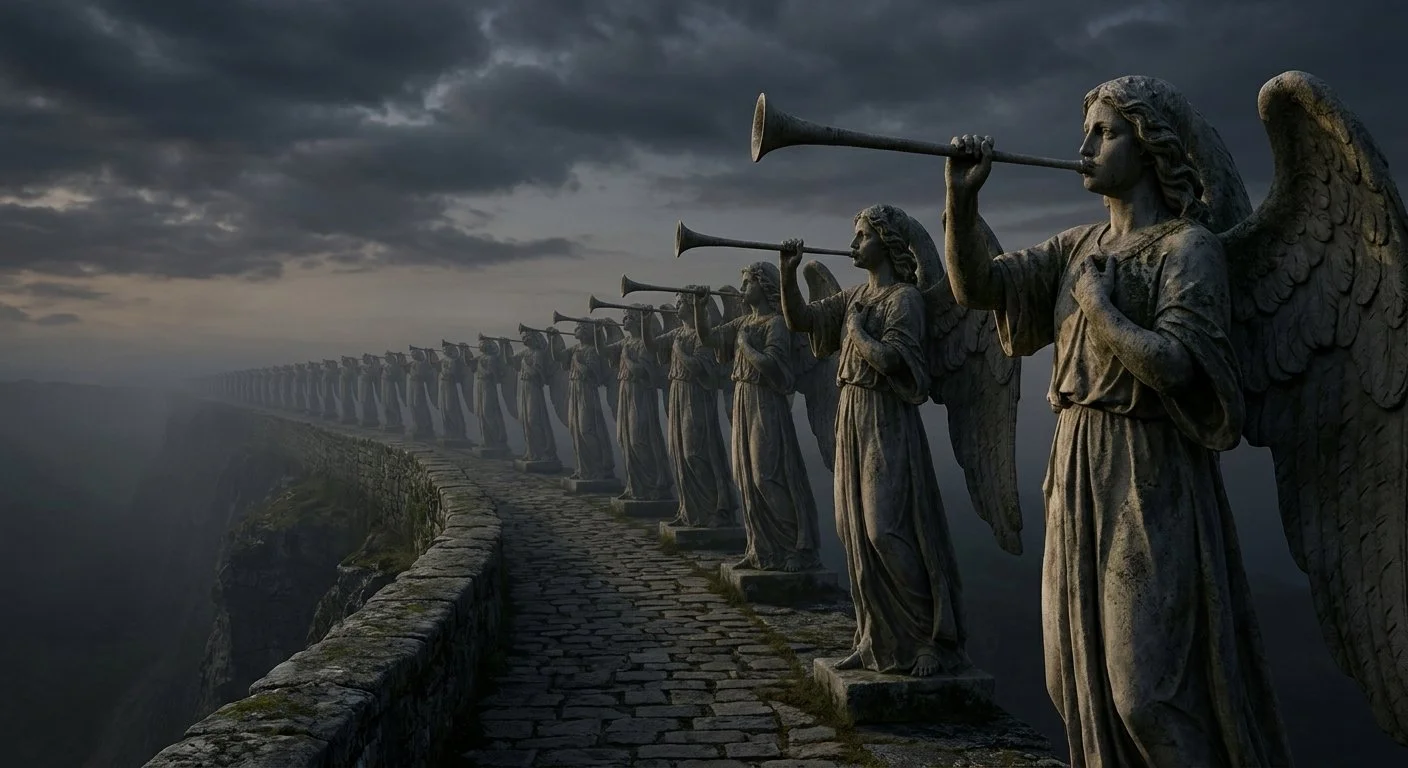
Imagine that at each prior cause in a chain of causes receding infinitely back there is a unique angel that will blow its horn if and only if no angel at any prior cause already blew its horn. Now, pick any one of these causes: Cn. A horn is blown at a cause prior to Cn and so not at Cn. Why must that be? Well, a horn would have been blown at a cause prior to Cn if a horn had not been blown at a cause even prior to that. In other words, an angel at Cn-1—a cause prior to Cn—would have blown its horn if no angel at a cause prior to Cn-1 (Cn-2) already blew its horn. (To spell this out for those struggling to connect the dots, realize that at Cn-2 a horn is either blown or not. If a horn is blown at Cn-2, then that means a horn is blown at a cause before Cn. If a horn is not blown at Cn-2, then that means a horn is blown at Cn-1—in effect, at a cause before Cn.)
But now we land in contradiction. Since a horn is blown, a horn is blown at a specific cause. That cause, of course, can be described as Cn—Cn being, after all, any arbitrary moment. For reasons just explained, though, no horn is blown at Cn. So a horn is blown at Cn and yet no horn is blown at Cn. We land in such contradiction by supposing that the chain of causes recedes to infinity. The contradiction goes away if the chain has a first member. For in this case the angel at the first cause blows its horn and all the rest of them do not blow their horns.
Captain Howdy Paradox
Imagine that during the witching hour—from 3am to 4am—a demon (Pazuzu) does a palm dance to see if he is going to possess a little girl (Regan MacNeil): he is inside Regan if and only if his palms are forward at the end of the series; he is not inside Regan if and only if his palms are backward at the end of the series. At 3am his right hand is level with his chin and his left hand is down at his waist, both hands palm-forward. At 3:30am he switches to a palm-back position. At 3:45am he switches to palm-forward. He keeps switching at every halfway mark, flipping his hands instantaneously (as a deity could) such that the end of the dance cannot culminate in his palms being somewhere in-between being palm-forward or palm-backward.
Now, since there is a later moment where palms are backward for each moment where palms are forward, it is absurd to say that he is inside Regan at the end (4am). And since there is a later moment where palms are forward for each moment where palms are backward, it is also absurd to say that he is not inside Regan at the end. In the worst case, then, Pazuzu is somehow both inside Regan and not inside Regan at the same time and in the same respect: a contradiction. In the best case, the series simply does not decide the final state: whether Pazuzu is or is not inside Regan is not settled by progressing through the series.
Even though the best case avoids contradiction, it still admits that there cannot be a regress of causes for an effect. Think about it. Either a final state never comes about or a final state does come about. Now, if a final state never comes about, then that amounts to admitting that there cannot be an infinite regress of causes for an effect. If a final state does come about, then that amounts to admitting that there cannot be an infinite regress of causes for an effect. For assuming the best-case scenario (namely, that a final state is not settled by the series), a final state comes about only if that final state is either uncaused or caused by something independent of the preceding switches. Either way, however, the final state is not caused by the series.
Responses?
I have heard several responses to these paradoxes, responses that attempt to vindicate the possibility of an actually infinite regress of causes for an effect. As a great admirer of Spinoza, someone who endorses the reality of infinite chains of causes receding back ad infinitum (never bottoming out), I myself search for ways out of these paradoxes. For the sake of convenience, I will consider replies only to the Angel paradox (a framing of the Grim Reaper paradox that I used in my paper “A Cosmo-Ontological Case for God” and in “A Rationalist Defense of Determinism”).
Some approaches are quite radical, such as denying the principle of contradiction on which these paradoxes depend. The idea is that while true contradictions do not occur in the world of finite things and at finite scale, all bets are perhaps off when we get to the infinite scale. The laws of logic can break down inside infinities just as the laws of physics can break down inside a black hole. Some who defend the dialetheia option even sometimes add, in what amounts to a sort of aesthetic reinforcement, that dialetheias are an essential part of the beauty of the world. This is a world, after all, where silences grow louder and where a high school graduation can be bittersweet. Of course, these examples are not true dialetheias. If the silence was loud in the exact same respect in which it was silent or if the emotion was sweet in the same respect that it was bitter—then, yes, these cases would be true dialetheias as opposed to the fake ones we tend to get in spiritual traditions like Zen. But the point is that when we make the radical jump to the infinite, laws of logic can break down.
The problem here is that the law of contradiction seems unavoidable: you can neither attempt to prove it nor attempt to disprove it without relying on it. For whatever it might be worth to say, in classic logic—which, and this is at least somewhat the rub, relies on the law of contradiction—all it takes is one contradiction and you can prove that any statement is true. Take the conjunction “p and not-p,” where “p” is a proposition that can be anything (“The Eiffel Tower is in France,” for instance). Of course, if we have “p and not-p,” then we have “p.” We can then form a disjunction where “p” is one disjunct and “q,” which can be absolutely any proposition (“All women love to be killed by means of a man climbing up their vaginas”). But we also know that, since we have “p and not-p,” we also have “not-p.” But since we have “p or q” and then we consider that “p” is not the case, we know by disjunctive syllogism that “q” must be the case. But it seems quite strange, to say the least, that we can prove anything without getting up from the armchair.
Less radical is what we might call the “Multiverse Defense,” versions of which I am more prone to hear. According to the Multiverse Defense, at every causal step there is a bifurcation of realities: in one universe, the angel at a certain cause blows its horn; in another universe, it refrains. There is no contradiction because every potential scenario where an angel might blow its horn is realized in some universe or another. In universe A, an angel at Cn blows its horn. In universe B, an angel at Cn-1 blows its horn, and so on. This continues across an infinite number of universes.
The problem with the Multiverse Defense is that it shifts the goalpost. Look at it this way. A cause in universe A cannot bring about an effect in universe B. A universe or possible world, after all, is an entire way reality can be. Since there is no inter-universe causation, we can simply focus on a single universe: universe A, for example. An angel at each cause in the infinite chain of causes in universe A will blow its horn if and only if no prior angel has blown its horn. But then for any given cause Cn, a horn must have been blown at some prior cause—which, of course, is itself describable as Cn.
Another response might be that these scenarios rig the game against causal infinitism: the contradiction is imposed from the outside, by the Angel rule. The Angel scenario supposes that every cause in an infinite chain depends on its predecessor. Each cause, in this case, has a prior cause, and each prior cause has a prior cause, without end—the buck of origination, so to say, always passed off to a prior cause. Nothing seems wrong with that in itself. Indeed, many philosophers (like Spinoza) look at things exactly that way. It is when the angel rule is added in that a problem appears. The rule, in effect, poisons the well. It turns the nature of the infinite chain against itself. At best, then, what results in contradiction is not the infinite causal chain itself but rather the meshing of an infinite causal chain with the angel rule.
Here are some responses to this objection.
First, it is said that nothing seems wrong with having the causal buck always passed off to a prior cause, ad infinitum. That is said too easily. At minimum it violates intuition. Think of an infinite chain of dominos. Like in the causal chain in question, where whatever one member is and does is completely a function of what the previous is and does, any one domino tips as a result of a previous domino tipping. How could the domino right in front of me tip if its tipping needs to be preceded by the tipping—one after the other—of an actually infinite number of antecedent dominos?
Or look at it this way. Imagine an infinite chain of things whose existence depends on what is prior. As a parallel, also imagine a chain of powerstrips. Each powerstrip passes along power only once it receives power, just as each mirror passes along light only once it receives light. But just as even an infinite chain of mirrors could not generate any light to begin with, even an infinite chain of powerstrips could not generate any power to begin with. A source of power in the case of the powerstrips, a source of light in the case of the mirrors, is required. The same goes for the existence of any member of the chain in question: no member could exist in a scenario where, in other words, the existence of each member is brought about by the existence of some other member that itself could bring about the existence of another member only once its own existence had been brought about by the existence of some other member (and so on).
What is required is something quite different from the dependent members of the chain. What is required is an absolutely nonderivative wellspring of existence-light-power. If the chain includes all that factors into how anything on the chain is (which is what we are supposing), then there must be something efficacious in the chain that is nonderivative. That which is nonderivative is either uncaused or self-caused. Could that uncaused or self-caused thing be merely at some intermediary point in the chain? No. That would mean the preceding causes did not fully cause the thing in question. But that is not what we are supposing. That uncaused or self-caused member, then, either must be at the start or (in the case of Spinoza) at all points (as synchronic or grounding factor). The latter case is consistent with a causally infinite chain. But the point here is not that there cannot be an infinite causal chain. The point, rather, is to push against the idea that supposing an infinite chain of causes in itself seems perfectly kosher.
The defender of causal finitism might also bring up the following point. To say that a causal series can be actually infinite presumes that there can be an actual infinity. But the notion of an actual infinity itself appears self-contradictory. On the one hand, an actual infinity is a completed infinity. On the other hand, the notion of infinity seems to be the notion of what is never completed—what is indefinitely large and may grow indefinitely but without bound. The notion of an actual infinity would be, therefore, the notion of a completed never-completed.
Of course, the infinitist can play the same game. One might just as well point out that the notion of an incomplete infinity appears self-contradictory. That which is incomplete is that which lacks. But that which is infinite is that which does not lack. And we can add to this the fact that infinitist thinkers gesture toward actual infinities with a variety of arguments. Russell argues that n, a finite number, cannot be the number of numbers since the number of numbers from 0 to n, inclusively, is always n + 1. Perhaps, so I can argue from what I know about Spinoza, when we see things from the standpoint of eternity, actual infinities appear more feasible. It might be insisted, in particular, that the infinite totality of ever-new iterations of thoughts and propositions and numbers are all always already there. Being that eternity is atemporality, it is inappropriate—so the infinitist might continue—to use the language of “ever- growing” to describe the infinite: the number of names may grow, but not the things named. Just because humans climb to higher numbers successively does not mean the numbers themselves do.
But the bigger issue is this, and here is the second point. The objection at hand is that imposing the Angel rule is what brings the problem, what generates the contradiction. That does not seem right. Consider a parallel in another area of philosophy. Many people have called utilitarianism into question by imagining stress-test scenarios where the agent, if acting according to utilitarian dictates, must do something that violates moral intuitions (like pull the trolley lever to kill the one person, or frame an innocent hobo in order to stop a race war). The objector seems to be saying, in parallel, that the problem is not with utilitarianism itself but with the conjunction of utilitarianism and these scenarios. Utilitarianism, that is to say, would be just fine (totally consistent with giving us non-repugnant moral answers) were it not confronted with these strange scenarios involving people tied up to railroad tracks.
The defender of causal infinitism will likely push back on the analogy. They might argue that while both are stress tests (the trolley problem a stress test on utilitarianism, the angel scenario a stress test on causal infinitism), there is a relevant difference. There definitely are differences: one forces the theorist to bite a bullet (pull the lever, a non-contradictory action) whereas the other explodes the world into absurdity (at least according to classical logic’s principle of explosion, which I mentioned above when talking about dialetheias). But surely that is not a relevant difference. The repugnance of the implication brought to light by a stress test has no bearing on whether the stress test is illicit or not. There seem only two basic ways for there to be a relevant difference: (1) the angel rule itself is not allowed to be raised in the first place or (2) how the angel rule is employed or utilized in the scenario is unfair in some way.
As far as I can tell, option 1 is out. It is hard for me to see why it would be in itself an unfair stress test. The Angel rule says, in essence, “this action will happen given a certain way things are prior”; “the subsequent state is this if the previous state is that.” But that is exactly how the whole chain runs: what happens at any point is a function of what happened before (which by transitivity implies, for whatever it might be worth to say, that what happens at any point is a function of everything that came before). No new unfair conditions are being imposed. Indeed, the rule reflects the machinery of the causal chain itself.
One might try to insist that there is a gap between x depending on prior states, on the one hand, and x blowing a horn if and only if no earlier angel blew a horn, on the other hand. The former, so one might try to press the point, is local whereas the latter is global: any particular C on the chain sprouts simply from the previous whereas any particular angel on the chain must be sensitive to the entire infinite past.
Upon consideration, however, that does not seem to be a real gap. Any particular angel needs to know only whether a horn has sounded at its predecessor: if yes, then stay quiet; if no, then blow. The operation is local like any causal link. The rule, yes, ranges over an infinite history. But no angel needs to survey the entire line back to know what to do. It only needs to know what happened just before. All the information it needs to know what to do, inherited by its own immediate cause, is supplied by that local knowledge.
The finitist will see all these wriggling moves to get out of the problem a delaying of the inevitable. Look at it in these terms. It is just as much a categorical truth that a horn is not blown at Cn as it is that a horn is blown before Cn. Either a horn is blown at Cn-2 (call this proposition “p”) or a horn is not blown at Cn-2 (“not-p”). In both cases, a horn is not blown at C (call this proposition “q”). While the form of reasoning is conditional (if either p or not-p, then q), the fact that q is true is non-conditional because the antecedent (either p or not-p) is unconditionally true and thereby what it implies (q) is unconditionally true. The same applies to the proposition that a horn was blown before Cn (call this proposition “r”). Either a horn is blown at Cn-2 (call this proposition “p”) or a horn is not blown at Cn-2 (“not-p”). If p, then r. But if not-p (the only other option), then r too. No matter what, unconditionally, r is true: a horn was blown before Cn. But again, Cn is any arbitrary spot. Both Cn-1 and Cn-2 could stand in the role of Cn. Whenever they do, though, it is clear that in neither case does a horn blow. The contradiction is unavoidable.
The finitist seems to have the upper hand. It is hard not to find the Angel paradox convincing each time I think it through. And yet I respect Spinoza, who is both an enemy of dialetheias and an advocate of infinite causal chains. What moves does a causal infinitist like Spinoza have left? There is an asymmetry I see: we can zero in upon any C and know that the angel does not blow its horn and yet we cannot zero in upon any C and know that an angel does blow its horn there. But this asymmetry, while real, does not seem to have any relevance. For all that matters is that we know a horn blows before any given C (Cn). It need not matter where before (whether Cn-1 or Cn-2). Besides, even if we prioritized the truth that no C zeroed in upon will be attended by an angel that blows its horn (prioritized this over the truth that a horn was definitely blown at either Cn-1 or Cn-2), that would not matter. For if no angel blows anywhere, then for any given angel zeroed in upon no earlier angel has blown. And that would mandate that every angel blow, in which case we have only magnified the contradiction: every angel does not blow and yet every angel does blow.
What moves does an infinitist like Spinoza have left? The only thing I can imagine Spinoza arguing is that the problem is with the observer, at least the observer who in Spinoza’s terms is operating at a lower level of knowledge (a level characterized by segmented myopic thinking) rather than the highest level (a level characterized by an intuitive grasp of the whole gestalt). If this is not just hot air, what relevance might this have? I do not know. Perhaps the Spinozist might argue that the infinite chain is not really an assembly of successive causes but rather a unified plenum. And if this is the case, perhaps he can show that the observer who zeroes in upon a specific C and then reasons backward from it is mistaking the implication of that local and limited analysis—even though it is a categorical implication—for truths about the whole.
“We need books that affect us like a disaster, that grieve us deeply, like the death of someone we loved more than ourselves, like being banished into forests far from everyone, like a suicide. A book must be the axe for the frozen sea within us.”—Kafka (against the safe-space cancel culture pushed by anti-art bullies, left and right)