A Triptych Titled "Happy Hour" (Round 3)
SCENT OF THE DAY: Iris Ghalia Trifecta, by Ensar Oud
Iris Ghaliya trifecta is considered the Oud Picante of Ensar. Barring Ensar’s curry-kitchen releases, which can throw people for a loop, this really is one of the most challenging he has to offer.--just like Picante is one fo the most challenging Areej releases. Do not get things confused, though. This is no Murasakino or Homa. This might not even be a Joint or a Furyo in challenge-factor for that matter. Ensar does not really make challenging perfumes. He creates unsoaked elegance. This just so happens to be one of his most growly. I need to be clear on this. Most of Ensar’s scents arte wildly animalic. It is just that they rarely if ever, even here, have that rank-feral quality. Never would one say of an Ensar perfume what one might say about a crusty pair of panties that stand on end: “Them shits are rank!” And really, it is hard even to say his stuff is feral if you think of dirty as a necessary condition for being feral. Because even is musk bombs—animalic as can be—have a clean-ethereal quality even when Ensar throws in hyrax and muskrat and the like.
iris ghalia is a costus benchmark, even over—if only because of the naturalism—Rake and Ruin as well as Ambilux./ The costus works really well to emphasis the rootiness fo the iris—iris in its denuded raw tuberous form, stark as a white wall. It seems like a guinea pig pen—that level of furry woodiness—for afar: that is how you come off. Costus musk dry down of ambilux is nearly one to one. Yes in terms of feel this is like a ramped up elite-artisinal take on Ambilux. It brings os much more dimension. Not only does it have some TSVGA-style animalics (like muskrat and hyrax) on top of the heavy hitters that Ambilux does not even have (tonkin-moingolian-tibetan musk trifecta, leathery castoreum, sour civet, salty ambergris), it brings such a creaminess with its iris-sandalwood combo and also this counterpoitn watery vibe from the blue lotus. I suspect this is one of the mosty hated Ensars because people do not like costus. I happen to love it. I love it in Rake and Ruin, Opus 7, Ambilux especially.
Smokey skunky old-world purple candy match-melted (literally it jas that quintessential matchstick oud that actually take forefront in drydown) with goat lanolin—indeed, as it dried down, it does give me vibes of Wolf Brother’s Goat, only much more oud-musk focused. The musks are tremendous here. I had to leasrn to smell them. It does not top my Musk Sultani or my Of Wolves and Men—two scents that I really have no words for. If it were not for my explorations into oud oils, I would have said because of those scents that musk—real deer musk—is superior to oud. I heard Ramsay for years go off about it and there really is nothing as seductive as that—nothing. The oud here has that Cambodian-style sweet-tobacco vibe. It is not rank as it is, especially here since Ensar does not soak his ouds. But yes you really do get some fruity-boozy tones of cherry tobacco ash—nothing as medicinal bitter as Of Wolves and Men but definitely there and, again, more oriented to the ashy side: picture thick iris rhizome rubbed with the ash of burned tarry oud.
I like Ensar and I like this, even though this is one of his most polarizing, drawing a lot of hate./ I like this scent a lot so far (on my first wear) but I like it a lot more on paper given its glut of animalic notes that would seem to give Fiona (a much more ambery and stunning creation, one-hit-wonder like): phenolic castoreum, ammonia-like civet, brown-eye hyrax, iodine-rot black ambergris, goat-lanolin mongolian musk, unquent-rodent-cage muskrat, chocolate-truffle Tibetan musk, blackcurrant-senior-citizen-skin Tonkin Musk, wet-dog costus—not to mention both goat-pen Indian oud and woody-parmesan Vietnamese oud./
I do owe this scent and Ensar himself more time (this is only my second solid wear). On my first go around I said that of the big artisanal guns (Russian Adam, old Bortnikoff) Ensar’s composing skill seems the weakest, more closer believe it or not to the garage feel of Pinoy Sirun. I can see why this scent in particular can reinforce that idea. And that was never a knock—I love lo-fi garage band stuff too: there is charm to the rough hewn. I have a friend Albert who puts out lofi music and unedited poetry that convery a charm and authenticity that my skilled work could never—and I am talking, if I do so say (I do have the hoursm the discipline, and the education), not just the Bortnikoff level skill (the best composure of these guys) but Jean Claude Elena and Corticiatto and Duchaufour and Vinchon-Sphener skill. / In some sense, my much more perfect work loses something, some of the human touch—it becomes less accessible/. There is something too the John Darneille lo-fi sound and Pinoy Sirun unfiltered perfumes that none of the masters can replicate. / So yes, my comment—only a preliminary one—about Ensar is no dig. / Indeed, when we add in his unsurpassed ingredient quality we do get something quiet awesome, like my friend Albert’s compositions: authentic and from the heart (roughhewn side) and yet based on top-shelf materials (dramatic, fucked up stories)—Bukowski in a bottle, especially this bottle (Iris Ghalia being quite an animalic number for an Ensar, albeit nothing that touches the level of a Homa or an Arsalan or ATon’s quite surprisingly troubling Murasakino. /
But now I see, having smelled so many, that I was mistaken. Ensar’s class plus material combo is unmatched even by the heyday of Bortnikoff. Some of this might be a function of the fact that he has now hired some ghost perfumers with the Corticiotto-training.
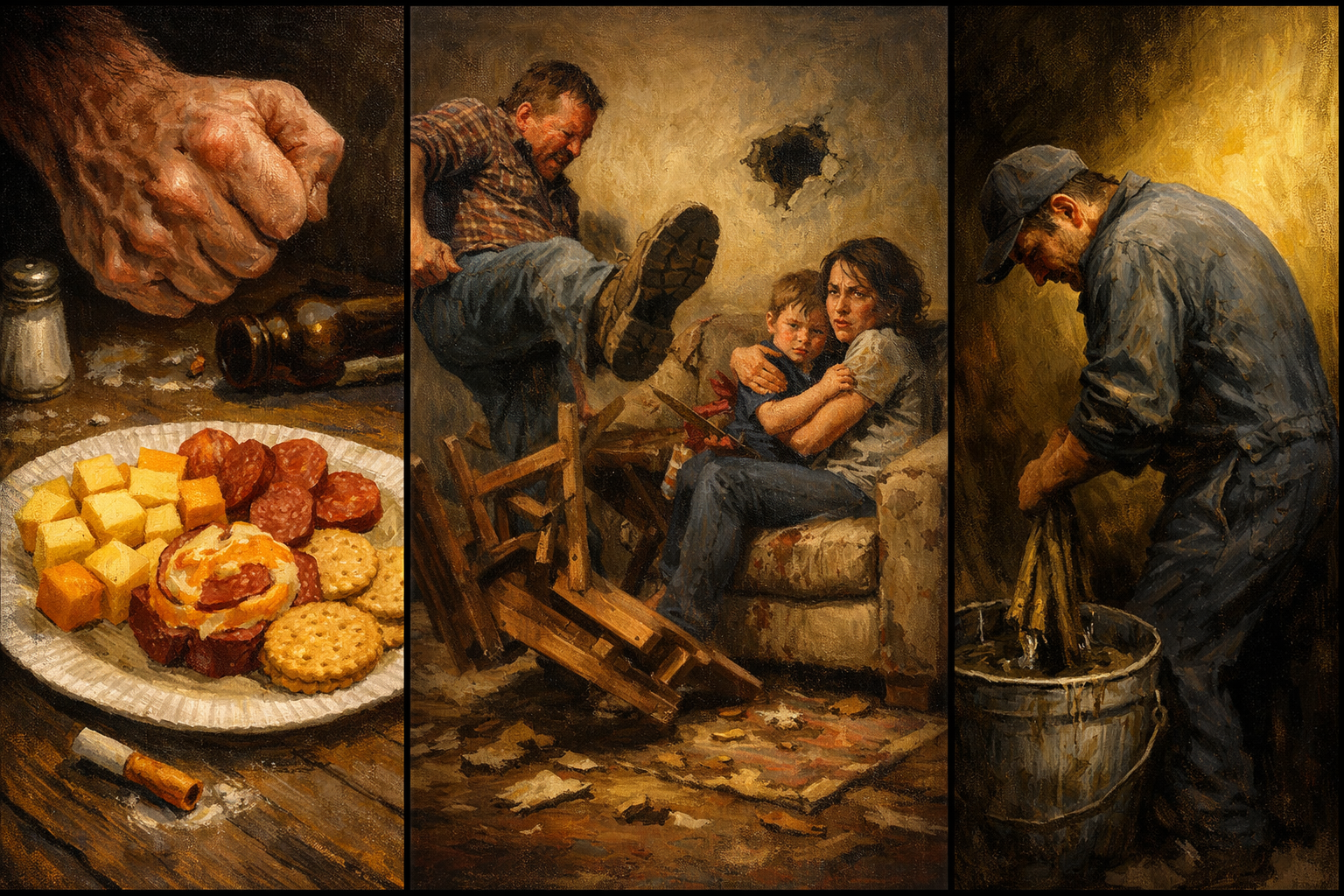
A Triptych Titled “Happy Hour”
The right panel showcases a janitor hunched against a backdrop of Rembrandt shadow, his yellow aura muddy like a monsoon river. The scruffy man, fidgety near passing eyes, lifts a frayed mop from a pail murky with silt. His back is skewed to us forty-five degrees, the inverted three-quarter pose accentuating one side creased with bitterness and disgust while concealing the other—a face, if only for our flung hope, more alive with empathy.
The left panel, a still-life, falls into a subgenre where domestic subjects (fruits, flowers, forks) face imminent disruption. And yet in this case, instead of some mischievous cat paw reaching for an oyster on the half shell, a gnarled fist— veiny, scarred—barrels down at a paper plate and its finger food of blue-collar Americana: sweaty cubes of Colby-Jack, pepperoni rings; a hunk of port-wine cheese-spread swirled yellow and prison-tray orange; Ritz crackers.
The center panel, double each wing’s width, zooms out from the plate to the larger scene at a moment shortly before, or perhaps after. A wall hole (fit for a fist) would take our eyes were it not for a man booting a dining chair, woman and child huddled on a sun-worn sofa burned by sleep cigarettes—janitor one-piece soaring with the shrapneled wood their way, the boy’s hand clutching what seems a knife tucked—tragic itself—between the cushions.
“We need books that affect us like a disaster, that grieve us deeply, like the death of someone we loved more than ourselves, like being banished into forests far from everyone, like a suicide. A book must be the axe for the frozen sea within us.”—Kafka (against the safe-space cancel culture pushed by anti-art bullies, left and right)