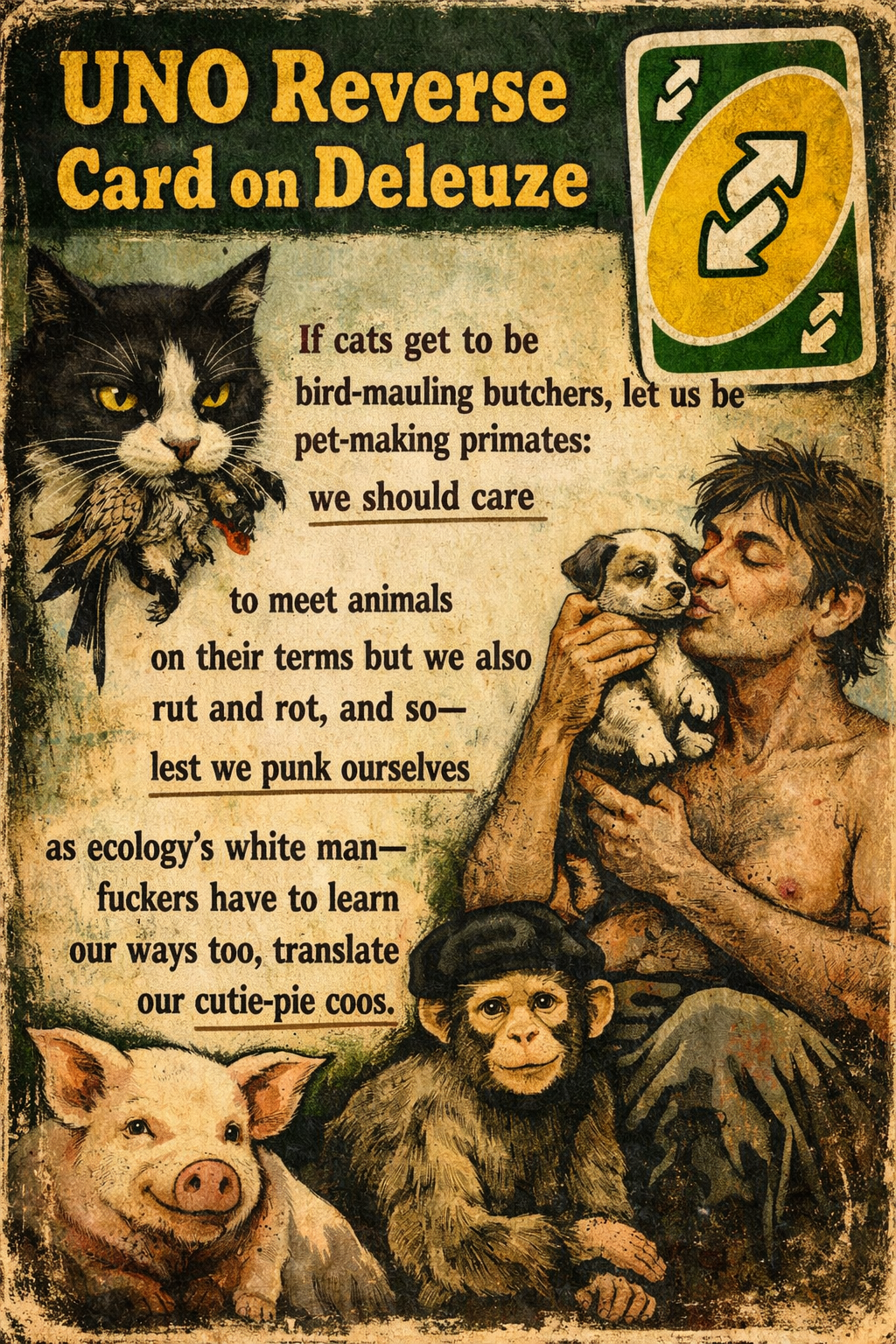
UNO Reverse Card on Deleuze
SCENT OF THE DAY: Triad, by Bortnikoff
Triad (2020, Dmitri Bortnikoff)—a woody-floral fragrance that, through its celebration of pink rose in all its fruity-sour-green (and later soapy-sour-green) glory, is one of the best animalic rose-ouds in my collection (right up there with Jinx’s J-Musk Zabad Boy, a skankier sibling that darkens the rose to the vintage extremes of Inverno Russo 2 as well as amps up the musky animalics and the citrus soapiness at least when compared to non-wood cap versions)—
gasses the nose with a nectar-grass merger of leafy-lychee May rose (buzzing with Spring vitality) and several oud varietals that, although high-potency and dosed with quite a heavy hand (in a good way), could make those who associate oud with the cowpat-barnyard aromas characteristic of unaged Assam oud think they have been shortchanged since they each tilt deeply into the green-vegetation territory (especially by the lemon-eucalyptus Sri Lankan oud, which brings facets of honey tea and even coffee bean, but also by the tonka-reinforced burley-tobacco combo of mossy-mildew Thai oud, which brings facets of fruit rot and even root-beer sarsaparilla, and—in what needed to be included if only to honor the Chinese Mafia the fragrance name calls to mind—pine-herbal Chinese oud, which brings facets of green peppercorns and even wet stone),
this mutually-reinforcing rose-oud interplay (both reinforcing especially one another’s vibrant stemmy-green aspect) scattered into immense projection by a lemon-leaf magnolia whose fruit-spritzer effervescence plays a big part not only in reinforcing the white-grape sparkle of the May rose but also in making Triad both highly luminous and projecting (one of the strongest projectors in Bortnikoff’s lineup, in fact)
and yet anchored in a phenolic-astringent aura that perhaps contributes the most to the gasoline facet I pick up (rubbery-industrial Sumatran benzoin, a form of benzoin—one Gardoni highlights in much-more-synthetic-seeming Risk—whose vanilla-almond facet is recessive and whose styrax-varnish facet is prominent, plus wine-barrel crocodile wood, a lacquered-parchment oud-adjunct—also known as Indonesian Bouya or white oud—not to be confused with the less-valuable oud filler Gaharu Buaya that sometimes gets called “crocodile agarwood,” plus musky-leathery hyraceum, mineralized excrement that tilts more in the creosote and burnt plastic direction than in the poop and colonoscopy direction)—
the overall result being a rose-oud fragrance that, although more celebratory of rose than even the rose-richer Oud Maximus (which, tangled in orange-spicy-skanky complexity, lacks Triad’s dialed-in purity of focus, where a busybody plurality finds itself corralled into a minimalistic-seeming unity that would make Raymond Carver proud), does not relegate the ouds to second-fiddle status, a fact that (as I suggested above) could easily go unappreciated given that the bitter-vegetal presence the oud blend imparts (especially the star oud here, Sri Lankan oud) carries the whole quite close to leafy-twig staples like Amouage’s Beach Hut Man (a fragrance that even those informed enough to know about the various species of oud, such as the sinensis and crassna and perhaps subintegra species we get here, and those careful enough not to build a monolith of oud around the Assam-malaccensis variety would never associate with oud);
the overall result being, in other words, a fragrance that, although convenient (and not wrong) to describe as a hyper-detailed 8K zoom-in on May rose (resolution so crystal-clear it is like seeing the borders of contact lenses against the film star’s sclera), is in reality a mutually-reinforcing oud-rose interplay in which the various bitter-botanical ouds (second element in the triad) amplify the May rose into Taif-rose intensity without spoiling its distinctive delicacy or creating some synthetic caricature (a feat achieved through the tension between the airy sparkle imparted by the magnolia, which together with May rose constitutes the first element in the triad, and the tarry-ferality of the hyraceum-bouya-benzoin combo, which is the third element),
a feat that for whatever complex tricks of the mind evokes an array of visuals from the Pak Chong shooting location of Bruce Lee’s 1971 breakout hit The Big Boss (cloudless skies of washed-out blue stark against background Sino-Thai mountains; dusty ochre roads lined by the wooden carts and makeshift stalls of Chinese-emigrant vendors under the meager shade of swaying coconut palms; sun-drenched sugarcane fields and the expansive green exotic lawns I get from Dia Man; Theravada monks bowed in robes of saffron orange; bleached Thai temples of breezeblock ventilation; tropical florals tucked behind ears and woven into hair) and particularly to the end fight scene on the manicured grass lawn of his enemy’s compound (only here, given the impact of the magnolia and May rose, Bruce struts in not while eating what seems to be pork rinds out of a brown paper bag but rather while sipping a BoKu, a now obsolete white-grape adult juice box from the baggy-suit nineties of Richard Lewis shoulder pads).
Willy the Rooster
Wedged midday between sidewalk and storefront, the wino— the one who, clockwork
as the freight train, throws asphalt haymakers at streetlamp shadows in midnight pain
(shouts folding to mumbles)— hides his face before the mirrors of a passing schoolgirl.
“We need books that affect us like a disaster, that grieve us deeply, like the death of someone we loved more than ourselves, like being banished into forests far from everyone, like a suicide. A book must be the axe for the frozen sea within us.”—Kafka (against the safe-space cancel culture pushed by anti-art bullies, left and right)