


to Hive being
welcome
What is Hive Being, and Why the Name?
You have likely heard talk of a hive mind, where one global mind finds more or less figurative expression in various local minds. Such talk is common enough in nature documentaries, especially ones concerning ants or bees, and in sci-fi programs. Take that notion, at least a loose version of it, and broaden its scope. That will be a decent first step in understanding the title I have chosen both for my Blog and for the first five-volume installment of my magnum opus Made For You and Me, a fragmentary collection of minimalist stanzas from 2016 to 2020.
In alignment with Spinoza (the 17th Century Rationalist to whom I devoted my doctoral studies), I view reality in its totality as a grand hive Being: all entities are but pulsating manifestations of the buckstopping fount of everything, an ultimate being we might call “God” or “Nature” (so long as, out of respect for the capital “G” and the capital “N,” we limit it neither to some anthropomorphic cloud father hurling lightning bolts nor to mere wilderness untouched by human smog). According to the hive-Being view (where reality is one lone superorganism, a monistic—and we might even say unividualist—conception I defend in both my creative and academic capacities), each non-foundational being (each being, that is, whose essence does not involve existence) is an utterly necessitated expression or eruption or exudation of this eternal source—each is, perhaps better put, a mode or manner of being, and so a focal point through which is disclosed, what classical theists sometimes call “being itself” (ipsum esse subsistens): the realness of the real, the being of whatever may be, the sheer activity of being, the very isness of whatever is. This Blog, which duplicates my Substack, throbs as but one among many literary unfurlings of this self-necessitated foundation, this supreme wellspring, of which we—like black holes and broken beliefs, like fractal ferns and flickering flames—are the inevitable stylings.
My Journey
I am an academic who found himself pressured into early retirement by the rising tides of cancel culture. The illiberal scourge of censoring, silencing, and shaming—although always with us throughout our evolution—reached a local peak around 2021. That was the turbulent year my creative pursuits, which the old left once encouraged as a healthy outlet for the stresses of a childhood steeped in poverty and illiteracy, drew the ire of the new safe-space left. A small cadre of self-proclaimed victims and their allies, several of whom continue to berate me years later under pseudonyms as see through as their sexual infatuation, sought to erase me and my heterodoxy. They found support from a wannabe-woke dean, covered in the grand inquisitor robes of our decadent modernity (full-body tattoos) and just itching to signal his commitment to protecting “vulnerable populations” from triggering material (even if just, as it was in my case, off-duty poems “unbecoming for someone calling himself a teacher”). Although I eventually won my due-process case with the help of The Foundation for Individual Rights and Expression, I slunk away from a college that turned its back on protecting freedom of expression and from an institution increasingly intolerant of intellectual diversity.
The wrecking ball to my too-comfy office in the windowless ivory tower came with a silver lining. From the ashes of my professional aspirations rose a phoenix of increased freedom to fulfill the literary calling I have pursued for decades. Reputation concerns never stopped me, even within academia’s sterile halls of conformity. Indeed, my unapologetic defiance, which has long baffled friends and family, no doubt chummed even safe waters—almost as if I were asking for it all along—until the cancel shiver grew too frenzied to hold back its blind thrashings. But now, now I piston the most forbidden territories of human thought with no longer even a twinge of conscience. The newfound freedom means extra time to hone my craft. When not assisting special-needs communities (a day job far more rewarding than freeway-flyer drudgeries), I pursue my literary mission with Dionysian fervor.
Call for Co-Conspirators
This space, my digital sanctuary, showcases the fruits of my mission. Think of my posts, even those linking to my publications, as works in progress. I want your input, unflinching brutality included. Each post begins with an invitation to action: “Let’s workshop this [draft about x, y, z].” Your contributions, whether through public comments or my contact page, help hammer scraps of ore into polished blades fit for magazine publication.
Your input is valuable, even if you are neither a writer nor a reader of literature—twin disciplines dying by the cyber nanosecond. Sometimes—even if at the risk of uttering banalities—an outsider’s fresh vantage can pierce the veils of convention to reveal what insiders miss. It often takes an outsider to make us even think to question our ingrained presuppositions and attitudes. I stand by the hygienic value of contagion. That is one reason I advocate so strongly for intellectual diversity and freedom of expression. And that is also one reason I was so harrowed by the anti-diversity swell of cancel culture in academia (an institution that should be the utmost caretaker of such values)—harrowed especially insofar as that swell masqueraded under the gaslighting guise of “diversity”).
You will witness the breathing evolution of my writings over time. To track these changes, I label each revision by round: “ROUND 2,” ROUND 3,” and so forth. Each piece undergoes continuous refinement based on your feedback and my own revisitations. Sometimes changes will mar the work. That is the risk of creative tinkering as a finite creature. I hope you will alert me to missteps. After many semesters of university writing workshops, one rule has impressed itself upon me: when someone senses a flaw, something almost always needs to change—even if, yes, the proposed solution misses the mark (which often it does). From a quick look into the archives, accessible here, you can see how much I have benefited from your feedback so far.
My Hope
Sharing drafts can be daunting. But showing you the ravaged and unperfumed real deal unfiltered by makeup (stuttering starts and falsities, awkward line breaks and clumsy word choices, grammatical errors and misspellings)—that not only makes my work more relatable, but helps me refine things through your input. I hope the unfiltered look at the raw process of fumbling, rather than just the polished product, also helps other writers develop their craft. Imperfect works often instruct more than perfect ones: whereas the perfect ones tend to have a grace by which they slip inside us without activating our scrutiny, the imperfect ones—especially the near perfect ones—show us glaringly what not to do.
People laugh at me, seeing—in my tilting at the windmills of literary excellence—a Don Quixote clunking around in Arthurian armor in a post-knight era. I am not naïve. I am well aware of the diminishing ability to read, let alone well: slowly and deeply, with gratitude. I am also aware that my style, which often nests subpoints within larger points, never waters down virtuosity for the sake of mass appeal. I watch readers stumble over my sentences, unable to unlock even just the music of the envelope let alone the semantic meat within, which—given my tendency to flashlight through the darker facets of human nature (the addicts, the miscreants, the abusers among us)—only adds an additional alienating layer of difficulty). Beholding these depressive scenes of even supportive family members getting bucked off my syntactic bronco makes me feel like a dinosaur who should get a hint and, if not succumb to the brain rot of skibidi-toilet speak, just hang himself already. Even though the decline in linguistic background and grammatical voltage makes my compositions seem quixotic in a world binging Netflix and TikTok, I persist—raging against the dying of the light—by some internal compulsion to celebrate the richness of language and thought.
My hope is that, despite social media’s unparalleled power to farm our attention, people never forget the unique power of writing. Beyond unveiling hypocrisy, teasing out complex implications, and detailing the commonalities between even the most alien phenomena, writing offers something we need today—trapped in agoraphobic cyber bubbles only thickened by the Lyme dangers of forests and the COVID dangers of cities—perhaps more than ever. Granting us rich access to the first-person perspectives of others (to how things feel to them), writing serves as one of humanity’s best tools for combating loneliness. It allows us to linger, broadly and deeply and at high resolution, within the inner lives of others in a way that other arts can only suggest.
What to Expect
My work spans a broad spectrum: from metaphysical discourses on free will and determinism and the ontology of holes to the ephemera of western culture (whether the childhood impacts of the hypersexual mono-image of black woman as squirting twerkers or Terrence Howard’s sham revolution of mathematics). Some tight and minimal, others free-flowing sprawls; some heady and abstract, others emotional and imagistic—my inkwell musings, which often blend scholarly rigor with a dark humor from both high and low culture, aim to capture the visceral intensity of our personal and social and ultimately existential predicaments.
By no means can I deny that drug abuse, sexual assault, and the tales of the broken and the damned loom large in the tag cloud of my work. My writing will never be a paradise of easy truths and comforting lies. It will challenge you, provoke you, and at times even repulse you. I offer no apologies for the monsters I unleash. They are as much a part of us, at long root scared rodent mammals scurrying in the shadows of dinosaurs, as our noblest aspirations.
But make no mistake. It is not all downer darkness. The archives are my receipts. You will find pieces exploring the pursuit of authenticity in a media-saturated world, the search for meaning in an indifferent cosmos, and the celebration of beauty in both the sublime and the profane. I locate much of my inspiration, in fact, in novelists like Dostoevsky and poets like Ted Kooser—writers unafraid to pursue moral agendas or risk Hallmark sentimentality in an age that often sneers at sincerity.
Be they satirical dissections of modern social dynamics or poignant poems about addiction or academic articles on moral responsibility, my goal is to provoke thought, evoke emotion, and foster meaningful dialogue. Fear has not and will not stop me from challenging humanity’s fundamental taboos (like bestiality and cannibalism) or self-reflecting into the dark chaos of the subconscious, even if that means exposing the Jungian shadows—the inner Goebbels—lurking within us all!
Expect posts each day, no day missed. Donations are welcome, but I impose no paywall: it feels wrong to charge for art, especially given our date with obliteration. Feel free to explore what amounts to, at the time of writing this, close to a thousand pieces of poetry and prose here. That should give you a sense of what awaits.
Join me—specula holstered—on this literary odyssey into the public and private nooks of the hive Being. Let us navigate the labyrinth of creation together, confronting our demons and even slaying our darlings if we must. Let us dance on the razor’s edge between the sublime and the profane in pursuit of an elusive literary perfection never to be confused—as it has been confused in our declining civilization—with the pursuit of popularity or likeability over truth.












tag cloud
- literature community
- American literature
- poetry
- literature
- poem
- literary
- creative writing
- writing
- poetry community
- Michael Istvan
- Istvan
- perception
- defiance
- suffering
- existential poetry
- dissociative
- existential
- healing
- human
- mortality
- power
- art
- artist
- God
- evolution
- love
- death
- darwin
- anxiety
- rape
- psychoanalysis
- addiction
- homeless
- addict
- trauma
- therapy
- rapist
- traumatic
- hypersexual
- grooming
- hyperarousal
- anal
- anal sex
- heart
- meditation
- incendiary
- Identitarianism
- dead
- tyrant
- poverty
- fap
- choking
- traitor
- honey pot
- treachery
- true crime
- identity
- cunnilingus
- power dynamic
- Vaginal
- woke
- OwnVoices
- crack
- disease
- animals
- empathy
- ally
- crime
- scarf
- summer
- identity politics
- body disposal
- kidnapping
- indians
- turtles
- Vagina
- sex
- Klan
- anality
- poet
- surrealism
- fisting
- erotic
- scatalogical
- Pussy
- sublime
- safe space
- adolescence
- poetry editor
- censor
- Nietzsche
- censors
- campus warrior
- artistry
- class
- borders
- violence
- substance abuse
- Earth
- sensual
Posts
MADE FOR YOU AND ME 2: hive Being (Stanzas 2017--part 78)
This fragment from Made for You and Me 2: hive Being (2017—part 78) continues the mosaic’s accumulation of aphoristic pressures, but with a particularly sharp emphasis on identity, value, and the instability of what we take to be real or worth pursuing. The lines move restlessly between metaphysics, social observation, mortality, and self-deception, producing a field in which no grounding principle remains secure for long.
A central current in this section is the problem of what constitutes the self. The question—“is the corpse more or less him / than the collage of memories / retained in the surrounding criers?”—functions as a conceptual anchor. It destabilizes any simple identification of the person with either the physical body or the social afterimage. The self becomes distributed, neither fully present in the remains nor fully preserved in memory. This concern echoes in the earlier line imagining “one being, with discrete centers of self-consciousness,” suggesting that even within a single organism, unity may be more apparent than real. The fragment repeatedly undermines the idea of a stable, singular identity.
Closely tied to this is the theme of misvaluation and misplaced investment. The warning to “build your identity around something / with a shelf life less than your own life” reframes mortality as a kind of training: attaching oneself to what will perish prepares one, paradoxically, for one’s own end. Similarly, the observation that truth claims may hold value “even with no grounding, just as money can” exposes the pragmatic dimension of belief. What matters is not always truth in a strict sense, but utility, circulation, and shared acceptance. Institutions “baptize” received views not to discover truth but to sustain themselves, revealing belief as an instrument of continuity rather than correspondence.
The fragment also returns to a recurring tension between awe and demystification. Genius, when misconstrued as effortless, removes the competitive impulse and allows enjoyment—yet this same misconstrual erases the labor behind creation. A virus becomes a “Kubrick monolith,” both banal and transcendent, its mechanical replication reinterpreted as cosmic signal. These gestures elevate the ordinary while simultaneously exposing the arbitrariness of such elevation. The sacred and the mundane are shown to be interchangeable frames rather than distinct categories.
Another strong thread is the critique of ego and self-presentation. The figure who mocks designer brands while flaunting “busy” as status reveals how identity simply shifts its markers without escaping the underlying need for distinction. The “ego shaky due to its awareness of being semi-literate” captures a more internal version of this instability: self-consciousness erodes confidence, producing a fragile identity constantly threatened by its own limitations.
The section’s engagement with religion is especially pointed. Several lines interrogate the logic of worship, suggesting that a being who demands belief under threat, or who values belief over moral action, would be ethically suspect. The idea that “only a devil would like those who believe in him for fear of torture otherwise” reframes piety as coercion. The closing aphorism intensifies this critique by suggesting that the culturally invoked “God-fearing” ideal may align more closely with fear-based domination than with any notion of the good. Across these lines, reverence is stripped of its assumed legitimacy and subjected to moral evaluation.
Memory and nostalgia appear as another destabilizing force. The pull of old songs, even when recognized as hollow, is compared to the persistence of family religion: both endure not because of their truth or richness, but because of their emotional imprint. The dying figure clinging to a childhood promise—“ice cream once you get well”—reduces life’s final horizon to a fragment of early comfort, suggesting that the deepest layers of identity may remain childlike and unresolved.
Finally, the fragment repeatedly poses existential dilemmas without resolving them. “Is it easier to blow your brains out or to reinvent yourself?” is not treated as rhetorical flourish but as a genuine impasse, reflecting the difficulty of transformation relative to cessation. Likewise, the notion that one’s “life continued even though his story seemed to have come to an end” captures the disjunction between narrative closure and lived persistence. Life exceeds the frameworks through which we attempt to make sense of it.
What unifies part 78 is its relentless questioning of foundations. Identity, truth, value, belief, and memory are all shown to be contingent, constructed, or misaligned with the realities they claim to represent. The fragment does not replace these with new certainties. Instead, it leaves the reader in a space where meaning must be negotiated without guarantees, where even the most basic categories—self, truth, God, worth—remain open to revision.
Meta Description:
This fragment from Made for You and Me 2: hive Being (2017—part 78) explores identity, value, belief, and mortality through aphoristic reflections that destabilize truth, selfhood, and religious authority.
Keywords:
mosaic poetry, aphoristic philosophy, identity, memory, belief, religion critique, value theory, existential reflection, selfhood, mortality
The Bad Seed (ROUND 1)
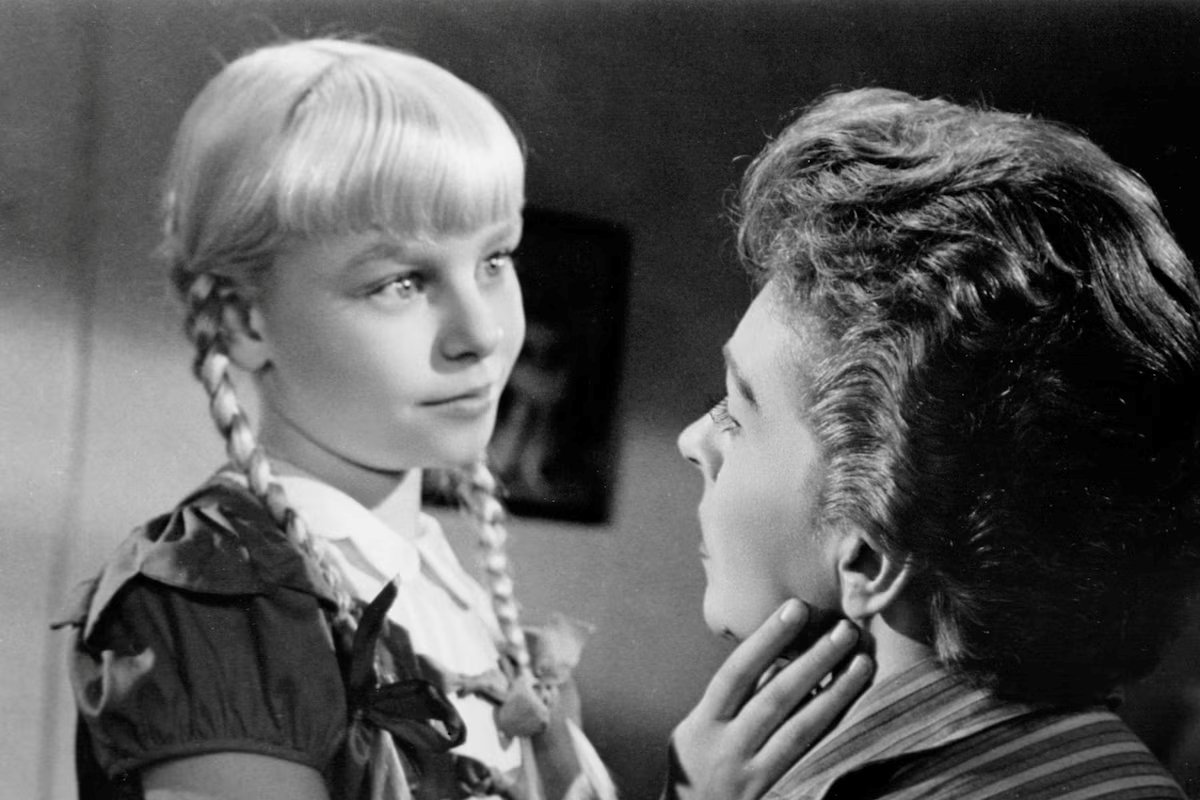
This piece, “The Bad Seed,” is a first-person prose narrative that stages a deeply disturbing account of projection, culpability, and the collapse of moral responsibility under the pressure of desire. At its core, the text is not an argument about evil in any metaphysical sense, despite its language, but a study in how a narrator constructs a framework—demonic possession, innate malevolence, metaphysical “bad seed” ontology—to displace, rationalize, and yet paradoxically intensify his own guilt.
The opening establishes the governing conceit: the child is “a demon.” This claim is immediately framed as something that might sound “odd,” but the narrator insists it would be confirmed by anyone in his position. This rhetorical move is important. It anticipates disbelief while attempting to preempt it by appealing to hypothetical shared experience. The narrative voice is thus defensive from the outset, already aware that its interpretation requires justification beyond ordinary moral reasoning.
What follows is a gradual construction of projection as ontology. The girl’s behavior—minor boundary-testing, suggestive tone, ambiguous gestures—is interpreted not as developmental or situational but as evidence of an underlying, pre-existing essence. The narrator explicitly rejects environmental or causal explanations, invoking philosophical frameworks (Leibniz, Spinoza, overdetermination) to argue that any account of her behavior must either parallel, redescribe, or redundantly accompany what she “already is.” This is a crucial move: by denying causation, he elevates his perception into metaphysical certainty. The girl is not made this way; she simply is this way.
Yet this metaphysical inflation coexists with a contradictory awareness of responsibility. The narrator repeatedly acknowledges that “I was to blame,” insisting that naming her nature does not absolve him. This creates a tension central to the piece: simultaneous displacement and self-indictment. He constructs an external source of corruption while also recognizing his own agency. Rather than resolving this tension, the text sustains it, allowing the two positions to reinforce one another. The more he frames her as demonic, the more intense his own participation appears; the more he admits his role, the more he seeks an explanation that exceeds ordinary culpability.
The middle sections elaborate a logic of complicity and equivalence. The narrator describes an eerie sense of mutual recognition—“as if we were… in league”—collapsing the asymmetry between adult and child into a fantasy of shared damnation. This is one of the most revealing aspects of the text. By imagining the relationship as one of equals, he erases the very power imbalance that defines the situation. The language of “two damned souls” functions not only as metaphor but as a mechanism for moral leveling.
The narrative’s escalation is structured through everyday interactions—basketball, casual physical contact, domestic intimacy—that are retrospectively reinterpreted as signs of deeper corruption. This retrospective framing is key. Events that might otherwise be read as mundane or ambiguous are re-coded as evidence once the narrator has committed to his explanatory framework. The past is rewritten to support the present interpretation.
The climactic scene foregrounds the narrator’s failure of intervention. He describes himself as “faking sleep,” a phrase that encapsulates the central ethical failure: the refusal to act under the guise of passivity. This is not ignorance or unconsciousness but deliberate non-resistance. The text is explicit that his physiological response contradicts any claim to innocence. The body, in this sense, becomes evidence against the narrative of victimization.
Importantly, the narrator does not fully exculpate himself. He acknowledges that “the source of my behavior was internal,” rejecting a complete transfer of blame. However, this acknowledgment is immediately reabsorbed into the larger framework of shared corruption and “jouissance.” The language of mutual activation—of being drawn into a pre-existing circuit of evil—allows him to maintain both guilt and justification simultaneously.
The closing sections intensify this dynamic by emphasizing instruction and transmission. The girl’s role shifts from instigator to guide, directing actions and shaping the involvement of others. This further reinforces the narrator’s constructed ontology while deepening the sense of collective participation. Yet even here, the text underscores that his compliance is voluntary, sustained by desire rather than coercion.
What emerges, then, is not a coherent theory of evil but a portrait of cognitive and moral distortion under extreme conditions. The narrator’s invocation of demonic essence, philosophical determinism, and shared damnation functions as a set of explanatory tools that both reveal and obscure his agency. The piece is unsettling precisely because it does not resolve these contradictions. It leaves the reader with a layered account in which acknowledgment of guilt coexists with elaborate mechanisms of displacement.
In this way, “The Bad Seed” operates as a study in how individuals narrate their own transgression. It shows how language, theory, and metaphor can be mobilized to make sense of actions that resist straightforward explanation, and how those same tools can distort responsibility even as they attempt to confront it.
Meta Description:
A disturbing psychological narrative examining projection, complicity, and moral distortion, exploring how a narrator constructs metaphysical explanations to grapple with his own culpability.
Keywords:
The Bad Seed, psychological narrative, projection, moral responsibility, complicity, unreliable narrator, philosophical justification, guilt, distortion

Loving Ourselves Without Denial (ROUND 2)
This poem, “Loving Ourselves Without Denial,” is a meditation on self-regard grounded not in idealization but in the recognition of degraded, involuntary persistence. Its central image—a boxer unconscious on the mat yet still “ticking out vestigial bobs and weaves”—reorients the idea of love away from admiration of excellence and toward an acceptance of the body’s stubborn, often undignified continuance. The title’s injunction “without denial” is thus literalized: what is to be loved is not the perfected self, but the compromised organism that continues to act even when agency has collapsed.
The opening blessing—“Blessed be that nervous-system circuitry”—sets the philosophical tone. The object of reverence is not the conscious will, nor the victorious athlete, but the underlying mechanism that keeps motion going in the absence of intention. The boxer is “flatlined,” effectively removed from the sphere of deliberative control, yet his body persists in enacting the gestures of the sport. These movements are “vestigial,” remnants of training that survive the loss of awareness. The poem therefore distinguishes sharply between cortical intention and subcortical persistence, suggesting that much of what we take to be action is in fact residual programming.
The extended similes complicate this persistence by rendering it grotesque, comic, and tender all at once. The unconscious fighter is likened to an “obese bridesmaid” awkwardly rehearsing choreography at the edge of a dance floor, to a “whimpering dog in dream-conflict,” and to a jazz guitarist submerged in a stream. Each comparison strips away heroic framing. The boxer is no longer a figure of disciplined masculinity but a body caught in compromised motion—out of place, half-coordinated, driven by patterns that no longer match the present situation. Yet these images also humanize him. They place his movements within a broader spectrum of embodied life: rehearsal, dreaming, improvisation.
The poem’s language of degradation—“degraded combos,” “piss-ass digs, low blows”—is crucial. It resists any attempt to aestheticize the scene into pure beauty or transcendence. What persists is not excellence but its diminished echo. And yet, the poem insists that this is precisely what merits blessing. The nervous system continues to “work the body,” even if poorly, even if inappropriately. This persistence is not rational; it is structural.
The final lines introduce a key conceptual frame: the “liminal seam… between rehearsal and showtime.” The boxer’s movements occur in a threshold state, where the distinction between practice and performance collapses. Without consciousness to situate the action, the body continues as if still engaged in the fight, even though the fight, in any meaningful sense, is over. The phrase “cortical current / bleeding enough into jaw and tongue” suggests a minimal residual connection between higher and lower systems—just enough to produce “stupid gurning,” a final, involuntary expression.
What emerges is a vision of the self as layered and partially autonomous. The poem rejects the idea that selfhood is identical with conscious control. Instead, it locates something worthy of love in the continuity of embodied pattern, even when that pattern is maladaptive or absurd. To love oneself “without denial” is to accept not only one’s intentions and achievements but also these residual, often embarrassing forms of persistence.
In this way, the poem offers a corrective to more aspirational models of self-love. It does not ask the reader to affirm their best self, but to extend compassion to the parts that continue mechanically, imperfectly, beyond the reach of will. The boxer’s unconscious motions become emblematic of a broader human condition: we are, in significant measure, carried by circuits we did not choose, repeating forms we only partially understand. The poem’s blessing is directed precisely at that condition.
Meta Description:
A philosophical poem exploring self-love through involuntary bodily persistence, depicting an unconscious boxer whose residual movements reveal the limits of conscious control.
Keywords:
Loving Ourselves Without Denial, self-love, embodiment, unconscious action, nervous system, persistence, philosophy of self, poetic analysis

Loving Ourselves Without Denial (ROUND 1)
This poem, “Loving Ourselves Without Denial,” is a meditation on self-regard grounded not in idealization but in the recognition of degraded, involuntary persistence. Its central image—a boxer unconscious on the mat yet still “ticking out vestigial bobs and weaves”—reorients the idea of love away from admiration of excellence and toward an acceptance of the body’s stubborn, often undignified continuance. The title’s injunction “without denial” is thus literalized: what is to be loved is not the perfected self, but the compromised organism that continues to act even when agency has collapsed.
The opening blessing—“Blessed be that nervous-system circuitry”—sets the philosophical tone. The object of reverence is not the conscious will, nor the victorious athlete, but the underlying mechanism that keeps motion going in the absence of intention. The boxer is “flatlined,” effectively removed from the sphere of deliberative control, yet his body persists in enacting the gestures of the sport. These movements are “vestigial,” remnants of training that survive the loss of awareness. The poem therefore distinguishes sharply between cortical intention and subcortical persistence, suggesting that much of what we take to be action is in fact residual programming.
The extended similes complicate this persistence by rendering it grotesque, comic, and tender all at once. The unconscious fighter is likened to an “obese bridesmaid” awkwardly rehearsing choreography at the edge of a dance floor, to a “whimpering dog in dream-conflict,” and to a jazz guitarist submerged in a stream. Each comparison strips away heroic framing. The boxer is no longer a figure of disciplined masculinity but a body caught in compromised motion—out of place, half-coordinated, driven by patterns that no longer match the present situation. Yet these images also humanize him. They place his movements within a broader spectrum of embodied life: rehearsal, dreaming, improvisation.
The poem’s language of degradation—“degraded combos,” “piss-ass digs, low blows”—is crucial. It resists any attempt to aestheticize the scene into pure beauty or transcendence. What persists is not excellence but its diminished echo. And yet, the poem insists that this is precisely what merits blessing. The nervous system continues to “work the body,” even if poorly, even if inappropriately. This persistence is not rational; it is structural.
The final lines introduce a key conceptual frame: the “liminal seam… between rehearsal and showtime.” The boxer’s movements occur in a threshold state, where the distinction between practice and performance collapses. Without consciousness to situate the action, the body continues as if still engaged in the fight, even though the fight, in any meaningful sense, is over. The phrase “cortical current / bleeding enough into jaw and tongue” suggests a minimal residual connection between higher and lower systems—just enough to produce “stupid gurning,” a final, involuntary expression.
What emerges is a vision of the self as layered and partially autonomous. The poem rejects the idea that selfhood is identical with conscious control. Instead, it locates something worthy of love in the continuity of embodied pattern, even when that pattern is maladaptive or absurd. To love oneself “without denial” is to accept not only one’s intentions and achievements but also these residual, often embarrassing forms of persistence.
In this way, the poem offers a corrective to more aspirational models of self-love. It does not ask the reader to affirm their best self, but to extend compassion to the parts that continue mechanically, imperfectly, beyond the reach of will. The boxer’s unconscious motions become emblematic of a broader human condition: we are, in significant measure, carried by circuits we did not choose, repeating forms we only partially understand. The poem’s blessing is directed precisely at that condition.
Meta Description:
A philosophical poem exploring self-love through involuntary bodily persistence, depicting an unconscious boxer whose residual movements reveal the limits of conscious control.
Keywords:
Loving Ourselves Without Denial, self-love, embodiment, unconscious action, nervous system, persistence, philosophy of self, poetic analysis

Pumps and a Bump (ROUND 6)
This standalone piece, “Pumps and a Bump,” is a philosophically charged prose work that examines compulsive behavior, ritualized self-contradiction, and what it explicitly names as “meta absurdity.” Rather than functioning merely as a narrative of transgression, the text uses extremity to interrogate a broader question: how a sequence of actions can be fully explicable in causal terms yet appear profoundly incoherent—almost ridiculous—when viewed from a higher vantage point.
At the structural level, the piece is organized around accumulation and release. The opening sections dwell on the buildup—temporal, physiological, and psychological—framed through the speaker’s obsessive calibration of time (“no-fap fast,” circled dates, countdowns). Control is foregrounded: the body is disciplined, monitored, restrained. Yet this control is paradoxical. It does not prevent the eventual act; it guarantees it. The longer the delay, the more the release becomes less a lapse than a culmination. In this way, the text collapses the opposition between discipline and indulgence, presenting them instead as phases of the same cyclical mechanism.
This mechanism unfolds within a clinical setting, and that setting is crucial. Dentistry, a domain defined by trust, technical precision, and asymmetrical vulnerability, becomes the infrastructure that makes the transgression possible. The patient is reframed through procedural language—“cavities,” ranked and evaluated—so that the human body is reduced to a field of opportunity. What is especially striking is that the same classificatory mindset that governs legitimate medical practice is redeployed internally to justify violation. The professional framework does not break down; it is repurposed.
The conceptual center of the piece arrives immediately after the act, in the abrupt reversal from maximal indulgence to maximal erasure. The same figure who would risk everything for completion now works with equal intensity to eliminate its trace. This shift is not treated as simple hypocrisy or fear, though both are present. Instead, it becomes the site of a deeper philosophical problem. Every individual step—desire, action, concealment—admits of explanation. But the rapid oscillation between them produces what the text calls a “meta absurdity.” The question is no longer why each action occurs, but how the total pattern can appear so disproportionate, so structurally ridiculous, when apprehended as a whole.
The text sharpens this insight by invoking an external perspective, imagining how such behavior might appear to an alien or artificial intelligence. Stripped of human rationalizations, the sequence becomes a baffling loop: enormous effort is invested in producing a state, only for equal effort to be immediately invested in undoing it. This perspective does not negate causality; it exposes the gap between explanation and intelligibility. One can know why something happens without finding it meaningful or coherent.
The extended physical description intensifies this effect by foregrounding performance. The act is rendered in exaggerated, almost choreographic terms, drawing on cultural references, rhythm, and stylization. The body is not merely acting; it is staging itself. This introduces another layer of contradiction: even in a moment of transgression, the subject remains entangled in self-image, in the aesthetics of his own movement. The behavior is both compulsive and performative, both driven and self-conscious.
In its final movement, the piece shifts from evidence to atmosphere. Even if all material traces are removed, something persists—a “vibe of predation.” This distinction is philosophically significant. It suggests that actions do not only leave forensic residues but transform the qualitative character of a space. The returning observer may not detect proof, but encounters a changed environment. The act leaves not just evidence, but presence.
The closing question extends the inquiry outward, asking whether this layered absurdity—behavior that is causally explicable yet experientially incoherent—points beyond the individual to something more fundamental about reality itself. The text does not resolve this. Instead, it leaves the reader suspended between levels of analysis, each capable of explaining but none capable of reconciling the dissonance.
In this way, “Pumps and a Bump” operates as both character study and philosophical investigation. Its extremity is not incidental but instrumental, allowing it to expose the uneasy coexistence of rational explanation and existential absurdity. The horror lies not only in the act, but in the recognition that such contradictions can be fully intelligible from within and yet irreducibly senseless from without.
Meta Description:
A philosophically intense prose work exploring compulsive behavior, clinical power, and “meta absurdity,” examining how fully explainable actions can still appear profoundly incoherent when viewed from a broader perspective.
Keywords:
Pumps and a Bump, philosophical prose, absurdity, compulsion, repetition, clinical setting, explanation vs meaning, behavioral paradox, phenomenology, existential inquiry

MADE FOR YOU AND ME 2: hive Being (Stanzas 2017--part 77)
This fragment from Made for You and Me 2: hive Being (2017—part 77) continues the mosaic’s method of assembling aphoristic shards into a portrait of modern consciousness under pressure. The lines do not build a single argument so much as accumulate around recurring tensions: agency and dependence, memory and self-mythology, labor and waste, reverence and moral revolt. The result is a philosophical field in which private anguish, cultural memory, bodily discipline, erotic risk, and theological judgment coexist without hierarchy.
One of the strongest currents in this section is the question of what kind of being one is in relation to one’s own life. The opening line—“are you the root that finds the water or the leaf that catches the light?”—immediately frames existence in terms of receptivity, function, and positional difference. The self may be active seeker or passive receiver, hidden sustainer or visible surface. That question quietly governs much of what follows. Some lines imagine people straining toward mastery—lifting weights, trying to out-train a bad diet, racing home to intervene in catastrophe—while others emphasize how much is already determined by context, by panic, by the structure of one’s relationships, by the body’s limits, or by the slow erasures of disease.
The piece is especially interested in the instability of memory and the ethics of repetition. “By repeating it, are you preserving the memory of your tragedy or laundering it?” is one of the fragment’s central questions. It captures the suspicion that narration can both honor and sanitize, that the act of keeping something alive through language may also make it cleaner, more presentable, less true to its original violence. This concern echoes in the line about nostalgia for a moment in which one was already nostalgic for another moment. Memory becomes recursive, layered, and increasingly detached from the original lived experience. The self risks inhabiting not the past, but past versions of its own retrospective feelings about the past.
Another significant thread is the relation between worthwhile care and disguised cruelty. The line about “helping / the senile unscramble memories for an afternoon” is especially subtle. It asks whether the helper’s sense of doing good may coexist with a more troubling pleasure or imposition. That ambiguity runs through other lines as well: opening up one’s pitiableness only to someone who cannot judge; being paired from the start with someone already inclined to leave; taking each other’s medicines; wasting a day off in dread of work. Human care is repeatedly shown as compromised by need, asymmetry, projection, and fatigue. Yet the fragment never reduces such acts to bad faith. It simply refuses to let them remain innocent.
The section’s treatment of worship and divinity forms its clearest argumentative cluster. The last four aphorisms are variations on a single moral interrogation: could a being who demands reassurance, punishes disbelief amid evidential scarcity, or values doctrinal belief above the suffering of innocents ever be worthy of worship? These lines are powerful because they relocate the question of God from metaphysics to moral psychology. The issue is not whether such a being exists, but whether, if such a being existed, reverence would be fitting. The fragment thus turns traditional piety inside out. Worship is no longer assumed as the proper response to power; it must be ethically earned. This line of thought is prepared earlier by the claim that a being who created us for worship would already be suspect. Reverence is subjected to the same scrutiny as all the fragment’s other human arrangements.
Elsewhere, the poem continues its characteristic mingling of the abject, the comic, and the historically grave. A subway performer booed to tears, children sketching bomb damage, poetry in the pocket of an SS soldier, a Chaucer scholar who is also a serial rapist—these juxtapositions expose the instability of moral categories and the insufficiency of cultural polish. Refinement, talent, scholarship, and sentiment do not protect against cruelty. Likewise, brutality does not erase the strange presence of beauty, memory, or aspiration. The fragment persistently resists clean separation between civilization and barbarism.
The lines about risky behavior in a “zoo of cut-off domestication” offer another key insight. Affairs, gambling, and other self-endangering acts are presented less as deviance than as attempts to generate intensity inside an overcontained life. This links the fragment’s erotic, occupational, and existential themes. The wasted workday, the desire to write great verse, the front-yard weightlifting, the remembered VCR cart of substitute-teacher reprieve—all point to a life oscillating between routine and the desperate need to puncture routine. Risk becomes one of the last available solvents of deadened time.
What unifies the fragment, then, is not topic but pressure. Every line asks, in one form or another, whether our repetitions, attachments, and ideals are preserving life or laundering it; whether our efforts are forms of agency or symptoms of entrapment; whether the beings and systems we serve are worthy of that service. In that sense, part 77 is among the more overtly philosophical sections of the sequence. It does not merely register the textures of modern life; it subjects them to judgment.
Meta Description:
This fragment from Made for You and Me 2: hive Being (2017—part 77) examines agency, memory, labor, risky behavior, and the moral conditions of worship through a mosaic of aphoristic reflections.
Keywords:
mosaic poetry, aphoristic poetry, memory and repetition, agency, worship, moral philosophy, nostalgia, labor, risky behavior, existential reflection
Muse Juice Dammed by the Lie of Moral Desert (ROUND 1)
This poem, “Muse Juice Dammed by the Lie of Moral Desert,” is a compact philosophical meditation on artistic humility, the opacity of inspiration, and the self-punishing error by which creators treat mystery as evidence of personal failure. Its central claim is that the artist’s inability to understand what has come through him is not a mark against him, yet he takes it as exactly that. The poem therefore dramatizes a familiar but rarely isolated creative pathology: the movement from not understanding one’s own work to feeling unworthy of having produced it.
The opening image is immediately paradoxical. The poet “scribbles out / the gift he put on the page.” The work is both something he “put” there and something figured as a “gift.” That doubleness is essential. It suggests that authorship contains both agency and receptivity, both making and receiving. The poet has participated in the poem’s arrival, but he has not generated it in the sovereign, fully transparent way he would like to believe. The tragedy is that, instead of dwelling in that ambiguity, he destroys the gift.
The next phrase sharpens the poem’s logic with unusual precision: “inability to grasp its meaning, / he thinks … indicts him as unworthy.” The grammar matters. The poem is not saying that the poet indicts himself in some general way, nor that the poem itself accuses him. Rather, he believes that his inability to grasp the meaning of what he has written is itself an indictment. He mistakes opacity for disqualification. What should appear as a sign that the work exceeds his conscious command is taken as proof that he does not deserve it.
The parenthetical clause identifies the deeper error behind this misreading: he is “denying / the not-up-to-me-ness his heart knows / humbles every human idea.” This is the poem’s philosophical center. “Not-up-to-me-ness” names a truth about creation but also about human life more broadly: much of what matters most is not fully subject to will, possession, or mastery. The heart already knows this. It knows that every idea, once real enough, is humbled by the fact that it arises within conditions larger than the self. Inspiration, language, meaning—these are not wholly manufactured commodities. They strike, arrive, pass through. The poet’s mistake is to reject this humbling truth in favor of a fantasy of authorship as total control.
That fantasy is what the title calls “the Lie of Moral Desert.” The poem suggests that the artist imagines creative legitimacy in moralized terms: if something worthy has appeared on the page, he must be worthy of it in a direct and transparent sense; if he cannot account for it, he must somehow have failed. This is the lie. It assumes that gifts correspond neatly to deserts, that inspiration belongs only to those who can comprehend and justify it. Against this, the poem insists on giftedness as something irreducibly excessive to the self.
The final lines distill the critique: the poet behaves “as if the buck must stop / in the artist, sovereign not struck.” “Sovereign” and “struck” form the poem’s decisive opposition. To be sovereign is to imagine oneself as origin, master, final authority. To be struck is to acknowledge that creation involves being visited, interrupted, or moved by something not entirely one’s own. The bound poet chooses sovereignty, and that choice binds him. Because he cannot accept having been struck, he treats the surplus meaning in his own work as a failure of self-possession. Thus he erases what should have humbled him into gratitude.
What makes the poem especially strong is its refusal to sentimentalize artistic mystery. It does not merely celebrate inspiration as magical. Instead, it shows how difficult it is for the ego to tolerate receiving something it cannot fully own. The poet would rather destroy the gift than let it stand as evidence that meaning exceeds merit, that art can arrive through a person without being proportionate to that person’s self-understanding. In this sense, the poem is not only about writing. It is about the human resistance to grace.
Meta Description:
A philosophical poem about artistic humility and inspiration, “Muse Juice Dammed by the Lie of Moral Desert” explores how a poet mistakes his inability to understand his own work for evidence of unworthiness, thereby rejecting the giftedness of creation.
Muse Juice Dammed by the Lie of Moral Desert, artistic humility, inspiration, authorship, moral desert, creativity, self-doubt, philosophy of art, giftedness, poetic analysis

Dying Light 2: Stay Human (ROUND 1)
This poem, “Dying Light 2: Stay Human,” is a confrontational meditation on shifting moral codes, sexual norms, and the uneasy relationship between past brutality and present decadence. Its method is comparative shock: it juxtaposes a figure emblematic of overt historical evil—the Klansman—with a contemporary landscape of commodified sexuality and altered beauty, forcing the reader to confront not equivalence but disorientation.
The opening move is deliberately destabilizing. By asserting that “yesterday’s Klansman would have made / an honest lady of any black girl,” the poem does not redeem or soften the figure but reframes him within a different moral register: one governed by rigid, if abhorrent, codes of honor, hierarchy, and sexual conduct. The phrasing is jarring because it overlays an image of care or responsibility (“made an honest lady,” “piggybacking”) onto a figure otherwise associated with violence and dehumanization. This tension is the point. The poem forces the reader to reckon with the possibility that even within monstrous systems, certain behavioral constraints existed—constraints that may no longer operate in the same way.
The middle lines extend this reframing through grotesque historical imagery—“gator bait babies”—that recalls the brutality and objectification of Black bodies in the past. Yet even here, the poem insists on a kind of boundary: “before / putting his cock anywhere near” the contemporary figure described in the final lines. The implication is not moral rehabilitation but contrast. The past is presented as violently oppressive yet structured; the present, by contrast, is depicted as unmoored, driven by different forms of distortion.
The final image—“today’s Kardashian trout face: / zombie-eyed polymer calibrated / for friction, not fidelity”—shifts the poem’s target to contemporary aesthetics and sexual culture. The language is mechanistic and dehumanizing. Faces are “polymer,” eyes are “zombie,” and the body is “calibrated” like a device. This is a world in which human features have been reshaped into synthetic surfaces optimized for use rather than relationship. The phrase “for friction, not fidelity” crystallizes the poem’s critique: intimacy has been replaced by function, commitment by sensation.
The title, “Dying Light 2: Stay Human,” frames the entire piece as a commentary on degeneration. The “dying light” suggests a fading of something—perhaps moral coherence, perhaps human authenticity—while “Stay Human” reads as both instruction and irony. The poem questions whether humanity, understood as a balance of restraint, recognition, and relational depth, can persist under current conditions.
What emerges is not a simple argument that the past was better than the present. Rather, the poem exposes a paradox: a movement from overt, codified cruelty to a more diffuse, technologized, and aestheticized form of dehumanization. The shock lies in the comparison itself. By forcing these two modes into the same frame, the poem destabilizes easy narratives of progress and invites the reader to consider what has been lost even as certain forms of injustice have been challenged.
In its brevity, the poem operates as provocation rather than resolution. It leaves open the question of what it would mean, in such a landscape, to “stay human,” suggesting that the answer cannot be found in either past structures or present freedoms alone.
Meta Description:
A provocative poem contrasting historical brutality with modern synthetic aesthetics, exploring shifting moral codes, dehumanization, and the challenge of remaining human.
Keywords:
Dying Light 2 Stay Human, satire, moral comparison, historical vs modern, dehumanization, beauty standards, sexual culture, social critique, poetic analysis
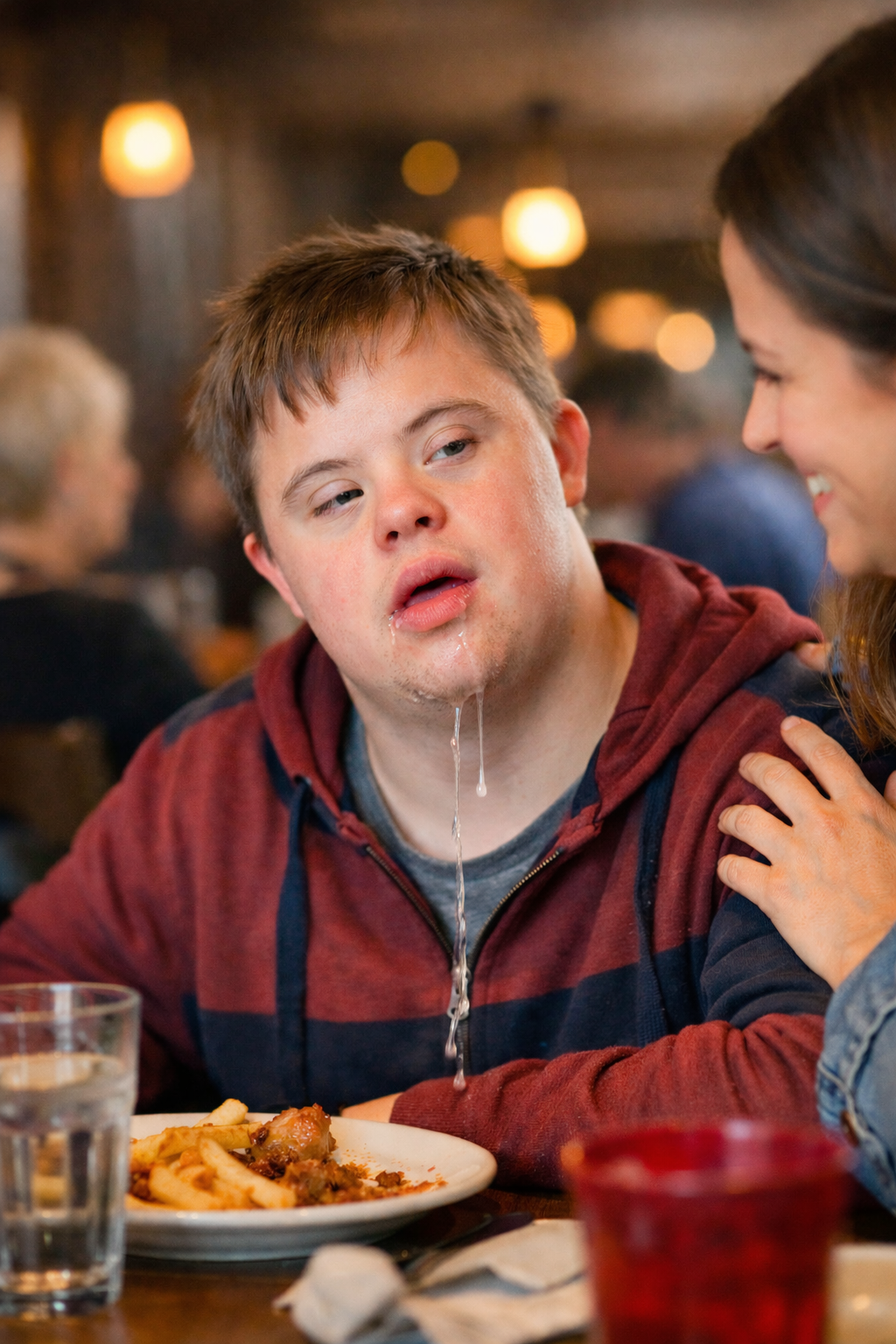
So Brave (ROUND 1)
This poem, “So Brave,” is a sharply compressed satire of contemporary moral performance, focusing on the uneasy relationship between ethical inclusion and aesthetic tolerance. Its central claim—that “morals have aesthetic criteria”—functions as both thesis and provocation. The poem suggests that what is publicly celebrated as moral progress is often quietly governed by limits of visual and emotional comfort.
The opening lines establish a domain of apparent advancement: the inclusion of actors with Down syndrome. This is framed as something “we now welcome,” but the phrasing is deliberately qualified—“some of us”—introducing distance between collective virtue and individual sincerity. The following image intensifies this ambiguity. The scene of tipsy spectators rising from a “love seat” to clap, offering “choked-up pieties,” captures a moment of self-congratulatory empathy. The emotional response is real, but it is also performative. The setting—domestic, relaxed, slightly inebriated—suggests that this moral affirmation is easy, even pleasurable.
The poem’s turn arrives in the final lines: “we still draw the line—comedy / aside—at excessive droolers.” Here, the earlier inclusion is exposed as conditional. The phrase “draw the line” is crucial. It reveals that acceptance is not absolute but bounded by thresholds of aesthetic tolerability. The reference to “comedy aside” further complicates the dynamic. It implies that certain forms of difference are permissible when framed as humor—when they can be consumed safely—but not when they disrupt comfort in more direct, visceral ways.
What the poem ultimately critiques is not inclusion itself but the selectivity underlying it. The willingness to embrace difference is shown to depend on how that difference presents—how it looks, how it feels, how easily it can be integrated into existing emotional and aesthetic frameworks. The discomfort with “excessive” bodily expression marks a limit where empathy falters. Moral commitment yields to sensory aversion.
The title, “So Brave,” operates ironically. It echoes the language often used to praise both performers and audiences in such contexts. Within the poem, however, bravery is recast as shallow or misplaced. The real challenge would be to extend acceptance beyond the boundaries of comfort, to confront forms of difference that resist aesthetic assimilation. Instead, the poem suggests, what is often celebrated as courage is merely the ability to affirm inclusion where it is already easy.
In its brevity, the poem exposes a tension at the heart of contemporary moral discourse: the gap between professed values and the unspoken criteria that shape their application. It leaves the reader with an unsettling question—how much of what we call ethical progress is contingent on what we can bear to see?
Meta Description:
A satirical poem examining the limits of moral inclusion, revealing how aesthetic comfort shapes who is accepted and who remains excluded.
Keywords:
So Brave, satire, morality and aesthetics, inclusion, disability representation, performative empathy, ethical limits, social critique, poetic analysis
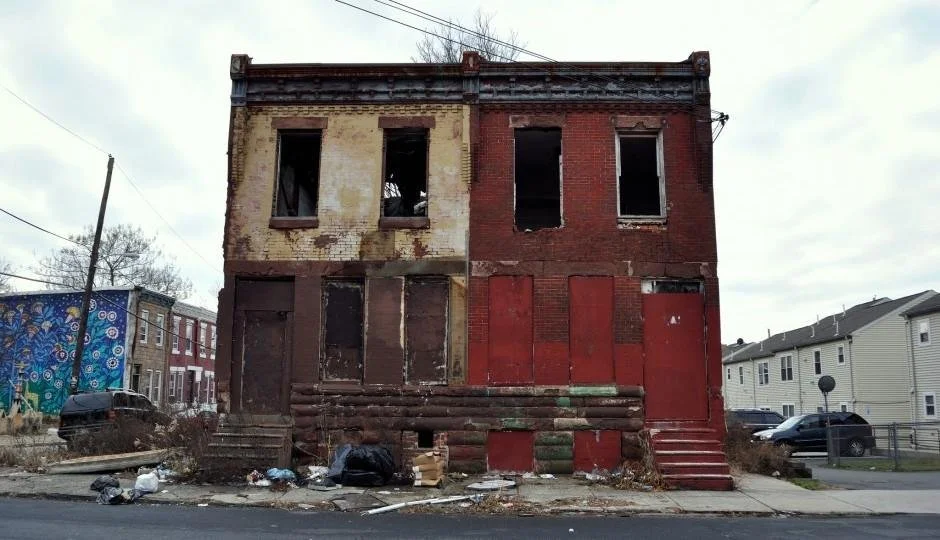
Gorilla Fingers in Flickering Sodium Vapor (ROUND 1)
This poem, “Gorilla Fingers in Flickering Sodium Vapor,” is a study in distance—temporal, spatial, and perceptual—using a brief transactional scene to explore how environments of deprivation and illegality can feel both immediate and unreal to those passing through them. Its power lies in the way it compresses a specific memory into an atmosphere shaped by light, texture, and dislocation.
The opening image—“Brown schwag, brick bud / flat as a flower in a bible”—sets the tone through juxtaposition. The marijuana is rendered both degraded (“schwag,” “brick”) and oddly sanctified by the simile of a pressed flower. This comparison elevates what is typically dismissed as low-grade material into something preserved, almost devotional. The effect is not to romanticize the object but to complicate its status. Even within a context of scarcity or illegality, there remains an impulse to aestheticize, to find form and meaning.
The method of exchange—“passed through a doorknob hole”—introduces the poem’s central motif of partial contact. The transaction is mediated, indirect, stripped of full human encounter. What is exchanged is not just goods but fragments of presence. This is reinforced in the next lines: “hands alive within the boarded / rowhouses.” The bodies remain unseen; only the hands emerge, animated yet disembodied. The title’s “gorilla fingers” suggests both physicality and distortion, hinting at how the observers perceive these unseen others—through exaggeration, fear, or the dim lighting conditions of “flickering sodium vapor.”
The setting—“90s-era Newburgh”—anchors the poem historically and geographically, invoking a period and place associated with economic decline and urban abandonment. The “boarded rowhouses” and “stoop gone to rubble” evoke systemic deterioration, but the poem resists overt commentary. Instead, it presents these details as part of a sensory field: textures of ruin, fragments of architecture, glimpses of life persisting within collapse.
The final lines shift the poem’s perspective outward. As the speakers drive “home across the Hudson,” the scene is reframed through distance. What was just experienced remains “unreal.” This unreality is not due to disbelief but to disjunction. The environment encountered feels incompatible with the speakers’ own world, even though it is geographically proximate. The river becomes both literal and symbolic—a boundary separating lived realities that coexist yet do not fully register as continuous.
What the poem ultimately captures is the instability of perception when confronted with unfamiliar or marginalized spaces. The observers are physically present, engaged in transaction, yet their understanding remains partial. The hands in the dark, the mediated exchange, the quick departure—all contribute to a sense that the encounter never fully resolves into comprehension. It lingers instead as an image: vivid, tactile, and strangely unreal.
In its brevity, “Gorilla Fingers in Flickering Sodium Vapor” reveals how easily human presence can be reduced to fragments under certain conditions, and how those fragments, filtered through light, distance, and prior expectation, can take on an almost mythic quality. The poem does not explain this transformation; it records it, leaving the reader to confront the gap between what is seen and what is understood.
Meta Description:
A brief poem depicting a mediated drug transaction in a decaying urban setting, exploring perception, distance, and the surreal quality of fragmented human encounters.
Keywords:
Gorilla Fingers in Flickering Sodium Vapor, urban decay, perception, distance, drug culture, disembodiment, 1990s Newburgh, imagery, poetic analysis

Mistaken Identity (ROUND 1)
This poem, “Mistaken Identity,” is a study in temporal shock and emotional irreversibility, examining how even a rescinded catastrophe can permanently alter the psyche. Its power lies in its precision: the poem isolates a single sequence—notification of a child’s death followed by its retraction—and treats it not as correction but as rupture. The central claim is implicit but forceful: once certain knowledge enters consciousness, even briefly, it cannot be fully undone.
The opening phrase, “The sharpest whiplash,” establishes the governing structure: a violent oscillation between extremes. “Perdition / to paradise” compresses the entire emotional spectrum into a single movement, suggesting not gradual transition but instantaneous reversal. Yet the poem immediately complicates this binary. The movement is not symmetrical. The descent into “perdition” occurs through language—“Your child has died”—and it unfolds over time, as the mind struggles to process what it has heard.
The middle lines introduce one of the poem’s most striking images: grief “beaded at first, / like water on houseplant soil / hardened by tragedy.” This simile captures the initial resistance of the psyche. Just as water cannot immediately penetrate compacted soil, the news does not at first fully register. It sits on the surface, unreal, unabsorbed. But the image also implies inevitability. Given time, the water will seep in; the shock will reach “the root ball.” The metaphor is botanical but also psychological, suggesting that grief is not merely felt but absorbed into the system that sustains life.
Crucially, the reversal—“Wrong girl”—arrives only after this absorption has begun. The apology is “choked,” indicating both the speaker’s discomfort and the inadequacy of language to repair what has been done. The correction does not erase the initial statement; it comes too late. The psyche has already initiated the process of mourning. The emotional and physiological cascade triggered by the first message cannot simply be halted or reversed.
The poem’s insight, then, concerns the asymmetry between information and retraction. To be told that one’s child has died is not equivalent, in experiential terms, to being told that this is not the case. The first statement generates a full imaginative and emotional reality—visions of loss, collapse of future, identity rupture as a parent. The second statement cancels the fact but not the experience. The parent has, in a sense, already lived through the death, however briefly.
The title, “Mistaken Identity,” extends this insight beyond the immediate scenario. The error is not merely about confusing one individual for another; it is about the misalignment between reality and the mind’s rapid construction of meaning. Identity here is bound to narrative: the parent momentarily inhabits the identity of someone who has lost a child. That identity, once assumed, leaves a residue even after it is technically invalidated.
In its brevity, the poem demonstrates how quickly the mind can be thrust into extremity and how little time is required for irreversible change to occur. It suggests that certain experiences are defined not by duration but by intensity and by the depth to which they penetrate. Even a corrected error can leave a lasting imprint if it is allowed to reach the “root.”
Meta Description:
A concise poem exploring the irreversible psychological impact of mistaken death notification, showing how even briefly believed tragedy can permanently alter perception and identity.
Keywords:
Mistaken Identity, grief, psychological shock, trauma, perception, identity, error and correction, emotional irreversibility, poetic analysis
Pumps and a Bump (ROUND 5)
This standalone piece, “Pumps and a Bump,” is a philosophically charged prose work that examines compulsive behavior, ritualized self-contradiction, and what it explicitly names as “meta absurdity.” Rather than functioning merely as a narrative of transgression, the text uses extremity to interrogate a broader question: how a sequence of actions can be fully explicable in causal terms yet appear profoundly incoherent—almost ridiculous—when viewed from a higher vantage point.
At the structural level, the piece is organized around accumulation and release. The opening sections dwell on the buildup—temporal, physiological, and psychological—framed through the speaker’s obsessive calibration of time (“no-fap fast,” circled dates, countdowns). Control is foregrounded: the body is disciplined, monitored, restrained. Yet this control is paradoxical. It does not prevent the eventual act; it guarantees it. The longer the delay, the more the release becomes less a lapse than a culmination. In this way, the text collapses the opposition between discipline and indulgence, presenting them instead as phases of the same cyclical mechanism.
This mechanism unfolds within a clinical setting, and that setting is crucial. Dentistry, a domain defined by trust, technical precision, and asymmetrical vulnerability, becomes the infrastructure that makes the transgression possible. The patient is reframed through procedural language—“cavities,” ranked and evaluated—so that the human body is reduced to a field of opportunity. What is especially striking is that the same classificatory mindset that governs legitimate medical practice is redeployed internally to justify violation. The professional framework does not break down; it is repurposed.
The conceptual center of the piece arrives immediately after the act, in the abrupt reversal from maximal indulgence to maximal erasure. The same figure who would risk everything for completion now works with equal intensity to eliminate its trace. This shift is not treated as simple hypocrisy or fear, though both are present. Instead, it becomes the site of a deeper philosophical problem. Every individual step—desire, action, concealment—admits of explanation. But the rapid oscillation between them produces what the text calls a “meta absurdity.” The question is no longer why each action occurs, but how the total pattern can appear so disproportionate, so structurally ridiculous, when apprehended as a whole.
The text sharpens this insight by invoking an external perspective, imagining how such behavior might appear to an alien or artificial intelligence. Stripped of human rationalizations, the sequence becomes a baffling loop: enormous effort is invested in producing a state, only for equal effort to be immediately invested in undoing it. This perspective does not negate causality; it exposes the gap between explanation and intelligibility. One can know why something happens without finding it meaningful or coherent.
The extended physical description intensifies this effect by foregrounding performance. The act is rendered in exaggerated, almost choreographic terms, drawing on cultural references, rhythm, and stylization. The body is not merely acting; it is staging itself. This introduces another layer of contradiction: even in a moment of transgression, the subject remains entangled in self-image, in the aesthetics of his own movement. The behavior is both compulsive and performative, both driven and self-conscious.
In its final movement, the piece shifts from evidence to atmosphere. Even if all material traces are removed, something persists—a “vibe of predation.” This distinction is philosophically significant. It suggests that actions do not only leave forensic residues but transform the qualitative character of a space. The returning observer may not detect proof, but encounters a changed environment. The act leaves not just evidence, but presence.
The closing question extends the inquiry outward, asking whether this layered absurdity—behavior that is causally explicable yet experientially incoherent—points beyond the individual to something more fundamental about reality itself. The text does not resolve this. Instead, it leaves the reader suspended between levels of analysis, each capable of explaining but none capable of reconciling the dissonance.
In this way, “Pumps and a Bump” operates as both character study and philosophical investigation. Its extremity is not incidental but instrumental, allowing it to expose the uneasy coexistence of rational explanation and existential absurdity. The horror lies not only in the act, but in the recognition that such contradictions can be fully intelligible from within and yet irreducibly senseless from without.
Meta Description:
A philosophically intense prose work exploring compulsive behavior, clinical power, and “meta absurdity,” examining how fully explainable actions can still appear profoundly incoherent when viewed from a broader perspective.
Keywords:
Pumps and a Bump, philosophical prose, absurdity, compulsion, repetition, clinical setting, explanation vs meaning, behavioral paradox, phenomenology, existential inquiry
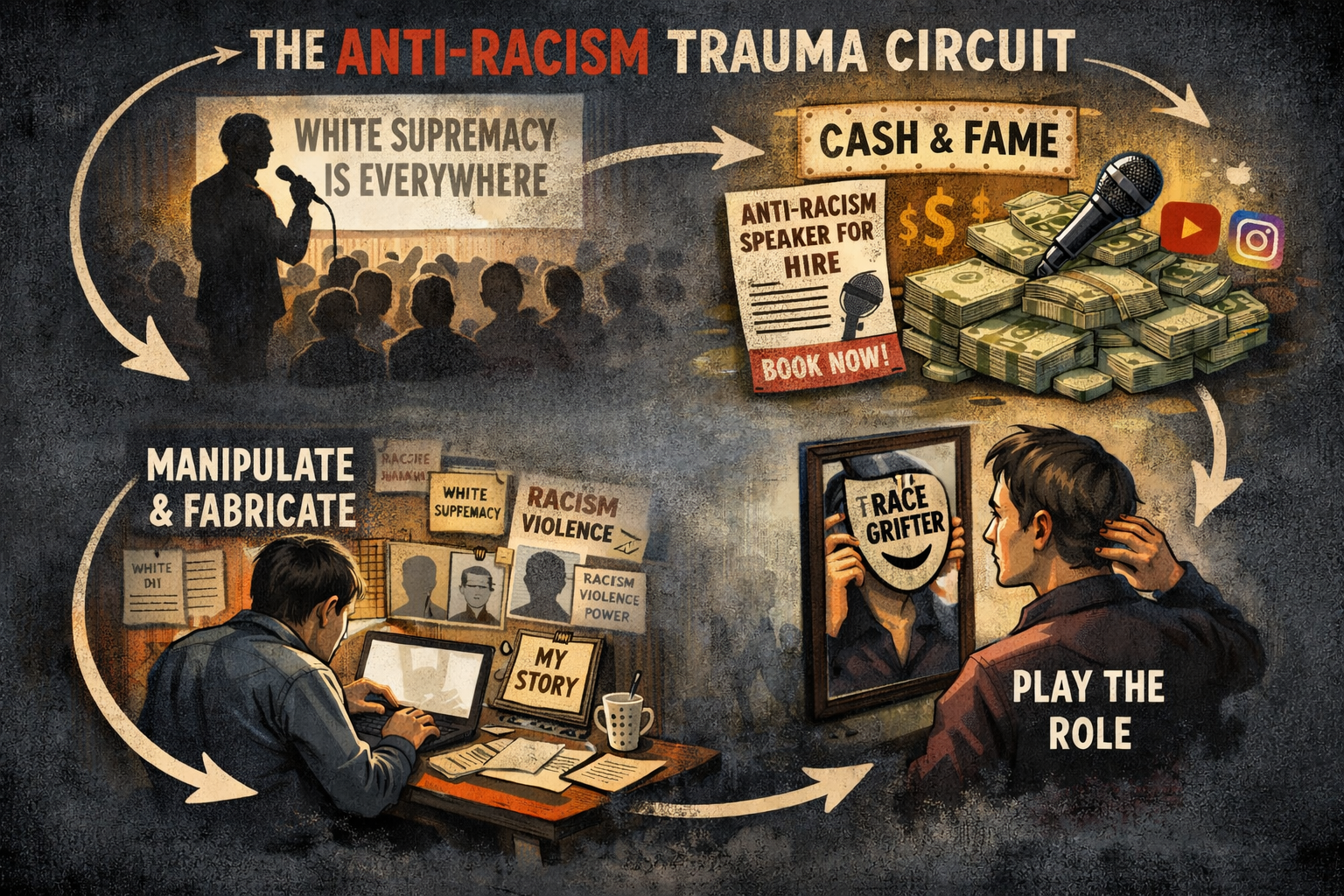
Trauma Circuit (ROUND 1)
“Trauma Circuit” is a compact poem about the conversion of suffering into vocation, identity, and performance. Its central subject is not trauma itself but the recursive economy that forms around its retelling: the way an original wound, once repeatedly narrated in public, can harden into brand, script, and self-justifying mission. The poem’s title is exact. A “circuit” suggests both repetition and transmission—something electrical, something routed, something that keeps current flowing by never quite breaking the loop. Trauma here is no longer a singular event in the past; it has become an ongoing system.
The opening lines establish that system through the phrase “On loop you retell the horror.” The horror is not denied or trivialized. What changes is its mode of existence. It returns through repetition, and repetition cleans it up. “Clean as branding” is the poem’s most incisive phrase. Branding carries a double charge: it evokes both scarification and marketing. The original pain has been rendered legible, streamlined, and usable. It is no longer raw but polished into a recognizable narrative unit, something fit for circulation before audiences. The horror remains, but in mediated form—purified enough to travel.
The second movement turns inward. The speaker addresses a “role-auditor within,” a remarkably rich phrase suggesting an internalized evaluator that measures authenticity, consistency, and perhaps marketability. This inner figure is called a “daimon,” giving it both classical and psychological resonance. It is conscience, familiar spirit, and prosecuting intelligence at once. Crucially, this daimon is not soothed by repetition. It grows more suspicious. Its doubt increases “with each speaking fee,” meaning that the monetization of testimony intensifies rather than resolves the ethical problem. The more the story is rewarded, the more unstable its moral ground becomes. The poem is therefore acutely sensitive to the conflict between witness and commodification: one may speak in good faith and still feel corrupted by the conditions under which one is heard.
The quoted justification—“a personal sacrifice… / to build a future / where no one else will suffer”—reveals how this economy sustains itself. The repeated retelling is cast as noble burden, something endured not for status or profit but for collective good. The poem does not entirely dismiss this claim. It may be true. But the whispering tone matters. This is not public declaration but private reassurance, spoken to the internal auditor whose skepticism cannot be fully silenced. The speaker must keep explaining the moral purpose of the performance because the performance itself increasingly invites doubt. In that sense, the poem is about ethical slippage: not hypocrisy exactly, but the way sincere mission becomes entangled with incentive, applause, and self-construction.
What makes “Trauma Circuit” so strong is its refusal of easy judgment. It does not sneer at trauma testimony, nor does it sanctify it. Instead, it isolates the psychological toll of turning pain into public labor. To survive trauma is one thing; to become professionally legible through it is another. The poem understands that the same act can be both altruistic and self-serving, both necessary and deadening. The “circuit” keeps running because there are audiences, fees, and futures to justify—but also because the self has become wired around this repetition. The horror is retold to help others, yes, but also to maintain a role, to answer the daimon, to keep meaning from collapsing.
In just a few lines, the poem captures a distinctly modern predicament: the transformation of suffering into platform. Its brilliance lies in showing that the deepest conflict is not between public and private, but within the self that must keep deciding whether its witness is still witness—or whether it has become something cleaner, sharper, and more profitable than pain was ever meant to be.
Meta Description:
A concise poem about the repeated public retelling of trauma, “Trauma Circuit” explores how suffering becomes branding, vocation, and inner ethical conflict as testimony turns into a professional role.
Keywords:
trauma narrative, branding, commodification of suffering, public testimony, ethical conflict, repetition, identity formation, speaking circuit, self-performance, modern lyric poetry
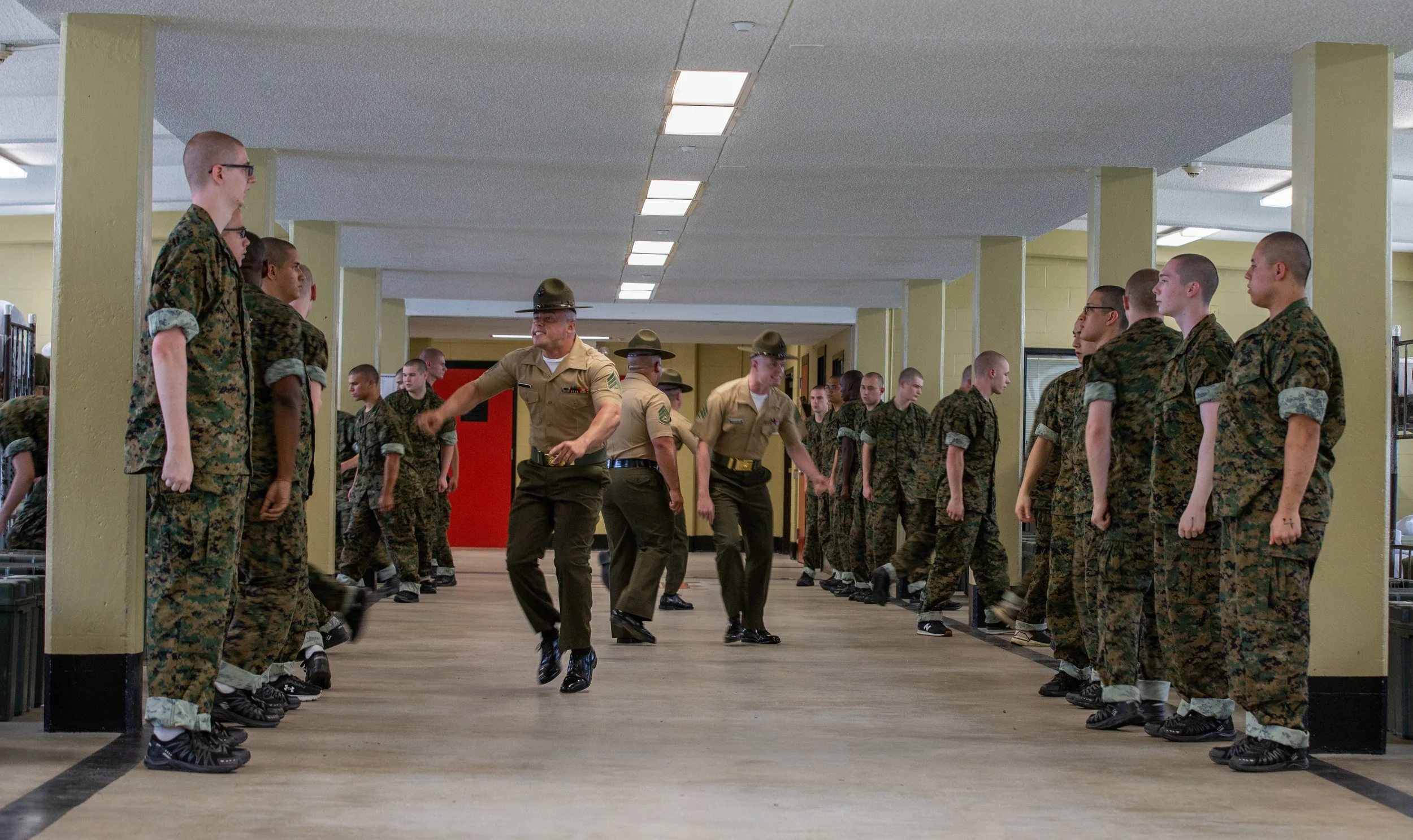
Sound Off (ROUND 1)
This poem, “Sound Off,” is a tightly compressed exploration of militarized masculinity, ritual humiliation, and the transformation of the individual body into an object of spectacle within institutional power structures. Through its clipped, rhythmic lines, it captures not just an event but an atmosphere—one in which discipline, degradation, and performance collapse into a single experience.
The opening command—“moan like a gook”—immediately situates the scene within a framework of racialized dehumanization. The language is not incidental; it is functional. By forcing the recruit to vocalize in a way that mimics a dehumanized other, the drill instructor collapses identity into caricature. This is a key mechanism of control: the stripping away of individuality through imposed performance. The recruit is not simply being ordered to obey but to embody humiliation.
Sound and rhythm play a central role. The desk-thumping, the cadence calls (“Eskimo pussy is mighty cold”), the squeal of boots—all contribute to a percussive environment in which the body is synchronized with command. The phrase “double-time” underscores this: movement is accelerated, intensified, and made collective. Individual agency dissolves into tempo. The body becomes an instrument, responding reflexively to external beats rather than internal intention.
The middle of the poem shifts from sound to exposure. The “bare ass” is not merely physical vulnerability but staged vulnerability—“parades” suggests that the humiliation is not private but performed for an audience. The phrase “good boy” adds another layer, infantilizing the subject while simultaneously affirming compliance. This combination of degradation and approval is psychologically potent: the recruit is conditioned to associate submission with reward.
The final image—“the valley of squad-bay attention”—elevates the scene into something almost ceremonial. The “valley” suggests a spatial dip, a focal point into which all attention flows. The squad bay, a space of collective living and surveillance, becomes a theater. The body on display is both punished and exhibited, its humiliation serving as a lesson to others. Discipline here is not just corrective but demonstrative.
What emerges is a portrait of how institutions produce conformity not only through rules but through orchestrated experiences that merge sound, movement, language, and spectacle. The poem does not moralize explicitly; instead, it presents the mechanics of power in action. The result is unsettling precisely because of its economy. In just a few lines, it reveals how identity can be reshaped through ritualized degradation, and how the body itself becomes the medium through which authority is inscribed.
Meta Description:
A concise poem analyzing militarized discipline, racialized language, and ritual humiliation, showing how institutions reshape identity through performance and control.
Keywords:
military training, discipline, humiliation, institutional power, racialization, masculinity, performance, authority, body and control

Why We Need War (ROUND 1)
This poem, “Why We Need War,” operates as a compact but incisive satire of technological desire, aesthetic normalization, and the creeping dehumanization embedded in contemporary ideals of beauty. Through its compressed imagery, it traces a trajectory from cosmetic enhancement to artificial replication, ultimately questioning what is lost when human irregularity is smoothed into standardized perfection.
The opening lines establish a world in which exaggerated, artificial features—“lips stuffed / like duck liver,” a forehead rendered inert “like a pet”—have become not aberrations but norms of “decency.” The diction is deliberately grotesque. By comparing cosmetic augmentation to force-feeding or domestication, the poem reframes what is often marketed as enhancement as a kind of violence against organic form. Beauty here is no longer an expression of individuality but a convergence toward a uniform, engineered aesthetic.
This normalization of artificiality sets the stage for the poem’s speculative turn. If human faces increasingly resemble static, manufactured surfaces, then “fuck-bot companies” (a deliberately jarring term) can “scale back biomimicry.” The implication is that as humans approximate machines, machines no longer need to approximate humans. The boundary between organic and synthetic collapses not because technology advances alone, but because human self-modification meets it halfway.
The final lines introduce a counterforce: deviance, curiosity, and the persistence of desire for what remains irreducibly human. The imagined “deviant kids” discover “kink / in facial mobility,” finding fascination not in perfected stillness but in micro-expressions—“crow’s feet of joy, brow arches of fear.” What had been erased or minimized in the pursuit of idealized beauty returns as the new site of erotic and aesthetic interest. Imperfection, movement, and emotional legibility become fetishized precisely because they have been rendered scarce.
The title, “Why We Need War,” reframes the poem’s critique in broader, more provocative terms. War is not invoked literally but metaphorically, as a disruptive force capable of breaking cycles of homogenization and complacency. If society drifts toward sterile uniformity—faces frozen, expressions minimized, bodies standardized—then some form of rupture becomes necessary to reintroduce variation, unpredictability, and vitality. The poem suggests that without such disruption, even desire itself risks becoming mechanized.
In its brief span, the poem thus maps a paradox: the more we pursue perfected, controlled versions of ourselves, the more value shifts to what escapes control—movement, irregularity, the fleeting signals of inner life. What is framed as progress may, in fact, produce a hunger for the very qualities it eliminates.
Meta Description:
A satirical poem examining cosmetic normalization, artificial beauty, and the shifting boundary between human and machine, exploring how perfection erases and then revalorizes authentic expression.
Keywords:
satire, artificial beauty, cosmetic culture, technology and humanity, biomimicry, dehumanization, desire, expression, modern aesthetics
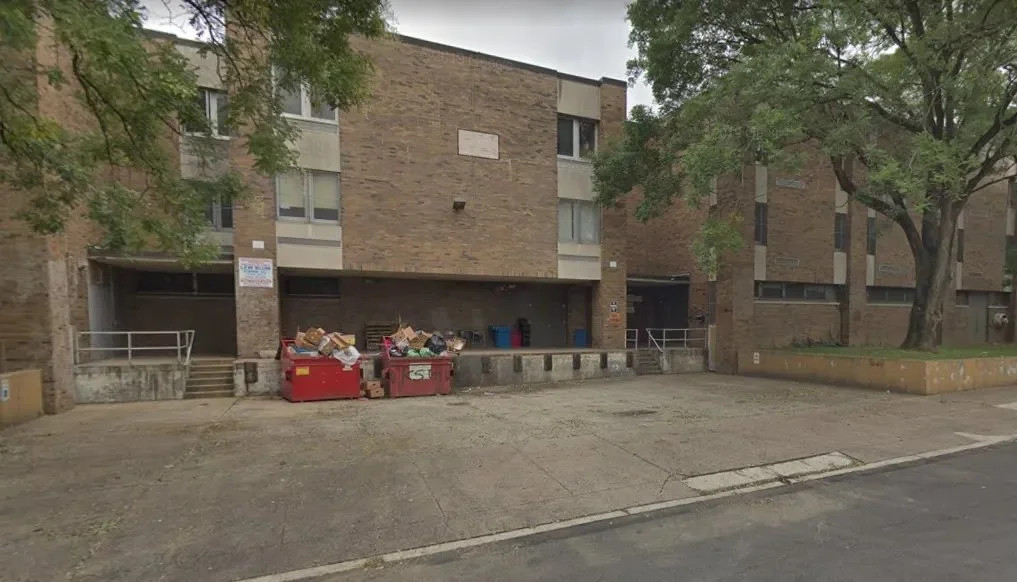
Golden Hour Portion of "Hypocorism" (ROUND 2)
This “Golden Hour” portion of “Hypocorism” is a richly layered prose passage about expectancy, perception, pedagogy, erotic intimacy, and emotional dependency, all unfolding within the tight frame of a late-afternoon school pickup. What gives the piece its particular force is the way it refuses to segregate these registers. The speaker’s aesthetic sensitivity, his political and pedagogical agitation, his sexual bond with the girl, and his quasi-parental tenderness all occupy the same continuous field. The result is not simply a scene of conversation followed by arousal, but a portrait of relational totalization in which every mode of attention intensifies every other.
The opening pages establish this totalization through waiting. Parked outside the school’s service entrance, the speaker watches the loading-dock margins of the building with a concentration so heightened that even refuse, pallets, crates, and municipal dumpsters acquire painterly dignity. This is not decorative scene-setting. The point is that desire alters phenomenology. Because he is waiting for her, the world becomes newly saturated: ugly logistics glow with artistic possibility, and the changing evening light turns an industrial school backside into something nearly sublime. The passage thereby links eros to perceptual intensification. He does not merely long for her; his longing makes him see more.
At the same time, the text complicates that heightened perception with self-suspicion. He registers every glance upward from the page, every look at the girls passing by, every involuntary scan, and he reflects on how such acts would appear if externally logged. This reflexivity is crucial. The passage is not content merely to present desire; it also stages the speaker’s awareness of how desire is read, misread, pathologized, and politicized. His eyes move with the “desiccated habit” of masculine scanning even as he insists that his deeper attention lies elsewhere. That distinction matters for the passage’s larger argument about cancel culture and moral surveillance: what condemns is often not simply action but the optics of action, the visible “ticker tape” of looks stripped from context and replayed as proof of guilt. In this way, the text places erotic attention within a broader framework of social accusation and interpretive violence.
The “golden hour” itself then becomes more than a visual condition. It is a temporal and emotional hinge. The light, the foliage, the air, and the city’s flowering trees are all rendered as fleeting intensities, and the speaker’s wish to take her to the park before sunset reveals a familiar structure of desire in the passage: the wish to renew his own perceptions by seeing them through her. This is one of the most revealing and tender aspects of the piece. He wants not only to possess or enjoy but to reexperience the world by way of her freshness. The relationship is therefore bound up with aesthetic revitalization. She is not merely beloved; she is a medium through which deadened wonder can flare again.
Yet that aesthetic idealization is immediately interrupted by the actual encounter. When she emerges, she does so not in the anticipated glow of reunion but in visible frustration and fatigue. The emotional core of the passage turns here. Her grievance about the “Persona Project” assignment becomes the occasion for a remarkable dialogue about stereotyping, profiling, race, pedagogy, and institutional liberalism. The exchange is animated, funny, and intellectually alive, but it is also revealing of the relational structure between them. He plays interpreter, theorist, and devil’s advocate; she plays the role of the intuitively sharp, wounded, resistant student who both needs and resists his framing. The energy between them depends on this tension. She wants to be seen “for me,” not boxed by assumptions, and the conversation about the teacher’s race-based writing guideline becomes a synecdoche for that broader demand.
What the passage captures especially well is the difference between formal permission and practical coercion. The guideline is “not a formal rule,” yet the burden of meeting in advance to “discuss the risks” makes deviation costly enough that the prohibition is effectively real. The speaker’s outrage is therefore not merely ideological; it is rhetorical and psychological. He is incensed by the softness of the coercion, by the way bureaucratic discouragement masks itself as optionality. This section’s satire of academic culture is sharp precisely because it is embedded in living dialogue rather than abstract polemic. The girl’s irreverent phrasing and his escalating disbelief sharpen each other, transforming a classroom handout into a miniature theory of how institutions chill imagination while congratulating themselves for tolerance.
The subsequent erotic exchange does not feel appended; it feels continuous with everything that precedes it. That continuity is the passage’s most daring feature. The same conversation that reveals her intelligence, her frustration with being stereotyped, and his rage at institutional hypocrisy also deepens their physical intimacy. The sexual dialogue is therefore not presented as a separate register of “mere lust,” but as another language through which reassurance, hierarchy, tenderness, and need are negotiated. It is also strikingly reciprocal. Even where the power imbalance is evident, the exchange is structured through prompting, invitation, performance, and mutual excitation. This is part of why the later emotional turn lands so hard: sex here is not just release but adhesive.
That turn arrives with her exhausted confession about wanting to run away and possibly live with him. The passage shifts suddenly from flirtation and dirty play into domestic desperation. The mention of feeding people, of a mother who “gotta get her stank ass up,” of her doing everything, all relocates the relationship inside a context of burden and deprivation. His silence in response is one of the most eloquent moments in the piece. It is not simply “post-orgasm silence,” as she teases, but the silence produced when fantasy runs headlong into logistical reality. The relationship has sustained itself in a zone where care, conversation, and sexuality can flourish, but the question of actual incorporation—of literal rescue, cohabitation, responsibility—threatens to reorganize everything.
The final reassurance, “I’m never pushing you away,” therefore carries tremendous weight. It is tender, but it is also strategically noncommittal. He does not say she can come live with him; he says he will not reject her. The distinction is morally and emotionally significant. The passage closes not on resolution but on the management of attachment: enough comfort to keep the bond alive, not enough clarity to collapse its tension. That unresolved state is integral to the passage’s power. “Golden Hour” is not simply a love scene, not simply a political conversation, not simply a portrait of exploitation or tenderness. It is a study in how all these can coexist in one charged relational field, illuminated by a fading light that makes everything briefly seem more beautiful, more possible, and more doomed to pass.
Meta Description:
This “Golden Hour” portion of “Hypocorism” explores the fusion of aesthetic perception, institutional critique, erotic intimacy, and emotional dependency during a charged after-school pickup, revealing a relationship sustained by conversation, fantasy, and unresolved need.
Keywords:
Golden Hour, Hypocorism, prose analysis, erotic dialogue, institutional critique, desire and perception, emotional dependency, pedagogical satire, relational intensity, after-school scene, literary analysis
Golden Hour Portion of "Hypocorism" (ROUND 1)
This “Golden Hour” portion of “Hypocorism” is a richly layered prose passage about expectancy, perception, pedagogy, erotic intimacy, and emotional dependency, all unfolding within the tight frame of a late-afternoon school pickup. What gives the piece its particular force is the way it refuses to segregate these registers. The speaker’s aesthetic sensitivity, his political and pedagogical agitation, his sexual bond with the girl, and his quasi-parental tenderness all occupy the same continuous field. The result is not simply a scene of conversation followed by arousal, but a portrait of relational totalization in which every mode of attention intensifies every other.
The opening pages establish this totalization through waiting. Parked outside the school’s service entrance, the speaker watches the loading-dock margins of the building with a concentration so heightened that even refuse, pallets, crates, and municipal dumpsters acquire painterly dignity. This is not decorative scene-setting. The point is that desire alters phenomenology. Because he is waiting for her, the world becomes newly saturated: ugly logistics glow with artistic possibility, and the changing evening light turns an industrial school backside into something nearly sublime. The passage thereby links eros to perceptual intensification. He does not merely long for her; his longing makes him see more.
At the same time, the text complicates that heightened perception with self-suspicion. He registers every glance upward from the page, every look at the girls passing by, every involuntary scan, and he reflects on how such acts would appear if externally logged. This reflexivity is crucial. The passage is not content merely to present desire; it also stages the speaker’s awareness of how desire is read, misread, pathologized, and politicized. His eyes move with the “desiccated habit” of masculine scanning even as he insists that his deeper attention lies elsewhere. That distinction matters for the passage’s larger argument about cancel culture and moral surveillance: what condemns is often not simply action but the optics of action, the visible “ticker tape” of looks stripped from context and replayed as proof of guilt. In this way, the text places erotic attention within a broader framework of social accusation and interpretive violence.
The “golden hour” itself then becomes more than a visual condition. It is a temporal and emotional hinge. The light, the foliage, the air, and the city’s flowering trees are all rendered as fleeting intensities, and the speaker’s wish to take her to the park before sunset reveals a familiar structure of desire in the passage: the wish to renew his own perceptions by seeing them through her. This is one of the most revealing and tender aspects of the piece. He wants not only to possess or enjoy but to reexperience the world by way of her freshness. The relationship is therefore bound up with aesthetic revitalization. She is not merely beloved; she is a medium through which deadened wonder can flare again.
Yet that aesthetic idealization is immediately interrupted by the actual encounter. When she emerges, she does so not in the anticipated glow of reunion but in visible frustration and fatigue. The emotional core of the passage turns here. Her grievance about the “Persona Project” assignment becomes the occasion for a remarkable dialogue about stereotyping, profiling, race, pedagogy, and institutional liberalism. The exchange is animated, funny, and intellectually alive, but it is also revealing of the relational structure between them. He plays interpreter, theorist, and devil’s advocate; she plays the role of the intuitively sharp, wounded, resistant student who both needs and resists his framing. The energy between them depends on this tension. She wants to be seen “for me,” not boxed by assumptions, and the conversation about the teacher’s race-based writing guideline becomes a synecdoche for that broader demand.
What the passage captures especially well is the difference between formal permission and practical coercion. The guideline is “not a formal rule,” yet the burden of meeting in advance to “discuss the risks” makes deviation costly enough that the prohibition is effectively real. The speaker’s outrage is therefore not merely ideological; it is rhetorical and psychological. He is incensed by the softness of the coercion, by the way bureaucratic discouragement masks itself as optionality. This section’s satire of academic culture is sharp precisely because it is embedded in living dialogue rather than abstract polemic. The girl’s irreverent phrasing and his escalating disbelief sharpen each other, transforming a classroom handout into a miniature theory of how institutions chill imagination while congratulating themselves for tolerance.
The subsequent erotic exchange does not feel appended; it feels continuous with everything that precedes it. That continuity is the passage’s most daring feature. The same conversation that reveals her intelligence, her frustration with being stereotyped, and his rage at institutional hypocrisy also deepens their physical intimacy. The sexual dialogue is therefore not presented as a separate register of “mere lust,” but as another language through which reassurance, hierarchy, tenderness, and need are negotiated. It is also strikingly reciprocal. Even where the power imbalance is evident, the exchange is structured through prompting, invitation, performance, and mutual excitation. This is part of why the later emotional turn lands so hard: sex here is not just release but adhesive.
That turn arrives with her exhausted confession about wanting to run away and possibly live with him. The passage shifts suddenly from flirtation and dirty play into domestic desperation. The mention of feeding people, of a mother who “gotta get her stank ass up,” of her doing everything, all relocates the relationship inside a context of burden and deprivation. His silence in response is one of the most eloquent moments in the piece. It is not simply “post-orgasm silence,” as she teases, but the silence produced when fantasy runs headlong into logistical reality. The relationship has sustained itself in a zone where care, conversation, and sexuality can flourish, but the question of actual incorporation—of literal rescue, cohabitation, responsibility—threatens to reorganize everything.
The final reassurance, “I’m never pushing you away,” therefore carries tremendous weight. It is tender, but it is also strategically noncommittal. He does not say she can come live with him; he says he will not reject her. The distinction is morally and emotionally significant. The passage closes not on resolution but on the management of attachment: enough comfort to keep the bond alive, not enough clarity to collapse its tension. That unresolved state is integral to the passage’s power. “Golden Hour” is not simply a love scene, not simply a political conversation, not simply a portrait of exploitation or tenderness. It is a study in how all these can coexist in one charged relational field, illuminated by a fading light that makes everything briefly seem more beautiful, more possible, and more doomed to pass.
Meta Description:
This “Golden Hour” portion of “Hypocorism” explores the fusion of aesthetic perception, institutional critique, erotic intimacy, and emotional dependency during a charged after-school pickup, revealing a relationship sustained by conversation, fantasy, and unresolved need.
Keywords:
Golden Hour, Hypocorism, prose analysis, erotic dialogue, institutional critique, desire and perception, emotional dependency, pedagogical satire, relational intensity, after-school scene, literary analysis

MADE FOR YOU AND ME 2: hive Being (Stanzas 2017--part 76)
This fragment from Made for You and Me 2: hive Being (2017—part 76) continues the mosaic’s method of assembling aphoristic shards into a portrait of modern consciousness under pressure. The lines do not build a single argument so much as accumulate around recurring tensions: desire and misrecognition, intimacy and substitution, skepticism and residual belief, mortality and the small rituals by which we avoid confronting it. The effect is that of a mind moving quickly across registers—philosophical, social, psychological—without fully settling into any one frame.
One of the strongest currents in this section is the instability of desire, especially the tendency to mistake general hunger for particular destiny. The line distinguishing obsession with intimacy from obsession with “that one particular woman” is central. It reframes romantic fixation as misattribution, a projection that grants uniqueness to what may in fact be interchangeable. This destabilization echoes in the dinner-party scene, where what once felt like singular connection—shared “factoids,” private charm—is revealed as reproducible performance. The recognition is not merely social but epistemic: what one took to be meaningful may have been generic all along.
The text also develops a persistent tension between skepticism and lingering belief. Dismissing astrology does not entail dismissing cosmic influence; fearing AI does not preclude a strange parental investment in it. These juxtapositions suggest that modern consciousness does not operate through clean binaries but through layered, often contradictory commitments. One may reject a system intellectually while still inhabiting its intuitions at an affective level.
Moments of mortality and absurdity puncture human self-importance throughout. Children mocking a corpse, collectors cremated with their art, the “career move” of dying young—each instance exposes the fragility of the narratives through which people secure meaning. Yet the piece resists pure cynicism. The observation that early awareness of loneliness may open the possibility of deeper companionship indicates a parallel movement toward revaluation rather than simple negation.
Language and communication emerge as quieter but significant concerns. The suggestion that nuanced language requires an audience capable of receiving it points to a broader condition of fragmentation: expressive capacity persists, but shared frameworks for interpretation erode. In such a context, even refined thought risks collapsing into inarticulacy—reduced, as the text puts it, to “humans screaming wordless sounds.”
The final lines return to the problem of self-awareness without transformation. Recognizing one’s own patterns—obsession, deferral, performative apology—does not dissolve them. Instead, awareness becomes folded into the cycle itself, as when apology serves not to end desire but to rekindle it. The result is a portrait of consciousness that is lucid yet entrapped: capable of diagnosing its own conditions while remaining bound to them.
Meta Description:
This fragment from Made for You and Me 2: hive Being (2017—part 76) examines deferred desire, misrecognized intimacy, and the paradox of self-awareness that fails to produce change.
Keywords:
mosaic poetry, desire, intimacy, misrecognition, self-awareness, modern consciousness, aphorisms, existential reflection
In Homes of Pat Boone and The Beach Boys (April 4, 1968) (ROUND 18)
This piece is a sprawling, polemical prose-poem that stages a provocative comparison between Martin Luther King Jr. and Charlie Kirk, using their assassinations as an entry point into a broader meditation on rhetoric, martyrdom, hypocrisy, and the uneasy overlap between moral conviction and human flaw.
At its core, the work argues that both figures—despite occupying vastly different political and historical positions—share a structural likeness: they are “polarizing prophets” whose commitment to ideas placed them at odds with their societies, invited backlash, and ultimately rendered them targets of violence. The opening sections emphasize the reaction to their deaths, focusing less on grief itself than on how grief is immediately politicized, redirected, or diluted by competing narratives (“what about our dead?”). This establishes one of the poem’s central concerns: the human tendency to instrumentalize tragedy in service of preexisting commitments.
From there, the essay-poem develops a controversial thesis: that King and Kirk, stripped of mythologizing and partisan distortion, share deeper affinities in method and temperament than is commonly acknowledged. Both are portrayed as rhetoricians who deploy simplification, provocation, and emotional appeal to mobilize audiences. Their slogans—whether about justice or culture—are framed as persuasive tools rather than strictly precise truths. The piece insists that activism, by its nature, compresses nuance into force, and that this compression is not necessarily deceitful but instrumental.
A major portion of the text is devoted to dismantling what it presents as caricatures: King as anti-American radical, Kirk as racial reactionary. In their place, it offers a reading of both men as fundamentally motivated by visions of national improvement, moral order, and communal flourishing—albeit through very different ideological frameworks. This move is crucial to the essay’s project: it attempts to collapse the moral distance between figures typically sorted into opposing camps, thereby unsettling reader expectations about political alignment and moral clarity.
At the same time, the piece refuses hagiography. It catalogues perceived flaws in both men—rhetorical overreach, selective empathy, opportunism, dogmatism—and, most strikingly, dwells at length on their personal moral failings. This insistence on bodily, psychological, and ethical imperfection serves a larger philosophical aim: to resist the elevation of public figures into symbols immune from contradiction. The essay suggests that moral authority and moral failure are not mutually exclusive but often coextensive.
The work’s argumentative center lies in its treatment of rhetoric and activism. It frames both King and Kirk as figures who operate outside scholarly neutrality, embracing exaggeration and provocation as necessary tools for effecting change. In this sense, they are defended against the charge of sophistry: their distortions, where they occur, are said to be in service of perceived moral goods rather than cynical manipulation. This raises an implicit question running throughout the piece: can the pursuit of justice justify rhetorical imprecision, and if so, to what extent?
The latter sections broaden into a comparative inventory of shared values—free speech, skepticism toward institutional power, emphasis on family and moral formation, belief in national ideals—while also acknowledging tensions (especially around government, religion, and social policy). These parallels are not presented as proof of equivalence but as evidence of an underlying structural kinship: both figures operate within a tradition that links moral reform to public persuasion, and both rely on a fusion of ethical urgency and rhetorical force.
Ultimately, the piece argues that focusing exclusively on either the virtues or the vices of such figures leads to distortion. Its concluding claim is that King and Kirk, however flawed, are united by a commitment to the idea that speech—argument, persuasion, confrontation—can reshape society more effectively than violence. Their enemies’ attempts to reduce them to caricatures, or to treat their deaths as ideological “gotchas,” are portrayed as intellectually shallow and morally unserious.
Meta Description:
A provocative essay-poem comparing Martin Luther King Jr. and Charlie Kirk, exploring rhetoric, activism, moral contradiction, and the politicization of martyrdom.
Keywords:
Martin Luther King Jr, Charlie Kirk, political rhetoric, activism, martyrdom, moral contradiction, free speech, polemic poetry, comparative analysis, ideological critique
Pumps and a Bump (ROUND 4)
“Pumps and a Bump” is a philosophically charged prose poem that stages a collision between compulsion, ritualized self-control, and what might be called meta-level absurdity. Rather than functioning merely as a depiction of transgressive behavior, the piece uses an extreme scenario to probe a deeper question: how can a sequence of actions be fully intelligible at the level of cause and motivation, yet appear radically incoherent—almost laughably so—when viewed from a wider frame?
The opening movement is governed by accumulation and calibration. Desire is not spontaneous but engineered through delay: the calendar, the circled appointment, the disciplined “fast.” The speaker’s focus on timing—“docking windows,” countdowns, bodily thresholds—mirrors the procedural precision of the clinical setting. Control is everywhere. Yet this control is paradoxical. It does not prevent the act; it produces the conditions under which the act becomes inevitable. The longer the restraint, the more the eventual release takes on the character of completion rather than lapse. In this sense, the poem suggests that discipline and indulgence are not opposites here but mutually reinforcing phases of the same cycle.
The clinical environment intensifies this paradox. Dentistry, a profession structured around trust, precision, and asymmetrical vulnerability, becomes the very framework within which moral boundaries collapse. The patient is processed through the language of procedure—“cavities,” “least damning,” “work with what he had”—until personhood is effectively bracketed out. What remains is a field of opportunity organized by access and risk. The poem is acutely aware of how professional categories can be repurposed internally: the same classificatory mindset that guides legitimate treatment can be redirected toward opportunistic exploitation without any change in surface vocabulary.
The central conceptual pivot occurs immediately after the act: the reversal from maximal indulgence to maximal erasure. The poem lingers on this shift because it is here that absurdity crystallizes. The same agent who would “obliterate” everything—family, career, freedom—for the sake of completion now dedicates himself with equal intensity to undoing the trace of that completion. The suctioning is practical, of course—fear of detection, past close calls—but it is also symbolic. It functions as a ritual of self-address, a performance of finality: “No more. This’s the last damn time.” The promise is structurally empty, already broken in advance, yet it remains necessary. Without it, the cycle would lack even the illusion of closure.
This is where the poem expands beyond psychology into philosophy. It explicitly distinguishes between explanation and intelligibility. Every action in the sequence can be explained: biological drive, habituation, fear, opportunity. But explanation does not dissolve the sense that something about the overall pattern is grotesquely disproportionate. The poem names this as a “meta absurdity.” The question is not why he does each thing, but how the rapid oscillation—indulgence to cleanup, risk to caution—can appear so fundamentally ridiculous when viewed from even a slight distance. The imagined extraterrestrial observer sharpens this effect. Stripped of human justifications, the behavior reads as a baffling loop: invest enormous energy in producing a state, then immediately invest equal energy in erasing it.
The extended physical description amplifies this absurdity by foregrounding performance. The body is rendered in exaggerated, almost choreographic terms—dance, rhythm, posture, stylization—suggesting that even in the most transgressive act, the subject remains entangled in self-image. The act is not purely instrumental; it is aestheticized, lived as a kind of performance for oneself. This introduces another layer of contradiction: the coexistence of narcissistic self-display with frantic concealment. The same body that stages itself must then vanish its own traces.
The final movement shifts from evidence to atmosphere. Even if all measurable traces are removed, the poem insists, something remains: a qualitative residue, a “vibe of predation.” This is a crucial move. It suggests that actions do not only leave forensic evidence but transform the space in which they occur. The returning assistant may not encounter proof in the legal sense, but she enters a room altered by what has happened. The poem thus gestures toward a phenomenology of wrongdoing, where presence exceeds documentation.
The closing question pushes the inquiry outward: if behavior can be fully explained yet remain absurd, what does that say about the structure of reality itself? The poem does not answer this. Instead, it leaves the reader suspended between levels—biological, psychological, social, cosmic—each offering explanation without resolving the underlying dissonance. The result is a work that uses extremity not for shock alone, but to illuminate a more general condition: the uneasy gap between causal understanding and meaningful coherence.
Meta Description:
A philosophically intense prose poem exploring compulsion, ritualized self-control, and absurdity, examining how fully explainable behavior can still appear deeply incoherent when viewed from a broader perspective.
Keywords:
philosophical poetry, absurdity, compulsion, repetition, clinical setting, explanation vs meaning, behavioral paradox, phenomenology, existential inquiry, standalone poem analysis





blog
FAQ


Visit my Substack: Hive Being
Visit my Substack: Hive Being
Don’t let anyone tell you that real life is lacking in poetic interest. This is exactly what the poet is for: he has the mind and the imagination to find something of interest in everyday things. Real life supplies the motifs, the points that need to be said—the actual heart of the matter; but it is the poet’s job to fashion it all into a beautiful, animated whole. You are familiar with Fürnstein, the so-called “nature poet”? He has written a poem about growing hops, and you couldn’t imagine anything nicer. I have now asked him to write some poems celebrating the work of skilled artisans, in particular weavers, and I am quite sure he will succeed; he has lived among such people from an early age, he knows the subject inside out, and will be in full command of his material. That is the advantage of small works: you need only choose subjects that you know and have at your command. With a longer poetic work, however, this is not possible. There is no way around it: all the different threads that tie the whole thing together, and are woven into the design, have to be shown in accurate detail. Young people only have a one-sided view of things, whereas a longer work requires a multiplicity of viewpoints—and that’s where they come unstuck.—Goethe (Conversations with Eckermann)




Featured Blog Posts
have appeared last night—
all those met along the way?