Fallen Few (ROUND 1)
scent of the day: Interlude Man, by Amouage
Interlude Man is, at root, a shisha-hookah leather fragrance like the much more roughewn and stunning Castore Rouge—only Interlude man goes herbal green over a synthetic-generic castoreum and synthetic-western oud (whose edginess is made pc and safe and slightly annoying by amberwoods) whereas Castore Rouge goes berry-red over the real pelty-oil castoreum and real diesel raspberry and cheese rind Vietnamese oud (whose skankines sis boosted by pescatarian-manure black ambergris).
It was easy early in my journey to miss the leather beneath all the smoke and greenery and pizza pizzazz. But that is what this scent is—indeed, a leather nearly as rugged and oily as something like Cuioum (but tilted more green in a Bandit direction). In another house’s hands, this scent might have resolved into something broadly familiar: incense, balsams, dark woods, leather, and a dignified sweetness. What prevents it from becoming generic is the deliberate sabotage of that familiarity: a chaos of herbs and spices—pimento berry, turmeric, allspice, and above all oregano (various things that made me not see the leather at first. It seems like all of these are cast into a flame. The smoke that results is not smooth and orderly but jagged, green, and volatile. The result is a fragrance that feels less like a devotional burning of incense than a ceremony with teeth, where the air is thick with ritual and menace at once.
The opening behaves like aromatic disorder made intentional. Citrus is present, but not as clean lemon or lime; it reads more as overripe orange pushed through hot spice, briefly luminous before the herbal smoke closes in. Oregano acts as the signature disruption. Bitter-green, slightly medicinal, and unmistakably specific—the oregano sets the theme and keeps the composition from collapsing into the anonymous category of resinous Arabic smokiness. Even as it recedes from center stage, it remains faintly in the weave, guiding the scent’s direction and maintaining its identity. At times that oregano can take on an odd, almost raspberry-like sweetness (something like what I get in Ombre Leather and Tuscan Leather and even Terroni). I get that uncanny berry sweetness (a sweetness that in my early days churned my stomach) I guess from the oregano refracting through the sweet resinous base. Even though this is masculine, the sweetness—a solid connection with Interlude Woman (albeit not explicitly kiwi candy as it is there)—makes this much easier for a typical woamn to wear than the dry Epic Man—a scent I now realize I do prefer.
Beneath the turbulence lies the fragrance’s true platform: a creamy-sweet and yet nearly diesel-smelling leather—this a function of labdanum, opoponax, and a faux oud. This baseline persists through much of the wear. Rather than reading as sugary, it behaves like balsamic sweetness—thick, textured, and slightly animal. The sweet support the smoke the way velvet supports a ceremonial robe. This is what gives Interlude what Ramsay calls its “opium den” atmosphere: burning sandalwood, dried rosemary and thyme, and resinous frankincense wafting as if they were incense in a liturgical rite meant not to soothe but to summon. The smoke is layered rather than linear, shifting between ember-glow and charred bitterness, between sanctuary and sabotage.
As the top spices and aromatics soften, the darker architecture becomes increasingly legible. A dark amber and hazy campfire impression grows; frankincense turns more resinous than churchlike; myrrh feels sweet and balsamic rather than explicitly religious. The smoky herbs gradually give way to smoky woods—bark, sticks, pencil-shavings dryness—like something being waved through the air to clear spirits, or perhaps to welcome them. Through this phase, the perfume’s real identity reveals itself with increasing clarity: this is a leather scent as much as an incense scent, a leather-incense hybrid where the hide is never truly hidden, only masked by spectacle.
About an hour in, the leather can surface with startling realism—smoky, creamy, and strangely industrial, like diesel leather stained with fuel. This is not a polite suede. It is hard-wearing, lived-in, and almost mechanical in its grit. It pairs naturally with patchouli’s dark roughness. Indeed, those sensitive to patchouli migth see this as predominantly a patchouli leather. Together leather and patchouli create a dominant masculine profile, not in the sense of polish or “gentlemanliness,” but in the sense of force and indifference: the aura of someone who does not care to be palatable. A subtle headshop haze appears around the edges—suggestive of stale smoke and resin—adding an illicit undertone that further distances the frankincense and myrrh from easy religious associations.
In the deep drydown, the smoke thins and the composition relaxes into a warmer residue. A vanilla-caramel woodiness remains, with the creamy balsamic base continuing long after the most aggressive incense has burned down. The earlier raspberry-tinged sweetness within the smoke becomes easier to contextualize here, as if the fragrance had been carrying the seed of its late warmth from the beginning. Even in this softer phase, the scent retains a peculiar persistence in perception: it resists becoming mere background, remaining present in a way that some heavy fragrances do not.
Interlude Man ultimately reads as controlled disorder: a classical resin-incense body made unforgettable by the deliberate insertion of aromatic chaos. Its notoriety is not only a matter of volume, but of character—oregano’s green bite acting as a signature that both polarizes and differentiates. The fragrance is not designed to be universally agreeable. It is designed to be singular, a virtuosic performance of smoke, resin, spice, and leather that feels like a ritual carried out with intent—half exorcism, half invitation. I will always have this in my collection. But I have too many bottles. HMU if you want to buy one.
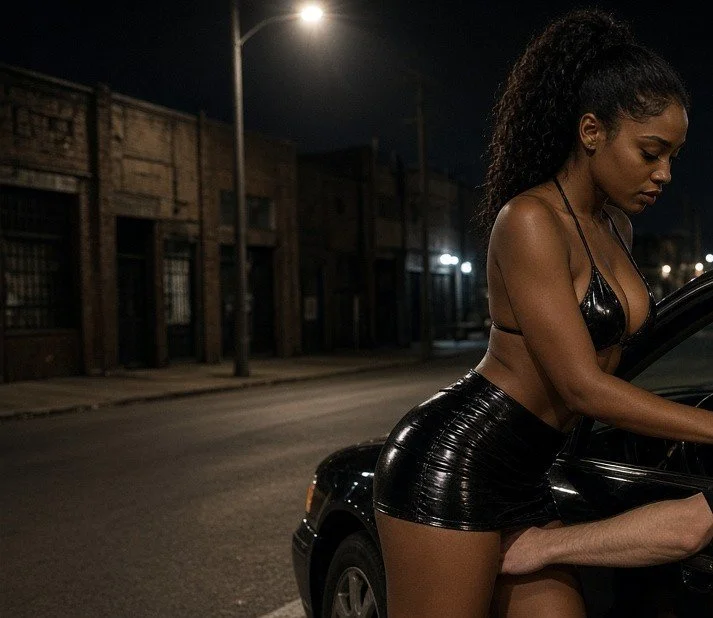
Let's workshop this poem about how hookers, despite our condemnation, are honest actors who show us the whorish truth of all women, just as much as hip-hop shows us the appropriating truth of all art.
Fallen Few
To condemn hookers just for being whores is to deny, in a toupeed disgust for Earth,
our situation: every lady spreads tang in transaction— hookers, clacking up to the car
for a finger-sniff sample, simply let us explore our home through a cranked speculum.
“We need books that affect us like a disaster, that grieve us deeply, like the death of someone we loved more than ourselves, like being banished into forests far from everyone, like a suicide. A book must be the axe for the frozen sea within us.”—Kafka (against the safe-space cancel culture pushed by anti-art bullies, left and right)