


to Hive being
welcome
What is Hive Being, and Why the Name?
You have likely heard talk of a hive mind, where one global mind finds more or less figurative expression in various local minds. Such talk is common enough in nature documentaries, especially ones concerning ants or bees, and in sci-fi programs. Take that notion, at least a loose version of it, and broaden its scope. That will be a decent first step in understanding the title I have chosen both for my Blog and for the first five-volume installment of my magnum opus Made For You and Me, a fragmentary collection of minimalist stanzas from 2016 to 2020.
In alignment with Spinoza (the 17th Century Rationalist to whom I devoted my doctoral studies), I view reality in its totality as a grand hive Being: all entities are but pulsating manifestations of the buckstopping fount of everything, an ultimate being we might call “God” or “Nature” (so long as, out of respect for the capital “G” and the capital “N,” we limit it neither to some anthropomorphic cloud father hurling lightning bolts nor to mere wilderness untouched by human smog). According to the hive-Being view (where reality is one lone superorganism, a monistic—and we might even say unividualist—conception I defend in both my creative and academic capacities), each non-foundational being (each being, that is, whose essence does not involve existence) is an utterly necessitated expression or eruption or exudation of this eternal source—each is, perhaps better put, a mode or manner of being, and so a focal point through which is disclosed, what classical theists sometimes call “being itself” (ipsum esse subsistens): the realness of the real, the being of whatever may be, the sheer activity of being, the very isness of whatever is. This Blog, which duplicates my Substack, throbs as but one among many literary unfurlings of this self-necessitated foundation, this supreme wellspring, of which we—like black holes and broken beliefs, like fractal ferns and flickering flames—are the inevitable stylings.
My Journey
I am an academic who found himself pressured into early retirement by the rising tides of cancel culture. The illiberal scourge of censoring, silencing, and shaming—although always with us throughout our evolution—reached a local peak around 2021. That was the turbulent year my creative pursuits, which the old left once encouraged as a healthy outlet for the stresses of a childhood steeped in poverty and illiteracy, drew the ire of the new safe-space left. A small cadre of self-proclaimed victims and their allies, several of whom continue to berate me years later under pseudonyms as see through as their sexual infatuation, sought to erase me and my heterodoxy. They found support from a wannabe-woke dean, covered in the grand inquisitor robes of our decadent modernity (full-body tattoos) and just itching to signal his commitment to protecting “vulnerable populations” from triggering material (even if just, as it was in my case, off-duty poems “unbecoming for someone calling himself a teacher”). Although I eventually won my due-process case with the help of The Foundation for Individual Rights and Expression, I slunk away from a college that turned its back on protecting freedom of expression and from an institution increasingly intolerant of intellectual diversity.
The wrecking ball to my too-comfy office in the windowless ivory tower came with a silver lining. From the ashes of my professional aspirations rose a phoenix of increased freedom to fulfill the literary calling I have pursued for decades. Reputation concerns never stopped me, even within academia’s sterile halls of conformity. Indeed, my unapologetic defiance, which has long baffled friends and family, no doubt chummed even safe waters—almost as if I were asking for it all along—until the cancel shiver grew too frenzied to hold back its blind thrashings. But now, now I piston the most forbidden territories of human thought with no longer even a twinge of conscience. The newfound freedom means extra time to hone my craft. When not assisting special-needs communities (a day job far more rewarding than freeway-flyer drudgeries), I pursue my literary mission with Dionysian fervor.
Call for Co-Conspirators
This space, my digital sanctuary, showcases the fruits of my mission. Think of my posts, even those linking to my publications, as works in progress. I want your input, unflinching brutality included. Each post begins with an invitation to action: “Let’s workshop this [draft about x, y, z].” Your contributions, whether through public comments or my contact page, help hammer scraps of ore into polished blades fit for magazine publication.
Your input is valuable, even if you are neither a writer nor a reader of literature—twin disciplines dying by the cyber nanosecond. Sometimes—even if at the risk of uttering banalities—an outsider’s fresh vantage can pierce the veils of convention to reveal what insiders miss. It often takes an outsider to make us even think to question our ingrained presuppositions and attitudes. I stand by the hygienic value of contagion. That is one reason I advocate so strongly for intellectual diversity and freedom of expression. And that is also one reason I was so harrowed by the anti-diversity swell of cancel culture in academia (an institution that should be the utmost caretaker of such values)—harrowed especially insofar as that swell masqueraded under the gaslighting guise of “diversity”).
You will witness the breathing evolution of my writings over time. To track these changes, I label each revision by round: “ROUND 2,” ROUND 3,” and so forth. Each piece undergoes continuous refinement based on your feedback and my own revisitations. Sometimes changes will mar the work. That is the risk of creative tinkering as a finite creature. I hope you will alert me to missteps. After many semesters of university writing workshops, one rule has impressed itself upon me: when someone senses a flaw, something almost always needs to change—even if, yes, the proposed solution misses the mark (which often it does). From a quick look into the archives, accessible here, you can see how much I have benefited from your feedback so far.
My Hope
Sharing drafts can be daunting. But showing you the ravaged and unperfumed real deal unfiltered by makeup (stuttering starts and falsities, awkward line breaks and clumsy word choices, grammatical errors and misspellings)—that not only makes my work more relatable, but helps me refine things through your input. I hope the unfiltered look at the raw process of fumbling, rather than just the polished product, also helps other writers develop their craft. Imperfect works often instruct more than perfect ones: whereas the perfect ones tend to have a grace by which they slip inside us without activating our scrutiny, the imperfect ones—especially the near perfect ones—show us glaringly what not to do.
People laugh at me, seeing—in my tilting at the windmills of literary excellence—a Don Quixote clunking around in Arthurian armor in a post-knight era. I am not naïve. I am well aware of the diminishing ability to read, let alone well: slowly and deeply, with gratitude. I am also aware that my style, which often nests subpoints within larger points, never waters down virtuosity for the sake of mass appeal. I watch readers stumble over my sentences, unable to unlock even just the music of the envelope let alone the semantic meat within, which—given my tendency to flashlight through the darker facets of human nature (the addicts, the miscreants, the abusers among us)—only adds an additional alienating layer of difficulty). Beholding these depressive scenes of even supportive family members getting bucked off my syntactic bronco makes me feel like a dinosaur who should get a hint and, if not succumb to the brain rot of skibidi-toilet speak, just hang himself already. Even though the decline in linguistic background and grammatical voltage makes my compositions seem quixotic in a world binging Netflix and TikTok, I persist—raging against the dying of the light—by some internal compulsion to celebrate the richness of language and thought.
My hope is that, despite social media’s unparalleled power to farm our attention, people never forget the unique power of writing. Beyond unveiling hypocrisy, teasing out complex implications, and detailing the commonalities between even the most alien phenomena, writing offers something we need today—trapped in agoraphobic cyber bubbles only thickened by the Lyme dangers of forests and the COVID dangers of cities—perhaps more than ever. Granting us rich access to the first-person perspectives of others (to how things feel to them), writing serves as one of humanity’s best tools for combating loneliness. It allows us to linger, broadly and deeply and at high resolution, within the inner lives of others in a way that other arts can only suggest.
What to Expect
My work spans a broad spectrum: from metaphysical discourses on free will and determinism and the ontology of holes to the ephemera of western culture (whether the childhood impacts of the hypersexual mono-image of black woman as squirting twerkers or Terrence Howard’s sham revolution of mathematics). Some tight and minimal, others free-flowing sprawls; some heady and abstract, others emotional and imagistic—my inkwell musings, which often blend scholarly rigor with a dark humor from both high and low culture, aim to capture the visceral intensity of our personal and social and ultimately existential predicaments.
By no means can I deny that drug abuse, sexual assault, and the tales of the broken and the damned loom large in the tag cloud of my work. My writing will never be a paradise of easy truths and comforting lies. It will challenge you, provoke you, and at times even repulse you. I offer no apologies for the monsters I unleash. They are as much a part of us, at long root scared rodent mammals scurrying in the shadows of dinosaurs, as our noblest aspirations.
But make no mistake. It is not all downer darkness. The archives are my receipts. You will find pieces exploring the pursuit of authenticity in a media-saturated world, the search for meaning in an indifferent cosmos, and the celebration of beauty in both the sublime and the profane. I locate much of my inspiration, in fact, in novelists like Dostoevsky and poets like Ted Kooser—writers unafraid to pursue moral agendas or risk Hallmark sentimentality in an age that often sneers at sincerity.
Be they satirical dissections of modern social dynamics or poignant poems about addiction or academic articles on moral responsibility, my goal is to provoke thought, evoke emotion, and foster meaningful dialogue. Fear has not and will not stop me from challenging humanity’s fundamental taboos (like bestiality and cannibalism) or self-reflecting into the dark chaos of the subconscious, even if that means exposing the Jungian shadows—the inner Goebbels—lurking within us all!
Expect posts each day, no day missed. Donations are welcome, but I impose no paywall: it feels wrong to charge for art, especially given our date with obliteration. Feel free to explore what amounts to, at the time of writing this, close to a thousand pieces of poetry and prose here. That should give you a sense of what awaits.
Join me—specula holstered—on this literary odyssey into the public and private nooks of the hive Being. Let us navigate the labyrinth of creation together, confronting our demons and even slaying our darlings if we must. Let us dance on the razor’s edge between the sublime and the profane in pursuit of an elusive literary perfection never to be confused—as it has been confused in our declining civilization—with the pursuit of popularity or likeability over truth.










tag cloud
- literature community
- American literature
- poetry
- literature
- poem
- literary
- creative writing
- writing
- poetry community
- Michael Istvan
- Istvan
- perception
- defiance
- suffering
- existential poetry
- dissociative
- existential
- healing
- human
- mortality
- power
- art
- artist
- evolution
- God
- death
- love
- darwin
- anxiety
- rape
- psychoanalysis
- addiction
- homeless
- addict
- trauma
- therapy
- rapist
- traumatic
- hypersexual
- hyperarousal
- grooming
- anal sex
- anal
- heart
- incendiary
- dead
- Identitarianism
- tyrant
- meditation
- poverty
- fap
- choking
- traitor
- treachery
- identity
- honey pot
- true crime
- power dynamic
- woke
- cunnilingus
- Vaginal
- animals
- OwnVoices
- empathy
- ally
- crime
- summer
- scarf
- body disposal
- kidnapping
- Klan
- sex
- crack
- identity politics
- Vagina
- disease
- indians
- turtles
- fisting
- Pussy
- surrealism
- anality
- erotic
- scatalogical
- violence
- teenybopper
- artistry
- borders
- poet
- mommy
- animal
- sublime
- victim
- pedophilia
- van gogh
- adult-minor
- safe space
- poetry editor
- americana
- math
Posts
Body Talk ‘98 (ROUND 1)
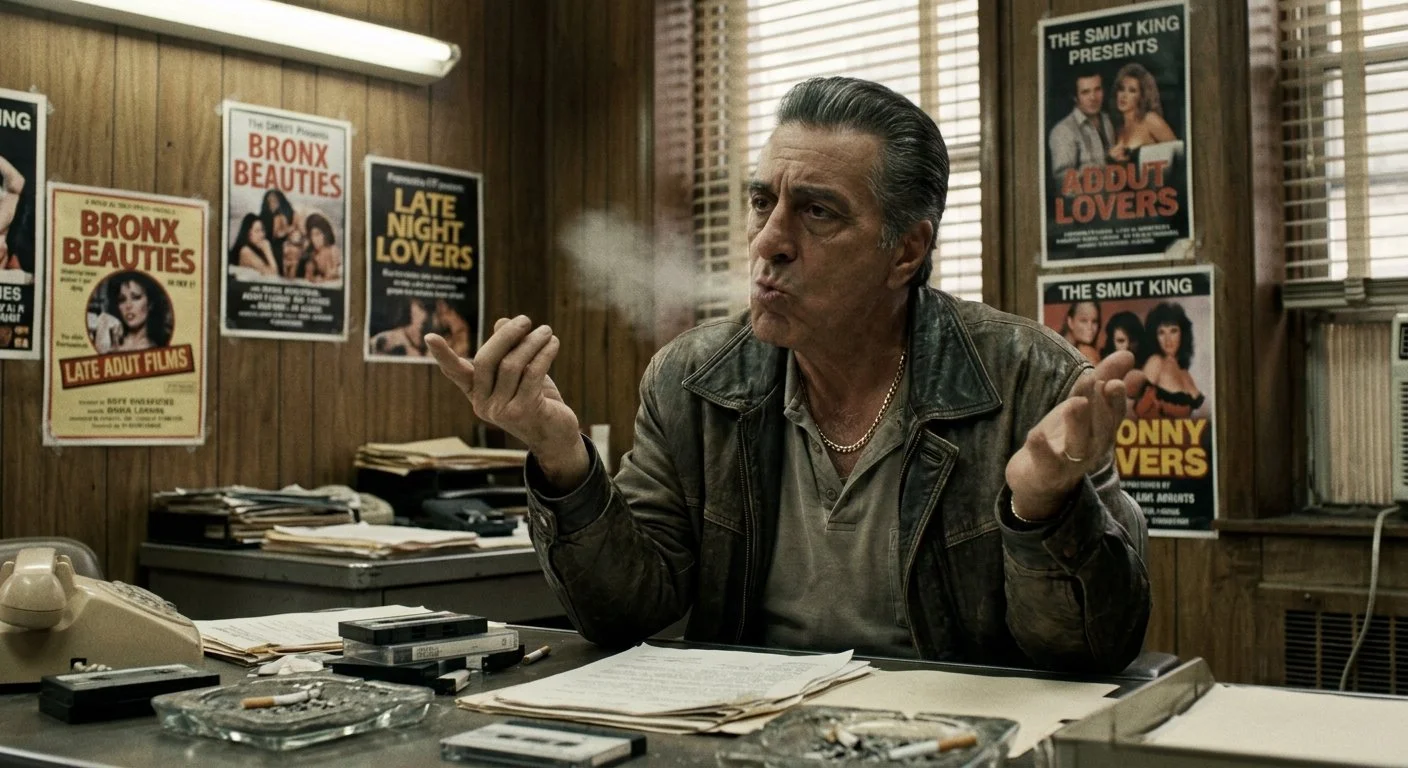
"Body Talk '98" is a dramatic monologue in the tradition of Browning's most unsettling speakers — a voice so fully inhabited, so precisely rendered in its own register, that the reader never receives external judgment, only the judgment that accumulates from listening carefully to what the voice reveals about itself. Its subject is a pornography producer conducting what is nominally a job interview with a new cameraman, but which is in fact a sustained performance of power: the establishment and maintenance of dominance over a younger man who remains almost entirely silent throughout, his presence registered only through the boss's reactions to behavior the reader cannot directly observe. The piece's formal achievement is to make that silence eloquent — to construct a complete portrait of both men through one man's voice alone.
The title's double register establishes the piece's governing concern immediately. "Body Talk" is the subject of the boss's explicit lesson — the idea that the body communicates involuntarily, that posture and gesture and physical comportment reveal what the mouth conceals or declines to say. But "Body Talk '98" as a title also positions the piece historically, anchoring it in a specific moment of American culture: the late 1990s, the era of VHS pornography's last dominance before internet distribution transformed the industry, the era of beepers and briefcases, of Columbo reruns and Wilt Chamberlain photographs on nightstands. The "'98" is not decorative. It places the boss's particular mode of masculinity — its references, its idioms, its casual brutalities, its specific cultural touchstones — in a historical context that has since been overtaken, making the piece simultaneously a character study and a period piece.
The boss arrives fully formed in his first sentence: "Whoa whoa — fuckin whoa, huh?" The triple repetition, the self-interruption, the rhetorical "huh?" that demands agreement rather than soliciting it — these establish in three words the character's fundamental operation. He talks to fill space, to prevent others from filling it, to maintain the initiative at all times. The instruction to "take it down a few notches" is delivered to someone we have no indication was pitching anything — the command reveals that the boss has already decided to be managing the other person's energy regardless of what that energy actually is. "When in Rome — get my drift?" is the first of many idiomatic phrases deployed as weapons: the phrase does the work of establishing in-group familiarity while simultaneously implying the new man does not yet belong to the group.
The Tom Bombadil reference is the piece's first significant depth charge. The boss tells Frank to "look it up" — positioning himself as a figure of whimsical, ungovernable power who cannot be possessed or commanded, who is at home in his domain in a way that makes all threats slide off him. Tom Bombadil in Tolkien is the anomalous figure outside the Ring's power, cheerfully immune to what destroys everyone else. That the boss of a pornography operation identifies with this figure tells us everything: he sees himself as a lord of his specific territory, answerable to nothing, charmed against consequence. The comparison is simultaneously self-aggrandizing and inadvertently revealing — Bombadil is also, in many readings, a figure of utter inconsequence, beloved but peripheral to everything that actually matters.
The Fratmatose Freshman critique is the piece's first extended comic set piece, and it is genuinely funny in the way that only perfectly observed professional incompetence can be. The boss's objection to the title — "Who wants to feel dumb pickin out a movie?" — contains a legitimate insight about audience psychology delivered in the idiom of a man who would never articulate it as such. His reading of the consumer behind the adult-video store curtain is acute: "He already feels embarrassed enough." The empathy here is real, however crudely expressed. The boss understands his audience because he is, in some fundamental way, continuous with it — his contempt for the gonzo film's night-vision "wobbly green pussy" is the contempt of a craftsman for shoddy work, not a moralist for the work itself.
The boss's relationship to craft is the piece's most complex and most sympathetically rendered theme. He is not an intelligent man in the conventional sense — his speech is full of malapropisms, half-finished thoughts, idiomatic shortcuts — but he has genuine professional competence and genuine professional pride. His critique of the Fratmatose filmmaker's failure is structurally identical to the critique any experienced producer might make of a film-school graduate's first project: too much concept, not enough execution, insufficiently aware of the audience's actual experience. "Too much head and you start losin touch" is the boss's formulation, and it is not wrong. The piece understands this without endorsing it.
The thermometer routine — the piece's first extended comic digression — is a tour de force of vernacular performance, and its relationship to the piece's central theme of body language is more precise than it initially appears. The elaborate misdirection the boss describes — the concerned look, the run to the bathroom, the ass-heated thermometer, the side-to-side cock swing, the perching of balls on doorknobs — is an extended lesson in redirection as a communication strategy. The point of the routine, as the boss explains it, is that "the last thing from her mind is that you're holdin somethin up there — redirection." The humor is broad and physical, but the underlying principle is the same one that governs the boss's entire mode of interaction: control what the other person is attending to, and you control what they know. The thermometer routine is a vulgar elaboration of the body-talk lesson. Both are about managing perception through deliberate physical performance.
The second section's shift to the editing room is the piece's tonal pivot. The boss at the monitor becomes a different figure — still domineering, still managing Frank's responses, but genuinely engaged with what he is showing, capable of something like aesthetic appreciation. "Fuckin poetry, pure poetry if you ask me Frank. That's where the poetry's gotta be: in the scene, not in a fuckin pun." This is the piece's most direct statement of the boss's aesthetic credo, and it is not without coherence. He is making a distinction between the kind of meaning that resides in craft and execution — in the correctly framed shot, the perfect angle, the precise distance — and the kind of meaning that resides in verbal cleverness or conceptual ambition. His critique of the Fratmatose filmmaker's punning title and his praise of the sea-mussel framing are expressions of the same aesthetic: the thing should do its work through what it shows, not through what it names or implies.
The dead cameraman — "kidney failure. That's big shoes. I get emotional about it" — is the piece's most economical character notation. The boss has genuine loyalty and genuine grief, expressed in the idiom available to him. The parenthetical aside is delivered and then dropped, the emotion real and immediately covered over. This is the piece in miniature: the boss's emotional life is present but managed, processed through the same body-language awareness he is trying to teach Frank. He does not dwell because dwelling is a form of loss of control.
The gazelle comparison — "She's watchin the cameraman like a fuckin gazelle" — is the piece's most precise image and its thematic center. The actress looking at the camera for reassurance, for information about whether something has gone wrong, is positioned as prey scanning for threat. The boss's lesson is that the experienced cameraman must provide nothing — "straightfaced, like nuttin's up" — because the actress's uncertainty must be managed, her attention directed, her behavior shaped by the cameraman's performed neutrality. The body-talk lesson is here extended to its fullest professional application: the cameraman's body must lie on behalf of the production. The fact that this lying is directed at a woman in a vulnerable physical situation, during an anal scene she may not have been fully prepared for, is handled by the piece with the same deadpan the boss recommends: the information is present, the editorial frame is absent.
The "u and me" digression — the boss's retreat from the lobster dinner revelation — is the piece's most revealing moment of self-correction. He has disclosed something he did not intend to disclose: that he took the actress to dinner before dropping an anal scene on her, that the sequence was his choice and his misdirection. The "assume" idiom is deployed as a face-saving maneuver, but the boss immediately concedes: "But even if she was all prepped up Frank, my point still stands you fuckin wise guy." The concession is honest — the Frank figure has caught him in something, and he knows it. "I don't sense that you're trying to offend me. You're an innocent, Frank — a rarity in this business. You tell it like it is just for the sake of telling it like it is." This is the piece's most complex moment of characterization: the boss recognizing and naming a quality in Frank — directness without aggression, honesty without agenda — that he identifies as rare and that he values, even as it threatens his control.
The Wilt Chamberlain photograph, the Asian girlfriend digression, the eel invitation — these are the piece's coda, the boss winding down in the way that men like him wind down: through a series of elaborations and digressions that are all forms of showing off, of demonstrating the range and energy of the mind even as the interview concludes. The offer to Frank's girlfriend — "She ever wanna shit some live eels for us you bring her along" — is the boss at his most grotesque, but even here the grotesquerie is performed rather than felt. He is entertaining himself, maintaining his energy, refusing to let the departure be quiet.
The final routine — the fake search for lost feelings — is the piece's final comic set piece and its structural rhyme with the thermometer routine. Both are elaborate performances designed to redirect a woman's attention and emotional response. Both involve the deliberate staging of concern, of urgency, of searching. Both end with a reveal that is not what it appeared. The thermometer routine ends with the woman's attention redirected to hygiene rather than deception. The "lost feelings" routine ends with the man announcing he has lost his feelings in a context so absurdist — after tearing apart the bedroom as though searching for a physical object — that the announcement cannot be received in the way it would otherwise be received. Both routines are lessons in the management of emotional scenes through physical performance. Both are, in the boss's terms, body talk.
Formally, the piece is a masterwork of idiomatic characterization. The boss's speech is rendered with phonological precision — the dropped consonants, the rhetorical questions, the interrupted syntax, the sudden pivots — that make him fully audible. The reader hears this voice because the voice has been constructed from the inside out: not assembled from observed tics but generated from a character whose relationship to language is itself the subject. The boss uses language the way he uses body language: to fill space, to control the room, to prevent silence from becoming someone else's opportunity. The piece's formal brilliance is that it makes this use of language itself the evidence for everything it wants to say about the character.
"Body Talk '98" is ultimately a piece about power's self-portrait — the way that a certain kind of intelligence, operating entirely within the terms of its own domain, produces a coherent and even occasionally admirable worldview that is also, viewed from outside, a portrait of practiced exploitation dressed as professional expertise. The boss is not a villain in his own account. He is a craftsman, a mentor, a fair guy who does not bend for everyone. The reader's position — receiving his account without the ability to correct it, in the position of Frank — is the piece's deepest formal argument: that this is what it sounds like from inside a certain kind of room, and that the body talk happening in that room is the only language available.
Meta Description
A dramatic monologue in which a pornography producer conducts a job interview that is in fact a sustained performance of power — deploying body language, comic digression, professional aesthetics, and vernacular philosophy to construct a complete self-portrait of a man whose intelligence and genuine craft operate entirely within the terms of his own domain.
Keywords
Body Talk '98, dramatic monologue, vernacular characterization, pornography industry, power and performance, body language, idiomatic prose, Tom Bombadil, Wilt Chamberlain, thermometer routine, gazelle comparison, craft and exploitation, 1990s period piece, close reading, Hypocorism

Crank Shaft (ROUND 4)
"Crank Shaft" is a study in the irreducibility of fractured consciousness. Its narrator sits immobile on a curb in the aftermath of a child's death — a death he witnessed and could not prevent. The piece does not pursue guilt as its subject. It pursues something harder: the way consciousness, under the pressure of catastrophic witness, does not consolidate into remorse or clarity or collapse, but continues generating its ordinary traffic — desire, calculation, self-interest, animal solidarity, spiritual hunger, mortality, artistic ambition — at the same frequency it always did, except now without the possibility of relief or discharge.
The title operates at multiple levels simultaneously, and its multiplicity is the piece's thesis in compressed form. "Crank shaft" is, mechanically, the component that converts reciprocal piston motion into rotational force — the machine's engine of transformation, turning one kind of movement into another. Cars have crankshafts. The newly resurfaced road has one in every vehicle that guns down it. But "crank" as verb is also slang for masturbation, and "shaft" carries its own phallic register. The narrator was cranking when the wheel of a car passed over the boy's skull. The title fuses these two motions — the man's reciprocal autoerotic action and the mechanical rotation of the killing wheel — into a single compound word, implying that the two chains of causality the narrator watches converge are not coincidental but structurally rhymed: the crankshaft of the title is the mechanism connecting them before the event even occurs.
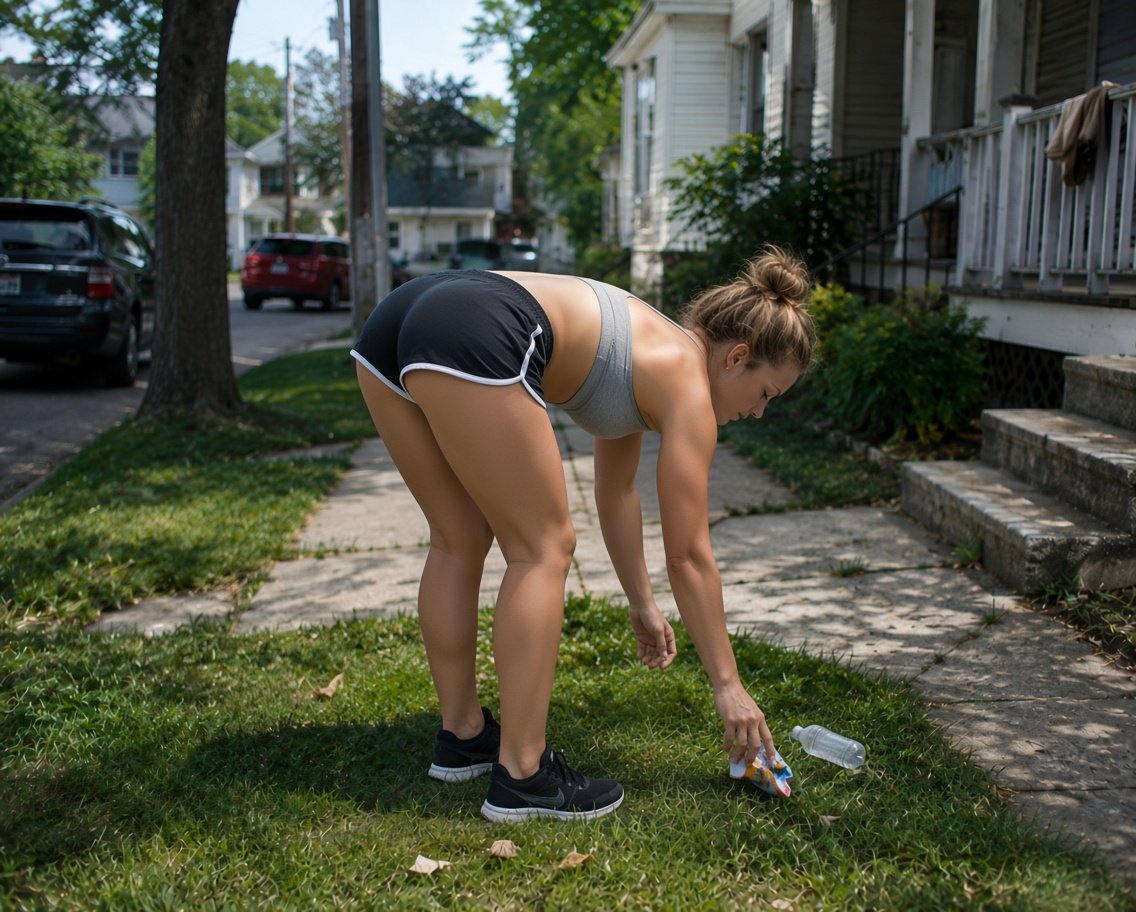
The opening paragraph achieves its effects through deliberate impoverishment cut with a single startling sensory intrusion. "I have not gotten up from the curb. The ambulance had taken the body long ago. I just sit here." The sentences are meager, sequential, declarative. But into this minimalism arrives the smell of the officer's menstruation — "the copper sourdough of her menstruation" — a detail whose precision is as shocking as its placement. The narrator's erotic register is operational even here, even now, even with the police beside him taking his words about a dead child. The smell is gone but he keeps sensing "that scribbling at my side" — not "her" scribbling but "that," the officer depersonalized into her function, her instrument of record, before she has fully departed. The narrator's consciousness cannot exempt even this moment from its ordinary appetitive attention. This is the piece's central psychological claim established in its first paragraph: the machinery does not stop for catastrophe.
The stillness passage is the piece's most formally controlled atmospheric writing. The neighborhood quiet is rendered in specific sensory terms — "Not one blown sub-woofer rattling out blunt smoke, not one burst of shirtless beef" — making the absence vivid by naming what is absent. The hush is "resinous, slow-burning," an atmosphere with physical texture, coating the block rather than settling over it. The children's whispering analogy then delivers the passage's most disturbing material: the parental spat that produced the hush is not merely screaming and broken glass but something more — "throttled taunts gushing out from the pretzeled mound of mommy on the floor ('Beat it up, nigga! Beat that asshole up!')" with the children deliberately kept as audience: "Keep it open! Let em see the shit." The hush the narrator sits in is the same hush those children produce: the silence of witnesses who have absorbed something too large and too unresolved for sound. The dogs have stopped their chronic digging and whining. The animals register what the humans cannot articulate. The stillness is the stillness of a block that has absorbed too much in too short a time.
The brief passage about the house across the street — the screen door creaking open, the mother who screeched away behind the dopplering sirens — delivers one of the piece's most restrained and most devastating images. "My hands were out — down and out, open as my mouth — in my driveway, helpless. She did not look at me." The physical description of his posture — hands open, mouth open, the posture of surrender or supplication — catches the narrator in the moment immediately following the accident, before the vigil began. He was helpless then. He remains helpless now. The house afterward "stood there, porch sagged like the blow-up pool, as if in an apneic slumber marked by the occasional stuttering gasp." The house breathes without its occupants. The domestic space has been evacuated of its life while retaining its physical form — a correlative for what has happened to the neighborhood's ordinary time.
The Georgie passage is the piece's single most accomplished sustained writing. The cat's backstory — found as a runt while the narrator was trimming the flea bush of the condemned house, a house abandoned after IBM "creampieing the aquifer with forever toxins, dipped like a deadbeat dad" — grounds Georgie in a specific history of institutional abandonment that the narrator has been managing, inadequately, for years. The ten-plus strays trapped and surrendered, the twice-a-year flush of feral kittens, the "profligate chaos of a growth as obdurate as a drunk with his car keys" — these establish the narrator as a man who has genuinely invested in trying to manage what is beyond management, who has for a decade attempted small acts of stewardship against large forces of indifference. The IBM detail is not incidental: it positions the neighborhood's deterioration as the consequence of corporate extraction, and Georgie as one of its indirect products.
The Bach comparison is the passage's formal apex. Georgie's braced sidewinding walk — "body cramped like toes in the peak of orgasm, contorted enough, every muscle fiber fighting itself" — produces in the narrator's imagination "the haunted-castle organ opening of Bach's 'Toccata and Fugue in D minor, BWV 565.'" The comparison is precise because it is exact: that specific piece opens with exactly the quality of grandiose, doom-laden, architecturally imposing musicality that Georgie's distress genuinely evokes. The comparison is not comic. It is the narrator's consciousness doing what it always does — finding the precise cultural analog, the exact match — even in the most unlikely material and at the least appropriate moment. This is a mind that cannot stop working.
Georgie's refusal to approach in this scene carries its maximum weight because the narrator notes it with specific self-consciousness: "I do not feel my eyebrows raise. And I note that." The reflexive awareness — noting what he does not feel — is the piece's most precise notation of the dissociation that has set in. He is monitoring his own responses from outside and finding them absent. The cat that always comes to him has read something in the scene, in the man, that warrants withdrawal. "What does he know?" The question is not rhetorical. It is genuine inquiry the piece leaves open.
The retrospective account of the morning and the accident is the piece's most carefully paced movement, and the newly resurfaced road is its most significant environmental detail. "The road had just been resurfaced. You could smell the bitumen even in the house. A trackless black still, pickable into little phenolic balls at the curb edge; no grass yet scattered upon it by mowers and whackers — speed was an urge I could understand." The fresh blacktop offers no traction, no texture, no resistance — the specific conditions that turned the boy's tip into something fatal. "Speed was an urge I could understand" is the piece's most quietly complex moment: the narrator extending understanding and even identification to the conditions that killed the child, folding the death into a broader ecology of impulse that he does not exempt himself from feeling.
"For some reason I cannot remember his name." This is the final version's most important single sentence. The narrator does not simply omit the boy's name; he marks the omission, registers it as strange, cannot account for it. The erasure is a form of evidence: the narrator was so thoroughly inside his own experience that the child next door remained peripheral even in his death. The name has not been suppressed out of callousness. It has genuinely not been retained. This is the piece's most honest self-indictment, delivered without any framing as such.
The toy bucket and pink beach shovels — "radiating the haunted kinetics of a cursor left blinking mid-sentence" — are the piece's most carefully chosen domestic detail. A cursor blinks in expectation of the next character that will not come. The toys sit in expectation of the hands that will not return to them. "I shake my head at them, at where I have wound up." This is the only moment in the piece where something like unmediated self-reproach surfaces — not at the death, not at the accident's conditions, but at the distance between where he is and where a morning could have gone. The shaking of the head is a physical punctuation mark on a thought the narrator cannot finish.
The unreleased load comparison — "The unreleased load has befuddled my loins like Georgie" — is the piece's darkest comic moment and its most psychologically precise. The narrator's physically unresolved state is compared to the cat's psychic rack: both bodies in a bind between competing needs, neither able to fully discharge or fully guard. The comparison refuses the dignity of clean suffering. It insists on the body's continuation as a site of need even in the aftermath of catastrophe.
The intrusive sexual fantasy — slurping the mother's "fat maternal petals meaty as tuberose smells," whispering "I'm gonna give you another baby," hushing her "like a baby herself" — is the piece's most disturbing formal decision, and it is fully earned by everything that precedes it. The consciousness that has been noting the officer's menstrual smell, calculating how to milk his ex-wife's sympathy, monitoring the erotic choreography of the neighbor's bends since spring — this consciousness does not observe a period of mourning. The specific content of the fantasy is what makes it most revealing: "Make me feel good. Make me feel good." The line, given to the imagined mother, makes explicit what the fantasy is doing. It is not purely predatory. The libidinal unconscious is attempting, in the only register available to it, a form of reparation — giving back what was taken, providing comfort in the form it knows. The piece does not redeem this. It holds it precisely as what it is: the machinery running in the only mode it has, trying to address an immense situation with instruments designed for something else entirely.
The mortality passage is the final version's most significant addition and it transforms the piece's scope. "I have chosen the pursuit of glory over family." The inventory that follows — hip flexibility declining, sparse crown, nighttime urination, the coming day of seated breathlessness — is not self-pity but accounting. The narrator is taking stock of what his choices have produced. "Who now is left at my side to tolerate my repetitions and back my tall tales? Will there be anyone even to fake like they are interested? What hand will guide me back to before the womb?" These are not rhetorical questions. They are the questions of a man who has organized his life around solitude and art and is now sitting on a curb with no one coming for him. "My son is here. But I cannot stop working." The art is the crankshaft that has been running beneath everything else. The child's death is the occasion. The narrator's life is what the vigil is actually about.
The closing movement achieves its fullest form here. "I lie back." The physical surrender to the ground marks a qualitative shift: the narrator is no longer sitting in vigil but giving himself to the earth. "I can feel the planet's core latched to my bones, its implacable suckle — all draw, no release." The gravitational image gives the inertia its cosmic dimension. The narrator is not merely tired or numb but held by a force operating at the level of mass and planetary attraction. Everything has been drawn in — desire, grief, mortality, art, the dead child, the unreleased load, the cat's knowledge, the blinking toys — and nothing has been released. The crankshaft turns without converting its motion into anything. The sun bothers his face. He has reason to get up. But how can I?
The final question is the piece's only moment in which the narrator directly addresses himself — steps outside the stream of consciousness and poses a genuine inquiry to the body on the curb. It is not rhetorical. It is an honest question about what it would take to restart, to convert inertia back into motion. The piece does not answer it. The machinery is at rest. The getting up has not happened and may not. The crankshaft is turning without going anywhere, which is exactly the mechanical condition the title names.
Meta Description
A prose piece in which a man sits immobile on a curb after witnessing a child's death, his consciousness continuing to generate desire, mortality reckoning, artistic ambition, sexual fantasy, and animal solidarity simultaneously — a study in the irreducibility of fractured consciousness, centered on a newly resurfaced road, a cat who will not come, toys blinking like an interrupted cursor, and the question of what it would take to get up.
Keywords
Crank Shaft, psychological fragmentation, trauma prose, erotic consciousness and catastrophe, witness and helplessness, Georgie the cat, Bach Toccata and Fugue, art versus family, mortality and artistic ambition, newly resurfaced road, toy bucket cursor, IBM environmental abandonment, gravitational closing, close reading, Hypocorism, crankshaft mechanism
Crank Shaft (ROUND 3)
"Crank Shaft" is a study in the irreducibility of fractured consciousness. Its narrator sits immobile on a curb in the aftermath of a child's death — a death he witnessed, could not prevent, and is implicated in by the precise act through which he was prevented from acting. The piece does not pursue his guilt as a legal or even moral verdict. It pursues something harder: the way consciousness, under the pressure of catastrophic self-implication, does not consolidate into remorse or clarity or collapse, but continues generating its ordinary traffic — desire, calculation, self-interest, animal solidarity, spiritual hunger, mortality, artistic ambition — at the same frequency it always did, except now without the possibility of relief or discharge.
The title operates at multiple levels simultaneously, and its multiplicity is the piece's thesis in compressed form. "Crank shaft" is, mechanically, the component that converts reciprocal piston motion into rotational force — the machine's engine of transformation, turning one kind of movement into another. Cars have crankshafts. The car that kills the boy is driven by one. But "crank" as verb is also slang for masturbation, and "shaft" carries its own phallic register. The narrator was cranking when the shaft of the car's wheel passed over the boy's skull. The title fuses these two motions — the man's reciprocal autoerotic action and the mechanical rotation of the killing wheel — into a single mechanism, implying that the two chains of causality the narrator watches converge are not coincidental but structurally linked: joined in the crankshaft of the title before the event even occurs.
The opening paragraph achieves its effects through deliberate impoverishment cut with a single startling sensory intrusion. "I have not gotten up from the curb. The ambulance had taken the body long ago. I just sit here." The sentences are meager, sequential, declarative. But into this minimalism arrives the smell of the officer's menstruation — "the copper sourdough of her menstruation" — a detail whose precision is as shocking as its placement. The narrator's erotic register is operational even here, even now, even with the police beside him taking his words about a dead child. The smell is gone but he keeps sensing her presence. His consciousness cannot exempt even this moment from its ordinary appetitive attention. This is the piece's central psychological claim established in its first paragraph: the machinery does not stop for catastrophe.
The expanded stillness passage is the revision's most significant formal achievement. The earlier version's quiet neighborhood hush is here given a specific and devastating genealogy: the children whispering in the wake of a parental spat that escalated from screams and shattered glass into something else entirely — "throttled taunts gushing out from the pretzeled mound of mommy on the floor ('Beat it up, nigga! Beat that asshole up!')" — with the children deliberately kept as audience: "Keep it open! Let em see the shit." The neighborhood hush is now rhymed explicitly with the hush of children who have witnessed their mother's orgiastic absorption in violence and sex simultaneously, kept watching by adult insistence. This is the Gonzo Domestic Squabble template transposed into the narrator's own street: the children made witnesses to adult intensity they cannot process, the animals registering what the humans cannot. The dogs have stopped their chronic digging and whining. The stillness is the stillness of a neighborhood that has absorbed too much.
The Georgie passage is the piece's single most accomplished writing, and it earns that designation through the specificity of its attention. Georgie is fully named, fully individuated — a runt found two summers back, a feral cat whose forced adulthood in New York extremes has left him with "needs neglected," who seeks the narrator's hand "with a crying desperation" even as that same hand triggers in him the "spiritual bind between having to make biscuits and having to maintain the sleepless guard." The Bach comparison — the braced sidewinding walk described as "the haunted-castle organ opening of Bach's 'Toccata and Fugue in D minor, BWV 565'" — is the piece's most extravagant simile, and it earns its extravagance because the precision is exact: every muscle fiber fighting itself, the body contorted enough to produce a specific, unmistakable sound in the observer's imagination. Georgie does not come to the narrator today. He slinks back into coverage. The cat that has always permitted the narrator's touch has read something in the scene, in the man, that warrants withdrawal. The piece does not explain what Georgie knows. It asks the question — "What does he know?" — and leaves it open.
The retrospective account of the mother's ass and the boy's death proceeds as in earlier versions, but two revisions sharpen the psychological argument. First, the interior monologue during the voyeurism is now more explicitly voiced — "Bet that shit taste so fuckin good" — making the erotic consciousness more audible, more present, less retrospectively constructed. Second, the crucial exculpatory move of the marathon analogy now concludes with "People masturbate" — a sentence of devastating baldness. Having built the logical case that bodily states do not disqualify action, the narrator collapses the case into its simplest possible statement. The argument reaches its terminal point and the terminal point is nothing more than a declaration of ordinariness. People masturbate. The child is dead.
The unreleased load comparison — "The unreleased load has befuddled my loins like Georgie" — is the revision's most darkly comic and most psychologically precise detail. The narrator's physically unresolved state is compared to the cat's psychic rack: both bodies in a bind between competing needs, neither able to fully discharge or fully guard. The comparison refuses the dignity of clean suffering. The narrator on the curb is not a man in grief; he is a man in an unresolved physiological state that the afternoon's events have made unresolvable, compared to a feral cat with a complicated relationship to being touched. The loins and the cat belong in the same sentence. The piece knows this.
The mortality passage is the revision's most significant addition and it transforms the piece's meaning at its deepest level. The narrator has chosen art over family — "I have chosen the pursuit of glory over family" — and has chosen not merely glory but the most demanding and least rewarded form of it: to stand on an astral plane alongside Nietzsche and Emerson, which "requires enough truth telling to be hated while alive." The physical inventory that follows — the hip flexibility declining, the sparse crown, the nighttime urination, the coming day when seated breathing will require rest — is not self-pity but accounting. The narrator is taking stock of what his choices have produced and what they have cost. "Who now is left at my side to tolerate my repetitions and back my tall tales? Will there be anyone even to fake like they are interested? What hand will guide me back to before the womb?" These are not rhetorical questions. They are the questions of a man who has organized his life around solitude and art and is now sitting on a curb with no one coming for him, understanding perhaps for the first time the full cost of that organization. His son is present but the narrator notes it and immediately returns: "But I cannot stop working." The addiction to art is the crankshaft that has been running beneath everything else. The child's death is not the piece's only subject. The narrator's life is.
The intrusive sexual fantasy — slurping the mother, whispering "I'm gonna give you another baby" — returns and is if anything more devastating in this version because it follows directly from the mortality passage. The man who has just inventoried his aging body and his chosen solitude now fantasizes about giving a grieving mother another baby. The libidinal unconscious's attempt at reparation — giving back what the crankshaft took — is continuous with the piece's larger argument about what the narrator has cost himself and others through his chosen mode of existence.
The closing movement achieves its effect through the replacement of sitting with lying. "I lie back." The earlier version held the narrator upright on the curb; this version surrenders him to the ground. "I can feel the planet's core latched to my bones, its implacable suckle — all draw, no release." The gravitational image gives the inertia a cosmic dimension: the narrator is not merely tired or numb but held by a force operating at the level of mass and planetary attraction, a force that is all draw and no release, which is the piece's final description of the crankshaft mechanism. Everything has been drawn in — desire, guilt, mortality, art, the dead child, the unreleased load, the cat's knowledge — and nothing has been released. The sun bothers his face. He has reason to get up. But how can I? The question is not rhetorical. It is genuine. The piece ends where the crankshaft has always been: turning without being able to stop, unable to convert its motion into anything that would allow rest.
Formally, the piece's syntax continues to move between meager declarative sentences and long recursive clauses in a rhythm that mimics the narrator's oscillation between numbness and eruption. The Georgie passage is the piece's longest and most syntactically elaborate, and its elaborateness is earned: the cat's complexity of being — the spiritual bind, the braced sidewinding walk, the Bach comparison — requires the long sentence because the cat cannot be rendered in the short one. Everything else tends toward the short sentence because the narrator's consciousness, in its catastrophic state, cannot sustain elaboration for long before the elaboration collapses back into the declarative. The prose thinks and stops. Thinks and stops. The crankshaft turning.
Meta Description
A revised and deepened prose piece in which a narrator's vigil on a curb after a child's death — caused by his masturbation — accumulates new dimensions: the cop's menstrual smell, the neighborhood's orgiastic backstory, Georgie the cat rendered in Bach, a mortality passage about art chosen over family, and a gravitational closing image of a body held to the ground with all draw and no release.
Keywords
Crank Shaft, psychological fragmentation, trauma prose, erotic consciousness and catastrophe, moral culpability literature, Georgie the cat, Bach Toccata and Fugue, art versus family, mortality and artistic ambition, masturbation and catastrophe, intrusive fantasy, gravitational inertia, close reading, Hypocorism, crankshaft mechanism
Crank Shaft (ROUND 2)
“Crank Shaft” is a story about collision—not merely the collision between a child and a car, but the collision between desire and catastrophe, narcissism and grief, private fantasy and public reality. Its central achievement lies in its refusal to arrange these forces into a morally reassuring hierarchy. The narrator witnesses the death of a young boy while masturbating to the boy’s mother, and the story's power emerges from its insistence that the resulting psychic landscape is not one of simple guilt, remorse, or redemption. Instead, the narrator enters a state of profound ontological suspension in which ordinary motivations, judgments, and desires lose their coherence.
The title is crucial. “Crank Shaft” immediately invokes multiple registers at once. It suggests masturbation ("cranking"), machinery, rotational force, and the transmission of energy. A crankshaft converts linear motion into rotational motion and vice versa. The story is similarly concerned with the conversion of one kind of psychic energy into another. Sexual desire becomes guilt. Guilt becomes paralysis. Paralysis becomes something approaching mystical stillness. Throughout the narrative, forces continue moving through the narrator long after the event itself has concluded.
The opening establishes this state of suspension:
I have not gotten up from the curb.
The sentence is deceptively simple. The narrator's refusal—or inability—to move becomes the story's governing image. Everything afterward unfolds from this fixed point. The body remains stationary while consciousness drifts through memory, fantasy, self-interrogation, and increasingly strange forms of perception.
The story's treatment of time is especially important. Chronological time continues. The sun remains high. The day advances. Yet subjective time has broken apart.
Much more day remains. Yet the stillness is of twilight, an alien twilight.
The phrase "alien twilight" captures the story's central atmosphere. Twilight normally signifies transition. Here, however, it appears in the middle of the day. The world has become temporally dislocated. Categories no longer align with experience.
This dislocation spreads outward into the environment itself. The neighborhood becomes unnaturally quiet. Dogs stop barking. Squirrels stop moving. Even a feral cat behaves differently. The story does not ask the reader to believe that nature has literally responded to the boy's death. Rather, it depicts a consciousness projecting its own rupture onto the surrounding world.
The result resembles what phenomenologists describe as a transformation in the structure of lived experience. The narrator is not simply observing a quieter neighborhood. He inhabits a reality whose very texture has changed.
The feral cat sequence deepens this theme.
Ordinarily the cat comes running.
Ordinarily the cat seeks affection.
Ordinarily familiar routines persist.
Instead:
he slinks back into coverage.
The cat becomes an image of instinctive withdrawal. Unlike the narrator, who remains trapped at the scene, the animal responds appropriately to danger. The narrator repeatedly attributes forms of wisdom to nonhuman creatures throughout the story. Animals seem attuned to realities humans miss or ignore.
This concern culminates in one of the story's most revealing observations:
all of us fight to ignore—if only for what it says about us, not just as stewards of nature but as members no less embedded than any other.
The line gestures toward a worldview in which human beings are not separate from nature but participants within it. The narrator's catastrophe strips away ordinary illusions of separateness. Human beings become animals among animals.
Yet the story's most daring move lies elsewhere.
The narrator's sexual desire does not disappear after the boy's death.
Indeed, it persists.
The lengthy recollections of the mother's body, the flirtatious dynamic across the street, and the narrator's masturbatory fixation are not narrative distractions. They are the story's central psychological challenge.
Most fiction would force a moral conversion here. The death of the child would instantly extinguish desire. The narrator would become purified through tragedy.
Instead, desire survives.
Even after witnessing the accident, the narrator imagines comforting the mother sexually:
I pictured myself slurping the mom
I pictured whispering "I'm gonna give you another baby"
These fantasies are shocking not because they reveal monstrousness but because they reveal continuity. Human consciousness does not conveniently reorganize itself around moral expectations. Sexual desire, grief, self-interest, pity, shame, and fantasy coexist.
The story repeatedly refuses to sort them into separate compartments.
This refusal gives the narrative its psychoanalytic depth.
Freud frequently emphasized that traumatic events do not necessarily eliminate desire. More often, trauma creates bizarre juxtapositions in which incompatible impulses occupy the same psychic space. The narrator's erotic fantasies become unbearable precisely because they persist alongside genuine horror.
The resulting shame becomes one thread among many rather than the story's defining center.
In fact, one of the most remarkable features of the narrative is how shame gradually loses its force.
Thought after thought arises:
sympathy for me
neighbors perhaps looking out their blinds
an offering of sorts
The narrator continually generates explanations for why he remains on the curb. Yet each explanation dissolves.
The story systematically dismantles psychological interpretation.
Every motive appears plausible.
Every motive appears insufficient.
The narrator eventually arrives at a state beyond motive altogether.
This movement forms the story's philosophical core.
What begins as guilt gradually transforms into something closer to ego dissolution.
The final pages depict a consciousness being emptied out:
Now I am mostly empty.
The sentence marks a profound shift. Earlier sections overflow with fantasy, memory, rationalization, and self-consciousness. By the end, the internal machinery has begun shutting down.
The image of gears is significant:
The deep gears I have always known to spin have stopped.
This may be the story's most important line.
The narrator has spent the entire narrative trapped inside mechanisms of desire, fantasy, interpretation, and self-concern. Those mechanisms finally cease operating.
The title returns here with transformed meaning.
The crankshaft no longer turns.
The engine has stalled.
Yet what replaces it is not despair.
Instead, the story enters a state approaching mystical absorption:
I can feel the planet's core latched to my bones
I feel one with the tree, one with the buzzing wire.
This language evokes traditions ranging from mystical quietism to certain forms of ecological consciousness. The narrator experiences himself not as an isolated individual but as part of a larger field of being.
Importantly, this state does not arrive through enlightenment.
It arrives through catastrophe.
The death of the child functions as an involuntary spiritual event. It strips away ordinary psychic activity, leaving behind a bare encounter with existence itself.
The story's final insight is therefore neither moral nor theological.
The narrator never discovers a lesson.
He never redeems himself.
He never achieves forgiveness.
Instead, he encounters a temporary condition in which desire, shame, fantasy, ambition, and self-justification are swallowed by a deeper stillness.
The tragedy does not make him better.
It makes him smaller.
And within that reduction, he experiences something he has perhaps never known before: a world no longer organized around himself.
“Crank Shaft” is ultimately a story about the collapse of psychic machinery. It begins with a man absorbed in private appetite and ends with a consciousness suspended between grief, exhaustion, and transcendence. Its subject is not guilt but interruption—the sudden stopping of the mechanisms through which a self ordinarily sustains its place in the world. What remains after that stoppage is terrifying, humbling, and strangely beautiful.
Meta Description
A philosophical and psychoanalytic story about a child's accidental death, the persistence of desire amid catastrophe, ego dissolution, traumatic stillness, and the collapse of the psychic machinery that organizes ordinary consciousness.
Keywords
trauma fiction, psychoanalytic literature, ego dissolution, catastrophic witness, guilt and desire, traumatic stillness, phenomenology of grief, erotic fixation, death and consciousness, existential fiction, moral ambiguity, psychic paralysis, ecological consciousness, shame and fantasy, traumatic interruption, literary realism, ontological crisis, contemporary literary fiction, desire after tragedy, philosophical fiction
Crank Shaft (ROUND 1)
"Crank Shaft" is a study in the irreducibility of fractured consciousness. Its narrator sits immobile on a curb in the aftermath of a child's death — a death he witnessed, could not prevent, and is implicated in by the precise act through which he was prevented from acting. The piece does not pursue his guilt as a legal or even moral verdict. It pursues something harder: the way consciousness, under the pressure of catastrophic self-implication, does not consolidate into remorse or clarity or collapse, but continues generating its ordinary traffic — desire, calculation, self-interest, animal solidarity, spiritual hunger — at the same frequency it always did, except now without the possibility of relief or discharge.
The title operates at multiple levels simultaneously, and its multiplicity is the piece's thesis in compressed form. "Crank shaft" is, mechanically, the component that converts reciprocal piston motion into rotational force — the machine's engine of transformation, turning one kind of movement into another. Cars have crankshafts. The car that kills the boy is driven by one. But "crank" as verb is also slang for masturbation, and "shaft" carries its own phallic register. The narrator was cranking when the shaft of the car's wheel passed over the boy's skull. The title fuses these two motions — the man's reciprocal autoerotic action and the mechanical rotation of the killing car — into a single mechanism, implying that the two "chains of causality" the narrator watches converge are not coincidental but structurally linked: joined in the crankshaft of the title before the event even occurs.
The opening paragraph achieves its effects through deliberate impoverishment. "I have not gotten up from the curb. The ambulance had taken the body long ago. I just sit here." The sentences are meager, sequential, declarative. They refuse emotional amplification because the narrator's consciousness has not yet begun to amplify — or rather, it exists in a state between amplification and something else, something the piece will not name until its final paragraph. The police officer who stood beside him has drifted away; he cannot say when. Time has become unreliable — a recurring feature of the piece's temporal architecture.
The second paragraph's extended silence is doing what silence in fiction always does: making the unusual feel cosmic. The twilight that "refuses to lift," the absent sub-woofers and weedwackers, the dogs that have stopped their chronic efforts to escape their minds — these details accumulate into a collective mourning the narrator's own consciousness cannot yet perform. The animals register what the man cannot. This is not anthropomorphism but its opposite: the piece suggests that intuitive attunement to catastrophe is more available to creatures unburdened by the narrator's particular form of self-consciousness. The feral cat, the squirrel, the dogs organize themselves around the event with a precision of response he finds himself unable to match from within. His vigil is, partly, an attempt to approximate what they do naturally.
The cat passage is one of the piece's most intricate moments. The narrator has a relationship with this animal built on patient habituation and mutual accommodation. The cat is "in that spiritual bind between needing to make biscuits and needing to maintain that sleepless guard" — a formulation that finds in feline ambivalence an exact analogue for the narrator's own divided state: between the need for comfort and the compulsion toward vigilance, between desire and danger. But today the cat refuses approach, slinking back into coverage "as if the world to him, even with the lack of usual traffic, were full of tripwires visible only to creatures more attuned to intuition." The cat has read something in the scene, in the narrator, that warrants withdrawal. This is one of the piece's quietest indictments.
The fourth paragraph initiates the retrospective account, and it does so with a sentence that refuses to soften its framing: "It happened while I was watching the mother's ass through the blinds." This is the piece's central confession, delivered without syntactic ceremony. The mother has been the narrator's sustained erotic preoccupation since Spring. The piece renders his desire in terms that are both psychologically precise and deliberately excessive — "the vision of how blown out she must be, especially against how tight she kept what was visible to the public eye" pulls at the pornographic logic of concealment and revelation, but the narrator's prose voice doesn't aestheticize this: it reports it, flatly, as part of a psychological inventory. The hunger "grunts" pulled from his throat are animalistic precisely at the moment when the animal world is quietly retreating from him.
The Vaseline, the dish soap, the paper towels — these domestic particulars are the piece's most morally weighted details. They ground the narrator's compromised state in the specific, unglamorized textures of ordinary self-gratification: not fantasy or psychology but petroleum jelly and kitchen sinks. "My hand was greased with Vaseline. I saw the tire run over the worst spot." The juxtaposition is not played for horror; it is allowed to speak at its own frequency. The piece trusts its materials.
The marathon analogy is the narrator's most sophisticated act of self-exculpation, and the piece exposes it without editorializing. The argument is that bodily states do not disqualify one from action — that if marathon runners can go on despite soiling themselves, masturbating would not have prevented a response. But the analogy fails at its premise. A marathon runner's diarrhea is not chosen. The narrator's masturbation was — and was chosen, moreover, in the direct presence of children playing outside, whose safety he had declared his "war" for nearly a decade. The piece does not point this out explicitly. It simply places the analogy in proximity to the facts and lets the distance between them become readable.
The prayer is similarly self-unraveling. "If I had really thought the prayer would have efficacy, would I still have taken this me time?" This conditional exposes the prayer as insurance rather than supplication — a hedged appeal to a God he does not actually believe in enough to act on. He prayed because praying was cheaper than stopping. The prayer's failure to carry conviction is itself a form of evidence: it tells us what he actually, in the moment, believed about the situation's severity — and what he chose anyway.
The intrusive sexual fantasy in the later paragraphs is the piece's most disturbing formal decision, and it is fully earned. Sitting on the curb, the narrator imagines going down on the mother after the funeral, imagines whispering "I'm gonna give you another baby" at climax. "The shame of such thoughts, just like the thoughts themselves — all of it keeps receding and I remain here." The piece does not present this as a moral revelation — as proof of the narrator's depravity — but as evidence of something more disturbing: that consciousness does not reorganize itself around catastrophe. The same erotic circuitry running while the child tipped off his bike continues to run after. Eros does not observe a period of mourning. The fantasy of giving the grieving mother "another baby" is not simply grotesque; it is the libidinal unconscious's attempt to perform reparation in the only language it knows, which the piece allows to be simultaneously obscene and, in its own broken way, legible.
The performativity passage is where the piece most directly examines its own procedure. The narrator lists the possible explanations for his continued vigil — spectacle for neighbors, cosmic gratitude, preemptive offering — and watches each explanation "drop away each time they rise." He cannot make these explanations stick because they are insufficient. Whatever holds him to the curb is not reducible to any instrumental logic. The piece does not replace the failed explanations with a better one. What remains after all of them have dropped away is the vigil itself, which the piece presents as genuinely opaque — not transcendent, not redemptive, but real in a way that exceeds the narrator's available categories.
The final paragraph enacts the dissolution it names. "The deep gears I have always known to spin have stopped." The mechanical metaphor reaches back to the title: the crankshaft is no longer turning. "I feel one with the tree, one with the buzzing wire." Through exhaustion or grace or both, the narrator has arrived at something like the animals' attunement — a state in which selfhood temporarily ceases to organize experience from the center and instead becomes part of the environment. But the piece refuses to aestheticize this. The sun burns his scalp. "I have reason to get up. But how can I?" The final line is not rhetorical. It is a genuine question about what it means to re-enter the self — to restart the crankshaft — after this.
Formally, the piece moves between impoverished declarative sentences and long recursive clauses in a rhythm that mimics the narrator's oscillation between numbness and eruption. The short sentences carry the facts; the long sentences carry the consciousness's attempts to process them. Neither mode achieves resolution. Tense shifts — present vigil, past event — create a palimpsest structure in which the event keeps returning into the present tense of the curb. The narrator cannot finish thinking about what happened because he has not left the site where it happened, and cannot leave because he cannot finish thinking.
What "Crank Shaft" achieves is a portrait of psychological fragmentation that neither condemns nor exonerates but insists on the full complexity of a consciousness simultaneously capable of deep care, chronic selfishness, genuine grief, and the unstoppable continuation of desire through all of it. The crankshaft is still the mechanism. The question the piece leaves open is whether the man on the curb is the driver or the engine — whether he willed this or was run by it — and the refusal to answer is the piece's deepest ethical act.
Meta Description
A prose piece examining psychological fragmentation in the aftermath of catastrophic witness: a narrator whose masturbatory act entangles him in a child's death sits immobile on a curb while his consciousness continues to generate desire, calculation, self-exculpation, and grief in equal, irresolvable measure — refusing every explanation for why he stays.
Keywords
Crank Shaft, psychological fragmentation, trauma prose, erotic consciousness and catastrophe, moral culpability literature, prose poem close reading, traumatic witness, dissociation and desire, interior monologue analysis, flash fiction guilt, consciousness and catastrophe, self-exculpation narrative, death and eros, contemporary American prose poetry, compromised narrator





blog
FAQ


Visit my Substack: Hive Being
Visit my Substack: Hive Being
Don’t let anyone tell you that real life is lacking in poetic interest. This is exactly what the poet is for: he has the mind and the imagination to find something of interest in everyday things. Real life supplies the motifs, the points that need to be said—the actual heart of the matter; but it is the poet’s job to fashion it all into a beautiful, animated whole. You are familiar with Fürnstein, the so-called “nature poet”? He has written a poem about growing hops, and you couldn’t imagine anything nicer. I have now asked him to write some poems celebrating the work of skilled artisans, in particular weavers, and I am quite sure he will succeed; he has lived among such people from an early age, he knows the subject inside out, and will be in full command of his material. That is the advantage of small works: you need only choose subjects that you know and have at your command. With a longer poetic work, however, this is not possible. There is no way around it: all the different threads that tie the whole thing together, and are woven into the design, have to be shown in accurate detail. Young people only have a one-sided view of things, whereas a longer work requires a multiplicity of viewpoints—and that’s where they come unstuck.—Goethe (Conversations with Eckermann)




Featured Blog Posts

have appeared last night—
all those met along the way?
Scholarly Essay: "Pound Town: A Defense of the Moral Permissibility of Bestiality"
"Pound Town: A Defense of the Moral Permissibility of Bestiality" is a work of philosophical provocation in the tradition of the academic thought experiment — rigorous, footnoted, structured in the formal architecture of analytic ethics, and dedicated to two figures (Gary Varner, a philosopher of animal ethics, and Grandpa Jack) whose juxtaposition announces the essay's governing tonal register: the personal and the scholarly, the lived and the argued, occupying the same space without apology. It is a piece that takes seriously the philosophical obligation to follow argument wherever it leads, even when — especially when — it leads somewhere the culture has decided in advance cannot be arrived at by honest reasoning. Whether one arrives at its conclusions or not, the essay is a sustained demonstration that the consensus against bestiality rests on philosophical foundations considerably shakier than its cultural certainty suggests.
The essay's formal strategy is the systematic elimination of available rationales. It does not argue for bestiality in the abstract or as a general practice. It argues for the moral permissibility of certain instances of bestiality — a narrower and more defensible claim — and it does so by walking through every category of objection the philosophical and cultural arsenal provides: intuition, biblical authority, naturalness, animal wellbeing, and human wellbeing. Each section follows the same structure: state the argument in its most rigorous form, then dismantle it. What accumulates across these demolitions is not a positive case for bestiality so much as a negative case against the coherence of its prohibition — a demonstration that the grounds on which the taboo rests are either internally inconsistent, arbitrarily applied, or insufficient to do the philosophical work required of them.
The twelve cases organized into four categories at the essay's opening are the piece's most formally accomplished section, and they deserve attention as a philosophical device before anything else. The cases range from unequivocally immoral scenarios — the hen throttled to death in Case 1, the starved collie in Case 2, the drugged piglet in Case 3 — to scenarios of such apparent benignity that the moral objection becomes increasingly difficult to locate: the tween girl getting off from her horse's gyrations in Case 4, the man ejaculating on a turtle's shell in Case 6, the primatologist taken by the orangutan in Case 7. This range is not rhetorical sleight of hand but philosophical precision: it forces the reader to specify exactly what feature of any given case makes it morally objectionable, and in doing so exposes how few of the available features — coercion, harm, lack of consent — apply to the cases in the B, C, and D categories. The cases are the essay's most effective argumentative tool because they make concrete what abstract prohibition tends to leave vague.
The section on intuition is where the essay's most philosophically consequential argument lives, and it is constructed with genuine care. The essay does not dismiss intuition as a moral guide; it accepts the reality of the disgust response and even owns it in the first person — "I too find it disgusting to envision someone, say, performing fellatio on a horse." What it refuses is the move from disgust to moral impermissibility, and it does so by attacking both premises of the intuition argument. Against premise two — that intuition against bestiality is universal — it marshals an extraordinary ethnographic inventory: ancient Egyptians, ancient Greeks, ancient Hindus, the Kisii of Kenya, the Masai, the Comeburras of Colombia, the Inuit, numerous tribal cultures across four continents, and a list of historically famous suspected practitioners that ranges from Tiberius to Aleister Crowley. The inventory is not merely comprehensive; it is philosophically functional. If the intuition against bestiality were a reliable moral guide, it would need to be something like universal. The evidence suggests it is not.
Against premise one — that intuitive wrongness implies moral wrongness — the essay deploys its most rhetorically powerful passage: the extended catalogue of human cognitive failures, biases, and moral atrocities that our intuitions have licensed, from geocentrism to the skull-reading of phrenology to the intuitive wrongness of miscegenation. The catalogue is deliberately excessive, accumulating well past the point at which any single item would suffice to make the logical point, because the accumulation is itself the argument: we are the sort of critters who cannot trust our gut about things we have decided in advance. The section on intuition concludes that moral repugnance, however indelible, requires independent justification — and then spends the rest of the essay demonstrating that the available independent justifications fail.
The biblical section is brisk because its work is largely done by the consistency argument: the Bible condemns homosexuality with the same force it condemns bestiality, and we have decided that the Bible's condemnation of homosexuality is insufficient to establish its immorality. The same epistemic grounds that license that conclusion license the same conclusion about bestiality. The essay does not attack the Bible's authority on religious grounds but on grounds of internal inconsistency and demonstrated errancy: a document that prohibits eating lobsters and getting tattoos and wearing linen-wool blends cannot be treated as a reliable moral authority on bestiality without accounting for why those prohibitions are being selectively ignored. The section's most philosophically interesting moment is the discussion of divine command theory, where the essay acknowledges the internal logic of the position — if right and wrong are ultimately God's arbitrary decree, then everything depends on correctly identifying God's decrees — while exposing the epistemic problem that position generates: by what method does one establish that the Bible, rather than competing holy texts, reflects those decrees?
The section on naturalness dispatches the is-ought fallacy with appropriate efficiency and then spends more time than strictly necessary on the enumeration of meanings of "unnatural" — not because the argument requires it, but because the enumeration reveals how many different objections are being bundled under a single term and how few of them, when separated and examined individually, withstand scrutiny. The observation that naturalness arguments are wielded against bestiality by people who sleep with CPAPs in air-conditioned homes after heart transplants is the essay's most elegant single point, delivered with the compression of good comic writing.
The animal wellbeing section is the essay's most extended and most philosophically serious, because it engages the strongest available objection. The essay does not dismiss the consent framework; it argues that animals can in fact communicate consent through behavioral signals — and here the inclusion of Liz Moores's description of equine attunement is the essay's most formally distinctive move, embedding a perfumer's testimony about the near-psychic quality of the human-horse bond in the middle of a philosophical argument about consent capacity. The passage is not merely decorative. It is evidence: the claim that horses cannot communicate consent, willingness, and refusal is empirically contested by anyone with sustained experience of horses, and the essay appeals to that experience directly. The section's most philosophically rigorous passage is the extended argument distinguishing the animal from the toddler — four criteria (hormonal maturity, radically different future, likelihood of later trauma, not yet at full cognitive capacity) that jointly explain why behavioral consent from an animal suffices where the same behavioral consent from a toddler does not. The distinction is careful and the criteria are genuinely functional, blocking the most common reductio offered against the consent argument.
The human wellbeing section is where the essay's rhetorical energy is highest, because it is where the essay's central meta-argument becomes most explicit: what is actually driving the taboo is not concern for animals but concern for human identity, human social order, and the illusion of human exceptionalism. The slippery slope arguments against bestiality are exposed as fallacies through the observation that the same logic would imply that consensual sex with humans increases the likelihood of nonconsensual sex with humans — a conclusion no one draws. The zoonotic disease objection is met with the observation that human-to-human sex also transmits disease, that precautionary measures reduce transmission risk to manageable levels, and that we do not condemn homosexual sex despite its statistically elevated disease transmission rates. The physical injury objection is met with the observation that risk of injury does not render an activity immoral — a point illustrated by skydivers and MMA fighters and Alaskan crab fishermen.
But the section's most penetrating argument is the one about intent. The essay identifies the extraordinary fact that the same physical acts — masturbating animals, fingering their anuses, fondling their genitalia for insemination purposes — are standard husbandry practice when performed without sexual intent and criminal bestiality when performed with it. The mere addition of human arousal converts a kosher farmhand procedure into moral depravity. The essay does not simply note the arbitrariness of this distinction; it names what it reveals: that the taboo on bestiality is fundamentally about protecting the human's sense of radical difference from animals, and that this protection is organized not around actual harm to anyone but around the maintenance of a conceptual boundary that evolutionary biology has already rendered philosophically dubious.
The concluding argument is the essay's most formally elegant section, structured as a dilemma that closes without remainder. Either animals have no moral worth — in which case bestiality is permissible for the same reasons any use of animals is permissible, and the other rationales have already been shown to fail — or animals have at least some moral worth — in which case the essay's cases demonstrate that bestiality need not violate that worth, and once again the other rationales have been shown to fail. The dilemma is constructed so that neither horn provides a stable position from which to maintain the absolute prohibition, and the essay's final image — "uncontroversial enjoyment of earthly beings thrown into this, like this, with such a transient lifespan" — is its most philosophically honest moment: the view from Camus and Sartre, the absurdist perspective that asks what, in a cosmos of countless suns and reams of death, justifies the certainty with which we organize our moral horror.
What "Pound Town" achieves is something genuinely difficult in philosophical writing: it makes the reader feel the inadequacy of their own position without necessarily arriving at the author's conclusion. The essay does not require the reader to endorse bestiality. It requires the reader to explain, with genuine rigor, why the cases in categories B, C, and D are wrong — and it has, by the time that requirement becomes clear, already demolished the most available explanations. The dedication to Grandpa Jack alongside Gary Varner is the essay's final formal gesture: the argument belongs to the philosophical tradition and to a life, and the philosophical tradition cannot be fully separated from the life that inhabits it.
Meta Description
A rigorous work of analytic philosophy arguing through intuition, biblical authority, naturalness, animal wellbeing, and human wellbeing that bestiality is morally permissible in certain circumstances — systematically exposing the internal inconsistencies of its prohibition and identifying human exceptionalism, rather than genuine moral concern, as the taboo's actual foundation.
Keywords
Pound Town bestiality philosophy, moral permissibility bestiality, animal consent, zoophilia ethics, divine command theory, naturalness fallacy, is-ought fallacy, animal wellbeing argument, human exceptionalism, consent and behavioral signals, slippery slope fallacy, analytic ethics provocateur, thought experiment cases, Hypocorism, interspecies ethics