


to Hive being
welcome
What is Hive Being, and Why the Name?
You have likely heard talk of a hive mind, where one global mind finds more or less figurative expression in various local minds. Such talk is common enough in nature documentaries, especially ones concerning ants or bees, and in sci-fi programs. Take that notion, at least a loose version of it, and broaden its scope. That will be a decent first step in understanding the title I have chosen both for my Blog and for the first five-volume installment of my magnum opus Made For You and Me, a fragmentary collection of minimalist stanzas from 2016 to 2020.
In alignment with Spinoza (the 17th Century Rationalist to whom I devoted my doctoral studies), I view reality in its totality as a grand hive Being: all entities are but pulsating manifestations of the buckstopping fount of everything, an ultimate being we might call “God” or “Nature” (so long as, out of respect for the capital “G” and the capital “N,” we limit it neither to some anthropomorphic cloud father hurling lightning bolts nor to mere wilderness untouched by human smog). According to the hive-Being view (where reality is one lone superorganism, a monistic—and we might even say unividualist—conception I defend in both my creative and academic capacities), each non-foundational being (each being, that is, whose essence does not involve existence) is an utterly necessitated expression or eruption or exudation of this eternal source—each is, perhaps better put, a mode or manner of being, and so a focal point through which is disclosed, what classical theists sometimes call “being itself” (ipsum esse subsistens): the realness of the real, the being of whatever may be, the sheer activity of being, the very isness of whatever is. This Blog, which duplicates my Substack, throbs as but one among many literary unfurlings of this self-necessitated foundation, this supreme wellspring, of which we—like black holes and broken beliefs, like fractal ferns and flickering flames—are the inevitable stylings.
My Journey
I am an academic who found himself pressured into early retirement by the rising tides of cancel culture. The illiberal scourge of censoring, silencing, and shaming—although always with us throughout our evolution—reached a local peak around 2021. That was the turbulent year my creative pursuits, which the old left once encouraged as a healthy outlet for the stresses of a childhood steeped in poverty and illiteracy, drew the ire of the new safe-space left. A small cadre of self-proclaimed victims and their allies, several of whom continue to berate me years later under pseudonyms as see through as their sexual infatuation, sought to erase me and my heterodoxy. They found support from a wannabe-woke dean, covered in the grand inquisitor robes of our decadent modernity (full-body tattoos) and just itching to signal his commitment to protecting “vulnerable populations” from triggering material (even if just, as it was in my case, off-duty poems “unbecoming for someone calling himself a teacher”). Although I eventually won my due-process case with the help of The Foundation for Individual Rights and Expression, I slunk away from a college that turned its back on protecting freedom of expression and from an institution increasingly intolerant of intellectual diversity.
The wrecking ball to my too-comfy office in the windowless ivory tower came with a silver lining. From the ashes of my professional aspirations rose a phoenix of increased freedom to fulfill the literary calling I have pursued for decades. Reputation concerns never stopped me, even within academia’s sterile halls of conformity. Indeed, my unapologetic defiance, which has long baffled friends and family, no doubt chummed even safe waters—almost as if I were asking for it all along—until the cancel shiver grew too frenzied to hold back its blind thrashings. But now, now I piston the most forbidden territories of human thought with no longer even a twinge of conscience. The newfound freedom means extra time to hone my craft. When not assisting special-needs communities (a day job far more rewarding than freeway-flyer drudgeries), I pursue my literary mission with Dionysian fervor.
Call for Co-Conspirators
This space, my digital sanctuary, showcases the fruits of my mission. Think of my posts, even those linking to my publications, as works in progress. I want your input, unflinching brutality included. Each post begins with an invitation to action: “Let’s workshop this [draft about x, y, z].” Your contributions, whether through public comments or my contact page, help hammer scraps of ore into polished blades fit for magazine publication.
Your input is valuable, even if you are neither a writer nor a reader of literature—twin disciplines dying by the cyber nanosecond. Sometimes—even if at the risk of uttering banalities—an outsider’s fresh vantage can pierce the veils of convention to reveal what insiders miss. It often takes an outsider to make us even think to question our ingrained presuppositions and attitudes. I stand by the hygienic value of contagion. That is one reason I advocate so strongly for intellectual diversity and freedom of expression. And that is also one reason I was so harrowed by the anti-diversity swell of cancel culture in academia (an institution that should be the utmost caretaker of such values)—harrowed especially insofar as that swell masqueraded under the gaslighting guise of “diversity”).
You will witness the breathing evolution of my writings over time. To track these changes, I label each revision by round: “ROUND 2,” ROUND 3,” and so forth. Each piece undergoes continuous refinement based on your feedback and my own revisitations. Sometimes changes will mar the work. That is the risk of creative tinkering as a finite creature. I hope you will alert me to missteps. After many semesters of university writing workshops, one rule has impressed itself upon me: when someone senses a flaw, something almost always needs to change—even if, yes, the proposed solution misses the mark (which often it does). From a quick look into the archives, accessible here, you can see how much I have benefited from your feedback so far.
My Hope
Sharing drafts can be daunting. But showing you the ravaged and unperfumed real deal unfiltered by makeup (stuttering starts and falsities, awkward line breaks and clumsy word choices, grammatical errors and misspellings)—that not only makes my work more relatable, but helps me refine things through your input. I hope the unfiltered look at the raw process of fumbling, rather than just the polished product, also helps other writers develop their craft. Imperfect works often instruct more than perfect ones: whereas the perfect ones tend to have a grace by which they slip inside us without activating our scrutiny, the imperfect ones—especially the near perfect ones—show us glaringly what not to do.
People laugh at me, seeing—in my tilting at the windmills of literary excellence—a Don Quixote clunking around in Arthurian armor in a post-knight era. I am not naïve. I am well aware of the diminishing ability to read, let alone well: slowly and deeply, with gratitude. I am also aware that my style, which often nests subpoints within larger points, never waters down virtuosity for the sake of mass appeal. I watch readers stumble over my sentences, unable to unlock even just the music of the envelope let alone the semantic meat within, which—given my tendency to flashlight through the darker facets of human nature (the addicts, the miscreants, the abusers among us)—only adds an additional alienating layer of difficulty). Beholding these depressive scenes of even supportive family members getting bucked off my syntactic bronco makes me feel like a dinosaur who should get a hint and, if not succumb to the brain rot of skibidi-toilet speak, just hang himself already. Even though the decline in linguistic background and grammatical voltage makes my compositions seem quixotic in a world binging Netflix and TikTok, I persist—raging against the dying of the light—by some internal compulsion to celebrate the richness of language and thought.
My hope is that, despite social media’s unparalleled power to farm our attention, people never forget the unique power of writing. Beyond unveiling hypocrisy, teasing out complex implications, and detailing the commonalities between even the most alien phenomena, writing offers something we need today—trapped in agoraphobic cyber bubbles only thickened by the Lyme dangers of forests and the COVID dangers of cities—perhaps more than ever. Granting us rich access to the first-person perspectives of others (to how things feel to them), writing serves as one of humanity’s best tools for combating loneliness. It allows us to linger, broadly and deeply and at high resolution, within the inner lives of others in a way that other arts can only suggest.
What to Expect
My work spans a broad spectrum: from metaphysical discourses on free will and determinism and the ontology of holes to the ephemera of western culture (whether the childhood impacts of the hypersexual mono-image of black woman as squirting twerkers or Terrence Howard’s sham revolution of mathematics). Some tight and minimal, others free-flowing sprawls; some heady and abstract, others emotional and imagistic—my inkwell musings, which often blend scholarly rigor with a dark humor from both high and low culture, aim to capture the visceral intensity of our personal and social and ultimately existential predicaments.
By no means can I deny that drug abuse, sexual assault, and the tales of the broken and the damned loom large in the tag cloud of my work. My writing will never be a paradise of easy truths and comforting lies. It will challenge you, provoke you, and at times even repulse you. I offer no apologies for the monsters I unleash. They are as much a part of us, at long root scared rodent mammals scurrying in the shadows of dinosaurs, as our noblest aspirations.
But make no mistake. It is not all downer darkness. The archives are my receipts. You will find pieces exploring the pursuit of authenticity in a media-saturated world, the search for meaning in an indifferent cosmos, and the celebration of beauty in both the sublime and the profane. I locate much of my inspiration, in fact, in novelists like Dostoevsky and poets like Ted Kooser—writers unafraid to pursue moral agendas or risk Hallmark sentimentality in an age that often sneers at sincerity.
Be they satirical dissections of modern social dynamics or poignant poems about addiction or academic articles on moral responsibility, my goal is to provoke thought, evoke emotion, and foster meaningful dialogue. Fear has not and will not stop me from challenging humanity’s fundamental taboos (like bestiality and cannibalism) or self-reflecting into the dark chaos of the subconscious, even if that means exposing the Jungian shadows—the inner Goebbels—lurking within us all!
Expect posts each day, no day missed. Donations are welcome, but I impose no paywall: it feels wrong to charge for art, especially given our date with obliteration. Feel free to explore what amounts to, at the time of writing this, close to a thousand pieces of poetry and prose here. That should give you a sense of what awaits.
Join me—specula holstered—on this literary odyssey into the public and private nooks of the hive Being. Let us navigate the labyrinth of creation together, confronting our demons and even slaying our darlings if we must. Let us dance on the razor’s edge between the sublime and the profane in pursuit of an elusive literary perfection never to be confused—as it has been confused in our declining civilization—with the pursuit of popularity or likeability over truth.










tag cloud
- literature community
- American literature
- poetry
- literature
- poem
- literary
- creative writing
- writing
- poetry community
- Michael Istvan
- Istvan
- perception
- defiance
- suffering
- existential poetry
- dissociative
- existential
- healing
- human
- mortality
- power
- art
- artist
- evolution
- God
- death
- love
- darwin
- anxiety
- rape
- psychoanalysis
- addiction
- homeless
- addict
- trauma
- therapy
- rapist
- traumatic
- hypersexual
- hyperarousal
- grooming
- anal sex
- anal
- heart
- incendiary
- dead
- Identitarianism
- tyrant
- meditation
- poverty
- fap
- choking
- traitor
- treachery
- identity
- honey pot
- true crime
- power dynamic
- woke
- cunnilingus
- Vaginal
- animals
- OwnVoices
- empathy
- ally
- crime
- summer
- scarf
- body disposal
- kidnapping
- Klan
- sex
- crack
- identity politics
- Vagina
- disease
- indians
- turtles
- fisting
- Pussy
- surrealism
- anality
- erotic
- scatalogical
- poet
- violence
- artistry
- borders
- teenybopper
- sublime
- mommy
- animal
- van gogh
- victim
- safe space
- pedophilia
- adult-minor
- poetry editor
- americana
- math
Posts

Cast the First Stone
The poem "Cast the First Stone" is a pointed critique of moral hypocrisy and the ease with which individuals claim a higher ground while conveniently forgetting their own past compliance with societal pressures. Addressed to those who claim they would resist contemporary moral trends, the poem holds a mirror to those same individuals, reminding them that they were once themselves eager to fit in, as symbolized by their desire to wear Jordans. The rhetorical move here is to question the reader's ability to truly stand apart from peer pressure, particularly when it comes to controversial and rapidly shifting social norms—namely, the use of new pronouns and the policing of language in educational settings.
The poem juxtaposes two periods of social conformity: the speaker recalls a time when wearing Jordans was a near-necessity for acceptance in school, subtly underlining how even minor acts of conformity can be driven by immense social pressures. This detail is not arbitrary; it calls into question the reader’s potential to stand up to much more intense social dynamics, like those faced by today’s youth navigating issues of gender identity. The poem draws attention to a new kind of conformity that exists under the guise of personal empowerment but is deeply embedded in a trend-driven culture where the stakes are much higher—this time involving the life-altering decisions of transitioning and gender identity politics. The question the poem raises is not just about whether one would resist these trends today, but whether anyone really has the strength to stand against the tide when conformity is woven into the fabric of adolescence and peer identity.
The reference to making teachers "dance to your newfangled pronouns" evokes a specific contemporary anxiety about the power dynamics in classrooms, where students wield unprecedented influence over language and behavior. The poem highlights the extent to which these power dynamics can feel coercive to those in authority, often involving threats of being labeled transphobic or politically incorrect. But the poem is more than a critique of these students; it is a critique of those who believe they are somehow immune to these dynamics—those who claim they would resist the pressure to conform to pronoun usage but fail to realize how often they themselves conformed to similarly arbitrary social markers, like brand-name shoes.
In drawing this parallel between the past and the present, the poem suggests that no one is truly above the pressures of conformity. The same individuals who so adamantly wore Jordans in their youth would likely have succumbed to the same pressures faced by today's adolescents. The reference to puberty blockers and "glitter scalpels" makes the stakes of this new conformity more visceral: while past acts of conformity might have seemed trivial, today's pressures involve body-altering, life-changing decisions. The poem asks: would these moral critics have resisted the "bully temptation" to make their teachers comply with pronoun usage, or would they have fallen in line, just as they did with fashion trends?
The poem raises important questions about the nature of social influence, power dynamics, and moral conviction. It reminds us that, regardless of the time or issue, peer pressure has a powerful way of compelling compliance. The concluding rhetorical question—whether the reader truly believes they would have resisted—challenges the reader to confront their own history of conformity and question the strength of their convictions in the face of real-world pressure.
The poem "Cast the First Stone" critiques moral hypocrisy by drawing a parallel between past and present forms of social conformity. It challenges those who believe they would resist current trends, such as the use of pronouns in schools, by reminding them of their own compliance with peer pressures in the past, like the compulsion to wear Jordans. Through this comparison, the poem explores the complexities of peer influence and the illusion of moral superiority, ultimately questioning whether anyone can truly stand apart from societal pressures.
Social conformity, peer pressure, moral hypocrisy, pronouns in schools, gender identity, societal trends, adolescence, power dynamics, contemporary issues, personal empowerment, puberty blockers, body autonomy, moral critique, social trends, classroom authority.

MADE FOR YOU AND ME 2: hive Being (Stanzas 2017--part 41)
The poem presents a vivid kaleidoscope of modern societal contradictions, emotional dissonance, and the conflicts between individual identity and communal expectations. Themes such as race, performance, addiction, and the human desire for permanence or stability are skillfully interwoven into seemingly fragmented but symbolically rich scenarios. The poem draws attention to the complex and often paradoxical relationships individuals have with societal structures, social media, and themselves.
The line "united in that we are shrieking" sets the tone for the entire poem: we are bound not by shared experiences or values, but by the intensity of our individual outcries, manifesting as a collective existential scream. From this framework, the subsequent lines explore how personal crises and social performativity entwine with identity and power dynamics. The reference to Veruca-Salt types highlights how false accusations can carry racial connotations, alluding to historical and racial tensions surrounding white women accusing black men of crimes they did not commit, an implicit critique of racial and gendered power imbalances.
The poem then shifts to the theme of identity construction through external validation and perception. The juxtaposition between personal self-grooming before an interview and the absurd extremes of celebrity cosmetic surgeries illustrates the fragility of self-perception in the face of societal pressures. The idea that social media breaks, themselves performative acts, become exaggerated as forms of integrity, underscores the tension between authenticity and the demands of public persona.
Further, the exploration of addiction is portrayed through the metaphor of superposition—mirroring quantum states where an addict balances between functional and dysfunctional behaviors until observed, which collapses these possibilities into a singular, tragic outcome. The reference to "slam poetry performances of charlatan Afrocentrism" critiques how certain movements that seek to resist white supremacy can become commodified, using easy slogans and hollow rhetoric to appeal to audiences rather than truly challenge systemic issues.
The depiction of the shopping-cart man suggests the blurred line between reality and performance in the lives of those on the margins of society. Similarly, the imagery of police shielding a black person's head as they arrest them juxtaposes a moment of humanity against the broader context of systemic violence, forcing readers to confront the contradictions of power.
In one of the most intimate moments of the poem, the parental figure attending their daughter's ballet recital for the first time wrestles with the realization that personal milestones are often overshadowed by the transactional demands of professional life. The poem thus captures a universal struggle between individual fulfillment and the broader societal expectations that threaten to strip it away.
Through a critique of race, class, performance, addiction, and identity, this piece deconstructs the myriad ways people construct, perform, and navigate their lives, often at the intersection of private desires and public roles.
identity performance, societal contradictions, addiction superposition, racial tensions, social media performativity, power dynamics, slam poetry critique, quantum metaphor, parental roles, systemic critique, individual fulfillment

Bitch-Ass Nigga
"Bitch-Ass Nigga" confronts the realities of street life, male aggression, and the complexities of urban youth culture through the lens of a specific community dynamic. The poem’s focus on a neighbor’s intervention in a potentially violent confrontation underscores a layered examination of masculinity, respect, and conflict resolution. The term "bitch-ass nigga," while harsh and laden with racial and gendered connotations, sets the tone for an exploration of social expectations around toughness, respect, and the male body as a site of power and vulnerability.
In the scene, young teens swarm in the “bottle-glass street,” an evocative image that conjures a sense of urban decay and danger, with shattered glass symbolizing both the literal and metaphorical fragmentation of lives in the neighborhood. These teens are on the precipice of violence, reflective of a larger societal issue where disenfranchised youths, particularly young Black men, often find themselves engaging in physical confrontations as a means of asserting dominance or simply surviving in their environment. The “quiet neighbor” emerges as a figure who understands both the risks involved in such altercations—“group stomping, / police fire”—and the potential positive outcomes that can arise from channeling male aggression into structured physical combat. This neighbor embodies a sense of old-school masculinity, where physical confrontation, if managed within the bounds of sport, can serve as a path to earning respect and fostering self-confidence.
The quiet neighbor’s decision to step out with boxing gloves and invite the boys into his backyard is an act of courage, perhaps even mentorship. It reflects a belief in the transformative potential of controlled combat, where violence is not merely a destructive force but a tool for growth and development. This approach to conflict resolution, however, is not without its complications. The neighbor is aware of the risks inherent in this environment, where police violence is a constant threat, and yet he steps forward, offering an alternative to the chaotic violence that might otherwise erupt. His insistence on bringing the boys to his backyard suggests a desire to create a space where they can safely engage in combat while still adhering to a code of respect and discipline.
The poem ultimately raises questions about the nature of masculinity in such environments. The use of boxing as a metaphor for controlled violence highlights the duality of male aggression: it can be both a destructive force and a means of building confidence and earning respect. In a world where young men are often expected to perform a hyper-masculine role, the quiet neighbor provides a counter-narrative, one that reframes physical combat as a way to develop rather than destroy. The poem thus serves as a meditation on the ways in which communities, particularly Black communities, navigate the complex dynamics of male identity, violence, and respect in the face of systemic pressures like poverty and police presence.
urban masculinity, youth aggression, conflict resolution through sport, controlled violence, respect in Black communities, boxing as mentorship, street life dynamics, hyper-masculine expectations, community intervention, systemic pressures in urban environments.

Built-In Vetting and Defense
In "Built-In Vetting and Defense," the poem portrays a highly calculated, transactional world of drug dealing, where power is subverted through a twisted form of mutual coercion. The dealer insists that the buyer threaten him, flipping the script and making the buyer responsible for initiating the transaction under duress. This method enables the dealer to claim that any illegal sale was done involuntarily, thus protecting himself from legal consequences. The forced recitation of threats during video chats creates a bizarre ritual, demonstrating how paranoia and survival have redefined trust in this dangerous, illicit space.
The poem deftly captures the tension of these interactions, as the buyer is coerced into delivering a violent ultimatum in order to obtain drugs, framing the transaction as legally ambiguous. The inclusion of a disturbing, sing-song chant, “♪ Mr. ’Tato Head, ♪” adds a layer of dark absurdity, revealing how deeply twisted this environment is, where the power of threat becomes intertwined with grim humor. The ritualized threat adds a performative element to the transaction, blending menace with absurdity, as if to downplay the grim reality with a veneer of forced casualness.
The poem examines themes of manipulation, paranoia, and the moral contortions present in criminal dealings. It explores the psychological toll of existing in a world where coercion is mutual and trust is based on threats of violence. The piece critiques the absurd lengths to which individuals go to protect themselves in the underworld, where every move is calculated for survival, and moral lines are blurred beyond recognition.
mutual coercion, drug dealing dynamics, illegal transactions, plausible deniability, under duress, power inversion, paranoia, criminal manipulation, threat-based exchanges, dark humor, moral ambiguity

The Violinist
“The Violinist” is a layered exploration of the complicated relationship between an artist father and his son, marked by both resentment and unexpected joy. The opening lines, “He had pleaded for abortion / (in fear a child would smother / his art),” immediately introduce us to a father who views parenthood as a threat to his creative pursuits. This perspective frames the father’s identity, suggesting that his primary concern lies in preserving his autonomy and the freedom to create, unburdened by familial obligations. In choosing art over potential fatherhood, the father reveals his belief in the inherent conflict between creative freedom and parental responsibility.
Yet, the reality of fatherhood quickly defies these initial fears. His son, the very child he sought to avoid, becomes an unexpected source of both irritation and fulfillment. The father’s dread of being “smothered” by parental duties is inverted, as his son becomes the only other toenails he could “nibble.” This peculiar and intimate image suggests an oddly affectionate but predatory dynamic, where the father is simultaneously drawn to and threatened by the presence of his son. The act of “nibbling” evokes a primal connection, underscoring the interdependence that forms despite the father’s earlier reservations.
The poem skillfully captures the father’s ambivalence as the son grows, gradually surpassing him in various realms: “being bested by a kid / in ever-new areas (math, height, chess, / even music).” This passage reveals the father’s competitive nature, his sense of insecurity deepened by his son’s achievements. What was once a fear of being tied down becomes a more personal fear of inadequacy, as the son not only shares his interests (music) but surpasses him in them. The father’s identity, built upon his artistic ambitions, is challenged by the very person he once feared would hinder his growth.
Yet, the poem culminates in a complex emotional turn: “ominous joy / crescendoed with time.” This line evokes the musical metaphor of a crescendo, suggesting that the father’s emotions swell in intensity over time. The joy he experiences is “ominous,” tinged with darkness and perhaps an underlying anxiety about being outshone by his son. However, the fact that this joy exists at all points to the father’s realization that fatherhood, despite its challenges, has enriched his life. The competitive tension between father and son ultimately produces a deep, albeit fraught, bond, where pride and fear coexist. The poem masterfully portrays the complicated emotional landscape of fatherhood, capturing the father’s oscillation between fear of being overshadowed and pride in his son’s growth.
father-son competition, ambivalence in fatherhood, artistic ambition and family, surpassing parents, emotional complexity of parenthood, fear of inadequacy in fathers, familial intimacy and resentment, generational rivalry, creative tension in family relationships, interdependence of father and son.

Gig Economy Tonsils
"Gig Economy Tonsils” is a haunting commentary on the unending cycles of labor, addiction, and the dehumanization of the working class within the modern economy. The title itself evokes a tension between the body’s biological needs—like tonsils, part of the immune system—and the disposable nature of labor under late capitalism, where even our organs might feel like they are consumed by the demands of a ‘gig economy.’ This reference to tonsils hints at something once vital but now taken for granted or removed, much like the human spirit eroded by the pressures of endless toil and addiction.
The poem immediately confronts us with a bleak worldview. "No retirement in living sight, their manta ‘shit, ain’t none for eating either’" suggests that for the poem’s subjects—likely fentanyl-addicted laborers—there is no respite, no end in sight, no retirement from their lives of grind. The concept of retirement, typically a hopeful goal at the end of a working life, is inverted here, with the drug addicts rationalizing that there is no retirement from eating, so why should their addiction be any different? The poem cleverly critiques this rationalization, showing how addiction becomes another form of labor, one they can never escape because survival itself demands constant consumption. Just as eating is essential for life, so too does addiction become essential for enduring the drudgery of existence.
Further, the drug use is portrayed as a product of systemic neglect, captured in the line “Xmas, Easter, just hollow markers of a world in withdrawal." These major holidays, usually associated with family, renewal, and celebration, are rendered meaningless, mere markers in a calendar devoid of meaning. The juxtaposition of sacred holidays with the phrase “world in withdrawal” draws attention to the widespread emotional and physical withdrawal from life itself that accompanies addiction and endless work. The poem suggests that these traditional markers of meaning have been hollowed out by a society that prioritizes profit over people, leaving behind a populace that grinds through their lives in a fog of fentanyl and empty celebrations.
The poem also reflects on the nature of survival in a capitalistic society that never allows for rest. The fentanyl-addicted subjects are “grinding now triple shifts to stay falling,” a vivid metaphor that highlights how the endless hustle and gig economy mentality extend even to the world of addiction. These addicts, like gig workers, must constantly hustle just to survive, but rather than upward mobility or stability, their efforts lead only to a slow fall. They orbit life as if satellites, “not sharply enough to crash.” The satellite imagery underscores the sense of detachment and isolation, drifting through life in an endless, futile orbit, never quite crashing but always spiraling downward. This speaks to the nature of addiction and late capitalism alike: an unbreakable cycle that consumes both the body and the spirit, with no final conclusion—only slow decline.
The poem touches on the deep societal failure to address this condition. While drug addicts are dismissed and forgotten by society, this poem insists that their experience is emblematic of a much larger crisis: one where work, addiction, and survival are indistinguishable. The comparison between addiction and the basic need to eat blurs the line between necessity and vice, showing how even our most essential human functions have become entangled with the destructive forces of labor exploitation and capitalist survival mechanisms.
In sum, “Gig Economy Tonsils” exposes the interconnectedness of addiction, labor, and survival in a world where there is no final rest, no redemption from the grind—whether that grind is work or addiction. The poem deftly critiques both the personal rationalization of addiction and the systemic forces that create an endless cycle of consumption, where even drug use becomes another form of labor in a life with no retirement.
addiction in capitalism, gig economy and addiction, labor as survival, endless grind, perpetual addiction cycle, drug use rationalization, survival under capitalism, fentanyl addiction and labor, consumption and capitalism, systemic failure and addiction, satellite imagery in addiction poetry, capitalism and drug dependency.

Something Concrete
This poem, "Something Concrete," presents a nuanced exploration of vulnerability, regret, and the unanticipated consequences of emotional optimism. The poem starts with a "promising goodnight kiss," evoking a hopeful but fragile moment of connection following a period of emotional drought. The divorce referenced places the speaker in a liminal state, suggesting emotional recovery still in process, and the "first since the divorce" introduces a sense of tentative rebirth in the domain of intimacy. The kiss marks a return to vulnerability, and the mention of friends "worrying" adds an external layer of concern, framing the speaker's emotional leap as potentially reckless. This sets the stage for the speaker's "headlong" dive—an evocative metaphor for plunging into hopeful optimism without fully considering the risks.
The central metaphor of the "shunned pool" takes on a deeper resonance. "His ex’s joy" becomes a haunting specter of past happiness, and the pool itself functions as both a literal and symbolic space—once filled with water and joy, but now drained, emptied of its original life, much like the emotional state of the speaker. The sudden revelation that the pool has been "drained for skateboarding" by his son during the last weekend visit underscores the generational divide and the unintended consequences of miscommunication or neglect. The act of draining the pool, an innocent oversight by the speaker, takes on tragic weight as his hopeful dive is not into something sustaining but rather into a void, mirroring his internal emotional state—one where the wellspring of his ex’s joy no longer exists.
This final image of a dive into an empty pool connects to the larger themes of the poem: a dive into the past, misguided by hope, lands the speaker in a space of unintended pain, and the literal emptiness of the pool speaks to the emotional void left by both the divorce and the separation from his son. The poem illustrates the peril of engaging with past joys, now inaccessible or misinterpreted, and the unintended harm that arises from failing to recognize when circumstances have irreversibly changed.
vulnerability, regret, misplaced optimism, divorce, emotional void, generational divide, past joy, unintended consequences, intimacy, emotional recovery.

MADE FOR YOU AND ME 2: hive Being (Stanzas 2017--part 40)
This fragmentary text presents a surreal and incisive critique of modern society's intersections between banality and horror. By opening with "taxidermist and painter, freeze-framing a facsimile of life," the imagery draws attention to the ways in which we attempt to capture and preserve life, art, and meaning, only to reduce them to static representations. This opening metaphor can be understood as a comment on the desire to hold onto fleeting moments or create permanence in an impermanent world, a theme that reverberates throughout the piece.
As the text moves into absurd and jarring territory—"puppy Prozac," "oversold syndromes," "parental locks and boobytraps on graves to stop necrophilic pedophilia"—it emphasizes the surreal overreactions and moral panics that permeate societal discourse. These moments seem to mock the way we inflate our fears and commodify suffering, whether it be through the over-medication of pets or exaggerated concerns over posthumous violations. There is a recurring theme of commodification and oversaturation, particularly in "her channel really just an infomercial slicker for the modern age," suggesting that even in areas that demand authenticity, such as personal expression, we are manipulated into a consumerist feedback loop.
The critique deepens with the satirical treatment of social and political discourse. Lines like "in the kneejerk from Trump, nonwhite 'truth' becomes sanctified" and "the YouTube did not really detect notes of oak and ylang-ylang" play with the way identity and authenticity are often co-opted or exaggerated for political or commercial gain. In particular, the text points out the insulation of certain narratives from critique, a trend amplified by the platforms that propagate them. This insulation, however, leads not to deeper understanding, but to superficial validation of particular identities or ideas.
The piece also explores personal and societal relationships with trauma and taboo, frequently veering into darker territory. "Withdrawing consent during the final strokes" and "biting the baby’s leg through the padding of lips" suggest boundary-pushing imagery that calls into question the nature of consent and control, both bodily and ideologically. The suggestion that certain behaviors, even in their innocence or intimacy, mask a deeper violence speaks to the fragility of trust and the complexity of human interaction.
The text is further marked by a preoccupation with existential crises and the passage of time. The motif of reflection on past moments—"memories no longer too powerful to write about," "funeral homes steel reinforced for obese corpses," "courtships born from horror"—highlights the way time dulls even the sharpest traumas. Yet, the imagery implies that society has built both physical and mental fortresses to contain these traumas, reinforcing the theme of artificial preservation.
In sum, this piece functions as a dense tapestry of societal, political, and existential critique. Through fragmented, surreal imagery, it interrogates modern responses to trauma, identity, consumerism, and authenticity, all while maintaining a sardonic tone that refuses to let the reader settle into comfort or complacency.
commodification, trauma, authenticity, consumerism, surrealism, societal critique, political discourse, existential reflection, identity politics, moral panic.
The Purloined Rorschach
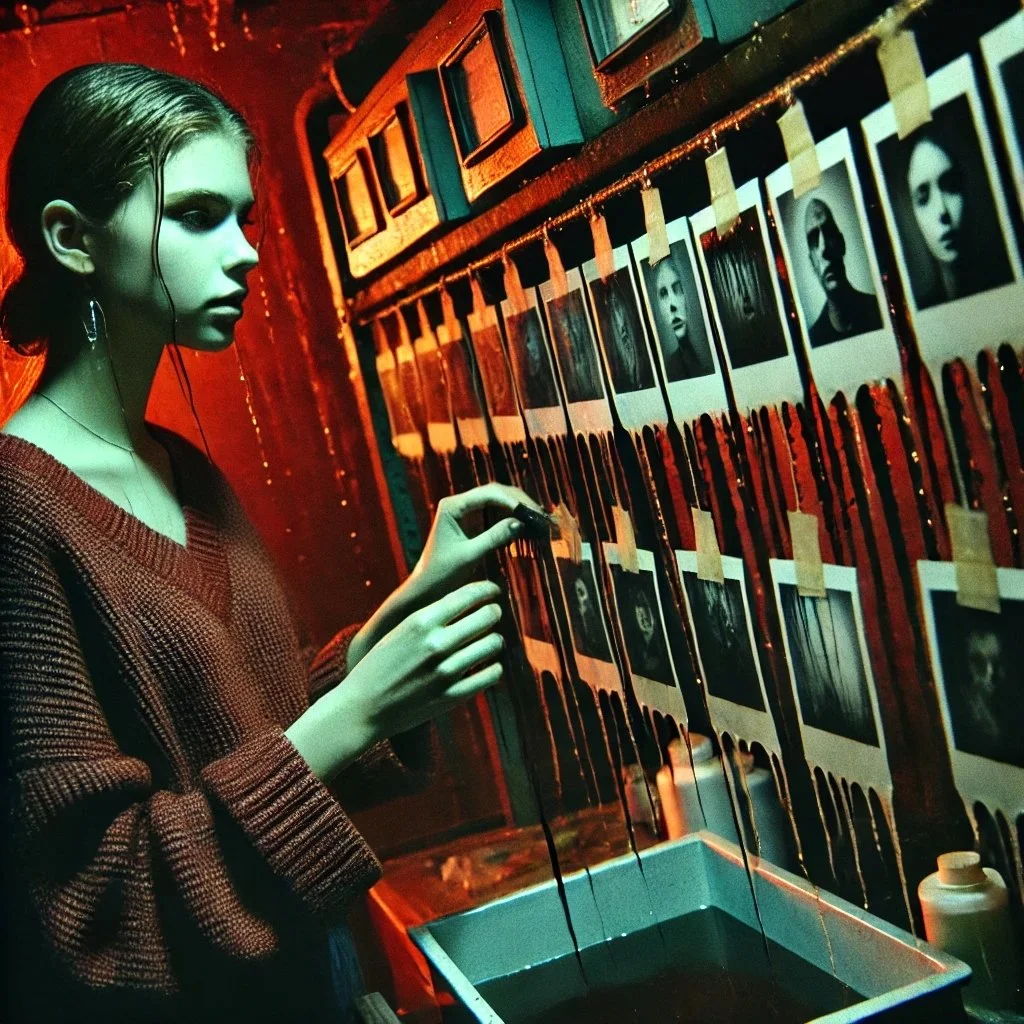
"The Purloined Rorschach" engages with themes of perception, consent, and the haunting effects of representation, drawing on the interplay between visual art and psychological analysis. The title immediately evokes associations with Lacan's psychoanalytic theory as well as Edgar Allan Poe's "The Purloined Letter," suggesting a metaphorical theft or concealment of meaning. By pairing "Rorschach" with "Purloined," the poem hints at the manipulation of perception, recalling the famous psychological inkblot test, which reveals as much about the observer’s mind as it does about the ambiguous shapes themselves.
The poem opens with a failure to articulate—"She failed to pin it down / with words"—a recognition that some experiences or images resist verbalization. This inability to define evokes both the subjectivity of perception and the limitations of language in capturing what is felt but not fully understood. The negatives hanging in the art-class darkroom symbolize the incomplete or inverted view of reality. Negatives, in photography, contain all the information of the image but in reverse, and here they stand as a metaphor for how perceptions, particularly those hidden or obscured, reveal truths that are otherwise muted in their direct counterparts.
The "dangling negatives" are described as having an "eerie aura," which reflects the poem's meditation on the unsettling nature of imagery that captures people unawares—those "silent capture[s] of unwitting faces." The imagery of dripping negatives conjures a sense of both creation and dissolution, emphasizing the transformative process in which reality is manipulated and something darker or more elusive comes into focus. The "verted twins," or the original, positive versions of the images, are said to be "muzzled," implying that the negatives disclose something unspoken or unseen in the originals. In this way, the negatives amplify a hidden feature: "the bald ransack of consent," hinting at the unethical dimensions of capturing images or moments without the subject's permission or awareness.
By combining these motifs, the poem critiques both the art of photography and, more broadly, the way we consume and interpret visual media. The reference to "the silent capture of unwitting faces" calls attention to the power dynamics inherent in representation, where subjects are objectified and deprived of agency. There is an implicit tension between the act of creation and the moral implications of that creation, with the "bald ransack of consent" drawing attention to the ways in which art or media can exploit, appropriate, or violate without overt recognition.
This poem functions as a meditation on the ethics of observation, the nature of art as a form of power, and the darker aspects of how we frame, interpret, and use imagery—especially when the subjects of those images are unaware or unconsenting participants. Its brevity belies a dense engagement with questions of perception, representation, and the moral responsibilities of those who wield the camera, the brush, or the pen.
representation, consent, photography, negatives, perception, power dynamics, art ethics, imagery, visual media, unwitting faces, silent capture.
Leaves of Three Let Them Be
The poem "Leaves of Three Let Them Be" meditates on the tension between intuition, learned knowledge, and adaptability in navigating both ordinary and high-stakes situations. The title itself references the common adage warning of poison ivy, symbolizing the necessity of learned caution in the natural world. The phrase also sets the thematic stage for the poem’s exploration of when to trust preconceptions and when to challenge them.
In the first stanza, the metaphor of a blind tasting—commonly used in wine appreciation to strip away biases associated with labels—introduces the idea that we are often better served when freed from the weight of preconceptions. For sommeliers, whose craft is deeply tied to sensory perception, removing biases is necessary to fully understand the essence of what is tasted. The implicit argument is that, in areas of subjective judgment or fine distinctions, this approach enables greater clarity and authenticity. However, the poem pivots sharply in its second stanza, where it shifts the context from leisure or craft to survival, specifically on the "front lines." Here, the stakes are higher, and the dismissing of labels or preconceptions becomes not only impractical but dangerous.
The poem highlights a fundamental human dilemma: balancing the wisdom of experience—"labels and preconceptions"—with the need to remain open to new information. Labels are initially portrayed as "saviors," suggesting that our ability to categorize and interpret the world based on past knowledge is crucial for survival, especially in volatile or unpredictable environments. Yet the poem does not endorse rigid adherence to these preconceptions. The closing lines emphasize flexibility: the ability to "drop them in the face of new evidence." This nuanced argument underscores the poem's central theme—that the most adaptive and intelligent approach to the world involves a balance between relying on past knowledge and being open to change when circumstances demand it.
The poem, though concise, engages deeply with cognitive and philosophical issues, such as epistemology (how we know what we know) and the psychology of decision-making under uncertainty. It suggests that in a world marked by complexity and unpredictability, the survival of both individuals and societies depends not just on the knowledge they have accumulated but on their capacity to revise that knowledge when confronted with new truths. This openness to reconsidering one’s assumptions is framed as essential not only in intellectual pursuits but also in life-and-death situations, making it a universal call for intellectual humility and adaptability.
preconceptions, survival, adaptability, intellectual humility, blind tasting, labels, cognitive flexibility, epistemology, decision-making, new evidence.

Pulling Rank
"Pulling Rank" is a pointed critique of how identity is leveraged in contemporary social and political discourse, particularly within the framework of identity politics. The poem’s opening, “She opens her soliloquy with that dissent-snuffing script: 'Speaking as an x person,'” reveals the speaker’s frustration with the pre-emptive use of identity as a conversational weapon. By placing “dissent-snuffing” before “script,” the poem underscores how these opening words are not just a statement of personal identity, but a strategic move designed to shut down debate or criticism. The act of “pulling rank” on the basis of one’s identity highlights a shift from argumentation based on shared principles or logic to one dominated by personal experience, making it difficult for those outside the identity category to engage without being accused of invalidating the speaker's lived experience.
The “flex of ethnic high ground” reflects how this identity-based discourse often involves elevating one’s own cultural or racial background as inherently superior in matters of truth or justice. The metaphor of “sob-story judo” portrays the inversion of traditional power dynamics, where suffering, real or exaggerated, becomes a tool for rhetorical victory. Judo, a martial art focused on using an opponent's strength against them, serves as a fitting metaphor for how personal narratives of hardship can be wielded against any form of criticism or opposition. The “my-truth supremacy” that follows critiques the cultural rise of subjective narratives being given precedence over more objective, universally shared truths. This “supremacy” of personal truth aligns with the contemporary emphasis on the sanctity of lived experiences, even when such experiences are insulated from external validation or critique.
The poem taps into a larger cultural critique of how victimhood, particularly racial or ethnic victimhood, can be weaponized. The phrase “effective in a zeitgeist where, unless your skin skews pale, even fake bruises are brass knuckles” extends this critique, suggesting that in an era where whiteness is associated with privilege, any claim of marginalization by people of color—even falsified or exaggerated claims (“fake bruises”)—carries disproportionate rhetorical weight (“brass knuckles”). This line captures the speaker’s frustration with the asymmetry in cultural conversations about race, identity, and oppression. The suggestion that even “fake bruises” can be weaponized hints at a deeper skepticism about the authenticity of some claims of victimhood within identity politics, questioning whether the current climate enables the performance of victimhood rather than a genuine exchange of ideas.
The overall theme of the poem is a nuanced exploration of how identity, particularly marginalized identities, are wielded in modern discourse. The speaker’s tone, at times sardonic, reveals a frustration with the limitations this type of discourse imposes on genuine dialogue and critical engagement. The poem exposes the tension between recognizing genuine marginalization and the potential for exploitation, wherein identity becomes a currency that stifles rather than fosters meaningful conversation. This critique calls into question the boundaries between empathy and manipulation, raising the issue of whether the current discourse around identity truly seeks justice or merely uses suffering as a rhetorical advantage.
identity politics, victimhood, personal narrative, discourse, rhetorical dominance, ethnic hierarchy, power dynamics, subjective truth, marginalization, cultural critique

MADE FOR YOU AND ME 2: hive Being (Stanzas 2017--part 39)
This poem presents a layered meditation on the collapse of personal and societal safeguards against existential and environmental decay. The title phrase, "that vinegar band of brevity where the safe word has no efficacy," immediately signals a situation where traditional mechanisms of protection, communication, and control break down. The metaphorical use of a safe word, often a tool of consent and boundary, is rendered powerless here, suggesting a world in which the boundaries between comfort and danger, self-preservation and destruction, are no longer maintained. This is a theme that resonates throughout the poem, which oscillates between deeply personal and grander societal reflections.
One of the most powerful images, "your father’s clothes there in the corner, double-bagged still from the hospital," evokes the stark reality of loss, the impersonal handling of death, and the attempt to distance oneself from grief through sterile containment. The use of “double-bagged” connotes both the literal precautionary handling of contaminated objects and a symbolic gesture to quarantine the overwhelming emotions surrounding death. This suggests a societal tendency to compartmentalize trauma, to sanitize grief rather than confront it.
In contrast, the image of “wild horses grazing upon radiation hidden inside familiar green” brings a startling clash between the natural and the artificial. The horses, symbols of freedom and untamed nature, now feed unknowingly on poisoned land, their innocence marred by the invisible dangers of human technology. This juxtaposition echoes a broader critique of environmental destruction masked by superficial normalcy, highlighting the ways in which the effects of industrialization and technological advancement seep unnoticed into the natural world.
The poem then veers into reflections on societal anesthesia through images like “techno hypnosis in Japanese pachinko parlors,” a reference to addictive, mind-numbing entertainment that distracts from existential threats. These lines suggest a critique of the contemporary tendency to avoid reality, drowning out real dangers with immersive, trivial distractions. Similarly, the question, “How would we act if we began each day with a funeral?” is a rhetorical challenge, urging the reader to consider the weight of mortality and the collective failure to confront it in a meaningful way. By living as if death and decay are distant abstractions, society avoids responsibility for its own decline.
Further, the poem addresses generational culpability, questioning why past generations did not act to "stop the horror," a reference perhaps to environmental degradation, systemic violence, or societal corruption. The silence of older generations is framed as complicity, and the poem portrays this neglect as an ongoing source of suffering for future generations. In the midst of these existential musings, the figure of the "bum king" hollering “Mush!” at his strays stands as an emblem of desperation and the crumbling of order, symbolizing how even those at society's fringes attempt to assert control in a world slipping into chaos.
At its core, the poem engages with themes of powerlessness, the futility of human structures against the forces of time and entropy, and the existential loneliness that accompanies the gradual realization of this powerlessness. It is a work that critiques the denial of uncomfortable truths—whether personal (grief, familial loss) or societal (environmental collapse, cultural anesthesia)—and challenges the reader to confront what has been systematically avoided.
existentialism, grief, societal collapse, environmental decay, powerlessness, control, modern distractions, generational guilt, human vulnerability, technological sedation.
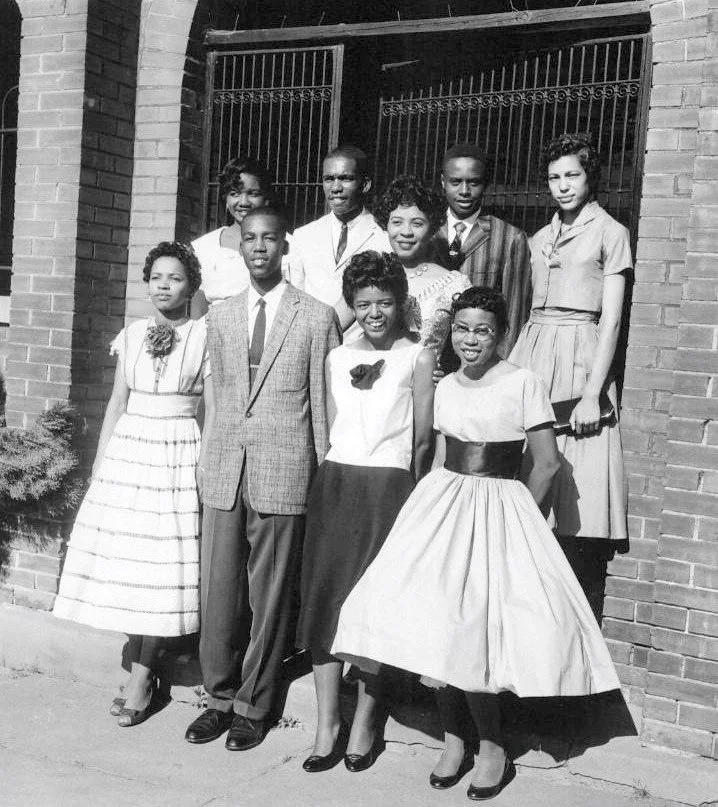
Little Rock Nine
This poem critiques the modern commercialization of black resistance, contrasting the bravery of the Little Rock Nine with contemporary movements that indulge in performative mysticism, pseudoscience, and the glorification of violence. It questions whether such movements, often framed in abstract or spiritual terms, meaningfully advance the cause of black liberation.

Mosh Pit
This poem offers a visceral exploration of primal impulses, drawing a parallel between human and animal behavior through the metaphor of a mosh pit. The opening line, "Even gorilla parents wrap their lips over their teeth," sets the stage for a meditation on restraint and the balance between aggression and affection, especially in parental relationships. Gorillas, known for their strength and potential ferocity, are portrayed here as embodying a careful, controlled interaction with their offspring, much like human parents who must temper their power when engaging with vulnerable children.
The physicality of the imagery, particularly the "nibbling at toddler limbs," highlights the tension between the primal urge to exert force and the necessity of tenderness. This tension mirrors human experiences where instincts to dominate or overpower must be subdued in the face of fragility and innocence. The mosh pit, implied through the metaphor of "ear-pulling romping of dumb flesh," serves as a symbol for both play and the underlying potential for violence in social interactions. Here, the "dumb flesh" speaks to the inherent vulnerability of the young or weaker party, whose playful or chaotic movements test the limits of the stronger being's self-control.
The poem’s deeper theme revolves around the idea of placation—specifically, how beings, whether animal or human, manage their aggressive urges through negotiated behaviors. The urge to bite "clean through" becomes a metaphor for unchecked aggression or violence, while the act of nibbling and lip-wrapping represents the channeling of those impulses into socially acceptable actions. This primal flirtation with violence is not eradicated but managed through a delicate dance between desire and restraint. The speaker suggests that such behaviors are not limited to animals but are intrinsic to human nature as well, making the mosh pit a fitting metaphor for the chaotic, often unspoken negotiation between our violent urges and the social need for control.
The poem thus becomes an exploration of the thin line separating play from harm, highlighting how both humans and animals navigate this boundary. It raises questions about the nature of power, vulnerability, and the inherent fragility of life, all of which are subjects negotiated through our interactions with others—be it in a parental relationship, a social gathering, or the wider context of societal norms that manage violence.
primal urges, gorilla parenting, mosh pit, violence, restraint, fragility, social negotiation, human behavior, parental interaction, animal metaphor.

MADE FOR YOU AND ME 2: hive Being (Stanzas 2017--part 38)
This work presents a fragmented reflection on the darker undercurrents of human experience, focusing on trauma, repression, and the blurred boundaries between innocence and corruption. The imagery is visceral and often unsettling, blending the banal with the grotesque to evoke the ways in which trauma and desire coexist beneath the surface of everyday life. Themes of childhood innocence—juxtaposed against adult sexual desire—are explored through imagery that collapses the distance between pure curiosity and exploitation. For example, the toddler’s innocence is tainted by the presence of a molester, and a playful carousel ride morphs into a symbol of lurking, predatory intent. Such images suggest that the line between innocence and corruption is precarious, and that society’s attempts to uphold these distinctions are fragile at best.
From a psychoanalytic perspective, the poem can be interpreted as a meditation on the return of the repressed. The grotesque acts and desires mentioned—such as the molester’s exploitation of a toddler or the autistic child digging into their own flesh—seem to surface as manifestations of latent, unspoken traumas. Freud’s theory of the unconscious, particularly his idea that repressed desires and fears manifest in unexpected and often disturbing ways, can be applied to this text. The work’s refusal to provide a clear narrative mirrors the disjointed nature of traumatic memory, which often resurfaces in fragments, disassociated from linear time. The text’s seemingly unrelated vignettes of disturbing experiences highlight this fragmentation, suggesting that trauma and repression are not easily contained or processed within the bounds of conventional language or narrative.
Additionally, the poem addresses how language and cultural symbols both expose and obscure human experiences of desire and trauma. The image of a child gripping a carousel pole, sticky from cotton candy, is particularly striking in how it conflates innocence with impending danger. Carnivals and carousels, often symbols of childhood joy, are here tinged with a darker sexual undercurrent, pointing to the intrusion of adult knowledge and predatory impulses into the realm of childhood. This collapse of boundaries suggests a Freudian reading of the poem’s themes, where the distinctions between childhood innocence and adult desire are unstable, revealing a more troubling, unconscious reality.
Moreover, the poem’s fragmented structure and shifting imagery evoke a post-structuralist critique of how language fails to capture the full complexity of human experience. The work challenges the notion that meaning can be neatly contained within social norms or linguistic structures, particularly when it comes to the taboo or unspeakable aspects of human life. The text implies that societal efforts to categorize or explain human behavior—especially in terms of innocence and guilt, desire and trauma—inevitably fall short. Instead, the poem suggests that these experiences are more fluid, existing in a liminal space where language falters and cultural distinctions break down. This mirrors the psychoanalytic idea that much of human experience exists beyond the reach of conscious articulation, driven by unconscious desires and traumas that resist simple categorization or explanation.
Ultimately, the work grapples with existential questions about the human condition, particularly the tension between what is socially acceptable and what lurks beneath the surface. The recurring theme of unspeakable desires, whether sexual or otherwise, reflects a broader discomfort with the limits of language and societal structures in addressing the more primal aspects of human existence. The poem invites the reader to confront these uncomfortable truths, exposing the fragility of societal norms and the inadequacy of language to fully contain the darker elements of human nature.
This collection of fragmented reflections and images explores profound and often disturbing aspects of human experience, such as trauma, innocence, desire, and the collapse of language as a means to convey these complexities. The fragments embody a modernist approach to poetry, reminiscent of the stream-of-consciousness technique and the fragmented poetics of T.S. Eliot or the late avant-garde. The text juxtaposes ordinary and grotesque moments, oscillating between the innocence of childhood and the disturbing forces that shape it. It reflects on the inability of language, and by extension societal norms, to fully contain or express human experiences, particularly those related to trauma, exploitation, and base desires.
The recurring motif of innocence turned grotesque suggests that trauma is a cyclical and often subliminal force passed from generation to generation. The repeated invocation of childhood innocence—juxtaposed with sexual exploitation and degradation, as seen in lines like “sexual to the molester; pure curiosity to the toddler” or the “five-year-old paid a quarter for quarter entry”—interrogates the vulnerability of the child figure within a morally ambiguous or corrupt world. The grotesque descriptions of physical bodies and behaviors—such as "ass-digging autistic child sniffs his fingers" or "the bed-head beer-drunk flipflops around her trailer park"—further underscore the dissolution of social and moral boundaries. This blurring of the sacred and profane is an exploration of what theorists like Julia Kristeva would refer to as the "abject," elements of human experience that society repels yet remains fascinated by.
The piece also confronts the inadequacies of language and thought to contain or make sense of such experiences. The phrases "aspiring—squirming—for things for which there are no words" and "desire spilling beyond the brim of vocabulary" point to the central dilemma in which language is inadequate to express certain human conditions—particularly those related to trauma, primal desires, or existential dread. In the tradition of post-structuralist thinkers like Derrida, the text suggests that the reality of human experience is mediated through, and often trapped by, language, which both reveals and conceals. Words fail to convey the depth of human suffering, desire, and existential uncertainty, yet they remain the primary vehicle for meaning-making.
Finally, the piece delves into the intergenerational transmission of trauma, particularly through familial structures and cultural norms. Whether in the abusive imagery or in subtler, more existential reflections like "baroque prose covering horrible thoughts in a purple veil," the text suggests that families, social systems, and even language serve as carriers of trauma. In this sense, it aligns with psychoanalytic and post-Freudian critiques of family dynamics, exploring the repressed violence and desires that shape human development. The seemingly innocuous act of childhood play ("the password to the pillow fort") becomes an emblem of how trauma can be encoded in memory, later emerging as "a linguistic knot of innocence and trauma."
This piece uses fragmented imagery and disjointed reflections to explore the intergenerational transmission of trauma, societal repression, and the inadequacies of language to express complex human emotions and desires. It challenges the boundaries between innocence and grotesqueness, sacred and profane, while delving into the subtle ways trauma manifests in everyday life.
trauma, innocence, repression, grotesque, language inadequacy, psychoanalysis, intergenerational trauma, societal norms, abjection, existential dread, linguistic failure

Skirt
This poem offers a critique of the systemic and societal failure to address the awkward and confusing aspects of puberty. It underscores the silence and avoidance surrounding these critical developmental moments, pointing to the lack of guidance and support for young people navigating their changing bodies. The metaphor of being “bound by a clock now ticking” illustrates the relentless passage of time as both an internal and external pressure—where the inevitable arrival of puberty forces conversations that many adults, particularly those in institutional roles, attempt to evade. The figure of “Dr. Script Checklist” functions as a representation of institutional figures such as doctors, teachers, or even parents, who, instead of offering meaningful guidance, rely on standardized, superficial interactions that fail to address the emotional and psychological depth of what adolescence entails.
The poem’s vivid imagery, such as the “eyebags of evasion” and the “rank room of hairy changes,” speaks to the physical and emotional toll that avoidance takes on both the guides (the institutional or adult figures) and the preteens themselves. The description of the “eyebags” as a symbol of exhaustion suggests a cumulative fatigue—likely the result of years of evading honest discussions about puberty, sexuality, and the complex emotional landscapes that accompany these changes. The “rank room” symbolizes the uncomfortable and often unspoken realities of the adolescent body, where physical changes become the site of embarrassment and shame rather than natural development.
Moreover, the absence of a “knee-to-knee sit-down” conveys a deep failure in communication, one that should be intimate and compassionate but is instead replaced by institutional coldness or personal avoidance. The poem draws attention to the systemic neglect of emotional education, where myths of shame surrounding puberty are not addressed directly. The phrase “inoculating the preteen” cleverly uses medical language to highlight the idea that just as vaccines protect the body from disease, open and honest conversations can protect the mind from the toxic myths and distortions about puberty and sexuality. However, the poem laments that such intellectual and emotional “vaccination” does not take place. Instead, the myths surrounding puberty are “too ubiquitous to call ‘distorted,’” pointing to the overwhelming pervasiveness of shame and misunderstanding.
The poem also critiques the societal failure to recognize the importance of guiding young people through puberty, which is often relegated to a distant, uncomfortable task to be avoided rather than embraced. This systemic negligence results in preteens navigating the tumultuous waters of puberty alone, left to grapple with confusing and complex feelings without the support they deserve. Through its subtle yet pointed critique, the poem captures the intersection of institutional avoidance, personal evasion, and the vulnerable moments of adolescence that are left untended.
This poem critiques the societal and medical neglect of puberty and the failure to guide young individuals through these vulnerable changes. Using medical language and powerful imagery, it exposes the pervasive myths of shame surrounding adolescence and highlights the systemic avoidance of difficult but necessary conversations.
puberty, societal avoidance, systemic neglect, adolescence, medical language, institutional failure, shame, myths, emotional guidance, intellectual vaccination, development, Dr. Script Checklist, adolescence transition, preteen challenges, body changes, emotional toll, personal evasion.

Pillow Fort Password
"Pillow Fort Password" examines the horrifying reality of childhood molestation, a subject approached through unsettling imagery and a juxtaposition of innocence and corruption. The poem opens with "wide-eyed curiosity unfazed," suggesting the child's initial innocence, but this is quickly undermined by a darker narrative. The reference to Elsa’s "Let It Go," a song typically associated with childhood joy, contrasts sharply with the description that follows—"cherub hands" turning into a "gargoyle grip." The transformation from an angelic to monstrous image hints at the violation of innocence, with the child becoming an unwitting participant in something grotesque.
The line "pump that veiny rigidity with an obscene autonomy" is a disturbing and explicit reference to a child being involved in an act of molestation, underscoring the obscene and coercive nature of the situation. The phrase "too vigorous, too disinviting of oversight" points to the lack of adult intervention or awareness, a damning critique of societal failure to protect children from such abuse. The absence of "oversight" speaks to the hidden, secretive nature of molestation, where acts of violation occur beyond the gaze of those responsible for the child's safety. The use of the word "demonic" in the final line encapsulates the evil inherent in the situation, framing the molestation as not just a moral failing but a violation of the child's very humanity.
The pillow fort, typically a symbol of childhood innocence and imagination, becomes a setting of betrayal. It symbolizes a supposed place of safety turned into a site of trauma, furthering the sense of innocence corrupted. The use of sexual imagery combined with the context of childhood play creates a disturbing tension, reflecting the grotesque inversion of something pure into something deeply harmful. The poem is a stark portrayal of the hidden, horrific reality of child molestation and the failure of those who should be safeguarding the vulnerable.
"Pillow Fort Password" addresses the troubling intersection of childhood innocence and burgeoning sexual awareness, using stark and provocative imagery to critique societal discomfort with discussing bodily autonomy and sexual curiosity in young people. The poem sets up a tension between the external appearance of innocence, symbolized by the “wide-eyed curiosity” of the child unfazed by something as innocuous as Elsa’s “Let It Go,” and the darker, more complex undercurrent of premature sexual behavior. The "gargoyle grip" that is "hellbent on velocity" portrays an intense, almost otherworldly force behind the child’s actions, raising questions about the role of natural curiosity versus the taboo nature of such behaviors in society’s view.
By invoking a children's figure like Elsa, the poem establishes an environment of childhood innocence that contrasts with the more disturbing image of the child’s autonomous, unregulated exploration of their body. The saliva-evoking laughter transitions into an act that society may view as inappropriate or ‘demonic,’ highlighting the cognitive dissonance adults experience when witnessing children express forms of sexuality, however innocent the intention may be. This tension between innocence and obscenity underscores a larger societal reluctance to confront the reality of childhood sexual exploration, preferring to demonize or repress rather than guide.
The use of phrases like “obscene autonomy” and “too disinviting of oversight” reflects on the failure of adult intervention in such scenarios, whether due to ignorance, fear, or discomfort. The poem suggests that the child’s actions, though natural, become coded as demonic or inappropriate due to the inability or unwillingness of caregivers to engage with them constructively. It critiques the societal impulse to impose moral judgments on behavior that falls outside of traditional expectations of childhood purity, exposing a failure to reconcile the realities of bodily autonomy with normative ideas of innocence.
The poem can be read as a commentary on the complexity of child development, where boundaries between innocence and emerging sexuality are often blurred, and societal taboos prevent meaningful guidance or understanding. It calls attention to how these taboos, far from protecting children, contribute to a culture of avoidance and silence, leaving them to navigate their curiosities in isolation. The child’s “veiny rigidity” represents not just a physical reality, but the rigidity of societal structures around sexuality that fail to offer the fluid, adaptive responses children might need in such formative moments.

Wishful Cortical Core
The poem "Wishful Cortical Core" explores the human tendency to seek mystical explanations for shared mental experiences, despite their grounding in biology and media influences. By referencing "lysergic visions," the poem invokes psychedelic imagery and the influence of substances like LSD, suggesting how altered states of consciousness often lead individuals to embrace fantastical interpretations of reality. The phrase "media-coached like flying-saucer UFOs" highlights how popular culture and mass media shape these visions, subtly directing people toward specific cultural icons or experiences, such as UFO sightings, which became widespread only after media popularized them. The reference to Janis Joplin and paisley patterns alludes to the 1960s counterculture, where drugs and music intertwined to fuel a collective yet chemically influenced search for meaning.
The poem then pivots from this media-driven imagery to emphasize the biological similarity between human brains, describing them as "star-stuff riffs on a neurochemical theme." Here, the poet reminds us that much of what we experience, including mystical visions, can be traced back to the brain’s common structure and chemical processes. The shared nature of these experiences, rather than pointing to supernatural or "woo-woo" realms like astral planes, is rooted in the neurochemistry all humans share. The poet asks why people tend to leap toward metaphysical or supernatural explanations when such commonality is easily accounted for by our shared biology.
In essence, the poem critiques the human inclination to romanticize or mystify shared experiences that can be scientifically explained. It challenges the notion that collective psychedelic or spiritual experiences imply access to otherworldly planes, suggesting instead that these experiences are products of our biological makeup and cultural conditioning. The poem provokes readers to reflect on why we often prefer fantastical explanations over grounded scientific ones, even when the latter are sufficient to explain the phenomena.
psychedelic experiences, shared consciousness, media influence, brain chemistry, biological commonality, supernatural explanations, mystical interpretations, neurochemistry, cultural conditioning, altered states

Simple Shapes Turned Intergalactic Switchboards
The poem "Simple Shapes Turned Intergalactic Switchboards" critiques humanity’s compulsion to find significance in simple geometric shapes by linking them to extraterrestrial theories. The “duh triangle” in the poem symbolizes the rudimentary triangle, a form we instinctively associate with simplicity and stability in the natural and built world. It evokes the human tendency to elevate such basic shapes into grand designs, exemplified by the piling of stones into the monumental pyramids of Giza. However, the poem turns this focus on the modern obsession with fringe theories, as represented by the excessive consumption of television content that interprets these ancient structures not as human achievements but as the result of alien intervention. The scattering of pyramids globally becomes a convenient narrative for conspiracy theories, which exploit the human desire to transcend cosmic insignificance.
The poem contrasts the historical human drive to create (represented by the ancient pyramids) with the contemporary drive to mythologize, which seeks meaning beyond the earthly. It reflects on how humanity’s intellectual curiosity, once grounded in physical creation and scientific observation, has shifted into a yearning for fantastical explanations. The reference to “too much TV” underscores how media plays a significant role in distorting our view of history and the cosmos, distracting us from the real and tangible achievements of ancient civilizations in favor of speculative, often baseless, narratives of alien intervention. The global fascination with alien communication grids as explanations for these ancient wonders demonstrates humanity’s ongoing struggle to confront its existential triviality without the need for a transcendent "other."
Ultimately, the poem serves as a critique of how modern culture, rather than celebrating the tangible accomplishments of human history, frequently gravitates toward escapism through speculative conspiracies. By contrasting the real and the imagined, the poem invites readers to consider how we construct meaning, not from factual achievement, but from the desire to transcend the ordinary and embrace the fantastic, however improbable.
conspiracy theories, pyramids, alien intervention, geometry, ancient civilizations, escapism, human achievement, media critique, cosmic insignificance, historical creation

If It Were Not So Organically Human
"If It Were Not So Organically Human" critiques the modern tendency to embrace absurd conspiracy theories while ignoring very real and consequential global issues. The poem juxtaposes two worlds of thought: the "frothing" over fabricated narratives—such as "pizzagate," "chemtrails," and "reptilian flat Earth" conspiracies—against the actual, undeniable realities of state violence and corporate malfeasance. The conspiracies mentioned, which have captured the imaginations of certain groups, represent a form of escapism, a diversion from addressing pressing, tangible issues like drone strikes on hospitals and the unchecked power of corporations that monopolize seed patents while poisoning the environment with sugar and pesticides.
The poet cleverly suggests that such distraction might seem almost orchestrated, as if the focus on fantastical plots is intentionally designed to keep people from questioning and acting upon the real, oppressive forces shaping the world. Yet, the title—"If It Were Not So Organically Human"—indicates that this diversion is not part of a calculated conspiracy, but rather a fundamental human flaw. The irony is that, instead of grappling with the harsh truths of state and corporate corruption, individuals latch onto farcical ideas, driven by a psychological need for simpler, more digestible explanations for their anxieties.
In this way, the poem critiques not only the proliferation of conspiracy theories but also the failure of collective awareness. By choosing to focus on fictitious global conspiracies, society allows itself to overlook or tolerate the real machinations of power that shape its fate. The poem’s structure, moving from the imaginary to the real, creates a stark contrast between the bizarre yet captivating fantasies and the cold, impersonal violence of governmental and corporate entities. It calls for a realignment of focus—away from the outlandish and toward the urgent and true.
conspiracy theories, escapism, state violence, corporate control, environmental destruction, psychological diversion, pizzagate, chemtrails, reptilian, human nature, societal critique.





blog
FAQ

Visit my Substack: Hive Being
Visit my Substack: Hive Being
Don’t let anyone tell you that real life is lacking in poetic interest. This is exactly what the poet is for: he has the mind and the imagination to find something of interest in everyday things. Real life supplies the motifs, the points that need to be said—the actual heart of the matter; but it is the poet’s job to fashion it all into a beautiful, animated whole. You are familiar with Fürnstein, the so-called “nature poet”? He has written a poem about growing hops, and you couldn’t imagine anything nicer. I have now asked him to write some poems celebrating the work of skilled artisans, in particular weavers, and I am quite sure he will succeed; he has lived among such people from an early age, he knows the subject inside out, and will be in full command of his material. That is the advantage of small works: you need only choose subjects that you know and have at your command. With a longer poetic work, however, this is not possible. There is no way around it: all the different threads that tie the whole thing together, and are woven into the design, have to be shown in accurate detail. Young people only have a one-sided view of things, whereas a longer work requires a multiplicity of viewpoints—and that’s where they come unstuck.—Goethe (Conversations with Eckermann)




Featured Blog Posts
have appeared last night—
all those met along the way?
Scholarly Essay: "Pound Town: A Defense of the Moral Permissibility of Bestiality"
"Pound Town: A Defense of the Moral Permissibility of Bestiality" is a work of philosophical provocation in the tradition of the academic thought experiment — rigorous, footnoted, structured in the formal architecture of analytic ethics, and dedicated to two figures (Gary Varner, a philosopher of animal ethics, and Grandpa Jack) whose juxtaposition announces the essay's governing tonal register: the personal and the scholarly, the lived and the argued, occupying the same space without apology. It is a piece that takes seriously the philosophical obligation to follow argument wherever it leads, even when — especially when — it leads somewhere the culture has decided in advance cannot be arrived at by honest reasoning. Whether one arrives at its conclusions or not, the essay is a sustained demonstration that the consensus against bestiality rests on philosophical foundations considerably shakier than its cultural certainty suggests.
The essay's formal strategy is the systematic elimination of available rationales. It does not argue for bestiality in the abstract or as a general practice. It argues for the moral permissibility of certain instances of bestiality — a narrower and more defensible claim — and it does so by walking through every category of objection the philosophical and cultural arsenal provides: intuition, biblical authority, naturalness, animal wellbeing, and human wellbeing. Each section follows the same structure: state the argument in its most rigorous form, then dismantle it. What accumulates across these demolitions is not a positive case for bestiality so much as a negative case against the coherence of its prohibition — a demonstration that the grounds on which the taboo rests are either internally inconsistent, arbitrarily applied, or insufficient to do the philosophical work required of them.
The twelve cases organized into four categories at the essay's opening are the piece's most formally accomplished section, and they deserve attention as a philosophical device before anything else. The cases range from unequivocally immoral scenarios — the hen throttled to death in Case 1, the starved collie in Case 2, the drugged piglet in Case 3 — to scenarios of such apparent benignity that the moral objection becomes increasingly difficult to locate: the tween girl getting off from her horse's gyrations in Case 4, the man ejaculating on a turtle's shell in Case 6, the primatologist taken by the orangutan in Case 7. This range is not rhetorical sleight of hand but philosophical precision: it forces the reader to specify exactly what feature of any given case makes it morally objectionable, and in doing so exposes how few of the available features — coercion, harm, lack of consent — apply to the cases in the B, C, and D categories. The cases are the essay's most effective argumentative tool because they make concrete what abstract prohibition tends to leave vague.
The section on intuition is where the essay's most philosophically consequential argument lives, and it is constructed with genuine care. The essay does not dismiss intuition as a moral guide; it accepts the reality of the disgust response and even owns it in the first person — "I too find it disgusting to envision someone, say, performing fellatio on a horse." What it refuses is the move from disgust to moral impermissibility, and it does so by attacking both premises of the intuition argument. Against premise two — that intuition against bestiality is universal — it marshals an extraordinary ethnographic inventory: ancient Egyptians, ancient Greeks, ancient Hindus, the Kisii of Kenya, the Masai, the Comeburras of Colombia, the Inuit, numerous tribal cultures across four continents, and a list of historically famous suspected practitioners that ranges from Tiberius to Aleister Crowley. The inventory is not merely comprehensive; it is philosophically functional. If the intuition against bestiality were a reliable moral guide, it would need to be something like universal. The evidence suggests it is not.
Against premise one — that intuitive wrongness implies moral wrongness — the essay deploys its most rhetorically powerful passage: the extended catalogue of human cognitive failures, biases, and moral atrocities that our intuitions have licensed, from geocentrism to the skull-reading of phrenology to the intuitive wrongness of miscegenation. The catalogue is deliberately excessive, accumulating well past the point at which any single item would suffice to make the logical point, because the accumulation is itself the argument: we are the sort of critters who cannot trust our gut about things we have decided in advance. The section on intuition concludes that moral repugnance, however indelible, requires independent justification — and then spends the rest of the essay demonstrating that the available independent justifications fail.
The biblical section is brisk because its work is largely done by the consistency argument: the Bible condemns homosexuality with the same force it condemns bestiality, and we have decided that the Bible's condemnation of homosexuality is insufficient to establish its immorality. The same epistemic grounds that license that conclusion license the same conclusion about bestiality. The essay does not attack the Bible's authority on religious grounds but on grounds of internal inconsistency and demonstrated errancy: a document that prohibits eating lobsters and getting tattoos and wearing linen-wool blends cannot be treated as a reliable moral authority on bestiality without accounting for why those prohibitions are being selectively ignored. The section's most philosophically interesting moment is the discussion of divine command theory, where the essay acknowledges the internal logic of the position — if right and wrong are ultimately God's arbitrary decree, then everything depends on correctly identifying God's decrees — while exposing the epistemic problem that position generates: by what method does one establish that the Bible, rather than competing holy texts, reflects those decrees?
The section on naturalness dispatches the is-ought fallacy with appropriate efficiency and then spends more time than strictly necessary on the enumeration of meanings of "unnatural" — not because the argument requires it, but because the enumeration reveals how many different objections are being bundled under a single term and how few of them, when separated and examined individually, withstand scrutiny. The observation that naturalness arguments are wielded against bestiality by people who sleep with CPAPs in air-conditioned homes after heart transplants is the essay's most elegant single point, delivered with the compression of good comic writing.
The animal wellbeing section is the essay's most extended and most philosophically serious, because it engages the strongest available objection. The essay does not dismiss the consent framework; it argues that animals can in fact communicate consent through behavioral signals — and here the inclusion of Liz Moores's description of equine attunement is the essay's most formally distinctive move, embedding a perfumer's testimony about the near-psychic quality of the human-horse bond in the middle of a philosophical argument about consent capacity. The passage is not merely decorative. It is evidence: the claim that horses cannot communicate consent, willingness, and refusal is empirically contested by anyone with sustained experience of horses, and the essay appeals to that experience directly. The section's most philosophically rigorous passage is the extended argument distinguishing the animal from the toddler — four criteria (hormonal maturity, radically different future, likelihood of later trauma, not yet at full cognitive capacity) that jointly explain why behavioral consent from an animal suffices where the same behavioral consent from a toddler does not. The distinction is careful and the criteria are genuinely functional, blocking the most common reductio offered against the consent argument.
The human wellbeing section is where the essay's rhetorical energy is highest, because it is where the essay's central meta-argument becomes most explicit: what is actually driving the taboo is not concern for animals but concern for human identity, human social order, and the illusion of human exceptionalism. The slippery slope arguments against bestiality are exposed as fallacies through the observation that the same logic would imply that consensual sex with humans increases the likelihood of nonconsensual sex with humans — a conclusion no one draws. The zoonotic disease objection is met with the observation that human-to-human sex also transmits disease, that precautionary measures reduce transmission risk to manageable levels, and that we do not condemn homosexual sex despite its statistically elevated disease transmission rates. The physical injury objection is met with the observation that risk of injury does not render an activity immoral — a point illustrated by skydivers and MMA fighters and Alaskan crab fishermen.
But the section's most penetrating argument is the one about intent. The essay identifies the extraordinary fact that the same physical acts — masturbating animals, fingering their anuses, fondling their genitalia for insemination purposes — are standard husbandry practice when performed without sexual intent and criminal bestiality when performed with it. The mere addition of human arousal converts a kosher farmhand procedure into moral depravity. The essay does not simply note the arbitrariness of this distinction; it names what it reveals: that the taboo on bestiality is fundamentally about protecting the human's sense of radical difference from animals, and that this protection is organized not around actual harm to anyone but around the maintenance of a conceptual boundary that evolutionary biology has already rendered philosophically dubious.
The concluding argument is the essay's most formally elegant section, structured as a dilemma that closes without remainder. Either animals have no moral worth — in which case bestiality is permissible for the same reasons any use of animals is permissible, and the other rationales have already been shown to fail — or animals have at least some moral worth — in which case the essay's cases demonstrate that bestiality need not violate that worth, and once again the other rationales have been shown to fail. The dilemma is constructed so that neither horn provides a stable position from which to maintain the absolute prohibition, and the essay's final image — "uncontroversial enjoyment of earthly beings thrown into this, like this, with such a transient lifespan" — is its most philosophically honest moment: the view from Camus and Sartre, the absurdist perspective that asks what, in a cosmos of countless suns and reams of death, justifies the certainty with which we organize our moral horror.
What "Pound Town" achieves is something genuinely difficult in philosophical writing: it makes the reader feel the inadequacy of their own position without necessarily arriving at the author's conclusion. The essay does not require the reader to endorse bestiality. It requires the reader to explain, with genuine rigor, why the cases in categories B, C, and D are wrong — and it has, by the time that requirement becomes clear, already demolished the most available explanations. The dedication to Grandpa Jack alongside Gary Varner is the essay's final formal gesture: the argument belongs to the philosophical tradition and to a life, and the philosophical tradition cannot be fully separated from the life that inhabits it.
Meta Description
A rigorous work of analytic philosophy arguing through intuition, biblical authority, naturalness, animal wellbeing, and human wellbeing that bestiality is morally permissible in certain circumstances — systematically exposing the internal inconsistencies of its prohibition and identifying human exceptionalism, rather than genuine moral concern, as the taboo's actual foundation.
Keywords
Pound Town bestiality philosophy, moral permissibility bestiality, animal consent, zoophilia ethics, divine command theory, naturalness fallacy, is-ought fallacy, animal wellbeing argument, human exceptionalism, consent and behavioral signals, slippery slope fallacy, analytic ethics provocateur, thought experiment cases, Hypocorism, interspecies ethics