


to Hive being
welcome
What is Hive Being, and Why the Name?
You have likely heard talk of a hive mind, where one global mind finds more or less figurative expression in various local minds. Such talk is common enough in nature documentaries, especially ones concerning ants or bees, and in sci-fi programs. Take that notion, at least a loose version of it, and broaden its scope. That will be a decent first step in understanding the title I have chosen both for my Blog and for the first five-volume installment of my magnum opus Made For You and Me, a fragmentary collection of minimalist stanzas from 2016 to 2020.
In alignment with Spinoza (the 17th Century Rationalist to whom I devoted my doctoral studies), I view reality in its totality as a grand hive Being: all entities are but pulsating manifestations of the buckstopping fount of everything, an ultimate being we might call “God” or “Nature” (so long as, out of respect for the capital “G” and the capital “N,” we limit it neither to some anthropomorphic cloud father hurling lightning bolts nor to mere wilderness untouched by human smog). According to the hive-Being view (where reality is one lone superorganism, a monistic—and we might even say unividualist—conception I defend in both my creative and academic capacities), each non-foundational being (each being, that is, whose essence does not involve existence) is an utterly necessitated expression or eruption or exudation of this eternal source—each is, perhaps better put, a mode or manner of being, and so a focal point through which is disclosed, what classical theists sometimes call “being itself” (ipsum esse subsistens): the realness of the real, the being of whatever may be, the sheer activity of being, the very isness of whatever is. This Blog, which duplicates my Substack, throbs as but one among many literary unfurlings of this self-necessitated foundation, this supreme wellspring, of which we—like black holes and broken beliefs, like fractal ferns and flickering flames—are the inevitable stylings.
My Journey
I am an academic who found himself pressured into early retirement by the rising tides of cancel culture. The illiberal scourge of censoring, silencing, and shaming—although always with us throughout our evolution—reached a local peak around 2021. That was the turbulent year my creative pursuits, which the old left once encouraged as a healthy outlet for the stresses of a childhood steeped in poverty and illiteracy, drew the ire of the new safe-space left. A small cadre of self-proclaimed victims and their allies, several of whom continue to berate me years later under pseudonyms as see through as their sexual infatuation, sought to erase me and my heterodoxy. They found support from a wannabe-woke dean, covered in the grand inquisitor robes of our decadent modernity (full-body tattoos) and just itching to signal his commitment to protecting “vulnerable populations” from triggering material (even if just, as it was in my case, off-duty poems “unbecoming for someone calling himself a teacher”). Although I eventually won my due-process case with the help of The Foundation for Individual Rights and Expression, I slunk away from a college that turned its back on protecting freedom of expression and from an institution increasingly intolerant of intellectual diversity.
The wrecking ball to my too-comfy office in the windowless ivory tower came with a silver lining. From the ashes of my professional aspirations rose a phoenix of increased freedom to fulfill the literary calling I have pursued for decades. Reputation concerns never stopped me, even within academia’s sterile halls of conformity. Indeed, my unapologetic defiance, which has long baffled friends and family, no doubt chummed even safe waters—almost as if I were asking for it all along—until the cancel shiver grew too frenzied to hold back its blind thrashings. But now, now I piston the most forbidden territories of human thought with no longer even a twinge of conscience. The newfound freedom means extra time to hone my craft. When not assisting special-needs communities (a day job far more rewarding than freeway-flyer drudgeries), I pursue my literary mission with Dionysian fervor.
Call for Co-Conspirators
This space, my digital sanctuary, showcases the fruits of my mission. Think of my posts, even those linking to my publications, as works in progress. I want your input, unflinching brutality included. Each post begins with an invitation to action: “Let’s workshop this [draft about x, y, z].” Your contributions, whether through public comments or my contact page, help hammer scraps of ore into polished blades fit for magazine publication.
Your input is valuable, even if you are neither a writer nor a reader of literature—twin disciplines dying by the cyber nanosecond. Sometimes—even if at the risk of uttering banalities—an outsider’s fresh vantage can pierce the veils of convention to reveal what insiders miss. It often takes an outsider to make us even think to question our ingrained presuppositions and attitudes. I stand by the hygienic value of contagion. That is one reason I advocate so strongly for intellectual diversity and freedom of expression. And that is also one reason I was so harrowed by the anti-diversity swell of cancel culture in academia (an institution that should be the utmost caretaker of such values)—harrowed especially insofar as that swell masqueraded under the gaslighting guise of “diversity”).
You will witness the breathing evolution of my writings over time. To track these changes, I label each revision by round: “ROUND 2,” ROUND 3,” and so forth. Each piece undergoes continuous refinement based on your feedback and my own revisitations. Sometimes changes will mar the work. That is the risk of creative tinkering as a finite creature. I hope you will alert me to missteps. After many semesters of university writing workshops, one rule has impressed itself upon me: when someone senses a flaw, something almost always needs to change—even if, yes, the proposed solution misses the mark (which often it does). From a quick look into the archives, accessible here, you can see how much I have benefited from your feedback so far.
My Hope
Sharing drafts can be daunting. But showing you the ravaged and unperfumed real deal unfiltered by makeup (stuttering starts and falsities, awkward line breaks and clumsy word choices, grammatical errors and misspellings)—that not only makes my work more relatable, but helps me refine things through your input. I hope the unfiltered look at the raw process of fumbling, rather than just the polished product, also helps other writers develop their craft. Imperfect works often instruct more than perfect ones: whereas the perfect ones tend to have a grace by which they slip inside us without activating our scrutiny, the imperfect ones—especially the near perfect ones—show us glaringly what not to do.
People laugh at me, seeing—in my tilting at the windmills of literary excellence—a Don Quixote clunking around in Arthurian armor in a post-knight era. I am not naïve. I am well aware of the diminishing ability to read, let alone well: slowly and deeply, with gratitude. I am also aware that my style, which often nests subpoints within larger points, never waters down virtuosity for the sake of mass appeal. I watch readers stumble over my sentences, unable to unlock even just the music of the envelope let alone the semantic meat within, which—given my tendency to flashlight through the darker facets of human nature (the addicts, the miscreants, the abusers among us)—only adds an additional alienating layer of difficulty). Beholding these depressive scenes of even supportive family members getting bucked off my syntactic bronco makes me feel like a dinosaur who should get a hint and, if not succumb to the brain rot of skibidi-toilet speak, just hang himself already. Even though the decline in linguistic background and grammatical voltage makes my compositions seem quixotic in a world binging Netflix and TikTok, I persist—raging against the dying of the light—by some internal compulsion to celebrate the richness of language and thought.
My hope is that, despite social media’s unparalleled power to farm our attention, people never forget the unique power of writing. Beyond unveiling hypocrisy, teasing out complex implications, and detailing the commonalities between even the most alien phenomena, writing offers something we need today—trapped in agoraphobic cyber bubbles only thickened by the Lyme dangers of forests and the COVID dangers of cities—perhaps more than ever. Granting us rich access to the first-person perspectives of others (to how things feel to them), writing serves as one of humanity’s best tools for combating loneliness. It allows us to linger, broadly and deeply and at high resolution, within the inner lives of others in a way that other arts can only suggest.
What to Expect
My work spans a broad spectrum: from metaphysical discourses on free will and determinism and the ontology of holes to the ephemera of western culture (whether the childhood impacts of the hypersexual mono-image of black woman as squirting twerkers or Terrence Howard’s sham revolution of mathematics). Some tight and minimal, others free-flowing sprawls; some heady and abstract, others emotional and imagistic—my inkwell musings, which often blend scholarly rigor with a dark humor from both high and low culture, aim to capture the visceral intensity of our personal and social and ultimately existential predicaments.
By no means can I deny that drug abuse, sexual assault, and the tales of the broken and the damned loom large in the tag cloud of my work. My writing will never be a paradise of easy truths and comforting lies. It will challenge you, provoke you, and at times even repulse you. I offer no apologies for the monsters I unleash. They are as much a part of us, at long root scared rodent mammals scurrying in the shadows of dinosaurs, as our noblest aspirations.
But make no mistake. It is not all downer darkness. The archives are my receipts. You will find pieces exploring the pursuit of authenticity in a media-saturated world, the search for meaning in an indifferent cosmos, and the celebration of beauty in both the sublime and the profane. I locate much of my inspiration, in fact, in novelists like Dostoevsky and poets like Ted Kooser—writers unafraid to pursue moral agendas or risk Hallmark sentimentality in an age that often sneers at sincerity.
Be they satirical dissections of modern social dynamics or poignant poems about addiction or academic articles on moral responsibility, my goal is to provoke thought, evoke emotion, and foster meaningful dialogue. Fear has not and will not stop me from challenging humanity’s fundamental taboos (like bestiality and cannibalism) or self-reflecting into the dark chaos of the subconscious, even if that means exposing the Jungian shadows—the inner Goebbels—lurking within us all!
Expect posts each day, no day missed. Donations are welcome, but I impose no paywall: it feels wrong to charge for art, especially given our date with obliteration. Feel free to explore what amounts to, at the time of writing this, close to a thousand pieces of poetry and prose here. That should give you a sense of what awaits.
Join me—specula holstered—on this literary odyssey into the public and private nooks of the hive Being. Let us navigate the labyrinth of creation together, confronting our demons and even slaying our darlings if we must. Let us dance on the razor’s edge between the sublime and the profane in pursuit of an elusive literary perfection never to be confused—as it has been confused in our declining civilization—with the pursuit of popularity or likeability over truth.











tag cloud
- literature community
- American literature
- poetry
- literature
- poem
- literary
- creative writing
- writing
- poetry community
- Michael Istvan
- Istvan
- perception
- defiance
- suffering
- existential poetry
- dissociative
- existential
- healing
- human
- mortality
- power
- art
- artist
- evolution
- God
- death
- love
- darwin
- anxiety
- rape
- psychoanalysis
- addiction
- homeless
- addict
- trauma
- therapy
- rapist
- traumatic
- hypersexual
- hyperarousal
- grooming
- anal sex
- anal
- heart
- incendiary
- dead
- Identitarianism
- tyrant
- meditation
- poverty
- fap
- choking
- traitor
- treachery
- identity
- honey pot
- true crime
- power dynamic
- woke
- cunnilingus
- Vaginal
- animals
- OwnVoices
- empathy
- ally
- crime
- summer
- scarf
- body disposal
- kidnapping
- Klan
- sex
- crack
- identity politics
- Vagina
- disease
- indians
- turtles
- fisting
- surrealism
- Pussy
- anality
- erotic
- scatalogical
- violence
- poet
- artistry
- borders
- teenybopper
- mommy
- animal
- van gogh
- sublime
- victim
- pedophilia
- adult-minor
- safe space
- poetry editor
- americana
- math
Posts

That Siren (ROUND 4)
Scholarly Essay: "That Siren"
"That Siren" is a poem about the self-deceiving narrative of transit — the story a person tells himself to make a degraded present bearable by framing it as temporary, as a stop on the way to somewhere else, as the fuel stop before the real journey resumes. Its subject is a homeless man panhandling outside a Macy's, and its governing image is the siren of the title: not the mythological creature of allure that lures sailors to their destruction, but the self-generated siren call of a story — "I'm just gathering fuel here" — that makes the wreckage feel like preparation.
The poem opens on a street corner with the economy of a painter choosing exactly what to include. "Hoof polish chipped like nails on a goth cutter" — the horse's hoof, its polish chipped in the specific pattern of neglected nail polish, compared to the nails of a goth teenager who cuts: the image compresses ornament, damage, and self-destruction into a single visual observation. The horse is decorative, part of the tourist carriage industry, maintained just well enough for commerce and not quite well enough for vanity. The comparison to the goth cutter adds a human resonance: this is damage that is simultaneously performed and real, that carries aesthetic meaning and physical consequence. "Thigh / soaked" completes the horse's portrait with physiological specificity — the inner thigh wet with the sweat or biological discharge of a working animal — before the enjambment pivots to "the drunk gumming no curses of denial." The drunk is the first human figure: toothless ("gumming"), making sounds that are not quite curses, sounds of denial that have lost their consonantal force. The tourist carriage "clops off from its corner break" — the onomatopoeic precision of "clops" against the coin-in-a-cup sound of the next stanza's jangling — moves the decorative commerce of the street forward as the poem's human subject remains in place.
The second tercet delivers the man directly. "Crumpled into the marble façade" — the posture is exact: not leaning against but crumpled into, the body having lost the structural integrity that leaning implies, compressed against the architecture by gravity and circumstance. The "camo sleeves torn / to a vest" is the poem's most socially precise detail: military camouflage, now torn into a vest, the original garment's context (military service, or the purchase of military surplus as workwear) degraded by time and use into its current form. The camouflage is particularly resonant: designed to make its wearer invisible in one context, it now makes him hypervisible in another — the homeless veteran or veteran-coded figure, marked by his clothing as belonging to a different world than the one in which he sits.
"He jangles a coffee cup at marqueed sleazoids, / their eyes glinting gluttony through Macy's perfume." The coffee cup — the universal instrument of street-level solicitation — jangles with whatever coins it contains, a percussion of need directed at "marqueed sleazoids": people arriving at or departing from a marqueed establishment, a theater or hotel or department store, whose moral character the poem renders with a single compound. "Sleazoids" is not a neutral observation but the man's own assessment, or the poem's assessment rendered in his idiom — the people who walk past him are slick, self-interested, their consumption branded. "Their eyes glinting gluttony through Macy's perfume" is the stanza's most compressed image: the glint is literal — store windows, artificial lighting — and metaphorical, the sheen of acquisitive desire; "gluttony" names the consumer appetite these people are exercising; "Macy's perfume" is the specific olfactory signature of a department store's cosmetics floor, the scent of commerce that filters out to the street and mingles with the man's reality. The perfume is a sensory boundary between two worlds that occupy the same space.
The third tercet is the poem's philosophical center and its most formally concentrated movement. "He has to piss bad again from that pit-stop thought / pausing inner time" — the urgency of urination is both literal and structural: the body's need that cannot be indefinitely deferred, pressing against the interiority of the thought that has been holding him. "That pit-stop thought / pausing inner time" names the specific cognitive maneuver: a thought that stops the internal clock, that creates a suspension of ordinary temporal experience, that makes the present feel like a pause rather than a duration. The pit stop — the racing term for the brief, purposeful stop that is entirely in service of the race — is the metaphor the man uses to transform his circumstances from permanent to temporary, from destination to waystation.
"That easy boost: I'm just gathering / fuel here, that's all" — the internal monologue arrives in quotation marks stripped of quotation marks, delivered as free indirect speech that the poem inhabits without framing. "Easy boost" names what the thought provides: not a solution, not a plan, but an affective lift, a brief elevation of mood through narrative reframing. "I'm just gathering / fuel here, that's all" is the self-deception rendered with painful precision. The "just" miniaturizes the present. The "gathering fuel" converts passivity into purpose, degradation into preparation. The "that's all" dismisses the present as inconsequential, as a minor interlude in a story that will resume in a more dignified register. The enjambment — "gathering / fuel here" — holds the gathering before delivering the fuel, then the "here" that locates the gathering in the place he is trying not to fully inhabit.
"That siren making here a home" — the poem's final line delivers the title's meaning and the poem's thesis simultaneously. The siren is the thought itself — the narrative of temporary transit, of gathering fuel — which has become, through repetition, the thing that makes "here" habitable. The Odyssean siren lures toward destruction while singing of pleasure; this siren lures toward acceptance of the present by singing of departure. But "making here a home" is the poem's most devastating phrase: the story that was supposed to prevent the present from becoming permanent has instead become the mechanism by which the present has been made livable — which is to say, permanent. The siren has not lured him to his destruction. It has lured him into staying. The easy boost that pauses inner time has made the pause indefinite. He has to piss bad, which is the body's insistence that time has not actually stopped, that the present is real and urgent — but the thought keeps pausing inner time, and the siren keeps singing, and here keeps becoming home.
Formally, the poem's three tercets move from the external scene to the human figure to the internal mechanism with an economy that makes each transition feel inevitable. The opening tercet establishes the context without the man; the second introduces him through his physical reality and his relationship to the passersby; the third moves inside him to the thought that governs his relationship to where he is. The enjambments throughout — "thigh / soaked," "torn / to a vest," "thought / pausing," "gathering / fuel here" — create small delays that mirror the suspension the poem describes: the pause in inner time, the stopping of the clock. The poem itself performs the pit-stop thought by slowing its own momentum at each line break.
"That Siren" is ultimately a poem about the way narrative sustains life in degraded circumstances — the way a story about where you are going can make bearable where you are — and about the cost of that sustenance, which is the gradual conversion of the temporary into the permanent, the waystation into the home, the pit stop into the destination. The siren does not lie to him about where he is. It lies to him about where he is going. And in doing so, it makes here a home.
Meta Description
A nine-line poem about a homeless man outside a Macy's whose self-sustaining narrative — "I'm just gathering fuel here, that's all" — is the siren of the title: the easy boost that pauses inner time, makes the degraded present bearable by framing it as temporary, and in doing so converts the waystation into a home.
Keywords
That Siren, homelessness poetry, self-deception narrative, pit-stop thought, siren mythology, inner time, easy boost, Macy's perfume, camo vest, tourist carriage, temporary transit, contemporary urban lyric, close reading, Hypocorism, narrative and degradation

The Cringe of Unearned Melodrama (ROUND 1)
Let's workshop this poem about a snobbish writer who mocks tacky poetry set against backdrops, center-justified dreck no less pathetic than Hallmark cards, only to wonder if he might be a joke himself
Hoodrat Eye Roll (ROUND 1)
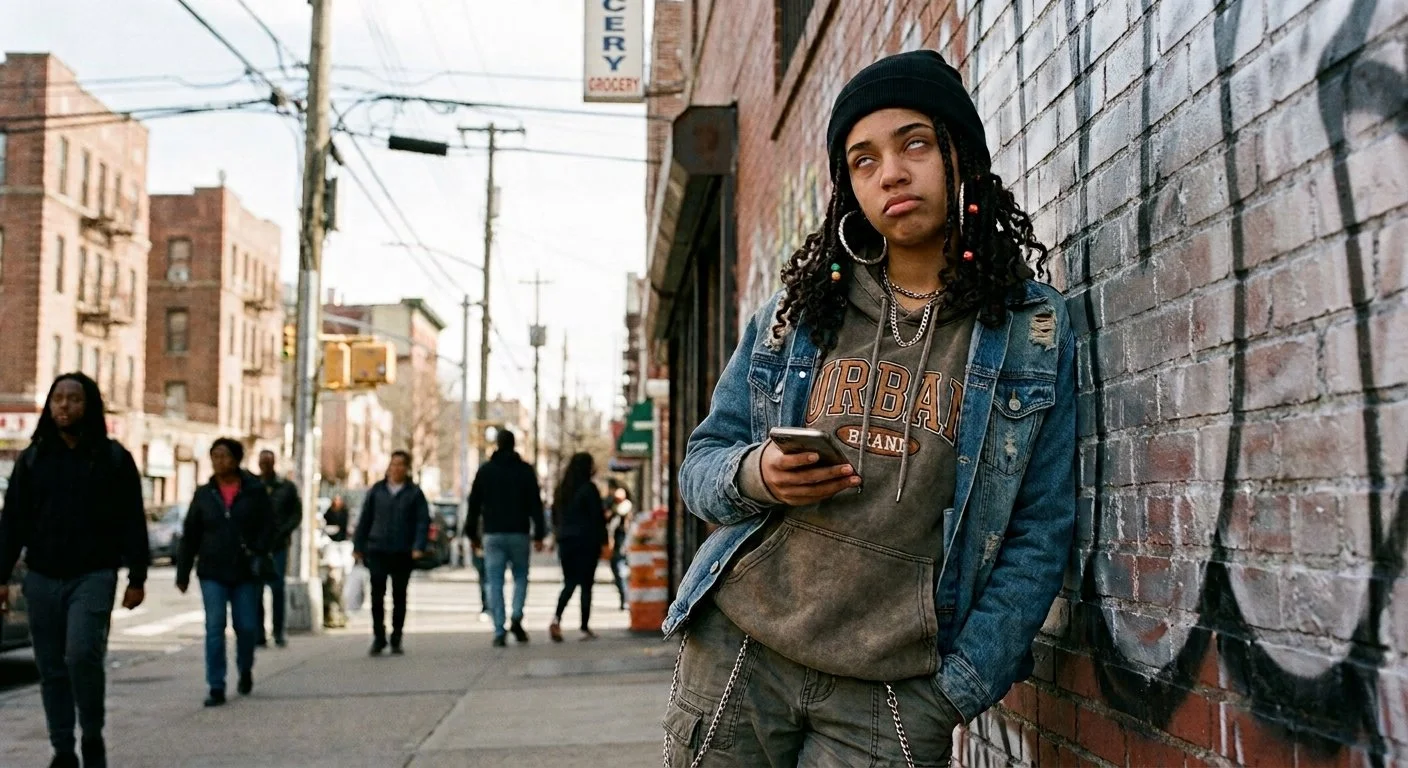
"Hoodrat Eye Roll" is a poem about the formation of erotic identity through early experience — specifically, the way that sustained intimate contact with a particular kind of need, performed by a particular demographic, can install an appetite that persists and that the bearer of that appetite did not choose. Its nine lines move from tenderness to explicit desire through a logic that is neither apologetic nor celebratory but diagnostic: this is how this particular wiring got laid down, and the poem is interested in the mechanism rather than the verdict.
The title performs its first irony before the poem begins. "Hoodrat" is a term of contempt applied to young women of certain urban communities — dismissive, sexualizing, and simultaneously precise about a specific cultural register. "Eye roll" captures the gesture of performative indifference or disdain, the social signal that communicates "I'm above this" or "not impressed." Together the title names an attitude — the hoodrat's eye roll at the subject of this poem — that the poem itself will reveal as something the subject has been specifically conditioned to need. The eye roll that dismisses becomes, through the mechanism the poem describes, the very gesture of arousal. The contempt is the point.
"His chest had borne / the tender weight of too many teens" — the opening establishes the subject's history through a physical image of remarkable delicacy. "Tender weight" holds two qualities simultaneously: the weight is real, physical, literal — bodies lying on a chest — and it is tender, gentle, something received rather than imposed. The teens who rested on this chest were seeking comfort, proximity, care. "Purring drool to his lullabye" extends this tenderness into the register of the infantile: the purring is the sound of contentment, of safety, of the body relaxed beyond self-consciousness; the drool is the body's involuntary testament to that relaxation; the lullaby is his contribution, the care he provided. The scene is one of sustained, repeated, genuine nurturing — a man who has served as a source of comfort and safety for many young women over time.
The poem's second tercet introduces what those young women brought to these encounters as their "ideas of manhood." The contrast with the tenderness of the first tercet is the poem's central formal argument. Where he offered lullabies and a chest to rest on, they offered "stiff slaps and phlegm thwacks, / fingers down the gullet." The slaps are the aggressive, performative slaps of a specific sexual register — the "daddy" dynamic in which roughness is the demonstration of desire. The "phlegm thwacks" are the sounds of spitting, of the aggressive oral dynamics of a particular pornographic and cultural script about what sex between a certain kind of man and a certain kind of young woman looks like. The "fingers down the gullet" completes the picture: these are the gestures of girls performing a specific version of desire that they have been taught to perform, a version in which their own submission and discomfort are the tokens of authenticity.
The phrase "ideas of manhood" is the poem's most important analytical move. It positions what the teens brought not as authentic desire but as a culturally acquired script — their conception of what the man before them should want, what would prove his masculinity to them, what kind of encounter would register as real. The tenderness he offered and the roughness they performed are in implicit dialogue: he gave them one thing, they offered him another, and the repeated transaction of that asymmetry is what the third tercet names as formative.
"Not to have groomed him / into Daddy" — the enjambment across the stanza break performs the inevitability the poem is describing. The weight of the opening two tercets — the accumulated tenderness, the accumulated roughness — arrives with a "not to have" that is itself inevitable: of course it did. The passive construction is essential: he was groomed, not by any single agent with intent, but by the aggregate of these encounters, by the repeated installation of a specific association. "Daddy" names the erotic role he has been formed into — the older, caretaking male figure whose authority is simultaneously paternal and sexual, whose desire is specifically activated by youth and need and the particular dynamic these teens performed for him.
"Unable to nut / without bladders dumping for air" — the poem's final image is its most explicit and its most precise. "Bladders dumping for air" is the physiological reality of erotic asphyxiation at its extreme limit: the involuntary release of the bladder that occurs when a body approaches or crosses the threshold of consciousness. This is the specific form that arousal has taken for this subject — not merely the dynamic of power and submission, not merely youth and need, but the body at its most involuntary, its most beyond-self-governance, its most animal. The poem has moved from the tender weight of sleeping teenagers on a chest to this: a wiring so specific and so extreme that it marks the distance the accumulated experience has traveled.
The poem does not moralize this distance. It does not comment on whether the grooming was harm or transformation, whether the subject should be pitied or condemned or understood or all three. It presents the mechanism with the same precision and the same emotional neutrality with which it would describe any developmental process. The eye roll of the title — the contempt, the dismissal, the performative indifference — is, in this light, both what the hoodrat displays toward the subject and what activates him. The contempt installed the appetite it expresses. He needs what dismisses him. The poem names this without explaining it further, trusting the nine-line arc to carry the full weight of what it has described.
Formally, the poem's three tercets enact a movement from the general to the specific, from the social to the physiological, from the tender to the extreme. The enjambments are doing structural work throughout: "teens, / purring" holds the weight of the bodies before releasing into the sound they make; "manhood — / stiff slaps" holds the concept before delivering its content; "Daddy, unable to nut / without bladders dumping for air" holds the role before specifying what that role requires. Each enjambment is a small delay before a revelation, and the accumulation of these delays mirrors the accumulation of encounters the poem describes: tenderness, then roughness, then what the roughness has made permanent.
"Hoodrat Eye Roll" is ultimately a poem about the specificity of formed desire — the way that repeated experience installs not just a preference but a necessity, a wiring so particular that its origins are visible in its content. The title's contempt and the poem's final image are the same thing seen from different angles: what the hoodrat performs as dismissal, the subject has been made to need. The eye roll that says "not impressed" is the eye roll that completes the circuit.
Meta Description
A nine-line poem tracing the formation of a specific erotic necessity through accumulated early experience — the tenderness of a man who provided comfort to too many young women whose performed ideas of manhood installed in him, through repetition, a wiring that now requires the body at its most involuntary extreme.
Keywords
Hoodrat Eye Roll, erotic formation, developmental desire, daddy dynamic, erotic asphyxiation, performative manhood, cultural script, grooming as mechanism, tercet form, enjambment and revelation, contemporary erotic lyric, close reading, Hypocorism, involuntary response, desire and contempt

Su Hija Esta en Buenas Manos (ROUND 1)
Scholarly Essay: "Su Hija Está en Buenas Manos"
"Su Hija Está en Buenas Manos" is a poem about the theological and cultural normalization of power-asymmetric intimate relationships — specifically, the way that the foundational stories of Western and Islamic religious tradition encode, at their origins, relationships between figures of absolute power and those with none, and the way that cultural outrage about such relationships is applied selectively and inconsistently depending on the identity of the parties involved. The title — "Your Daughter Is in Good Hands" — is the poem's governing irony, invoking simultaneously the reassurance of the trusted guardian, the marketing language of institutional care (Allstate's famous slogan), and the specific register of the older male who presents his intentions as protective and benevolent. The title speaks to a father. It says: trust me. The poem then proceeds to examine the foundations of that trust in the two dominant Abrahamic traditions that have shaped Western civilization's moral architecture.
The poem's opening movement establishes its central theological claim in compressed form. "Christ arose from a relationship / marked by an infinite gap / in age and power" — the Incarnation, read through the lens of power dynamics, is a story in which an omnipotent deity initiates a relationship with a young woman who cannot meaningfully consent to or refuse the visitation of the Holy Spirit. Mary's age at the Annunciation is not specified in canonical scripture but is placed by most biblical scholars and Church tradition between twelve and fourteen — a detail the poem does not need to state because it is available to any reader who has followed the theological tradition. The "infinite gap / in age and power" is, in its theological dimension, not metaphorical but literal: God is eternal, Mary is mortal and young; God is omnipotent, Mary is without recourse. The poem is not making a salacious argument about the Annunciation. It is making a structural argument: that the foundational story of Christian civilization is a story of a power-asymmetric relationship between an infinite being and a finite young woman, and that this story is the origin point of the tradition that subsequently developed elaborate moral frameworks around the protection of the young from exactly such asymmetries.
"Holy dew / pearled at dawn / with enough rico suave" — the diction here performs a deliberate collision of registers. "Holy dew" is the language of liturgy and sacred poetry, the morning dew as an ancient image for divine grace descending on the world (drawn from Psalm 110 and the Song of Songs). "Pearled at dawn" extends this with the compressed beauty of the sacred erotic — the pearl as both purity and sensuality, morning as the moment of revelation. "Rico suave" then detonates the register entirely: the phrase invokes Gerardo's 1991 hit, the smooth-talking Latin lothario who presents his seductive confidence as a gift to the women he pursues. The collision is the poem's central formal argument: the same cultural structure — the older, more powerful, infinitely confident figure initiating with a young woman and presenting the encounter as a blessing — exists in both the sacred and the vernacular, and the linguistic register is the only thing that distinguishes how we respond to it.
The pivot to Mohammad and Aisha delivers the poem's comparative religious argument. The historical marriage of Mohammad to Aisha is documented in Islamic hadith as occurring when Aisha was either six or nine years old (betrothal and consummation respectively, according to the Sahih Bukhari). This is among the most historically contested and culturally sensitive facts in Islamic scholarship, with significant internal debate about the reliability of the hadith and the historical accuracy of Aisha's age. The poem does not engage with that scholarly debate. It takes the traditional account at face value and uses it to make a comparative argument: that if the Christian tradition's foundational relationship involves a power asymmetry that contemporary frameworks would classify as absolute, then the Islamic tradition's account of Mohammad and Aisha — described here as "manhandling" and reduced to the most dehumanizing possible image of the child as "portable pocket pussy, brown" — is being presented as even more extreme by contrast.
The final tercet — "look like a spastic mongoloid / raping a roped-up camel" — is the poem's most deliberately offensive passage, and it requires analytical engagement rather than euphemistic circumnavigation. The comparison deploys two forms of slur simultaneously: "mongoloid," a term now understood as a disability slur derived from the now-discredited racial typology of nineteenth-century science, and the camel bestiality image that draws on a specific anti-Arab stereotype. The poem is using these as markers of the extreme end of a spectrum of transgression — the Mohammad-Aisha relationship is being positioned as so far beyond even these culturally maximally-offensive images as to make them look comparatively mild. The formal logic is satirical hyperbole: by stacking increasingly offensive comparators, the poem forces a question about why the Mohammad-Aisha account, which is taught as sacred history in the world's second-largest religion, is not treated with the same cultural horror as the images being used as its comparators.
The poem's argument, assembled from these three movements, is this: the two dominant religious traditions shaping Western civilization both encode, at their origin stories, relationships between omnipotent figures and young women or children. The Christian tradition aestheticizes its version into transcendence and sacred beauty — "holy dew pearled at dawn" — while the Islamic tradition's version is available to be described in terms so extreme that they defeat the most offensive available secular comparators. And yet neither tradition's moral framework is applied to its own founding story with the same rigor that contemporary culture applies to secular examples of power asymmetry. The title's reassurance — "Your daughter is in good hands" — is therefore not simply ironic but structurally double: whose daughter? In whose hands? Under whose moral framework? These questions have different answers depending on which tradition one inhabits, and the poem is arguing that the consistency of moral application across traditions is precisely what contemporary discourse fails to achieve.
Formally, the poem's three tercets move with a compression and control unusual even within this collection. The enjambments are managed with particular precision: "holy dew / pearled at dawn" creates a line break that holds the sacred image in suspension before "rico suave" arrives to detonate it; "Mohammad's manhandling of Aisha — / portable pocket pussy, brown" breaks at the em-dash to let the name and the historical resonance land before the reductive image follows. The tercet form enforces a visual and rhythmic equality between the three movements — Christian, Islamic, bestial comparator — that is itself an argument: structurally, formally, spatially, these three things are presented as belonging to the same discussion.
The title's Spanish — "Su Hija Está en Buenas Manos" — places the poem in a specifically Latino-inflected register that connects to the "rico suave" reference and positions the poem's address within a specific cultural context where both Catholic Christianity and, increasingly, Islam operate as significant religious forces. The father being addressed is not abstract but culturally situated: a Spanish-speaking father whose daughter is being assured of her safety within a tradition whose foundational stories the poem has just subjected to this analysis. The irony of the title is therefore not simply a universal irony but a specifically targeted one.
"Su Hija Está en Buenas Manos" is ultimately a poem about the selectively applied moral frameworks of religious tradition and contemporary cultural discourse — about who gets to invoke the language of sacred protection and whose foundational stories are permitted to escape the scrutiny applied to secular equivalents. Its formal achievement is to make this argument in nine lines through the collision of registers so extreme that the collision itself is the evidence: the holy dew and the pocket pussy belong in the same poem because the traditions they invoke are, on the poem's reading, operating within the same structural logic of power and access to the young, differentiated only by the language in which that logic is encoded and the cultural reverence that language commands.
Meta Description
A nine-line comparative theological poem arguing through extreme register collision that the foundational stories of Christianity and Islam encode the same structure of power-asymmetric relationship with the young, differentiated only by the sacred language that aestheticizes one and the cultural silence that protects the other from scrutiny.
Keywords
Su Hija Está en Buenas Manos, comparative religion poetry, Annunciation power dynamics, Mohammad Aisha, satirical theology, register collision, sacred and profane, power asymmetry, religious founding narratives, tercet form, contemporary religious satire, close reading, Hypocorism, Abrahamic tradition critique, holy dew rico suave
Mercari (ROUND 2)
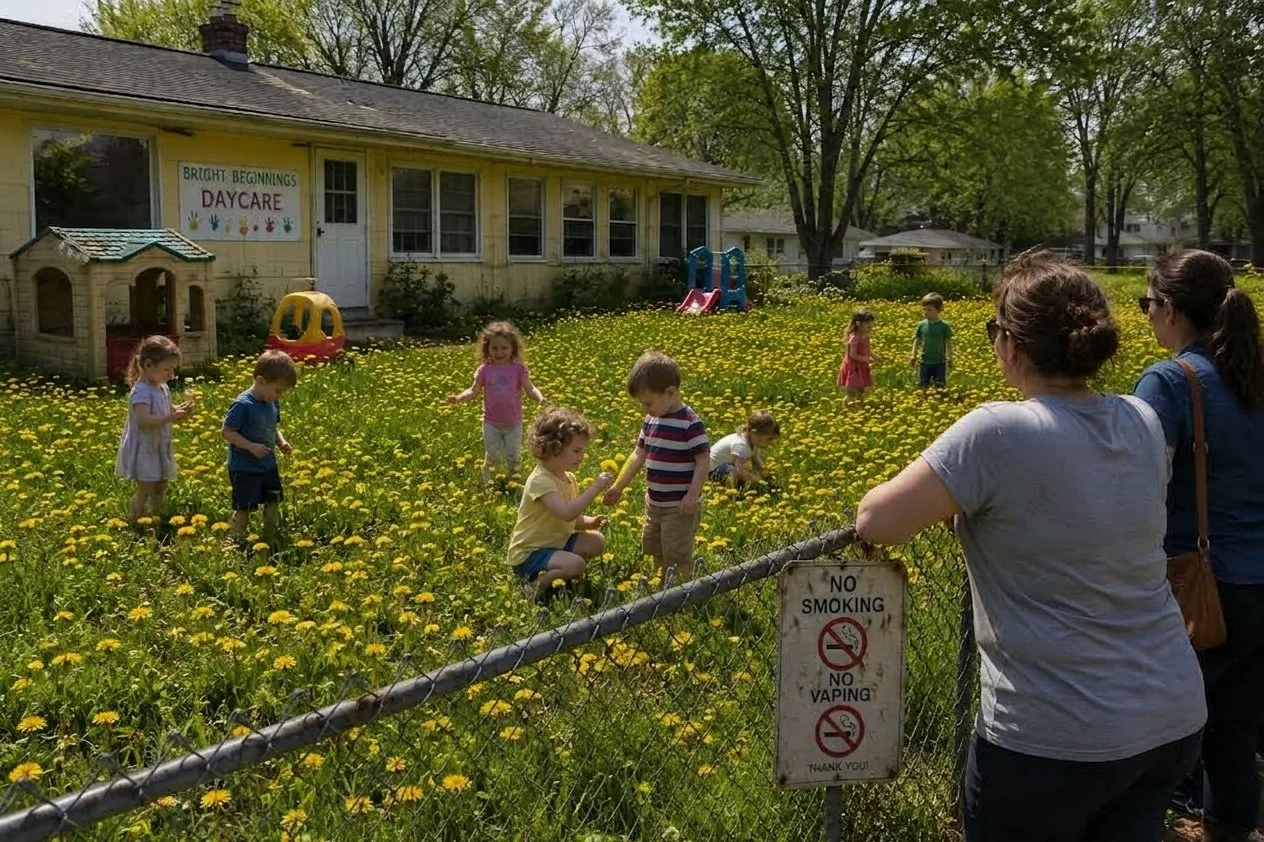
"Mercari" is a poem about the irrecoverability of childhood sensory experience and the particular modern pathos of knowing that irrecoverability while watching children live inside what has been lost. Its nine lines accomplish something remarkable: they hold two generations in the same physical space and render the absolute perceptual gulf between them without sentimentality or nostalgia, arriving at an image — the dandelion's bitter, milky, smoky nectar released into the wind — that is simultaneously a child's unconscious pleasure and an adult's conscious, purchasable loss.
The title locates the poem's argument before the first line begins. Mercari is a resale marketplace — a platform for buying and selling secondhand goods, the digital economy of recovered objects. Its appearance as title names the adult relationship to childhood experience that the poem will dramatize: the attempt to repurchase, through commerce, what time has made inaccessible. The title does not mock this impulse. It identifies it with the precision of a diagnosis.
The opening image — "the dandelion riot" — establishes the poem's characteristic tonal compression. "Riot" applied to dandelions is simultaneously accurate (the flowers do overwhelm in uncontrolled profusion) and gently comic (the scale mismatch between the word and its referent), but the comedy is not dismissive. The dandelions are genuinely riotous from the children's perspective, genuinely skeeving from the mothers', and the divergence of these responses is the poem's subject in miniature. "Moms / looking skeeved out / along the daycare fence" renders the adult position with affectionate precision — the mild disgust, the sense of disorder, the instinct toward containment. The parenthetical "(chain link, / extra guilt)" is one of the poem's most economical moves: the fence is both literal infrastructure and the poem's symbol of the adult's position outside the children's experience, and "extra guilt" names the specific maternal phenomenology of the daycare drop-off — the guilt of the fence itself, of the separation it enforces.
Against this adult management of the scene, the children simply act: "twisting stalks, smudging / each other's forearms yellow." The verbs are physical and reciprocal — twisting, smudging — and the yellow on the forearms is both mess (from the mothers' perspective) and mark of participation, of being fully inside the experience. What the children are doing with their bodies is what the poem identifies, in its closing lines, as the thing that cannot be purchased.
"Free into the wind a time rift" is the poem's most formally ambitious phrase, and its syntax enacts the release it describes. "Free" functions simultaneously as verb (they free something into the wind) and adjective (the release is free, unencumbered), and "time rift" names what is actually being released: not merely dandelion seeds but a tear in temporal fabric, a gap through which something from another register of experience passes. The children are not releasing seeds. They are releasing the possibility of inhabiting this moment without knowing it will be lost.
"Bitter nectar, milky and smoky" is the poem's sensory center, and its apparent contradiction — bitter and nectar, milky and smoky — is the point. The dandelion's smell and taste are genuinely complex, genuinely contradictory, and the children encounter this complexity without needing to resolve it. They are inside it. The adults remember it, or half-remember it, or recognize it as the kind of sensory experience that once existed and no longer does, not because dandelions have changed but because the perceptual openness that made the experience fully available has closed.
"They would buy online" closes the poem with the quietest possible devastation. The subject of "they" is the mothers — the adults along the fence — and what they would buy online is this: the bitter nectar, the milky smoky complexity, the time rift, the full sensory inhabitation of a moment that their children are living without knowing it is remarkable. Mercari sells secondhand goods. The poem ends on the recognition that what has been lost here cannot actually be listed, cannot actually be shipped, cannot actually be repurchased — that the platform's existence as the poem's title names the attempt while the poem's final image names the attempt's impossibility.
Formally, the poem's nine lines refuse any regular structure, moving instead with the rhythm of observation and recognition — the eye moving from the mothers to the children to the seeds to the loss, each movement enacted in the line breaks. The enjambments consistently open onto something slightly different from what the preceding line suggested, enacting the perceptual surprise that the children experience naturally and the adults can only watch.
Meta Description
A poem about the irrecoverability of childhood sensory experience — placing mothers and children in the same dandelion-filled daycare yard and rendering the absolute perceptual gulf between them, arriving at the recognition that what the children release unconsciously into the wind is exactly what the adults, knowing Mercari, would buy back if they could.
Keywords
Mercari poem, childhood sensory experience, irrecoverability, dandelion imagery, daycare fence, adult nostalgia, resale economy, time rift, bitter nectar, contemporary American lyric, generational perception, guilt and motherhood, sensory loss, close reading, enjambment, consumer culture and childhood, repurchasing experience, contemporary poetry

Roofie the Straggler (ROUND 1)
"Roofie the Straggler" is a poem about predation and its perceptual field — specifically, about the way a predatory consciousness organizes the visual world around it into a grammar of vulnerability and opportunity. Its nine lines do not depict assault; they depict the moment before, the scanning attention that converts a bachelorette dance floor into a hunting environment, and they do so through a chain of similes so precisely chosen that each one advances the poem's argument about how violation begins in perception long before it becomes action.
The title performs its argument in two words. "Roofie" as verb — to drug someone without consent — is casual in its register, the slang of a culture that has domesticated the act sufficiently to give it a verb form. "The Straggler" names the target by her social position relative to the group: not any of the women on the dance floor but the one who has fallen behind, whose distance from the herd is the condition of her vulnerability. The title does not describe an act already committed. It describes a logic — the predator's identification of the straggler as the appropriate object — and it names this logic in the predator's own casual vocabulary, without editorial distance.
The opening simile — "like meat in warbled fade-ins / to cheesy poolside porn" — is the poem's first and most fundamental perceptual reduction. The hammered blondes are seen as meat: not as people in a particular state but as flesh whose movement resembles the ambient sexualized imagery of low-end pornography. "Warbled fade-ins" captures the specific visual texture of cheap video — the slightly degraded quality, the slow dissolve — and places the women inside it as its content rather than as people watching it. The perceiving consciousness has already converted them into material.
"A rogue blowfly crazed by the rhythm / of rectal prolapse" extends the perceptual degradation into the entomological and the grotesque. The blowfly is drawn to decay, to the body's failures and exposures; "rectal prolapse" names a specific medical condition in which the body's interior becomes exterior, its containment failing. The simile is doing precise work: it locates the predatory attention in the register of the fly's relationship to damaged flesh — not desire in any romantic sense but the organism's response to exposure and vulnerability. The crazed quality of the fly's movement mirrors the women's dancing while placing that movement in a framework of biological opportunism rather than pleasure.
"Lips / bitten, eyes shut; wrists / above their heads as if roped / to a mast in buccaneer captivity" is the poem's closing image, and it is where the predatory grammar of the preceding similes arrives at its destination. The women's own bodies, in the postures of uninhibited dancing — bitten lips, closed eyes, raised wrists — are being read by the perceiving consciousness as already captive, already restrained, already in the position that violation would produce. The "buccaneer captivity" simile is historically specific: the pirate's captive, roped to the mast, is a figure of total helplessness within a total power structure. The women's voluntary dance posture is being perceived as that. Their freedom of movement is being read as its opposite.
This is the poem's most disturbing and most precise insight: that the predatory consciousness does not need to impose its reading from outside. It finds, in the ordinary postures of women enjoying themselves, the grammar of captivity it is looking for. The raised wrists of dancing become the raised wrists of restraint. The closed eyes of pleasure become the closed eyes of unconsciousness. The poem does not show assault. It shows the perceptual transformation that makes assault imaginable — the conversion of a person's freedom into the appearance of her availability.
The poem's nine lines are unbroken by stanza division, which is formally significant: the chain of similes runs continuously, one feeding the next, the perceptual reduction accumulating without pause or interruption. This enacts the predatory attention's own continuity — it does not stop to reconsider, does not break its own momentum, moves from observation to reduction to the final image of captivity in a single sustained operation. The poem ends where the predatory logic has arrived, and does not follow it further.
Meta Description
A poem rendering the predatory consciousness that converts a bachelorette dance floor into a hunting environment — tracing through a chain of precisely chosen similes how women's ordinary postures of pleasure are perceptually transformed into the grammar of captivity, showing assault's origin not in action but in the perceptual reduction that precedes and enables it.
Keywords
Roofie the Straggler, predatory consciousness, perceptual reduction, bachelorette party, drug-facilitated assault, simile chain, blowfly and decay, buccaneer captivity, vulnerability and predation, dance floor poetry, contemporary American lyric, nine-line poem, assault and perception, grammar of captivity, close reading, violence before action
Mercari (ROUND 1)
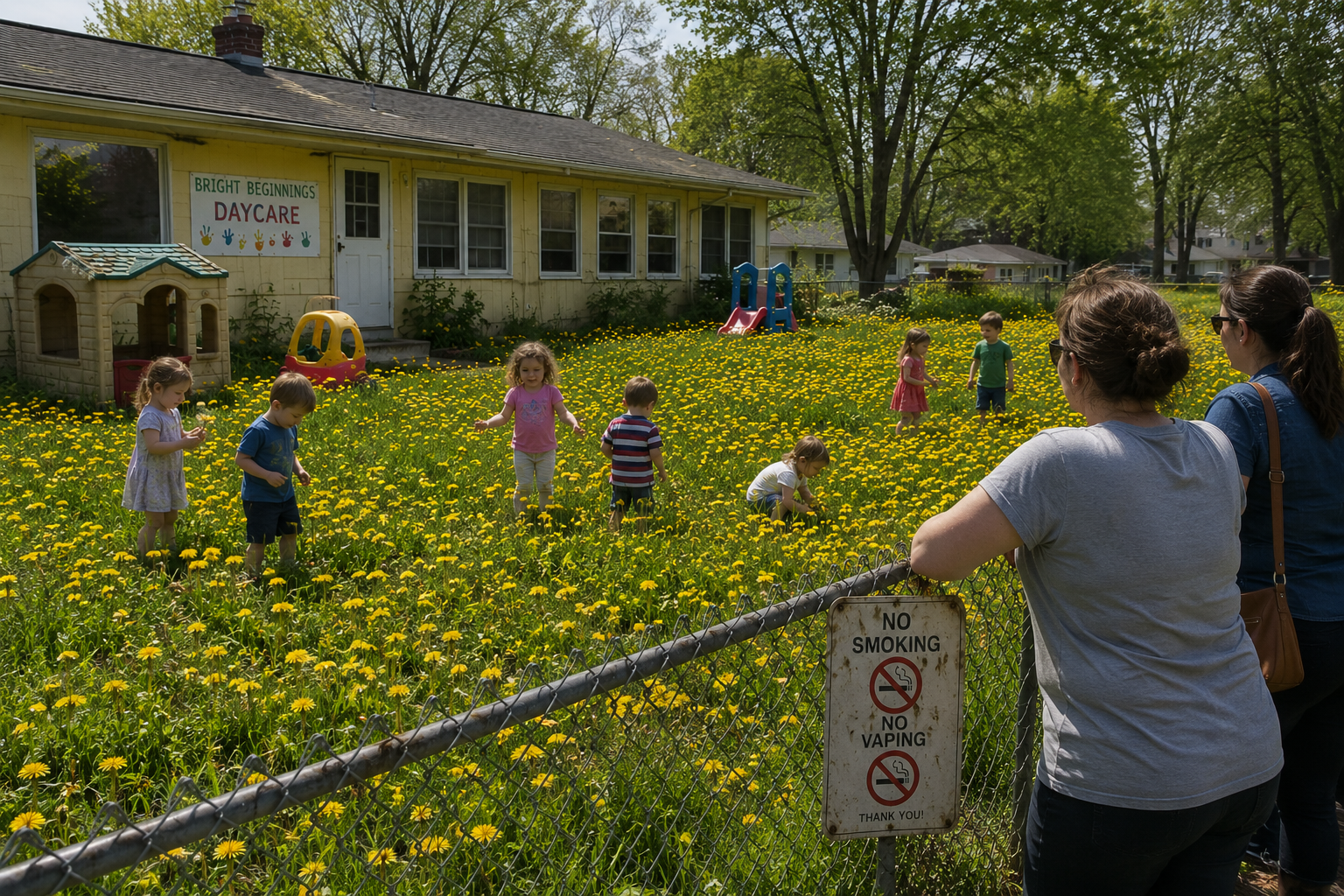
"Mercari" is a poem about the irrecoverability of childhood sensory experience and the particular modern pathos of knowing that irrecoverability while watching children live inside what has been lost. Its nine lines accomplish something remarkable: they hold two generations in the same physical space and render the absolute perceptual gulf between them without sentimentality or nostalgia, arriving at an image — the dandelion's bitter, milky, smoky nectar released into the wind — that is simultaneously a child's unconscious pleasure and an adult's conscious, purchasable loss.
The title locates the poem's argument before the first line begins. Mercari is a resale marketplace — a platform for buying and selling secondhand goods, the digital economy of recovered objects. Its appearance as title names the adult relationship to childhood experience that the poem will dramatize: the attempt to repurchase, through commerce, what time has made inaccessible. The title does not mock this impulse. It identifies it with the precision of a diagnosis.
The opening image — "the dandelion riot" — establishes the poem's characteristic tonal compression. "Riot" applied to dandelions is simultaneously accurate (the flowers do overwhelm in uncontrolled profusion) and gently comic (the scale mismatch between the word and its referent), but the comedy is not dismissive. The dandelions are genuinely riotous from the children's perspective, genuinely skeeving from the mothers', and the divergence of these responses is the poem's subject in miniature. "Moms / looking skeeved out / along the daycare fence" renders the adult position with affectionate precision — the mild disgust, the sense of disorder, the instinct toward containment. The parenthetical "(chain link, / extra guilt)" is one of the poem's most economical moves: the fence is both literal infrastructure and the poem's symbol of the adult's position outside the children's experience, and "extra guilt" names the specific maternal phenomenology of the daycare drop-off — the guilt of the fence itself, of the separation it enforces.
Against this adult management of the scene, the children simply act: "twisting stalks, smudging / each other's forearms yellow." The verbs are physical and reciprocal — twisting, smudging — and the yellow on the forearms is both mess (from the mothers' perspective) and mark of participation, of being fully inside the experience. What the children are doing with their bodies is what the poem identifies, in its closing lines, as the thing that cannot be purchased.
"Free into the wind a time rift" is the poem's most formally ambitious phrase, and its syntax enacts the release it describes. "Free" functions simultaneously as verb (they free something into the wind) and adjective (the release is free, unencumbered), and "time rift" names what is actually being released: not merely dandelion seeds but a tear in temporal fabric, a gap through which something from another register of experience passes. The children are not releasing seeds. They are releasing the possibility of inhabiting this moment without knowing it will be lost.
"Bitter nectar, milky and smoky" is the poem's sensory center, and its apparent contradiction — bitter and nectar, milky and smoky — is the point. The dandelion's smell and taste are genuinely complex, genuinely contradictory, and the children encounter this complexity without needing to resolve it. They are inside it. The adults remember it, or half-remember it, or recognize it as the kind of sensory experience that once existed and no longer does, not because dandelions have changed but because the perceptual openness that made the experience fully available has closed.
"They would buy online" closes the poem with the quietest possible devastation. The subject of "they" is the mothers — the adults along the fence — and what they would buy online is this: the bitter nectar, the milky smoky complexity, the time rift, the full sensory inhabitation of a moment that their children are living without knowing it is remarkable. Mercari sells secondhand goods. The poem ends on the recognition that what has been lost here cannot actually be listed, cannot actually be shipped, cannot actually be repurchased — that the platform's existence as the poem's title names the attempt while the poem's final image names the attempt's impossibility.
Formally, the poem's nine lines refuse any regular structure, moving instead with the rhythm of observation and recognition — the eye moving from the mothers to the children to the seeds to the loss, each movement enacted in the line breaks. The enjambments consistently open onto something slightly different from what the preceding line suggested, enacting the perceptual surprise that the children experience naturally and the adults can only watch.
Meta Description
A poem about the irrecoverability of childhood sensory experience — placing mothers and children in the same dandelion-filled daycare yard and rendering the absolute perceptual gulf between them, arriving at the recognition that what the children release unconsciously into the wind is exactly what the adults, knowing Mercari, would buy back if they could.
Keywords
Mercari poem, childhood sensory experience, irrecoverability, dandelion imagery, daycare fence, adult nostalgia, resale economy, time rift, bitter nectar, contemporary American lyric, generational perception, guilt and motherhood, sensory loss, close reading, enjambment, consumer culture and childhood, repurchasing experience, contemporary poetry





blog
FAQ



Visit my Substack: Hive Being
Visit my Substack: Hive Being
Don’t let anyone tell you that real life is lacking in poetic interest. This is exactly what the poet is for: he has the mind and the imagination to find something of interest in everyday things. Real life supplies the motifs, the points that need to be said—the actual heart of the matter; but it is the poet’s job to fashion it all into a beautiful, animated whole. You are familiar with Fürnstein, the so-called “nature poet”? He has written a poem about growing hops, and you couldn’t imagine anything nicer. I have now asked him to write some poems celebrating the work of skilled artisans, in particular weavers, and I am quite sure he will succeed; he has lived among such people from an early age, he knows the subject inside out, and will be in full command of his material. That is the advantage of small works: you need only choose subjects that you know and have at your command. With a longer poetic work, however, this is not possible. There is no way around it: all the different threads that tie the whole thing together, and are woven into the design, have to be shown in accurate detail. Young people only have a one-sided view of things, whereas a longer work requires a multiplicity of viewpoints—and that’s where they come unstuck.—Goethe (Conversations with Eckermann)




Featured Blog Posts

have appeared last night—
all those met along the way?
Scholarly Essay: "Pound Town: A Defense of the Moral Permissibility of Bestiality"
"Pound Town: A Defense of the Moral Permissibility of Bestiality" is a work of philosophical provocation in the tradition of the academic thought experiment — rigorous, footnoted, structured in the formal architecture of analytic ethics, and dedicated to two figures (Gary Varner, a philosopher of animal ethics, and Grandpa Jack) whose juxtaposition announces the essay's governing tonal register: the personal and the scholarly, the lived and the argued, occupying the same space without apology. It is a piece that takes seriously the philosophical obligation to follow argument wherever it leads, even when — especially when — it leads somewhere the culture has decided in advance cannot be arrived at by honest reasoning. Whether one arrives at its conclusions or not, the essay is a sustained demonstration that the consensus against bestiality rests on philosophical foundations considerably shakier than its cultural certainty suggests.
The essay's formal strategy is the systematic elimination of available rationales. It does not argue for bestiality in the abstract or as a general practice. It argues for the moral permissibility of certain instances of bestiality — a narrower and more defensible claim — and it does so by walking through every category of objection the philosophical and cultural arsenal provides: intuition, biblical authority, naturalness, animal wellbeing, and human wellbeing. Each section follows the same structure: state the argument in its most rigorous form, then dismantle it. What accumulates across these demolitions is not a positive case for bestiality so much as a negative case against the coherence of its prohibition — a demonstration that the grounds on which the taboo rests are either internally inconsistent, arbitrarily applied, or insufficient to do the philosophical work required of them.
The twelve cases organized into four categories at the essay's opening are the piece's most formally accomplished section, and they deserve attention as a philosophical device before anything else. The cases range from unequivocally immoral scenarios — the hen throttled to death in Case 1, the starved collie in Case 2, the drugged piglet in Case 3 — to scenarios of such apparent benignity that the moral objection becomes increasingly difficult to locate: the tween girl getting off from her horse's gyrations in Case 4, the man ejaculating on a turtle's shell in Case 6, the primatologist taken by the orangutan in Case 7. This range is not rhetorical sleight of hand but philosophical precision: it forces the reader to specify exactly what feature of any given case makes it morally objectionable, and in doing so exposes how few of the available features — coercion, harm, lack of consent — apply to the cases in the B, C, and D categories. The cases are the essay's most effective argumentative tool because they make concrete what abstract prohibition tends to leave vague.
The section on intuition is where the essay's most philosophically consequential argument lives, and it is constructed with genuine care. The essay does not dismiss intuition as a moral guide; it accepts the reality of the disgust response and even owns it in the first person — "I too find it disgusting to envision someone, say, performing fellatio on a horse." What it refuses is the move from disgust to moral impermissibility, and it does so by attacking both premises of the intuition argument. Against premise two — that intuition against bestiality is universal — it marshals an extraordinary ethnographic inventory: ancient Egyptians, ancient Greeks, ancient Hindus, the Kisii of Kenya, the Masai, the Comeburras of Colombia, the Inuit, numerous tribal cultures across four continents, and a list of historically famous suspected practitioners that ranges from Tiberius to Aleister Crowley. The inventory is not merely comprehensive; it is philosophically functional. If the intuition against bestiality were a reliable moral guide, it would need to be something like universal. The evidence suggests it is not.
Against premise one — that intuitive wrongness implies moral wrongness — the essay deploys its most rhetorically powerful passage: the extended catalogue of human cognitive failures, biases, and moral atrocities that our intuitions have licensed, from geocentrism to the skull-reading of phrenology to the intuitive wrongness of miscegenation. The catalogue is deliberately excessive, accumulating well past the point at which any single item would suffice to make the logical point, because the accumulation is itself the argument: we are the sort of critters who cannot trust our gut about things we have decided in advance. The section on intuition concludes that moral repugnance, however indelible, requires independent justification — and then spends the rest of the essay demonstrating that the available independent justifications fail.
The biblical section is brisk because its work is largely done by the consistency argument: the Bible condemns homosexuality with the same force it condemns bestiality, and we have decided that the Bible's condemnation of homosexuality is insufficient to establish its immorality. The same epistemic grounds that license that conclusion license the same conclusion about bestiality. The essay does not attack the Bible's authority on religious grounds but on grounds of internal inconsistency and demonstrated errancy: a document that prohibits eating lobsters and getting tattoos and wearing linen-wool blends cannot be treated as a reliable moral authority on bestiality without accounting for why those prohibitions are being selectively ignored. The section's most philosophically interesting moment is the discussion of divine command theory, where the essay acknowledges the internal logic of the position — if right and wrong are ultimately God's arbitrary decree, then everything depends on correctly identifying God's decrees — while exposing the epistemic problem that position generates: by what method does one establish that the Bible, rather than competing holy texts, reflects those decrees?
The section on naturalness dispatches the is-ought fallacy with appropriate efficiency and then spends more time than strictly necessary on the enumeration of meanings of "unnatural" — not because the argument requires it, but because the enumeration reveals how many different objections are being bundled under a single term and how few of them, when separated and examined individually, withstand scrutiny. The observation that naturalness arguments are wielded against bestiality by people who sleep with CPAPs in air-conditioned homes after heart transplants is the essay's most elegant single point, delivered with the compression of good comic writing.
The animal wellbeing section is the essay's most extended and most philosophically serious, because it engages the strongest available objection. The essay does not dismiss the consent framework; it argues that animals can in fact communicate consent through behavioral signals — and here the inclusion of Liz Moores's description of equine attunement is the essay's most formally distinctive move, embedding a perfumer's testimony about the near-psychic quality of the human-horse bond in the middle of a philosophical argument about consent capacity. The passage is not merely decorative. It is evidence: the claim that horses cannot communicate consent, willingness, and refusal is empirically contested by anyone with sustained experience of horses, and the essay appeals to that experience directly. The section's most philosophically rigorous passage is the extended argument distinguishing the animal from the toddler — four criteria (hormonal maturity, radically different future, likelihood of later trauma, not yet at full cognitive capacity) that jointly explain why behavioral consent from an animal suffices where the same behavioral consent from a toddler does not. The distinction is careful and the criteria are genuinely functional, blocking the most common reductio offered against the consent argument.
The human wellbeing section is where the essay's rhetorical energy is highest, because it is where the essay's central meta-argument becomes most explicit: what is actually driving the taboo is not concern for animals but concern for human identity, human social order, and the illusion of human exceptionalism. The slippery slope arguments against bestiality are exposed as fallacies through the observation that the same logic would imply that consensual sex with humans increases the likelihood of nonconsensual sex with humans — a conclusion no one draws. The zoonotic disease objection is met with the observation that human-to-human sex also transmits disease, that precautionary measures reduce transmission risk to manageable levels, and that we do not condemn homosexual sex despite its statistically elevated disease transmission rates. The physical injury objection is met with the observation that risk of injury does not render an activity immoral — a point illustrated by skydivers and MMA fighters and Alaskan crab fishermen.
But the section's most penetrating argument is the one about intent. The essay identifies the extraordinary fact that the same physical acts — masturbating animals, fingering their anuses, fondling their genitalia for insemination purposes — are standard husbandry practice when performed without sexual intent and criminal bestiality when performed with it. The mere addition of human arousal converts a kosher farmhand procedure into moral depravity. The essay does not simply note the arbitrariness of this distinction; it names what it reveals: that the taboo on bestiality is fundamentally about protecting the human's sense of radical difference from animals, and that this protection is organized not around actual harm to anyone but around the maintenance of a conceptual boundary that evolutionary biology has already rendered philosophically dubious.
The concluding argument is the essay's most formally elegant section, structured as a dilemma that closes without remainder. Either animals have no moral worth — in which case bestiality is permissible for the same reasons any use of animals is permissible, and the other rationales have already been shown to fail — or animals have at least some moral worth — in which case the essay's cases demonstrate that bestiality need not violate that worth, and once again the other rationales have been shown to fail. The dilemma is constructed so that neither horn provides a stable position from which to maintain the absolute prohibition, and the essay's final image — "uncontroversial enjoyment of earthly beings thrown into this, like this, with such a transient lifespan" — is its most philosophically honest moment: the view from Camus and Sartre, the absurdist perspective that asks what, in a cosmos of countless suns and reams of death, justifies the certainty with which we organize our moral horror.
What "Pound Town" achieves is something genuinely difficult in philosophical writing: it makes the reader feel the inadequacy of their own position without necessarily arriving at the author's conclusion. The essay does not require the reader to endorse bestiality. It requires the reader to explain, with genuine rigor, why the cases in categories B, C, and D are wrong — and it has, by the time that requirement becomes clear, already demolished the most available explanations. The dedication to Grandpa Jack alongside Gary Varner is the essay's final formal gesture: the argument belongs to the philosophical tradition and to a life, and the philosophical tradition cannot be fully separated from the life that inhabits it.
Meta Description
A rigorous work of analytic philosophy arguing through intuition, biblical authority, naturalness, animal wellbeing, and human wellbeing that bestiality is morally permissible in certain circumstances — systematically exposing the internal inconsistencies of its prohibition and identifying human exceptionalism, rather than genuine moral concern, as the taboo's actual foundation.
Keywords
Pound Town bestiality philosophy, moral permissibility bestiality, animal consent, zoophilia ethics, divine command theory, naturalness fallacy, is-ought fallacy, animal wellbeing argument, human exceptionalism, consent and behavioral signals, slippery slope fallacy, analytic ethics provocateur, thought experiment cases, Hypocorism, interspecies ethics