Sometimes the Telling is the Showing (ROUND 1)
scent of the day: Nose Rest Day
*Let's workshop this note about the virtues of telling instead of showing in the case of my poem “The Tooth,” a narrative about a neglected child running experiments on his incapacitated alcoholic dad.
Sometimes the Telling is the Showing
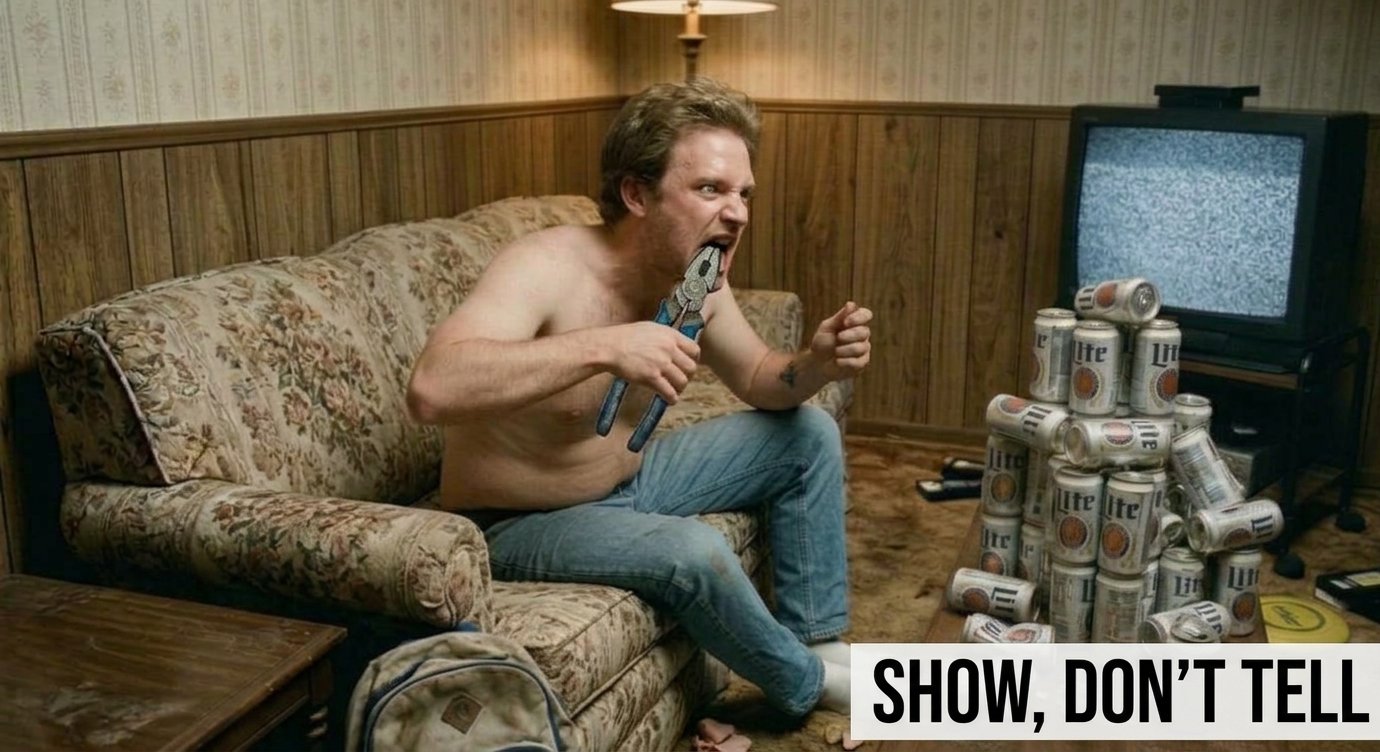
“Show, Don’t Tell” is one of those creative writing dictums that even laypersons could repeat. The rule makes good sense. Readers prefer to experience a scene, letting pure action and dialogue carry the story, rather than be lectured on what the story means or be hit with other types of authorial intrusion. Well, at least a certain type of reader prefers this. And that might just be the rub—since, by analogy, I hate the super-amber aromachemicals in today’s perfume, the ambrocenides and the ambrxtremes, that everyone loves (or thinks they love).
As both a scholar and a poet, as a person who finds it difficult not to pepper in meta-commentary, I often break this rule. Sometimes, likely more times than I would like to face, it is to my own detriment. But especially now that I am old, I have to accept who I am. The shaping period is largely over. My voice, the voice that they tell you to find, is purple and maximalist. Indeed, I am also finding out that it is quite sleazy, if not downright demonic—not just something I can do well, my bread and butter, but something that comes natural: home. “It is never too late”—that is another dictum, and one that pushes back against what I just said. But at this point for me to switch up would be disrespectful to my native gifts. I have a chance, I believe, to take this style further than even the Mt. Rushmore writers before me.
What would be the reason, anyway, for me to change now? Aiming to do so reads—to my heart—too much like self-hate, too much like going to gay-conversion therapy. Why not risk owning my voice? Obviously that message can be abused. It is just another message, flooding social-media, like “Get rid of them if they make you uncomfortable”—a message that itself, just like “Own your own voice,” could be healing for some (those, rare in our anti-diversity era of cyber bubbles and safe spaces from the violence of push back, who could use more validation in their lives) but poison for others (those, most of us, who could use more dissension in their lives). Why this message of “Own your own voice” is so perilous to follow, especially in our milquetoast age of trophies just for living and there are no winners, is because it justifies not doing the hard work required of mastery. It is important to learn the rules and imitate those who have succeeded and, in general, give the ta legomena their due. I am not ignorant to that. But I am getting old. And look how many “poets” are all over the place (especially ones hiding their inability to write a proper sentence behind associative scrambles of deep-sounding words and neat tricks of layout only one remove better than center justifying the fucking thing against a background of clouds). Everything is glutted. And then we have AI on the verge of being able to make Shakespeare look like a monkey at a typewriter. Why would I—at this point at least—compromise what I have unique about me even if it is bad? I am not out for glory. I do this for the love. And that is wise since, with the ascension of AI, the glory economy of art—as we all already feel in our hearts—is dead and done for, down the tubes.
I say this the way that the scholar presents their biases upfront. Because here I want to offer a small note on why it seems justified to break the show-don’t-tell-rule even in poetry. I want to be clear about the possibility that what I have to say could just be a cope, a way for me to rationalize my own way.
There are many legitimate reasons for breaking the rule. I want to focus on one—one that I think will garner bipartisan support if I articulate it with at least a modicum of care. As I see it, the act of telling can itself be the primary act of showing. It should be clear why I call this “bipartisan”: in arguing for an exception to the rule, I am nevertheless still prioritizing showing over telling.
To ground the discussion, let us look at one of my works in progress. It was written in honor of my dad who died on the day that I am releasing this: October 18th.
The Tooth
1
The snap-sizz of a match, the rasp-click of a lighter—amens like these were peanut shells next to the crack-fizz of a can. Five-five and balding since twenty, my dad would torch up a Newport 100 from the embered stump of the last—blazing through them like my thumb along the black beads he held in his casket. “Daddy’s got what they call an ‘oral fixation,’" so he would grin at my coughs: a confession made contract. But the beer, that bothered me most. “Daddy’s got a thirst.”
My nagging tears futile, his swear-on-me promises to quit
the guzzle broken too many times—a self-distracting thirst
to fuck with my father, a fierce thirst all my own, flowered
widest under moonlight (just like that older thirst for Pepsi
to wash down the Doritos, the Slim Jims, the Ring Dings)
in my transfixion before junk cable. Eyeing him for years
at our kitchen-living-bedroom table, every waking hour
smashed by his go-to Busch Light, could you blame me?
Frisbeeing bologna, liverwurst, on his head as he snored
adenoidal arpeggios in infantile oblivion on the hardwood
(fist-pump bullseyes landing in minuscule splats); stacking
board games, NYNEX phone books, on his chest, his face
(cans, lit candles, Aqua Velva undulant in Jenga precarity);
pinching his nose, his mouth, to silence the apneic rattles,
the flappy snorts and gasps that eclipsed (as if for theater)
my shouts: “Yo Dad! What the fuck! Go to the damn couch!”
I was hooked on such sweet-caffeinated sips of prankery before tolerance set in. And I snared others into the web. My friend and I once sharpied a clown face on him—black angles sharp, menacing like Gacy, around mouth and eyes, which in the noon sun (nickels still stuck to his bare gut after a long piss) I said he had drawn himself to amuse us but later (this to explain burns turned sores) had us scrub with the green part of the sponge (the only part there was).
2
Films on Lifetime, binkies after Ricki Lake at five—my dad liked their drama while he calibrated himself for the floor. All their “Mommy loved me too little, Daddy too much” only honing the mental slant of my mischief, in ambush I would wait for that soft spot just before gravity won out. And when it arose my intonation would twist histrionic, shaking like after-school-special lines: “Reefer?! Who, Son— who taught you this?” “You, alright!? I learned it from you!"
Anthropologist of dysfunction, weaponizer of emotion— I would take on a posture of too-sad-to-snack dejection and, at an ad break, go something like: “Hey Dad, can I—? Never mind. It’s fine.” Eyes up at the nicotined stalactites as if fighting back tears, this would suffice to draw him in. “S’matter Boy? Tell Daddy.” “I’m havin,” voice cracking, “well, just problems—problems back home, at Mommy’s.— I, I don’t know. It’s fine Dad. You wouldn’t understand.”
“Huh?” He would have me mute the TV, brows furrowed (matching my drama); mouth slack, beady eyes befuddled, concentration quivery versus inebriation’s tug: “The fuck— you talkin, Boy? Fuckin headcase!” Hands over my face, both to hide chuckles and to hint how deep this goes, the scene would unfold like a liturgy: “Well, he—.” “He!? He who!?” “Can we just watch the movie?” “Tell Daddy the fuck now!” “After—I don’t know. After, he says—never to tell or—.”
“After!? After the fuck what!? This fuckin for real Boy? Don’t tell me no lies.” “I’m not allowed to tell.—Okay!? He says if I tell anyone, it’ll break—break, our little secret.” “Our little fuckin secret!? The fuck!?—You bullshittin me!?” “Dad, he says it’s—it’s just for us. I can’t even tell Mommy.” “Mahfucka. Say what the fuck’s going on Son.—Mikey!” “I’m tellin lies. Forget it!,” I would yell, wiping Lifetime tears (aikidoing chuckles into sniffles). “Just drop it Dad. Please.”
I would clam up at this point. He would go from sobbing to smashing his beer-can barricade (“Touch my son! Watch! I’ll kill that motherfucker!”), back to sobbing, then too soon to dream-mutters raging through the stink of the Newport cooking his insensate pointer (forever hooked rigid by steel after a tendon tear). “It’s just—well,” I would say, prodding his gut to pull him back from snore land, “it doesn’t feel good. Dad—I don’t want to play any more ‘love games.’”
3
One Friday night, my father sat groaning about his tooth. “Gonna yank this bitch!” His repetitions finally breaking my concentration on my own consumptions, I funneled my frustration into instigating tones truer to my real age. “Stop jokin Dad. You can’t do that.” “Wanna fuckin bet?” “How can you do that without a dentist? It’s too painful.” “Sheeit!” He cocked a grin of someone who lost the battle with every bottle he met. “Daddy don’t need no dentist.”
“Pull your own tooth, without medicine?” “Pop’s medicine”: he held his beer high. “Got ya fuckin medicine right here.” I shook my head, giggling, as if I thought he was just joking. But he rapped his twist on Domino’s “Sweet Potato Pie,” his response to people (me, mainly) making him feel bad for drinking: “♪ I’m all fucked up and I don’t know why! Feeling kinda freaky, that’s no lie. ♪” “No way,” I cut in. “Daddy don’t lie to his son, Boy. Sheeit, you know that!”
A junky at ten, toying with prey like cats came naturally given the weakening highs. So rather than jump right to “Prove it,” I fell into the silence of someone holding back skepticism. But at the cusp of uvular flapping, my voice surged to outdoor decibel. “I know it all!” I said. His face squinched into wobbly perplexity. “Mom told me, okay?” I said as his head buckled into sleep. “Mom talkin what?” “It doesn’t matter.” “You make no goddamn sense Boy.”
“It doesn’t change things. It really doesn’t.” “You idiot.” “I know, okay!? You’re not my dad!” His cheeks and brows squeezed his eyes shut—his top teeth bared in agitation. “Huh? Tired of these mind games.” But having soaked up tales he would never have remembered he had told me— banging wives of impotent men for cash or, crucial here, fresh from the Marines and rescuing my would-be mother from Chris, her biker boyfriend at the time—I had angles.
“She told me everything. She took me to see my real dad. He’s okay, I guess. It’s more fun with you, th—.” “Who!? Who the fuck we talkin bout? You got some fuckin issues!” “He said I don’t have to call him ‘Dad’ yet if I don’t want. I can—I can just call him ‘Chris’ for now, or ‘Mr. Condon.’ He even took me on his motorcycle!” “Watch what you say— cuz I’ll kill the bitch.” “Dad, I’m telling you. I don’t care. I still love you.” “Sheeit. Look at you Boy. You Istvan clan!”
“I just don’t want you hurtin yourself if you’re not my dad,” I said (wincing at my ham-fisted pivot). His face contorted. “Fuck you talkin!?” I pressed on, banking on his fog to blur the stitches. “If you’re not my dad, you don’t have to prove anything by pullin your tooth,” I said as if (for all he knew) we had been talking about this. “I am your dad!—If I love ya.” He raised his hook, a gesture forever fused to that phrase. “Ain’t got shit to prove! Bitch’ll get yanked reeeal quick!”
“You sure you’re my dad—enough to pull your own tooth!?” “You don’t know shit. Get them fuckers.” His chin flicked to the linesmans on the TV. Handles greased (the channels turned by me), he held the pliers high as if to toast the pain that proved him. Then came the wrenching. “’Mon bitch!” I failed to tell the story at his wake: how then came the molar, berserk roots barnacled. Chest runneled red—“If I love ya!” he said, and spat into the heat grate at his feet. “If I love ya!”
Now in former versions of this poem I did cut many things precisely due to the show-don’t-tell rule. For example, the line “my shouts: ‘Yo Dad! What the fuck! Go to the damn couch!’ once had the adjective “pissed” before the “shout.” That was an example of telling that was easy to cut since it was redundant. “Shout” alone suffices in the context of what is shouted to show I am pissed. I still surely have more work to do on the poem in that regard.
But there are other instances of telling that I feel it would be wrong to cut. Here are a few followed by the show-don’t-tell rationale one might give for cutting it.
(1) “And when it arose my intonation would twist histrionic, / shaking like after-school-special lines: “Reefer?! Who, Son— / who taught you this?” The quote itself is the quintessential 1980s anti-drug PSA line. By labeling it as “histrionic” and comparing it to “after-school-special lines” right before quoting it, I tell the reader how to interpret the joke before delivering it.
(2) “Hands over my face, both / to hide chuckles and to hint how deep this goes.” Arguably all the telling I needed, if I needed any telling at all, was “To hide chuckles.” However, “and to hint how deep this goes” explicitly explains the emotional bait. The narrator’s broken dialogue in the next lines (“After, he says—never to tell”) already shows that depth to the father without needing to explain the strategy to the reader.
(3) “So rather than jump right to / ‘Prove it,’ I fell into the silence of someone holding back / skepticism.” Arguably this over-explains the tactical hesitation. Showing the silence, followed by the sudden explosion of “I know it all!”, lets the reader experience the manipulation in real time rather than reading a play-by-play strategy guide first.
(4) “I said (wincing at my ham-fisted pivot)” and “I pressed on, banking on his fog to blur / the stitches” and “I said as if (for all he knew) / we had been talking about this.” Here we have a high concentration of parenthetical meta-commentary where the narrator explains their conversational chess moves. The dialogue is already doing the heavy lifting—the reader can see how clumsy and aggressive the pivot is (“If you’re not my dad, you don’t have to prove anything by pullin your tooth”). Trusting the dialogue here without the self-critique would make the kid feel colder and more sociopathic in the moment.
While moving (and maybe they do point to things I need to rework or cull in later drafts), these criticisms seem insensitive to the larger point of the piece. When an adult narrator looks back at a traumatic or morally ambiguous childhood, the value of the prose—unlike what these criticisms seem to suggest—does not always lie solely in the dramatic reenactment. It lies—at least sometimes—equally in the moral, psychological, and emotional posture of the speaker—the speaker as he is in the present. The same goes for the narrator of “The Tooth.” He—the “I,” which truly is me—is coming to terms with how he treated his dad.
I write tons of poetry locked in the cinematic moment. But for whatever reason, and surely some of it is personal (a way for me, since this poem is autobiographical, to purge my guilt about how I punished my dad for his neglect), this one has an extra layer. The meta commentary, the brutal self-critique, seems crucial. It is crucial to me. At the end of the day, that is all that matters—yes, another seed of a dictum that can be abused. But actually I do also think it makes the story more interesting.
If I followed the show-don’t-tell rule religiously here, I would red-pencil every instance where the narrator steps outside the immediate sensory action to label his tactics or analyze his child-self. But aside from citing the cultural artifacts of the time (which I do, for instance, by means of the after-school-special analogy), the naming of what I was doing back then is important to conveying that I am fully cognizant of what I was doing and that I am not trying to sugarcoat it.
If I excised all the telling and nested commentary, I know what would remain: a harrowing narrative about a neglected child running physical and psychological experiments on an incapacitated alcoholic father. It would be vivid. It would be dramatic. And it would be missing the soul, the reckoning, I intended. It would be just a play-by-play of childhood cruelty: sociopathic child and a broken father locked in a grotesque power struggle. I do not want “The Tooth” to be just about what happened in that living room decades ago. I want it to be about the weight of those actions today, especially now that my father is dead.
It goes further, though. When I include a parenthetical like “(wincing at my ham-fisted pivot),” I am showing who I was—the depth of the consciousness of my manipulation. If I did not have it, we would default to reading the ten-year-old child as just hyper-focused on pushing the boundary or testing his leverage. But I wanted to indicate that this little boy had much more awareness, and almost was like honing a twisted craft live in the moment. That provides a way for me expose myself in the truest light, which feels important to do as a way to show myself dealing with the loss of my dad and all my guilt. We are so quick to say “children do not know any better.” While I do have an out for how I treated my dad (I was neglected and reared in all sorts of poison, constant secondhand smoke looking like Disney and Hallmark compared to the others), it was important to me—and I think it has importance in itself, regardless of me—to specify the depth of the calculation and what was going on internally within me then.
That brings me to a fundamental point about writing itself. Writing is special compared to every other art in its ability to do two main things: explore the innerscape and make metaphorical associations. Other artforms can do so only more or less indirectly and with great difficulty. Only through writing can we get such rich and sustained exploration of the inner lives of others—the otherwise private realm of qualia. Plumbing the otherwise-inaccessible depths of the invisible first-person perspectives of others (yes, even others across the species divide), language arts allow a deep intimacy to take place—where the very nerve endings of our private worlds seem to touch.
In writing, moreover, I can describe the commonality between the hush of the golden hour and the hush in the wake of shooting a gun into the sky. Indeed, I can lay out, as I do in a draft of my poem “A Dream Is a Wish Your Heart Makes,” a whole nest of associations to bring home the image of a meaty vulva: “gutted-goose apron; shadow-puppet wattle / (grabby slugs, ET undulants), as much tuckable frill as Ray Finkle; / a heft of Seussian technicolor that pools in the palm, roast beast / whose ripples would make Georgia O’Queef herself rubberneck— / rubbernose even, covert pleat-parting nudges gone truffle-snout / mania—like a postdoc botanist before an uncatalogued flower.”
To rely exclusively on showing threatens to undercut some of writing’s greatest richness. A painting can depict a nervous man—the pit stains, the red face. It can even drive home inner turmoil, project interior horror onto the physical world, by melting the landscape and making the sky blood-red (like Munch’s “The Scream”) or by distorting body and jawlines (like Francis Bacon does in many paintings). What I always liked about Hopper’s “Nighthawks” was how the harsh fluorescent light and lack of an exit door shows alienation and modern loneliness in a purely visual way.
Writing, on the other hand, can dive into the inner world with discursive clarity. It can explain in detail what the anxiety feels like from the inside. And then, in the real differentiating magic, it can explain the cause of the man’s anxiety while at the same time tracking his shifting self-justifications and contrasting his current anxiety with a memory from twenty years ago—and so on. All this special work—unless it is going to be done superficially or with excessive clunky maneuvers—will involve telling.
The same goes for metaphor and simile. A painting can show a bloody-necked head rolling behind the hills where the sun would normally be. But it cannot tease out the commonality between a rolling head of a man beheaded and the sun to the level of precision that writing can achieve. Every time one uses the “like” and “as if” of simile, one is telling as opposed to showing—that is the main point. Look at my opening lines: “The snap-sizz of a match, the rasp-click of a lighter—amens / like these were peanut shells next to the crack-fizz of a can.” I describe the sounds of lighting a cigarette as his “amens,” and then explain how an even holier sound for him was the crack of a brewski. How does one go about showing this with economy? Maybe a flashback where he saves the beer from falling in the creek instead of the cigarettes, instead of toddler me? But that seems odd to insert—almost like a hamfisted at-all-cost way to honor the show-don’t-tell rule.
Consider the phrasing “Anthropologist of dysfunction, weaponizer of emotion.” Far from being redundant summary, it is a confession. It shows that I do not view my childhood pranks as innocent mischief. I see them as clinical—downright predatory—psychological maneuvers. And now I have the language to call it out as what it is. The self-awareness of the wording emphasizes the tragedy: a child forced by neglect to become a cold observer of adult frailty, who then used that exact skill to wound the very father he wanted attention from. In light of the awareness, explicitly told in the first and last stanzas, that my father is dead, this shows how bad I feel about how I was—no matter my having the out of being the child, the one neglected.
Now that my father is gone, all these details carry the full weight of grief and accountability. The father cannot offer forgiveness. He cannot stand up out of the coffin and defend himself. All that remains is the evidence on the tape and my forensic dissection of my own guilt.
“Show, Don’t Tell” I agree remains a useful tool for scene-building. And as I move farther from the scholarly side of me, which had me bent too far to the telling extreme, I do try to swap out commentary for imagery, especially when imagery alone will suffice to convey the point. But telling—when deployed with intention, self-awareness, and retrospective distance—can provide something special. Here in “The Tooth” it provides the moral weight of the memory. I felt that a more profound thing I could do in this poem, but maybe that is just me, is to show the reader not just the drama of what happened but the excruciating process of an author telling himself the truth about who he used to be—and, indeed, likely still is to some extent.
“We need books that affect us like a disaster, that grieve us deeply, like the death of someone we loved more than ourselves, like being banished into forests far from everyone, like a suicide. A book must be the axe for the frozen sea within us.”—Kafka (against the safe-space cancel culture pushed by anti-art bullies, left and right)