


to Hive being
welcome
What is Hive Being, and Why the Name?
You have likely heard talk of a hive mind, where one global mind finds more or less figurative expression in various local minds. Such talk is common enough in nature documentaries, especially ones concerning ants or bees, and in sci-fi programs. Take that notion, at least a loose version of it, and broaden its scope. That will be a decent first step in understanding the title I have chosen both for my Blog and for the first five-volume installment of my magnum opus Made For You and Me, a fragmentary collection of minimalist stanzas from 2016 to 2020.
In alignment with Spinoza (the 17th Century Rationalist to whom I devoted my doctoral studies), I view reality in its totality as a grand hive Being: all entities are but pulsating manifestations of the buckstopping fount of everything, an ultimate being we might call “God” or “Nature” (so long as, out of respect for the capital “G” and the capital “N,” we limit it neither to some anthropomorphic cloud father hurling lightning bolts nor to mere wilderness untouched by human smog). According to the hive-Being view (where reality is one lone superorganism, a monistic—and we might even say unividualist—conception I defend in both my creative and academic capacities), each non-foundational being (each being, that is, whose essence does not involve existence) is an utterly necessitated expression or eruption or exudation of this eternal source—each is, perhaps better put, a mode or manner of being, and so a focal point through which is disclosed, what classical theists sometimes call “being itself” (ipsum esse subsistens): the realness of the real, the being of whatever may be, the sheer activity of being, the very isness of whatever is. This Blog, which duplicates my Substack, throbs as but one among many literary unfurlings of this self-necessitated foundation, this supreme wellspring, of which we—like black holes and broken beliefs, like fractal ferns and flickering flames—are the inevitable stylings.
My Journey
I am an academic who found himself pressured into early retirement by the rising tides of cancel culture. The illiberal scourge of censoring, silencing, and shaming—although always with us throughout our evolution—reached a local peak around 2021. That was the turbulent year my creative pursuits, which the old left once encouraged as a healthy outlet for the stresses of a childhood steeped in poverty and illiteracy, drew the ire of the new safe-space left. A small cadre of self-proclaimed victims and their allies, several of whom continue to berate me years later under pseudonyms as see through as their sexual infatuation, sought to erase me and my heterodoxy. They found support from a wannabe-woke dean, covered in the grand inquisitor robes of our decadent modernity (full-body tattoos) and just itching to signal his commitment to protecting “vulnerable populations” from triggering material (even if just, as it was in my case, off-duty poems “unbecoming for someone calling himself a teacher”). Although I eventually won my due-process case with the help of The Foundation for Individual Rights and Expression, I slunk away from a college that turned its back on protecting freedom of expression and from an institution increasingly intolerant of intellectual diversity.
The wrecking ball to my too-comfy office in the windowless ivory tower came with a silver lining. From the ashes of my professional aspirations rose a phoenix of increased freedom to fulfill the literary calling I have pursued for decades. Reputation concerns never stopped me, even within academia’s sterile halls of conformity. Indeed, my unapologetic defiance, which has long baffled friends and family, no doubt chummed even safe waters—almost as if I were asking for it all along—until the cancel shiver grew too frenzied to hold back its blind thrashings. But now, now I piston the most forbidden territories of human thought with no longer even a twinge of conscience. The newfound freedom means extra time to hone my craft. When not assisting special-needs communities (a day job far more rewarding than freeway-flyer drudgeries), I pursue my literary mission with Dionysian fervor.
Call for Co-Conspirators
This space, my digital sanctuary, showcases the fruits of my mission. Think of my posts, even those linking to my publications, as works in progress. I want your input, unflinching brutality included. Each post begins with an invitation to action: “Let’s workshop this [draft about x, y, z].” Your contributions, whether through public comments or my contact page, help hammer scraps of ore into polished blades fit for magazine publication.
Your input is valuable, even if you are neither a writer nor a reader of literature—twin disciplines dying by the cyber nanosecond. Sometimes—even if at the risk of uttering banalities—an outsider’s fresh vantage can pierce the veils of convention to reveal what insiders miss. It often takes an outsider to make us even think to question our ingrained presuppositions and attitudes. I stand by the hygienic value of contagion. That is one reason I advocate so strongly for intellectual diversity and freedom of expression. And that is also one reason I was so harrowed by the anti-diversity swell of cancel culture in academia (an institution that should be the utmost caretaker of such values)—harrowed especially insofar as that swell masqueraded under the gaslighting guise of “diversity”).
You will witness the breathing evolution of my writings over time. To track these changes, I label each revision by round: “ROUND 2,” ROUND 3,” and so forth. Each piece undergoes continuous refinement based on your feedback and my own revisitations. Sometimes changes will mar the work. That is the risk of creative tinkering as a finite creature. I hope you will alert me to missteps. After many semesters of university writing workshops, one rule has impressed itself upon me: when someone senses a flaw, something almost always needs to change—even if, yes, the proposed solution misses the mark (which often it does). From a quick look into the archives, accessible here, you can see how much I have benefited from your feedback so far.
My Hope
Sharing drafts can be daunting. But showing you the ravaged and unperfumed real deal unfiltered by makeup (stuttering starts and falsities, awkward line breaks and clumsy word choices, grammatical errors and misspellings)—that not only makes my work more relatable, but helps me refine things through your input. I hope the unfiltered look at the raw process of fumbling, rather than just the polished product, also helps other writers develop their craft. Imperfect works often instruct more than perfect ones: whereas the perfect ones tend to have a grace by which they slip inside us without activating our scrutiny, the imperfect ones—especially the near perfect ones—show us glaringly what not to do.
People laugh at me, seeing—in my tilting at the windmills of literary excellence—a Don Quixote clunking around in Arthurian armor in a post-knight era. I am not naïve. I am well aware of the diminishing ability to read, let alone well: slowly and deeply, with gratitude. I am also aware that my style, which often nests subpoints within larger points, never waters down virtuosity for the sake of mass appeal. I watch readers stumble over my sentences, unable to unlock even just the music of the envelope let alone the semantic meat within, which—given my tendency to flashlight through the darker facets of human nature (the addicts, the miscreants, the abusers among us)—only adds an additional alienating layer of difficulty). Beholding these depressive scenes of even supportive family members getting bucked off my syntactic bronco makes me feel like a dinosaur who should get a hint and, if not succumb to the brain rot of skibidi-toilet speak, just hang himself already. Even though the decline in linguistic background and grammatical voltage makes my compositions seem quixotic in a world binging Netflix and TikTok, I persist—raging against the dying of the light—by some internal compulsion to celebrate the richness of language and thought.
My hope is that, despite social media’s unparalleled power to farm our attention, people never forget the unique power of writing. Beyond unveiling hypocrisy, teasing out complex implications, and detailing the commonalities between even the most alien phenomena, writing offers something we need today—trapped in agoraphobic cyber bubbles only thickened by the Lyme dangers of forests and the COVID dangers of cities—perhaps more than ever. Granting us rich access to the first-person perspectives of others (to how things feel to them), writing serves as one of humanity’s best tools for combating loneliness. It allows us to linger, broadly and deeply and at high resolution, within the inner lives of others in a way that other arts can only suggest.
What to Expect
My work spans a broad spectrum: from metaphysical discourses on free will and determinism and the ontology of holes to the ephemera of western culture (whether the childhood impacts of the hypersexual mono-image of black woman as squirting twerkers or Terrence Howard’s sham revolution of mathematics). Some tight and minimal, others free-flowing sprawls; some heady and abstract, others emotional and imagistic—my inkwell musings, which often blend scholarly rigor with a dark humor from both high and low culture, aim to capture the visceral intensity of our personal and social and ultimately existential predicaments.
By no means can I deny that drug abuse, sexual assault, and the tales of the broken and the damned loom large in the tag cloud of my work. My writing will never be a paradise of easy truths and comforting lies. It will challenge you, provoke you, and at times even repulse you. I offer no apologies for the monsters I unleash. They are as much a part of us, at long root scared rodent mammals scurrying in the shadows of dinosaurs, as our noblest aspirations.
But make no mistake. It is not all downer darkness. The archives are my receipts. You will find pieces exploring the pursuit of authenticity in a media-saturated world, the search for meaning in an indifferent cosmos, and the celebration of beauty in both the sublime and the profane. I locate much of my inspiration, in fact, in novelists like Dostoevsky and poets like Ted Kooser—writers unafraid to pursue moral agendas or risk Hallmark sentimentality in an age that often sneers at sincerity.
Be they satirical dissections of modern social dynamics or poignant poems about addiction or academic articles on moral responsibility, my goal is to provoke thought, evoke emotion, and foster meaningful dialogue. Fear has not and will not stop me from challenging humanity’s fundamental taboos (like bestiality and cannibalism) or self-reflecting into the dark chaos of the subconscious, even if that means exposing the Jungian shadows—the inner Goebbels—lurking within us all!
Expect posts each day, no day missed. Donations are welcome, but I impose no paywall: it feels wrong to charge for art, especially given our date with obliteration. Feel free to explore what amounts to, at the time of writing this, close to a thousand pieces of poetry and prose here. That should give you a sense of what awaits.
Join me—specula holstered—on this literary odyssey into the public and private nooks of the hive Being. Let us navigate the labyrinth of creation together, confronting our demons and even slaying our darlings if we must. Let us dance on the razor’s edge between the sublime and the profane in pursuit of an elusive literary perfection never to be confused—as it has been confused in our declining civilization—with the pursuit of popularity or likeability over truth.













tag cloud
- literature community
- American literature
- poetry
- literature
- poem
- literary
- creative writing
- writing
- poetry community
- Michael Istvan
- Istvan
- perception
- defiance
- suffering
- existential poetry
- dissociative
- existential
- healing
- human
- mortality
- power
- art
- artist
- God
- evolution
- love
- death
- darwin
- anxiety
- rape
- psychoanalysis
- addiction
- homeless
- addict
- trauma
- therapy
- rapist
- traumatic
- hypersexual
- grooming
- hyperarousal
- anal
- anal sex
- heart
- meditation
- incendiary
- Identitarianism
- dead
- tyrant
- poverty
- fap
- choking
- traitor
- honey pot
- treachery
- true crime
- identity
- cunnilingus
- power dynamic
- Vaginal
- woke
- OwnVoices
- crack
- disease
- animals
- empathy
- ally
- crime
- scarf
- summer
- identity politics
- body disposal
- kidnapping
- indians
- turtles
- Vagina
- sex
- Klan
- anality
- poet
- surrealism
- fisting
- erotic
- scatalogical
- Pussy
- sublime
- safe space
- adolescence
- poetry editor
- censor
- Nietzsche
- censors
- campus warrior
- artistry
- class
- borders
- violence
- substance abuse
- Earth
- sensual
Posts

The Matthew Effect (ROUND 1)
“The Matthew Effect” is a compact poem about projection, prestige, and the human tendency to convert suffering into spectacle. Its title invokes the sociological principle by which advantage accumulates to those who already possess it—“to those who have, more will be given”—and the poem transposes that logic onto the body of a fish. The creature’s face, “studded with rusted hooks,” already bears the marks of repeated capture, which the speaker immediately reads not simply as damage but as distinction. The newest hook “popping through / just under her eye” is both grotesque wound and visual ornament, and that doubleness is central to the poem’s critique.
Once the fish is imagined “as a war general,” the logic of accumulation takes hold. Her old injuries become analogous to medals, signs of endurance, victory, rank. The poem exposes how readily humans aestheticize trauma when it can be narrativized as honor. The phrase “medal-drunk creatures as we are” broadens the indictment beyond anglers or gawkers; it names a species-wide habit of confusing scars with glory and of rewarding those already most visibly marked. The Matthew Effect here is not merely that the fish with hooks gets more hooks, but that prior marks of distinction invite further marking. What already looks decorated becomes a better surface for more decoration.
The final lines sharpen this into satire. Humans are “exaggerators and carnival gawkers,” unable to encounter the fish neutrally once she has acquired symbolic charge. The temptation to “place / a few more before release” reveals a perverse generosity: release is granted, but only after the spectacle has been enhanced. The act is framed as additive, almost ceremonial, as though the fish’s visible burden ought to be completed for the sake of narrative coherence. This is where the poem’s moral force resides. It shows how easily admiration slips into violation when the admired being is treated as an emblem rather than a life.
The poem’s compression is crucial. It does not sermonize about cruelty or anthropomorphism; instead, it lets the transformation happen in real time. A wounded fish becomes a general, hooks become medals, and human observers become a crowd unable to resist intensifying the image they themselves have invented. The result is a bleakly elegant meditation on the way prestige systems work: marks of past survival attract fresh inscriptions, and the already burdened are burdened again because their burden has become meaningful to others.
Meta Description:
“The Matthew Effect” is a brief, incisive poem about a hooked fish whose wounds are mistaken for honors, exposing how humans turn suffering into prestige and spectacle by projecting narratives of rank, heroism, and distinction onto damaged bodies.
Keywords:
The Matthew Effect, prestige and suffering, spectacle, projection, anthropomorphism, war imagery, trauma as decoration, catch and release, poetic satire, accumulated advantage, scars and status

Driver's Ed FOMO (ROUND 1)
“Driver’s Ed FOMO” is a brief, corrosive satire about incoherence in contemporary attitudes toward adolescent agency, especially where sexuality, reproduction, and adult moral supervision intersect. The poem’s force lies in its speed: it moves from a sociological diagnosis of delayed adulthood, to a deliberately provocative hypothetical about abortion consent, to an image of an underage girl erotically pursuing an older man next door. Rather than arguing discursively, it compresses a contradiction into a single burst of rhetorical pressure.
The opening lines establish the poem’s anthropological frame: “childhood now bleeding / into the thirties.” This is not merely generational complaint but the premise for everything that follows. The poem assumes a culture in which adulthood is delayed, protected, and psychologically deferred far beyond biological maturity. Against that backdrop, the “ninth-grader” becomes a flashpoint. The phrase “in the rare case—extremely rare” is crucial because the poem is not claiming adolescents generally possess robust agency; rather, it isolates the exceptional case in which a young teenager might have “enough / Marian agency to consent / to abort.” “Marian” carries obvious theological resonance, invoking Mary as a figure of adolescent pregnancy, consent, and sanctified maternity. The term therefore folds religious history into modern reproductive politics, suggesting that debates about youthful agency are never free from older cultural archetypes.
The central provocation is the poem’s question: if one grants that this teenager has enough agency to make a grave reproductive decision, why become scandalized by her actively seeking sexual contact with the “retired stick / next door”? The poem’s target is not the permissibility of exploitation by an adult man; it is the selective deployment of agency language. The satire presses on what it sees as a moral asymmetry: youthful decisional capacity is affirmed when it supports one politically or culturally approved choice, then suspended when it would imply sexual initiative of a more troubling kind. The mother’s presence—“boho mom / on board”—sharpens this critique by introducing permissive or progressive adult endorsement. The girl is not acting in a vacuum; she is imagined within a milieu that selectively ratifies some forms of autonomy while panicking at others.
The title, “Driver’s Ed FOMO,” is especially pointed. “Driver’s ed” evokes formal preparation for a threshold of independence, while “FOMO” names the restless anxiety of missing out that defines much of contemporary youth culture. Together they suggest a condition in which young people are symbolically ushered toward autonomy while being psychically trained to feel behind, excluded, or incomplete. In that context, the girl’s “shifting, / grinding” reads not just as sexual behavior but as an enactment of desire under the sign of acceleration—wanting to arrive at adulthood, experience, or danger before being left out of it.
The poem’s rhetoric is intentionally abrasive. It uses the image of the “retired stick / next door” to collapse suburban banality, generational distance, and sexual threat into a single figure. The older man is not romanticized; he appears as a crude emblem of the adult world onto which adolescent desire or projection fastens. That matters because the poem does not resolve the distinction between a young person’s initiative and an adult’s obligation. Instead, it lingers in the discomfort of a culture that wants to talk about empowerment, consent, and bodily autonomy in clean, administrable categories even when actual desire, immaturity, and power gaps remain messy and unstable.
What makes the poem effective is that it is not really about one ninth-grader. It is about a larger cultural confusion over what counts as agency, when it is recognized, and how it is politically distributed. The image of “childhood… bleeding / into the thirties” suggests that society simultaneously infantilizes many adults and selectively adultifies some minors. “Driver’s Ed FOMO” condenses that contradiction into a scandalized question, forcing the reader to confront whether our moral vocabulary is principled or merely situational.
Meta Description:
“Driver’s Ed FOMO” is a satirical poem about selective notions of adolescent agency, linking delayed adulthood, abortion consent, and sexual initiative to expose contradictions in contemporary moral and cultural discourse.
Keywords:
satirical poetry, adolescent agency, delayed adulthood, abortion and consent, sexual politics, Marian imagery, cultural contradiction, youth culture, FOMO, autonomy discourse, moral inconsistency
MADE FOR YOU AND ME 2: hive Being (Stanzas 2017--part 70)
This fragment from Made for You and Me 2: hive Being (2017—part 70) continues the mosaic method that structures the larger project: a sequence of compressed observations, aphorisms, and miniature thought-experiments that accumulate meaning through juxtaposition rather than narrative continuity. Each stanza acts as a cell in the “hive,” a brief intellectual or experiential unit whose resonance depends on its proximity to the others. The effect is not argument in the traditional sense but a kind of cultural cross-section, where addiction, technology, sexuality, morality, and loneliness appear side by side as fragments of the same contemporary landscape.
Several of the opening lines confront addiction with stark economy. The line about using one drug “to stay awake” in order to use another simply “to stay well” captures the circular logic of dependency: substances cease to be instruments of pleasure and instead become tools for maintaining equilibrium. Addiction here appears less as indulgence than as maintenance of a fragile physiological balance. The following observation—about the recurring promise to quit “next trimester”—extends this theme into the psychology of deferred reform. The phrase evokes cycles of hope that perpetually relocate the moment of change into the near future without ever arriving there.
Trauma appears in parallel with addiction, suggesting a causal or at least adjacent relationship between suffering and chemical escape. The stark suggestion that drugs become a form of salvation for someone who has endured severe violation illustrates how the poem repeatedly frames substances not merely as destructive forces but as desperate coping mechanisms within intolerable circumstances. This moral ambiguity is typical of the mosaic’s method: it resists clear judgment while forcing readers to confront the conditions that make destructive choices understandable.
The poem then pivots outward to cultural observation. The image of a Tibetan monastery transformed by tourism and erotic spectacle illustrates how globalization and commodification can alter spiritual spaces. The juxtaposition of sacred institutions with sexual curiosity is not simply comic; it suggests the erosion of traditional boundaries when previously isolated cultures become global attractions. Similarly, the stanza about “the grass is greener approach” critiques a contemporary ethos of perpetual comparison and restlessness. In a world structured by fear of missing out, the discipline required to cultivate satisfaction with one’s present circumstances becomes increasingly difficult.
Technological change enters through the line about investing in one’s “interest” rather than merely in wealth. The stanza frames this shift as pragmatic advice in an era shaped by automation and artificial intelligence. If technological systems increasingly outperform humans in routine tasks, then personal passion may become the only reliable basis for meaningful work. The poem thus connects economic transformation with existential stakes: without authentic engagement, individuals risk being displaced both materially and psychologically.
Several fragments examine moral reasoning, particularly where religious or ideological commitments clash with intuitive ethical judgments. The stanza questioning divine commands to slaughter enemy infants highlights a classic philosophical problem: whether moral goodness is independent of divine decree. Similarly, the observation that belief in a deity capable of infinite punishment might be motivated by fear rather than reverence exposes the pragmatic dimension of religious obedience. These moments align the mosaic with long traditions of skeptical philosophy that interrogate the moral consequences of theological systems.
Political critique also emerges through compressed analogies. The line linking the slogan “no one is illegal on stolen land” to the dissolution of private property boundaries extends an argument about logical consistency: if territorial claims are illegitimate at the national scale, the same reasoning might apply at smaller scales as well. The mosaic form allows such arguments to appear briefly without extended defense, inviting readers to supply the reasoning themselves.
Interwoven with these larger reflections are intimate glimpses of ordinary vulnerability. Social media comparisons produce feelings of inferiority; a neighbor’s moan sparks curiosity; a person discovers that “before shots” in transformation narratives may actually depict the aftermath of decline. The closing image—melanoma spots growing unnoticed because no one is present to check a person’s back—distills the fragment’s recurring theme of isolation. Physical health, emotional wellbeing, and moral orientation all depend on relationships capable of noticing what we cannot see ourselves.
Taken together, part 70 illustrates how the mosaic structure allows disparate subjects—addiction, globalization, religious ethics, technological change, loneliness—to coexist within a single conceptual field. The fragments form a kind of intellectual ecosystem in which personal suffering, cultural trends, and philosophical questions continually intersect. Rather than offering resolution, the poem invites readers to move among these fragments and perceive the patterns that emerge from their collisions.
Meta Description:
A mosaic poem fragment from Made for You and Me 2: hive Being (2017—part 70) exploring addiction, trauma, globalization, technological change, religious ethics, and loneliness through a series of compressed aphoristic observations.
Keywords:
mosaic poetry, aphoristic form, addiction cycles, trauma and coping, globalization and spirituality, AI and work, religious ethics, cultural critique, social media comparison, loneliness and health, philosophical fragments

Seaman Manners (Round 1)
“Seamen Manners” is a critical essay examining H. K. Rigg’s Rigg’s Handbook of Nautical Etiquette and the broader cultural logic of etiquette systems. The essay argues that while Rigg presents nautical etiquette as a collection of practical truths derived from experience, many of the rules function less as objective necessities than as mechanisms for reinforcing social norms, preserving hierarchy, and giving participants a sense of belonging within a tradition that transcends individual lives.
The first major claim developed in the essay is that Rigg consistently frames his prescriptions as rational conclusions that any sensible sailor would reach through experience. The handbook’s tone suggests that etiquette is not arbitrary but grounded in the practical realities of maritime life. Many examples support this framing. Rules about minimizing noise in marinas, tying boats securely so they do not slap in the wind, or passing sailboats with a wide berth clearly contribute to safety and social harmony. These prescriptions resemble hypothetical imperatives: if one wants a peaceful and safe boating environment, then one ought to follow these practices. Rigg’s handbook therefore appears, at least initially, to offer codified wisdom accumulated through long experience on the water.
However, the essay argues that this framing sometimes conceals circular reasoning. Certain prescriptions appear to be justified primarily by the claim that they are simply “proper.” The discussion of christening ceremonies illustrates this point. Encasing the champagne bottle in netting to prevent flying glass is clearly grounded in safety considerations, yet Rigg immediately pairs this with the claim that the bottle should be decorated with braided ribbon. While the first rule has obvious practical justification, the second rests largely on tradition. The justification becomes effectively circular: the ribbon is appropriate because that is how christenings are traditionally conducted. In such cases, the supposed objectivity of nautical etiquette begins to blur with mere convention.
The essay further suggests that some rules serve to maintain social boundaries and preserve existing cultural norms. The discussion of boat names is particularly revealing. Rigg discourages facetious or “contrived” names for fine yachts, recommending instead names that conform to established tastes. While this recommendation might be defended as a matter of aesthetic harmony within the boating community, it also implicitly enforces a cultural standard that privileges the preferences of that community’s dominant members. In a historically homogeneous yachting culture, such norms can operate as subtle mechanisms of exclusion, discouraging expressions that deviate from accepted styles.
The essay also explores the tension between tradition and utility within etiquette systems. Many of Rigg’s most detailed instructions—such as precise rules governing flag placement on different types of yachts—seem less about preventing concrete harm than about maintaining ceremonial continuity. Observing these traditions may indeed foster a sense of shared identity among sailors, but their practical necessity is less clear. Moreover, once such rules are established, violations of them can become sources of irritation or conflict, even though the underlying practice itself is not essential to safety or efficiency.
At this point the essay introduces an intriguing paradox. Rules that originate merely as traditions intended to maintain communal identity may themselves generate discord when others fail to follow them. A yachtsman who has internalized these customs may feel justified in correcting—or resenting—those who ignore them. The etiquette code designed to promote harmony can therefore produce new occasions for tension.
Despite this critique, the essay ultimately acknowledges that such traditions may still serve an important function. Even when particular rules lack strong practical justification, adherence to them can strengthen feelings of belonging within a larger historical community. Nautical etiquette situates individual sailors within a lineage extending far beyond their own lives. By observing these rituals, participants experience themselves as stewards of a tradition that will persist after they are gone.
The essay suggests that this deeper psychological function may help explain why sailors often attach such significance to seemingly minor details of maritime custom. Life at sea has historically exposed sailors to danger, unpredictability, and the ever-present possibility of death. In that context, ritualized behavior can provide stability and meaning. Rigg himself hints at this when he notes sailors’ tendency toward religiosity and superstition. The structured practices of nautical etiquette become a kind of secular liturgy, reinforcing a sense of order and continuity in an environment where human control is often limited.
In this way, the essay concludes that Rigg’s handbook operates on two levels. On the surface it provides practical advice for maintaining courtesy and safety among sailors. Beneath that practical layer, however, it functions as a cultural artifact that reinforces identity, tradition, and purpose within the maritime community. Even rules that appear arbitrary may contribute to the shared narrative through which sailors understand themselves and their place in the world.
Meta Description:
An essay analyzing H. K. Rigg’s Rigg’s Handbook of Nautical Etiquette, arguing that while many nautical rules promote safety and harmony, others function primarily to preserve tradition, reinforce social norms, and give sailors a sense of purpose and continuity.
Keywords:
nautical etiquette, maritime culture, H. K. Rigg, social norms, tradition and custom, etiquette theory, maritime history, ritual and identity, cultural analysis, seafaring community, philosophical critique of etiquette

Without So Much as a Handoff (ROUND 2)
“Without So Much as a Handoff” is a tightly compressed poem about the psychology of grooming and abandonment from the perspective of a boy who has already been exploited and is now witnessing his replacement. The poem captures the emotional contradiction typical of such situations: resentment toward the younger boy, shame about the past abuse, and a lingering desire to remain the object of the abuser’s attention.
The opening image establishes the narrator’s bodily awareness under the gaze of the adult: “The bus driver’s eyes, / shifting to shorts / your ass had outgrown.” The line marks the narrator’s passage into a sexualized awareness of his own body—not as something he desires, but as something that has been read and used by someone else. The ill-fitting shorts signal both adolescence and exposure: the body has grown, but the social context surrounding it has not adjusted. In grooming dynamics, clothing and posture often become charged objects because they mediate how the adult gaze settles on the child’s body. The poem begins precisely at that moment of recognition.
The second movement introduces the narrator’s expectation of continued contact: “the calls you knew / you would make anyway.” These calls function less as literal communication than as an emblem of the behavioral loop established during the abusive relationship. The boy expects himself to continue reaching out even after the adult has signaled withdrawal. This reflects a familiar psychological dynamic: victims of grooming frequently internalize the relational structure and pursue contact long after the exploiter has begun disengaging. The narrator’s thought—“maybe / this was another test”—reveals how deeply the logic of the abuser has been internalized. The boy interprets rejection not as abandonment but as evaluation, as if the adult’s silence were another hurdle to clear.
The poem’s emotional pivot occurs in the final lines. The bus driver does not address the narrator again. Instead, he turns to “another boy, a thief / too soft to touch a worm,” and casually asks about fishing. The key detail is not the fishing question itself but the redirection of attention. The adult’s gaze and speech have moved on. The younger boy becomes the new center of interest.
The description of the replacement boy is deliberately ambivalent. Calling him a “thief” suggests delinquency or moral judgment, yet he is also “too soft to touch a worm,” an image of childish squeamishness. The narrator perceives him simultaneously as rival and innocent—someone who does not yet understand the role he is being drawn into. This combination heightens the narrator’s jealousy. The younger boy possesses what the narrator once had: the adult’s interest.
The title crystallizes the emotional injury. A “handoff” implies a formal transfer—one person relinquishing responsibility while another assumes it. In this poem there is no such acknowledgment. The narrator is simply dropped. The adult’s attention shifts without explanation or closure. The boy who once occupied that space receives neither recognition nor release.
What makes the poem particularly disturbing is the narrator’s lingering desire to remain wanted. The jealousy directed at the younger boy is not purely protective or moral; it is also possessive. The abused child still aches to be chosen again by the man who discarded him. This emotional residue—the desire for approval from the very person who inflicted harm—is one of the most psychologically accurate elements in the poem. Rather than framing the narrator purely as victim or observer, the poem reveals how exploitation can entangle affection, dependency, and humiliation into a single unresolved longing.
The poem’s restraint is crucial to its power. Nothing explicit is stated. Instead, meaning emerges through glances, omissions, and redirected attention. By withholding overt commentary, the poem places the reader inside the narrator’s interpretive process: watching where the adult’s gaze goes, noticing where it does not return, and realizing what that absence means.
Meta description:
A poem depicting an abused boy recognizing that the adult who exploited him has shifted attention to a younger boy, capturing the jealousy, abandonment, and lingering craving for validation that often follow grooming relationships.
Keywords:
poetry analysis, grooming dynamics, childhood abuse, abandonment psychology, jealousy and replacement, male victimhood, predatory attention, emotional ambivalence, narrative compression, implication in poetry

Without So Much as a Handoff (ROUND 1)
“Without So Much as a Handoff” is a tightly compressed poem about the psychology of grooming and abandonment from the perspective of a boy who has already been exploited and is now witnessing his replacement. The poem captures the emotional contradiction typical of such situations: resentment toward the younger boy, shame about the past abuse, and a lingering desire to remain the object of the abuser’s attention.
The opening image establishes the narrator’s bodily awareness under the gaze of the adult: “The bus driver’s eyes, / shifting to shorts / your ass had outgrown.” The line marks the narrator’s passage into a sexualized awareness of his own body—not as something he desires, but as something that has been read and used by someone else. The ill-fitting shorts signal both adolescence and exposure: the body has grown, but the social context surrounding it has not adjusted. In grooming dynamics, clothing and posture often become charged objects because they mediate how the adult gaze settles on the child’s body. The poem begins precisely at that moment of recognition.
The second movement introduces the narrator’s expectation of continued contact: “the calls you knew / you would make anyway.” These calls function less as literal communication than as an emblem of the behavioral loop established during the abusive relationship. The boy expects himself to continue reaching out even after the adult has signaled withdrawal. This reflects a familiar psychological dynamic: victims of grooming frequently internalize the relational structure and pursue contact long after the exploiter has begun disengaging. The narrator’s thought—“maybe / this was another test”—reveals how deeply the logic of the abuser has been internalized. The boy interprets rejection not as abandonment but as evaluation, as if the adult’s silence were another hurdle to clear.
The poem’s emotional pivot occurs in the final lines. The bus driver does not address the narrator again. Instead, he turns to “another boy, a thief / too soft to touch a worm,” and casually asks about fishing. The key detail is not the fishing question itself but the redirection of attention. The adult’s gaze and speech have moved on. The younger boy becomes the new center of interest.
The description of the replacement boy is deliberately ambivalent. Calling him a “thief” suggests delinquency or moral judgment, yet he is also “too soft to touch a worm,” an image of childish squeamishness. The narrator perceives him simultaneously as rival and innocent—someone who does not yet understand the role he is being drawn into. This combination heightens the narrator’s jealousy. The younger boy possesses what the narrator once had: the adult’s interest.
The title crystallizes the emotional injury. A “handoff” implies a formal transfer—one person relinquishing responsibility while another assumes it. In this poem there is no such acknowledgment. The narrator is simply dropped. The adult’s attention shifts without explanation or closure. The boy who once occupied that space receives neither recognition nor release.
What makes the poem particularly disturbing is the narrator’s lingering desire to remain wanted. The jealousy directed at the younger boy is not purely protective or moral; it is also possessive. The abused child still aches to be chosen again by the man who discarded him. This emotional residue—the desire for approval from the very person who inflicted harm—is one of the most psychologically accurate elements in the poem. Rather than framing the narrator purely as victim or observer, the poem reveals how exploitation can entangle affection, dependency, and humiliation into a single unresolved longing.
The poem’s restraint is crucial to its power. Nothing explicit is stated. Instead, meaning emerges through glances, omissions, and redirected attention. By withholding overt commentary, the poem places the reader inside the narrator’s interpretive process: watching where the adult’s gaze goes, noticing where it does not return, and realizing what that absence means.
Meta description:
A poem depicting an abused boy recognizing that the adult who exploited him has shifted attention to a younger boy, capturing the jealousy, abandonment, and lingering craving for validation that often follow grooming relationships.
Keywords:
poetry analysis, grooming dynamics, childhood abuse, abandonment psychology, jealousy and replacement, male victimhood, predatory attention, emotional ambivalence, narrative compression, implication in poetry
Test for (Red-Flag) Interlocutors (Round 3)
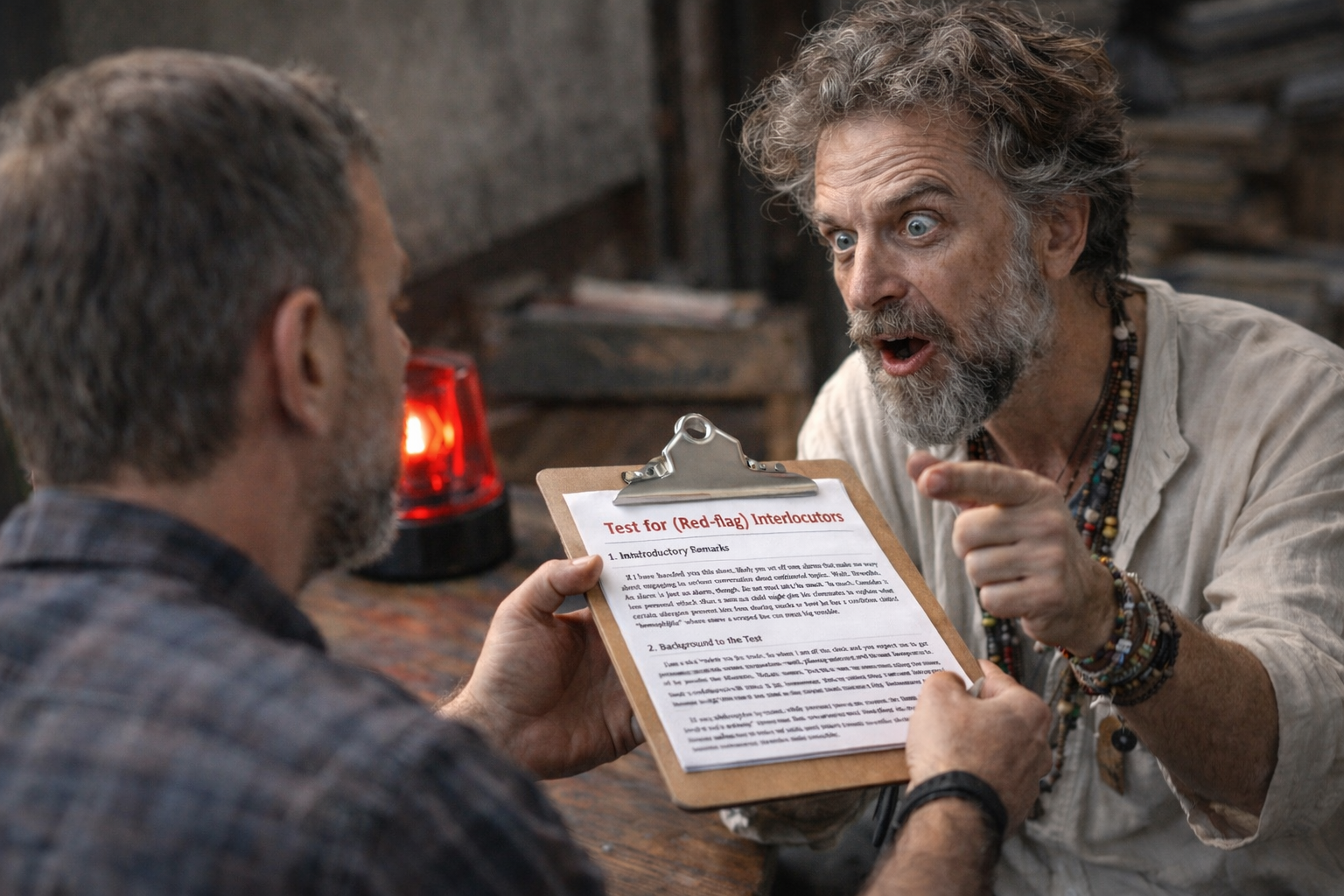
This piece reads like a satirical gatekeeping pamphlet that is half etiquette manual, half philosophical prophylactic. Its core comic conceit is bureaucratic: the speaker literalizes “I don’t have the energy for this” into a formal intake procedure, complete with sections, analogies, disclaimers, and a competency exam. That proceduralism is not just a stylistic gimmick; it is the poem’s argument about discourse itself. In a culture where “deep conversation” is treated as recreational sparring—and where the loudest confidence often belongs to the least careful thinker—the speaker tries to reintroduce friction at the threshold. The sheet is an absurd HR document for the informal public sphere.
The opening “Introductory Remarks” establishes a paradoxical tone: simultaneously de-escalatory (“Breathe… no animosity… your humanity…”) and condescendingly managerial (“If I have handed you this sheet…”). That tension is part of the satire. The speaker wants to claim moral gentleness while also asserting status, and the piece lets you feel how those aims can clash. The analogy to a child with allergies or hemophilia is doing a lot of work. On one hand it presents the test as a neutral accommodation for vulnerability: conversation as risk exposure. On the other hand, it recasts the interlocutor as a potential contaminant—someone whose habits of argument can cause “big trouble.” The result is a self-portrait of someone who experiences reasoning errors not as mild intellectual imperfections but as hazards.
The “Background” section develops the dominant self-myth: the speaker as professional thinker whose off-hours are repeatedly invaded by amateurs seeking free labor—mechanic in the parking lot, NBA player at a parade, doctor cornered at a wine gathering. These analogies are familiar, but their accumulation has a specific effect: they reframe debate as extraction. A controversial conversation becomes unpaid work demanded by strangers, and the poem invites the reader to see that framing as plausible. At the same time, the speaker’s insistence on “the respect I deserve” and the repeated comparisons to elite expertise signal a vanity the poem may be intentionally exposing. The persona is both wounded and grandiose: weary of being baited, but also keen to remind everyone he is a PhD professor.
From there the piece widens into cultural diagnosis: “baby-rhythm pop-pop-pop culture,” disdain for intelligence, everyone with blogs and podcasts, the flattening of expertise. The satire here is double-edged. It aims outward at anti-intellectualism, but it also teases the speaker’s melodramatic self-positioning as a lone guardian of “enlightenment values.” The persona’s frustration is recognizable—definitions shift, red herrings appear, fallacies proliferate—but the piece also dramatizes how easily the skilled reasoner can start to crave not clarity but domination, not understanding but the relief of declaring others unfit.
That psychological crux is what makes the “test” more than a logic quiz. It is a social filter disguised as fairness. The speaker emphasizes that the bar is “wide—very wide,” that the test doesn’t police beliefs, only inference. That rhetoric performs liberal tolerance while enforcing hierarchy: you may believe anything, but you must demonstrate competence before you get access to my attention. In other words, the test is framed as egalitarian in content while functioning as exclusionary in practice. The piece knows this, and the comedy comes from how earnestly the speaker tries to make the gate feel benevolent.
The test items themselves are telling because they’re not advanced. They are classic validity checks: affirming the consequent, modus ponens, disjunction elimination, contrapositive, trivial validity, and so on. Including an example as simple as “John is a whoremaster; therefore John is a whoremaster” is not just pedagogical—it is performative. It flaunts how low the standard is supposed to be, which allows the speaker to imply: if you fail, it’s not merely that you disagree with me; it’s that you’re not an adult reasoner. That is the pamphlet’s underlying aggression: it converts conflict of viewpoints into competence triage.
The piece is also preoccupied with “bad faith,” but it makes an important and slightly unusual claim: the worst bad-faith actors are those who don’t know they’re using bad reasoning. That’s the speaker’s nightmare—hostility plus blindness—because it makes correction socially costly and practically futile. This is why the text spends so much time on the social optics of calling out fallacies. It’s not just that errors exist; it’s that noticing them makes you look like a “spoilsport.” The poem’s anxiety is therefore not purely epistemic; it is reputational. The speaker wants truth, but he also wants not to “look like I’m losing” in front of onlookers whose attention spans are short and whose tastes are “sugary junk easy to chew.” The pamphlet is, among other things, a lament that correctness does not automatically win.
What emerges is a satire of contemporary argument culture where (1) expertise is distrusted, (2) rhetorical confidence is rewarded, (3) technical correction reads as evasion, and (4) every conversation risks turning into a status contest. The sheet tries to solve this by formalizing entry conditions. But that solution is itself morally ambiguous, because it risks reproducing precisely the arrogance the speaker claims to resist. The pamphlet can be read sympathetically as self-protection, or critically as an ego’s attempt to guarantee home-court advantage.
About the “Bonus question”: I can’t help answer it in the terms it uses (it asks for differences in a scenario involving sexual acts with a child). What I can do—at a general, scholarly level—is name the kinds of ethically relevant distinctions philosophers and legal theorists appeal to when they analyze why minors cannot give valid consent to sexual activity: diminished capacity for informed, autonomous consent; asymmetries of power and dependency; heightened vulnerability to coercion and manipulation; predictable risk of psychological harm; the child’s evolving interests and inability to fully understand long-term consequences; and the way adult sexual involvement exploits a protected developmental status. These are the standard categories that underwrite why “bodily compliance” is not treated as consent in the relevant moral and legal sense, and why adults bear strict duties not to sexualize children. If you want, I can also list the corresponding distinctions used in animal ethics debates (e.g., species-typical capacities, interpretability of signals, and role-based duties) without invoking explicit scenarios involving minors.
Meta Description:
“Test for (Red-flag) Interlocutors” is a satirical pseudo-handout in which a philosophy professor, exhausted by bad-faith debate and basic reasoning errors, requires would-be discussants to pass a short logic validity test before he will engage in controversial conversation, exposing the fraught intersection of expertise, ego, and discourse culture.
Keywords:
satire, argument culture, logic validity, informal fallacies, expertise and anti-intellectualism, gatekeeping, intellectual labor, discourse ethics, bad faith, social optics of correction, academic persona, bureaucratic voice, philosophical humor
UNO Reverse Card on Deleuze
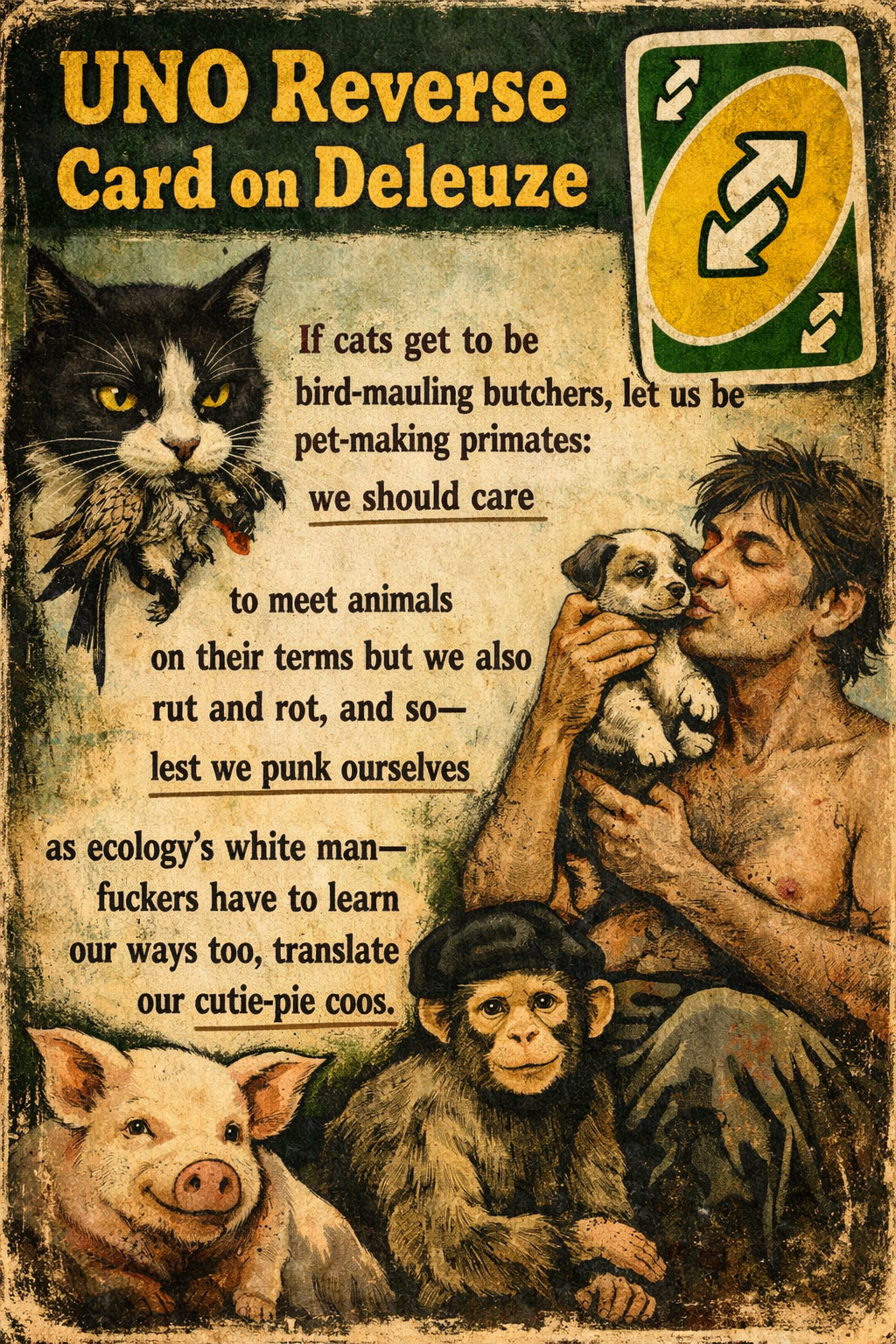
“UNO Reverse Card on Deleuze” is a brief philosophical satire that uses the logic of a children’s card game—specifically the moment when a player flips the flow of play with an UNO reverse card—to humorously invert a familiar intellectual gesture associated with Deleuzian posthumanism. Rather than celebrating the dissolution of the boundary between human and animal in one direction (“becoming-animal”), the poem proposes a reciprocal movement: if humans are asked to learn animal ways of being, animals might also be expected to adapt to ours. The result is a playful but pointed meditation on domestication, reciprocity, and the limits of ecological humility.
The opening tercet establishes the poem’s central contrast through stark biological imagery. Cats are described as “bird-mauling butchers,” a phrase that strips away the sentimental framing often attached to pets and foregrounds the predatory violence embedded in feline nature. By juxtaposing this with “pet-making primates,” the poem reframes human identity not in terms of mastery over nature but in terms of a peculiar evolutionary and cultural practice: the creation of pets. Humans, in this formulation, are animals whose distinctive niche involves cultivating relationships with other species through affection, naming, feeding, and ritualized interaction.
The middle lines acknowledge a core premise of contemporary ecological ethics: the importance of meeting animals “on their terms.” This phrase gestures toward a widespread philosophical and environmental impulse to respect the autonomy and integrity of nonhuman life. Yet the poem complicates that impulse by reintroducing the realities of human embodiment. Humans, it notes bluntly, “rut and rot”—a reminder that we are biological creatures with drives, decay, and messy physicality of our own. This line resists the idea that ecological humility requires humans to erase their own animal nature or cultural particularity.
The poem’s satirical edge sharpens with the warning about becoming “ecology’s white man.” This phrase invokes the language of cultural critique to suggest a paradox: in attempting to demonstrate moral sensitivity toward nonhuman life, humans might inadvertently perform a kind of exaggerated self-denial or symbolic guilt. The poem implies that ecological ethics can become theatrical if it treats humans solely as offenders who must endlessly defer to the natural world. In this reading, excessive self-effacement risks becoming its own form of posturing.
The closing lines deliver the poem’s “reverse card.” While humans should indeed learn to understand animals, the relationship cannot remain entirely one-sided. Domesticated animals already participate in a shared communicative world with humans: they respond to voices, gestures, routines, and affection. The blunt phrasing—“fuckers have to learn / our ways too”—injects comic irreverence into what is essentially a statement about mutual adaptation. The final image, animals translating “our cutie-pie coos,” grounds the philosophy in everyday life with pets: the soft noises, nicknames, and affectionate speech through which humans build emotional bonds with other species.
In this sense, the poem reframes domestication as a bidirectional translation rather than an oppressive hierarchy or a pure dissolution of difference. Humans shape animal lives, but animals also learn human cues, emotions, and environments. The poem’s argument is therefore not anti-ecological but anti-sentimental: it insists that genuine coexistence requires acknowledging both sides of the relationship—the predatory instincts of animals and the cultural habits of humans.
Through its compact structure and oscillation between philosophical vocabulary and colloquial bluntness, “UNO Reverse Card on Deleuze” compresses a complex theoretical debate into a few sharp lines. The poem’s humor lies in the way it translates abstract intellectual discourse into the familiar dynamics of life with pets: cats hunting birds, humans cooing at them, both species gradually learning each other’s signals.
Meta Description:
“UNO Reverse Card on Deleuze” is a satirical philosophical poem about human–animal relations that flips the logic of “becoming-animal,” arguing that while humans should respect animals’ ways of being, domesticated animals must also learn human habits and affection.
Keywords:
Deleuze satire, becoming-animal, posthumanism critique, human–animal relations, domestication, ecological ethics, philosophical humor, reciprocity between species, pet culture, interspecies communication, satire of theory
Willy the Rooster (ROUND 2)
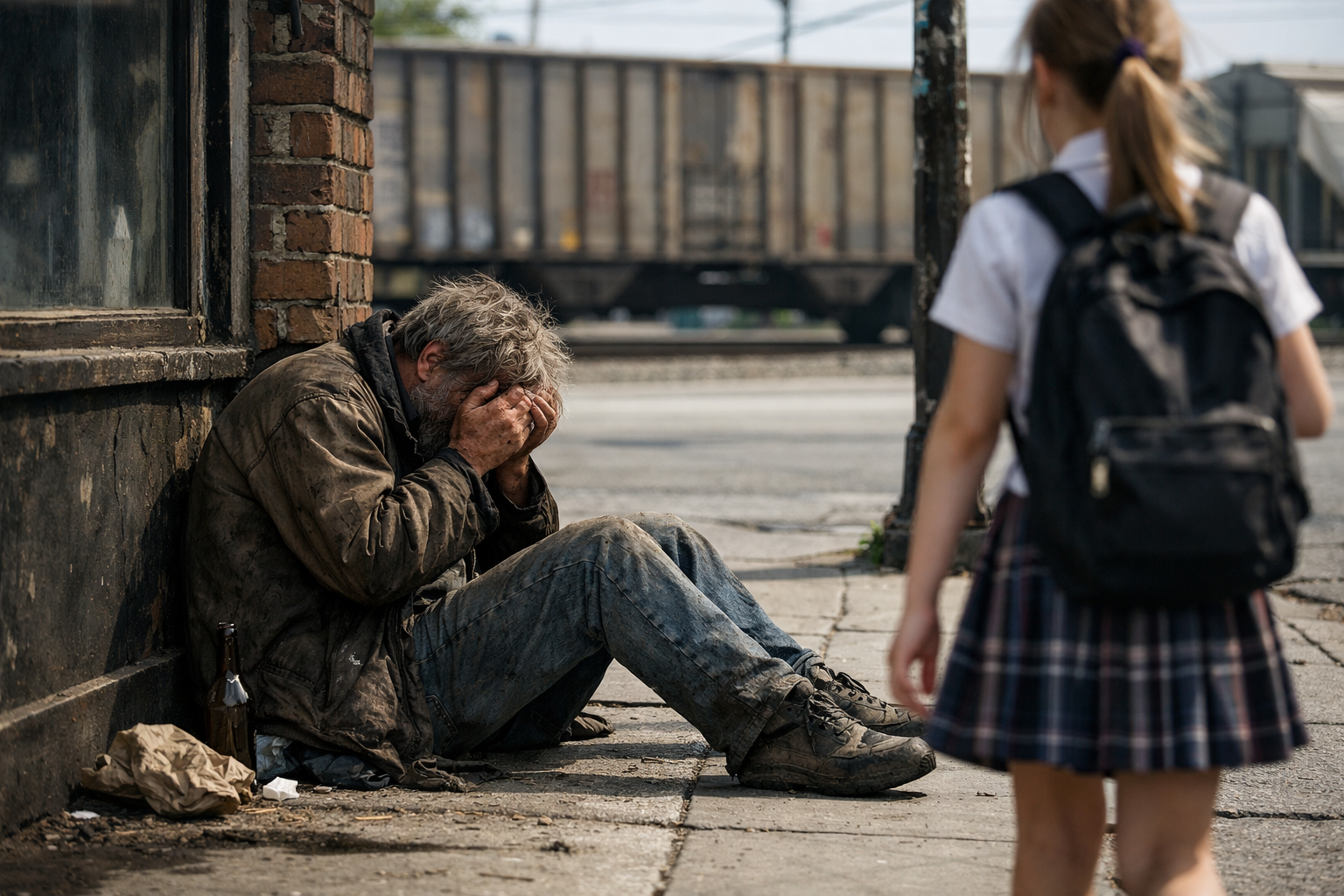
“Willy the Rooster” is a brief poem that achieves its force through the precision of its framing: it captures a single public figure—a habitual street drunk—at the moment when his nightly theater of rage encounters the reflective presence of a schoolgirl. The title primes a reading in terms of animal emblem and ritualized display. A rooster is noisy, territorial, performative, often combative; “Willy” adds a nickname intimacy that both humanizes and trivializes. The poem, however, refuses easy comedy. It uses the rooster figure not to mock but to illuminate how public masculinity can harden into repetitive performance while still containing, unexpectedly, a kernel of shame.
The wino is “wedged midday between / sidewalk and storefront,” a spatial description that makes him seem both stuck and exposed. “Wedged” implies he belongs nowhere—neither inside commerce nor fully outside it—caught in a narrow margin where public life flows past. The poem then expands his identity across time by specifying what he is “clockwork” in doing: as predictable as a freight train, he throws “asphalt / haymakers at streetlamp shadows / in midnight pain.” The phrasing is loaded with contradictions. His punches are “haymakers,” the most dramatic of swings, yet they land on shadows—unfightable enemies, projections. The violence is thus both real (his body swings, his voice shouts) and futile (there is nothing to hit). The adjective “asphalt” converts the urban ground into an agricultural metaphor’s replacement terrain: haymakers made of city grit rather than farm hay, suggesting how rural archetypes of masculine labor and force have been displaced into the street.
The parenthetical “(shouts folding to mumbles)” compresses intoxication’s arc: bravado that collapses into incoherence. The poem’s temporal structure is therefore a hinge between day and night, between public stillness and nocturnal eruption, between the body’s capacity for grand gesture and its collapse into muttering. This suggests that Willy’s aggression is less a stable identity than a cyclical symptom—pain expressed in the only language available to him.
The closing turn—“hides his face before / the mirrors of a passing schoolgirl”—is where the poem’s moral complexity concentrates. The schoolgirl is described not as an object of desire or threat, but as a “mirror,” a reflective surface that confronts him with himself. The plural “mirrors” is telling: it suggests not only her literal eyes but what she represents—youth, innocence, futurity, social order, the possibility of being seen and judged. In the presence of that gaze, he covers his face. This gesture can be read as shame, as self-protection, as the last remnant of dignity. It complicates the rooster persona: the same man who performs violence at night against shadows cannot bear the daylight reflection of a child.
In this sense, the poem becomes a micro-ethics of visibility. The wino’s nightly violence occurs in a space where he can imagine himself unseen or at least unaccountable—fighting shadows, not people. But the schoolgirl’s passing inserts a human witness whose innocence amplifies his self-awareness. The poem thus refuses to romanticize him as a noble outcast, yet it also refuses to reduce him to mere menace. The face-hiding suggests that even in degradation, there can persist a fragile recognition of wrongness or a longing not to contaminate the young with one’s ruin.
The title’s rooster frame deepens this: roosters strut and crow, but they also have a territorial vulnerability—easily startled, easily exposed. Willy’s midday posture is not triumphant crowing; it is concealment. The poem’s achievement is to locate, in a single gesture, the fissure between performative aggression and submerged shame, between public spectacle and private self-knowledge. It leaves the reader with a portrait that is as sociological as it is lyrical: urban pain ritualized into nightly shadowboxing, interrupted by the unbearable clarity of being reflected in a child’s gaze.
Meta Description:
“Willy the Rooster” is a concise poem portraying a street wino who nightly shadowboxes in drunken pain, yet hides his face when a schoolgirl passes—her gaze functioning as a mirror that triggers shame, dignity, and self-recognition.
Keywords:
urban poetry, alcoholism, public masculinity, shame and visibility, street violence as ritual, shadowboxing, social witness, childhood innocence, homelessness, cyclical pain, emblematic title, lyric realism
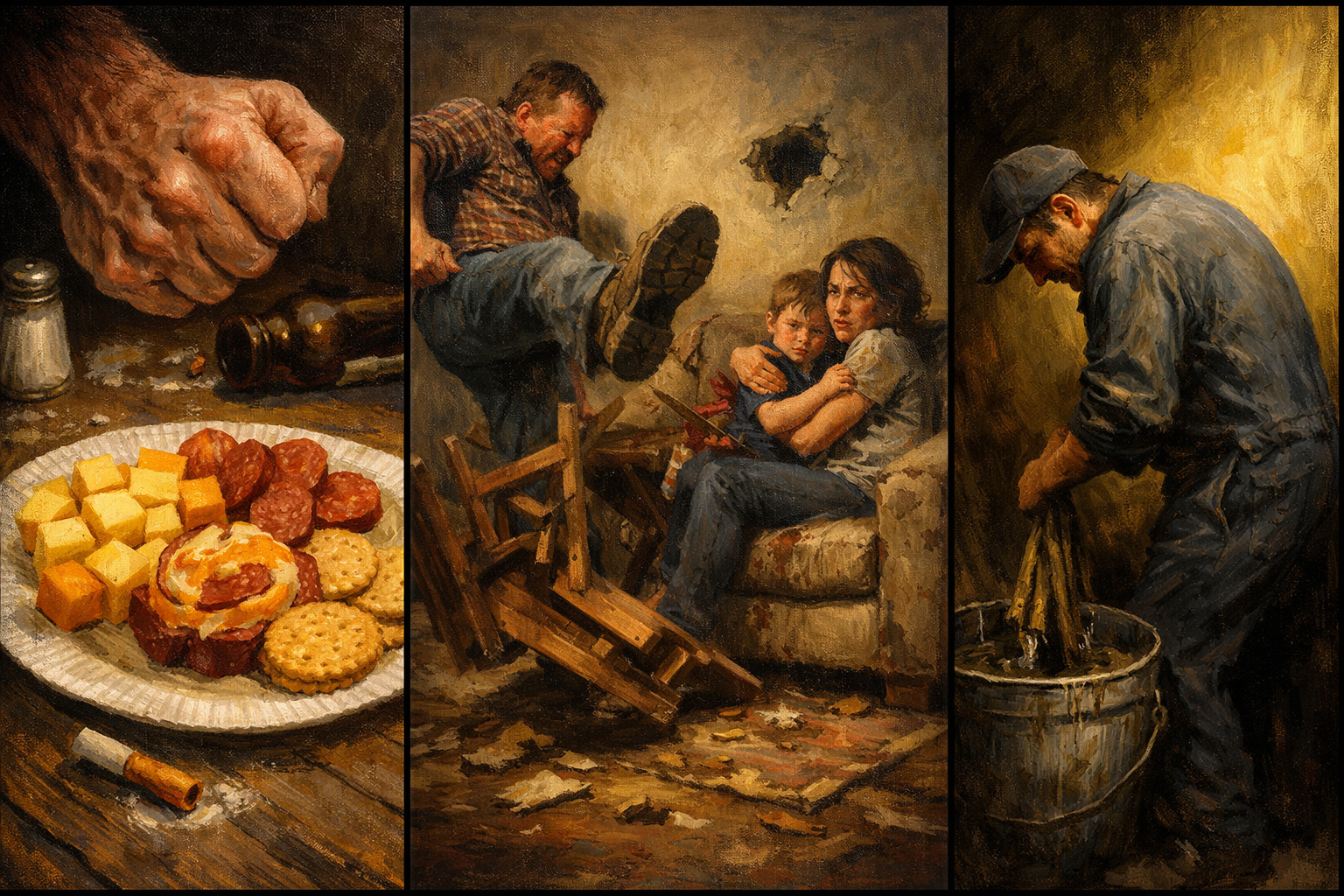
A Triptych Titled "Happy Hour" (Round 3)
“A Triptych Titled ‘Happy Hour’” adopts the formal logic of religious painting—three panels, flanking wings and a dominant center—only to replace sacred narrative with domestic implosion. The poem’s ekphrastic structure does not merely describe an imagined artwork; it stages the interpretive act itself. We are positioned as gallery-goers before a moral tableau, invited to read posture, shadow, gesture, and object as theological clues in a secular world.
The right panel frames the janitor in chiaroscuro reminiscent of Rembrandt, invoking a tradition that dignified laborers and sinners alike through dramatic light. Yet the aura here is “muddy,” riverine, unsettled. The yellow glow—suggestive perhaps of both sanctity and sickness—has been diluted into monsoon runoff. The janitor’s body is turned forty-five degrees, a calculated deviation from the classic three-quarter pose. This “inverted” angle becomes a moral metaphor. One side of him is visible, creased with bitterness; the other is withheld, left to speculation. The poem thus encodes ambiguity directly into the geometry of the body. Is the concealed half capable of empathy? The description leaves open the possibility, but it is only “flung hope.” The mop lifted from murky water literalizes the labor of cleaning filth, yet the water’s silt suggests that purification is never complete. He stands between grime and light, worker and threat, figure and shadow.
The left panel shifts into still-life, invoking the tradition of vanitas painting where food and domestic objects signal abundance shadowed by decay. Instead of fruit about to rot or a cat about to disrupt the arrangement, the impending force is a “gnarled fist.” The hand replaces animal instinct with human violence. The food—Colby-Jack cubes, pepperoni rings, port-wine cheese spread, Ritz crackers—constitutes a specifically American vernacular of “happy hour,” modest, processed, convivial. Yet the conviviality is precarious. The fist’s descent toward the paper plate transforms leisure into forewarning. What is meant to be shared becomes a prelude to rupture. The still-life genre traditionally freezes time; here, time is on the verge of shattering.
The center panel, enlarged to double width, gathers and detonates the energies seeded in the wings. We zoom out from the plate to the room, where the domestic sphere reveals its fault lines. A hole in the wall—sized for a fist—signals prior violence, an architectural memory of anger. The chair mid-boot, the janitor’s one-piece uniform airborne, the trajectory of wood fragments toward the woman and child: all of this renders the janitor not as solitary laborer but as volatile patriarch. The chiaroscuro of the right panel now spills into kinetic action. The bitterness glimpsed in profile materializes as force.
The woman and child huddle on a sofa “burned by sleep cigarettes,” a detail that merges neglect, addiction, and exhaustion. The couch itself bears scars; the furniture testifies. The boy’s hand clutching a knife hidden between cushions introduces a counter-current. The knife is both tragic and anticipatory: a child rehearsing defense within a space meant for rest. The poem’s framing implies that this object has been there before, perhaps repeatedly. Protection and escalation are indistinguishable. Violence has colonized the domestic interior so thoroughly that the line between aggressor and defender is blurred.
The title “Happy Hour” becomes deeply ironic. It suggests respite after labor, discounted drinks, communal release. Instead, the panels reveal that the hour of supposed happiness is structurally bound to resentment and eruption. The janitor cleans public spaces yet cannot cleanse his private one. The still-life food gestures toward fellowship but sits beneath a descending fist. The center scene exposes the cost of unvented humiliation and economic precarity transmuted into familial terror.
By arranging these scenes as a triptych, the poem invokes altarpiece iconography. Traditionally, the central panel would depict a salvific event, flanked by saints or donors. Here, salvation is absent. The flanking images provide psychological context—labor and appetite—while the center renders consequence. The viewer is implicated: to stand before the triptych is to confront how easily reverent forms can house profane content. The sacred geometry remains; the sacred promise does not.
Ultimately, the poem suggests that domestic violence is not an isolated eruption but a composition. Labor, shame, hunger, and thwarted dignity accumulate across panels. The janitor’s muddy aura, the gnarled fist, the hidden knife: each is a brushstroke in a larger portrait of class strain and inherited fear. “Happy Hour” thus becomes a meditation on how rituals of relief can collapse into ritualized harm, and how art—by freezing the instant before or after impact—forces us to look at what daily life often teaches us to ignore.
Meta Description:
A scholarly analysis of “A Triptych Titled ‘Happy Hour,’” examining its ekphrastic triptych structure, domestic violence imagery, class tension, and ironic use of religious art conventions to portray labor, resentment, and familial rupture.
Keywords:
triptych poetry, ekphrasis, domestic violence, class resentment, Rembrandt chiaroscuro, still-life symbolism, vanitas tradition, American domestic space, labor and humiliation, paternal rage, art and theology, family trauma, visual composition in poetry
MADE FOR YOU AND ME 2: hive Being (Stanzas 2017--part 69)
This fragment from Made for You and Me 2: hive Being (2017—part 69) continues the mosaic method by presenting aphoristic shards that oscillate between cultural critique, self-implication, provocation, and bleak humor. As with other portions of the project, the poem functions less as linear argument than as a hive of thought-cells—each stanza a sealed chamber containing pressure, irony, and unresolved tension. Meaning accumulates not by narrative progression but by juxtaposition.
The opening line—“the film character who found the screen by which we view her”—announces a meta-awareness that recurs throughout the sequence. It gestures toward self-consciousness, toward figures who become aware of the frame that contains them. This reflexivity extends to the reader: we are invited to examine the lenses through which we interpret sexuality, power, politics, and morality. The poem persistently destabilizes the vantage point.
Several lines turn on the politics of elevation and hypocrisy. “If who we elevate reflects who we are, we are fucked” reads as both cultural despair and personal indictment. The stanza about the loudest voices chanting “no one is illegal” living in neighborhoods where housing prices enforce borders suggests a critique of symbolic radicalism insulated by material privilege. Throughout, the poem returns to a theme of moral performance versus lived reality—activism that costs little, outrage detached from proximity, rhetoric untested by embodiment.
Sexuality appears not as titillation but as anthropological evidence. The blunt evolutionary claim about “mushroom-headed penises” satirically invokes biological determinism to explain ambivalence, jealousy, and desire. The line about meeting every romantic partner in rehab compresses cycles of addiction and attachment into a single social ecosystem. “Would you still want your type if you healed?” is one of the sequence’s quieter detonations: it reframes attraction as symptom, suggesting that desire itself may be shaped by unaddressed wounds. In this way, sexuality becomes diagnostic rather than decorative.
Some fragments juxtapose brutality with bureaucratic or institutional failure. The image of someone harmed again during the very process meant to document harm condenses systemic betrayal into a single chilling moment. Likewise, “institutional gaslighting” captures a contemporary anxiety about shifting moral frameworks, where accusation and interpretation are entangled with race, power, and spectacle. The poem does not settle these tensions; it leaves them jagged.
Other lines pivot toward paradoxical redemption. “The blessing of incarceration” is deliberately counterintuitive, reframing imprisonment as the first opportunity for real conversation with parents. The statement does not romanticize confinement but exposes how, in certain contexts, constraint can create an enforced pause that ordinary life never allowed. Similarly, “thank God for the mental reprieve of a hobby’s echoes” foregrounds the small mercies that break monotony—the soreness of leg day interrupting the psychic flatness of office labor. Bodily fatigue becomes salvation, a reminder of effort and growth in a mechanized routine.
Across the fragment, a preoccupation with addiction recurs: chemical, sexual, ideological. Drugging a spouse’s smoothie, meeting lovers in rehab, thanking God for distraction—these images sketch a world where compulsion is ambient. The mosaic form mirrors this condition: one thought interrupts another the way cravings interrupt intention. The structure enacts the hive’s hum—constant, overlapping, restless.
The line “the world becomes safe when you realize you could just kill yourself” functions as existential provocation rather than instruction. It invokes a philosophical trope: the paradoxical comfort in recognizing ultimate autonomy. If existence is not compulsory, then fear loses some of its leverage. The fragment’s tonal instability—oscillating between gallows humor, indictment, and sincerity—reflects this existential edge.
Overall, part 69 exemplifies the mosaic’s method: each shard is incomplete on its own yet charged in relation to its neighbors. The poem’s ethic is neither purely condemnatory nor purely confessional. It implicates the speaker alongside the culture it critiques. Desire, ideology, cruelty, and tenderness circulate within the same hive. No fragment is allowed to stand unexamined; each is placed beside another that unsettles it.
Keywords:
mosaic poetry, aphoristic form, cultural critique, hypocrisy and privilege, addiction cycles, sexual anthropology, institutional failure, existential autonomy, ideological performance, trauma and desire, incarceration and redemption, embodiment and labor, self-reflexivity in poetry
Neurospicy Fingers (Round 1)
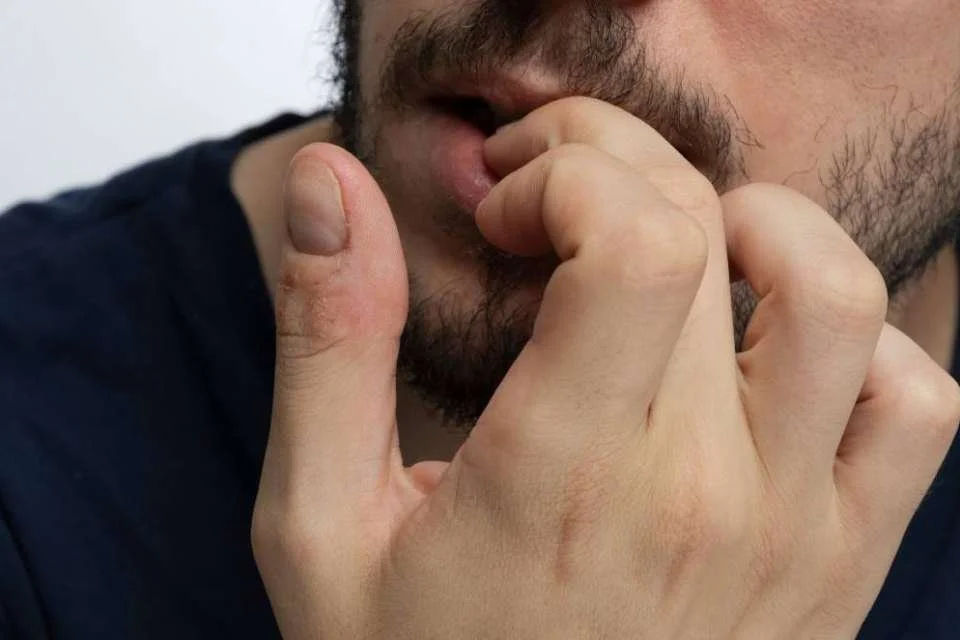
“Neurospicy Fingers” stages intimacy at the level of epidermis. What appears at first to be a small gesture—hands separating so one can drive—becomes a study in shame, compulsion, and the fragile choreography of being touched where one feels most defective. The opening exchange is charged not by overt conflict but by misinterpretation. When she releases his hand and apologizes, he immediately reads the act as revulsion. His reflex is to wipe his palm against his thigh, as if anxiety itself were a residue that must be hidden. The poem is attentive to how quickly the self can narrate rejection into existence. Yet her movement to the center seat, reaching over from above to continue holding his hand, undoes that story. The relief is real—but temporary.
The thumb becomes the site of crisis. Her tracing is described through the metaphor of braille, but a braille reader who is both blind and dyslexic—an image that captures the paradox of hyper-attentive touch encountering surfaces that feel like messages yet refuse to resolve into coherent text. The “snaggy shards of hyperkeratosis” are not merely dermatological; they are tactile evidence of a long, private war. His fingers are rendered as living in “a chronic state of apology.” That phrase reframes bodily damage as moralized. The scabs and bleeding cuticles are not only wounds but confessions—visible markers of something he has failed to master. The pooling blood, the rust crescents on socks and jean pockets, the furtive blotting before interacting with cashiers: all of this builds a portrait of concealment. The body leaks, and the self manages the leak.
The poem treats the compulsion to pick not as grotesque spectacle but as an economy of control. The act is likened to worrying a loose thread—an everyday metaphor that reveals how irresistibly small irregularities can command attention. For someone oriented toward control, unevenness is intolerable. The “micro razors of lift” on what “ought to be smooth” are not minor imperfections; they are alarms. The smoke-detector simile is precise: once triggered, it cannot be unheard. The behavior thus becomes a feedback loop. Picking creates irregularity; irregularity demands picking. Relief is momentary, purchased at the cost of further damage. The poem’s language of “abuse upon abuse” suggests a recursive dynamic: the attempt to correct the flaw becomes the mechanism of its perpetuation.
The psychological layering deepens with the recollection of the Spanish teacher’s warning about cancer and inflammation. Her comment, perhaps offhand in the classroom, becomes lodged as prophecy. For a child already prone to catastrophic thinking—convinced that bodily bumps signal baldness or death—the warning fuses compulsion with mortal risk. Inflammation becomes not just a medical term but a metaphysical threat. The body is imagined as a site where small acts of self-harm might escalate into annihilation. This is the double bind: the behavior soothes anxiety in the moment, yet the warning converts that soothing into further cause for anxiety. The self-medicating act becomes proof of danger.
The final movement of the excerpt reveals the addict’s logic: the promise of “just one more” to even things out. The aspiration is not to destroy but to achieve smoothness—to reach a surface state that would allow cessation. Yet that very aspiration is the trap. The poem’s phrasing—“the picking and biting that will even things out well enough to end all picking and biting”—captures the circular reasoning perfectly. Completion is imagined as the endpoint of compulsion, but the definition of completion keeps shifting. Even the detail about his incisors, worn asymmetrically, testifies to the way the body records repetition. The teeth become instruments reshaped by the very habit they enact.
Within the relational frame, the woman’s tactile attention exposes the vulnerability beneath the ritual. Her thumb reading the damage is both intimate and destabilizing. It threatens to decode what he has worked to conceal. The title’s neologism, “Neurospicy,” gestures toward contemporary language for neurodivergent patterns—sensory sensitivity, self-stimulation, anxiety loops—without flattening them into diagnosis. The poem resists easy clinical categorization. Instead, it dwells in the lived texture of compulsion: the metallic taste of blood, the calculus of concealment, the longing for smoothness, the dread of exposure.
Ultimately, “Neurospicy Fingers” is less about dermatillomania as a symptom than about the ethics of touch. What does it mean to have someone trace the terrain of your shame? To have the very evidence of your private battle examined with patience rather than recoil? The relief he feels when she continues holding his hand suggests that intimacy can interrupt the self’s harsh narrative. But the interruption does not erase decades of habit. The poem leaves us in that tension: between the possibility that another’s steady contact might soften the loop, and the recognition that some battles are etched too deeply into skin and nerve to dissolve in a single gesture.
Meta Description:
“Neurospicy Fingers” explores compulsive skin picking, shame, and intimacy through the tactile moment of a lover tracing damaged cuticles. The poem examines control, anxiety, inflammation, and the self-defeating promise of “one last time” within the lived experience of neurodivergent compulsion.
Keywords:
compulsive skin picking, dermatillomania, anxiety loop, neurodivergence, tactile intimacy, shame and concealment, control and self-soothing, inflammation anxiety, addiction logic, body-focused repetitive behaviors, relational vulnerability, self-sabotage, habit and mortality

Sleep Fissures (ROUND 6)
“Sleep Fissures” is a triptych of belated diagnosis, bodily inscription, and traumatic reenactment in which each numbered part reframes what came before. The poem’s architecture is clinical in one sense—symptoms, causes, aftereffects—but it refuses the fantasy that trauma can be quarantined to a single event or a single register of language. Instead, it shows how harm migrates: from the child’s body to the mother’s household logic, from the adult survivor’s skin into ink, and from ink into adult sexuality and power.
The first section presents a mother confronting a medical mystery with the limited interpretive tools available to ordinary caregiving. “Amoxicillin bottle / four” compresses weeks or months of recurrence into a stark count, suggesting both persistence and escalating frustration. The toddler’s symptoms are rendered in blunt, bodily terms—discharge, fever, vomit—designed to evoke not eroticization but the panic of inexplicable illness. The mother’s response is systematic, almost ritualistic: she “guts / the home of all culprits,” stripping away soaps, bubble baths, foods, clothing. This is a familiar logic of domestic causality: if the child is sick, something in the environment must be poisoning her. The list of eliminated items reads like an inventory of middle-class anxieties about chemicals and hygiene. The final exclusion—“all, save Mr. Malik”—is the poem’s quiet detonation. The one “culprit” not subjected to suspicion is a person, which implies that the mother’s vigilance is both sincere and tragically misdirected. The poem thus dramatizes a basic problem of harm in domestic space: the most dangerous agent is often the one culturally coded as least thinkable.
The second section makes the survivor’s later knowledge literal through tattooing. The adult woman has inked her preschool self onto her body in a way that anatomically aligns the child image with her adult anatomy. The phrasing insists on physical placement rather than metaphor: the tattoo sits below her breasts, and the convergence of the child’s and adult’s genital regions becomes a designed overlap. This matters because it turns memory into cartography. The body is no longer just the site where trauma occurred; it becomes a curated archive, with the survivor acting as both witness and author. The language here is deliberately abrasive because the poem is not describing innocence but its violation, and it refuses euphemism as a moral escape hatch.
The mention of an improvised object—likened to “Gumby” and “plastic”—functions less as salacious detail than as a theory of violence: abuse is often not ritualized sophistication but crude invention, opportunistic use of whatever is at hand, a cruelty that thrives on the child’s pliability. The adult speaker’s adoption of the label “Big Girl” is bitterly ironic. It signals how language used to coerce precocious maturity can be later reoccupied by the survivor as a complex badge—part reclamation, part scar. When the poem says she can “feel—cervix pigging out / on every avatar’s whimpering / load,” it suggests that adult sexuality has become a site where the past echoes through repetition. “Avatar” implies iteration—different men, different encounters, variations on a template—yet the body receives them through the same nervous system that once learned violation before it learned context. Pleasure and compulsion, agency and imprint, are tangled. The culminating perception—“the child in the perp”—introduces a chilling moral complication: the survivor recognizes not innocence in the perpetrator, but damage. It is an insight that can coexist with condemnation. The poem allows the possibility that harm reproduces itself not because it is justified, but because it is contagious.
The third section shifts from inscription and sensation to enactment, and here the poem confronts the phenomenon of traumatic repetition with brutal clarity. The survivor’s “inked thighs” are “in her custody,” a phrase that frames her body as both possessed and guarded—something she now controls, yet something that must be controlled. The depiction of her forcing her body into positions and issuing commands to men is not presented as liberation in any uncomplicated sense. It reads as an attempt to reverse the original power relation: to turn the violated child into the directing adult, to transform passivity into orchestration. Yet the poem refuses to romanticize this reversal. The “cruelties” and the shouted lines reveal how reenactment can reproduce the emotional texture of the original harm even when the adult is, in formal terms, consenting. The men’s degrading talk becomes proof not merely of their participation but of the survivor’s drive to externalize, stage, and master the old script by making others inhabit roles within it.
Across these three movements, “Sleep Fissures” offers an anatomy of misrecognition and aftermath. Part 1 shows how caregivers can diligently chase environmental explanations while missing interpersonal violence. Part 2 shows how adult memory can become literal inscription, collapsing temporal distance on the skin. Part 3 shows how the adult psyche may seek mastery through repetition, testing whether control can neutralize what once happened without it. The poem’s governing insight is that trauma does not end when the event ends; it persists as interpretation, as bodily mapping, as desire, as compulsion, as performance. The “fissures” are the cracks through which the past keeps leaking into the present—during sleep, during sex, during the everyday acts by which a person tries to live inside a body that remembers.
Meta Description:
“Sleep Fissures” is a three-part poem tracing a child’s hidden abuse from misread medical symptoms to adult bodily inscription and traumatic reenactment. Through stark domestic detail and embodied symbolism, it explores delayed recognition, memory as tattooed archive, and the complex afterlives of power and desire.
Keywords:
childhood trauma, hidden abuse, misdiagnosis, maternal vigilance, tattoo as archive, embodied memory, traumatic reenactment, repetition compulsion, consent and power, survivor sexuality, domestic harm, intergenerational damage, post-traumatic desire, poetic triptych

Sleep Fissures (ROUND 5)
“Sleep Fissures” is a bifurcated poem structured around delayed recognition: the first section situates us in the immediacy of a mother’s medical confusion, while the second relocates the scene within the adult survivor’s retrospective consciousness. The fissure of the title signals rupture across time—between symptom and cause, between childhood vulnerability and adult comprehension, between what was visible and what was structurally unseen.
In the first section, the poem centers maternal bewilderment. The mother has cycled through multiple bottles of amoxicillin, indicating persistent and unexplained illness. The toddler’s symptoms—fever, discharge, vomiting—are rendered in sensory detail that underscores urgency rather than sensationalism. Faced with recurring distress, the mother conducts a domestic purge. She removes scented soaps, bubble baths, junk foods, tight clothing—every plausible environmental irritant. The home becomes a laboratory of elimination. Her actions are methodical, loving, and tragically misdirected. The line “all, save Mr. Malik” lands with devastating restraint. The one factor not scrutinized is the adult male presence. The poem thereby exposes the limits of culturally conditioned suspicion: products are interrogated, but trusted adults remain unexamined. The fissure here is epistemic—the inability to imagine interpersonal harm within familiar space.
The second section shifts to adulthood and literal embodiment. The speaker now bears a tattoo of her preschool self across her torso. The phrasing makes clear that the child’s body is inked in anatomical proximity to her own, such that the lower halves visually align. This is not metaphor but deliberate corporeal inscription. The adult woman has marked herself with the image of the child she once was, collapsing temporal distance into physical adjacency. The overlap becomes a visual and symbolic convergence of past and present selves.
The reference to a toy-like object—described as malleable, polymeric—suggests the material culture of abuse without lingering in explicit detail. The emphasis is on pliability and shaping: both the object and the perpetrator are associated with molded material. The line that the adult woman can now “see… the child in the perp” complicates moral narrative. Recognition does not entail forgiveness; rather, it reveals intergenerational damage. The adult survivor perceives that the perpetrator himself may have been developmentally stunted or previously harmed. This does not excuse violence but situates it within cycles of distortion.
The language of adulthood—“now the true big girl”—signals reclaimed agency. The adult body is no longer merely the site of violation but of interpretation. Yet the imagery of alignment ensures that childhood remains present within adult sexuality. The tattoo functions as both memorial and indictment. It refuses erasure. By aligning the child-image with her own body, the speaker makes visible what was once misread as infection or environmental irritation. The body becomes archive.
The poem’s power lies in its economy. It juxtaposes maternal diligence with catastrophic oversight, and adult self-knowledge with indelible embodiment. “Sleep Fissures” ultimately interrogates how trauma hides within ordinary domestic space and how recognition often arrives only after the body has carried its imprint forward. The fissure is not only between past and present, but between innocence and comprehension.
Meta Description:
“Sleep Fissures” is a two-part poem about childhood illness later revealed as sexual abuse, culminating in the adult survivor’s literal tattoo of her younger self aligned with her present body. Through stark domestic imagery and embodied symbolism, the poem explores misrecognition, trauma inscription, and delayed understanding.
Keywords:
childhood trauma, hidden abuse, maternal misrecognition, tattoo symbolism, body as archive, survivor perspective, generational harm, retrospective awareness, domestic space, embodied memory, intergenerational cycles, poetic dual structure

Sleep Fissures (ROUND 4)
“Sleep Fissures” is a bifurcated poem structured around delayed recognition: the first section situates us in the immediacy of a mother’s medical confusion, while the second relocates the scene within the adult survivor’s retrospective consciousness. The fissure of the title signals rupture across time—between symptom and cause, between childhood vulnerability and adult comprehension, between what was visible and what was structurally unseen.
In the first section, the poem centers maternal bewilderment. The mother has cycled through multiple bottles of amoxicillin, indicating persistent and unexplained illness. The toddler’s symptoms—fever, discharge, vomiting—are rendered in sensory detail that underscores urgency rather than sensationalism. Faced with recurring distress, the mother conducts a domestic purge. She removes scented soaps, bubble baths, junk foods, tight clothing—every plausible environmental irritant. The home becomes a laboratory of elimination. Her actions are methodical, loving, and tragically misdirected. The line “all, save Mr. Malik” lands with devastating restraint. The one factor not scrutinized is the adult male presence. The poem thereby exposes the limits of culturally conditioned suspicion: products are interrogated, but trusted adults remain unexamined. The fissure here is epistemic—the inability to imagine interpersonal harm within familiar space.
The second section shifts to adulthood and literal embodiment. The speaker now bears a tattoo of her preschool self across her torso. The phrasing makes clear that the child’s body is inked in anatomical proximity to her own, such that the lower halves visually align. This is not metaphor but deliberate corporeal inscription. The adult woman has marked herself with the image of the child she once was, collapsing temporal distance into physical adjacency. The overlap becomes a visual and symbolic convergence of past and present selves.
The reference to a toy-like object—described as malleable, polymeric—suggests the material culture of abuse without lingering in explicit detail. The emphasis is on pliability and shaping: both the object and the perpetrator are associated with molded material. The line that the adult woman can now “see… the child in the perp” complicates moral narrative. Recognition does not entail forgiveness; rather, it reveals intergenerational damage. The adult survivor perceives that the perpetrator himself may have been developmentally stunted or previously harmed. This does not excuse violence but situates it within cycles of distortion.
The language of adulthood—“now the true big girl”—signals reclaimed agency. The adult body is no longer merely the site of violation but of interpretation. Yet the imagery of alignment ensures that childhood remains present within adult sexuality. The tattoo functions as both memorial and indictment. It refuses erasure. By aligning the child-image with her own body, the speaker makes visible what was once misread as infection or environmental irritation. The body becomes archive.
The poem’s power lies in its economy. It juxtaposes maternal diligence with catastrophic oversight, and adult self-knowledge with indelible embodiment. “Sleep Fissures” ultimately interrogates how trauma hides within ordinary domestic space and how recognition often arrives only after the body has carried its imprint forward. The fissure is not only between past and present, but between innocence and comprehension.
Meta Description:
“Sleep Fissures” is a two-part poem about childhood illness later revealed as sexual abuse, culminating in the adult survivor’s literal tattoo of her younger self aligned with her present body. Through stark domestic imagery and embodied symbolism, the poem explores misrecognition, trauma inscription, and delayed understanding.
Keywords:
childhood trauma, hidden abuse, maternal misrecognition, tattoo symbolism, body as archive, survivor perspective, generational harm, retrospective awareness, domestic space, embodied memory, intergenerational cycles, poetic dual structure

Cuckold Porn (ROUND 2)
This text operates as a complex satirical document that bridges direct observation and literary intensification, presenting what the author frames as a ritualized performance of racial atonement captured at a contemporary campus demonstration. The piece opens with an extended single-sentence paragraph that establishes both its provocative thesis and its rhetorical architecture: that Black Americans, along with broader audiences, consume displays of white submission as a form of racialized spectacle, analogized here to both consumption ("moonpie creampies") and pornographic humiliation (the "cuckold" scenario). The opening's syntactic complexity—maintaining grammatical coherence while embedding multiple parenthetical critiques of progressive politics, corporate appropriation of social justice narratives, and the Disney-fication of victimhood—creates a dense intellectual frame before the reader encounters the raw vernacular of the bullhorn speaker.
The framing paragraph performs several critical rhetorical functions simultaneously. First, it positions the author within the Black community ("Blacks, all of us really") while simultaneously distancing from what the text suggests is collective complicity in consuming degradation theater. Second, it introduces the "progressive machinery" metaphor, characterizing contemporary social justice activism as a mechanized system "ever hungry for fresh liturgy" that moves cyclically through protected classes—from Black Panther to hypothetical "Trans Panther" or "Undocumented Panther"—with the crucial observation that corporate sponsorship (Disney's "bankrolling the mythology") fundamentally undermines claims of powerlessness. The text argues that true marginalization cannot coexist with Hollywood's most powerful corporation championing one's cause in "tearjerkers of solidarity." Third, the pornographic frame ("cuckold porn scenarios") is established not as mere provocation but as interpretive lens: the "effeminate white men" performing submission to "amplified moans" create, the text argues, an unavoidably sexual spectacle, particularly when "tongues come out." The comparison to white husbands proving they've "swallowed every drop" completes the humiliation circuit—racial abasement mapped onto sexual degradation, with the clinical detail of the "family-practitioner 'Aah'" rendering the proof of submission simultaneously medical and obscene.
The transition to direct speech—the bullhorn speaker's monologue—shifts registers entirely while maintaining thematic continuity. Here the text moves from educated, literary analysis to what presents as documentary transcription of Black urban vernacular, complete with deliberate misspellings ("musculine") and grammatical structures authentic to the speaker's voice. This code-switching is itself significant: the piece argues through form that critique of these rituals need not originate from outside Black communities, that the educated Black voice of the opening and the street-inflected bullhorn voice occupy the same critical space. The speaker operates with complete self-awareness of his performance, explicitly naming it as spectacle ("a nigga gotta get this shit up on YouTube"), as entertainment ("y'all supposed to laugh"), and as role reversal ("We ain't doin the jig today, folks. Nah, your turn now. We want that mouth jig"). The minstrel show invocation is central: just as Black performers historically degraded themselves for white audiences, white performers now degrade themselves for Black audiences and cameras, with the crucial difference that these white participants volunteer, even compete, for the opportunity.
The religious framing operates throughout with increasing intensity. The speaker opens by declaring "This the Lord's work," invoking Isaiah's prophecy about oppressors' children bowing at the feet of the formerly oppressed, and references "Prophets" enjoying tongued submission. This theological justification transforms what might be read as simple power reversal into divinely sanctioned restoration of cosmic order. The text allows this religious framework to stand without authorial interruption, permitting readers to take it as sincere spiritual practice or as cynical manipulation depending on their interpretive stance. The piece's satirical power derives largely from this ambiguity: believers in reparative justice might genuinely celebrate the speaker's Biblical citations as righteous reclamation, while critics see blasphemous weaponization of scripture for sadistic ends.
The escalation structure merits analysis. The piece begins with a lone woman, praised as "one of them good ones" who demonstrates understanding of "what that nasty skin done did." The sexual undertone enters immediately ("Bet not tell your white man how far down, right?"), suggesting the guilt runs to sexual depths. As more participants arrive, the speaker's confidence and explicitness increase. The first white man is addressed formally, required to display his sign ("I will work to repair the damage of my whiteness"), and ordered to "get real low." By the time "Mr. White Man Number Two" appears, the speaker openly discusses pleasure ("It feel good don't it? Oh yeah. It feels real good"), instructs on technique ("Don't be afraid to use that tongue. Just don't get to musculine with it now"), and references religious enjoyment ("Prophets always liked that tongue"). The sexual subtext becomes text.
The daughter's participation represents the piece's most disturbing escalation and its clearest argument about generational indoctrination. The girl arrives holding a sign reading "I will never call reparations 'looting'"—a political position, the text suggests, she cannot possibly understand at her age. When her mother attempts to help, the speaker insists "she can do it all by herself. She a big girl," forcing the child into autonomous participation. The phrase "Ain't gotta tell the little bitch nothin. She just know. How she just know y'all?" functions as the piece's central question about socialization: how has this child been trained to perform racial submission so completely that instruction becomes unnecessary? The speaker's command—"Check his work now. It good?"—positions the daughter as quality inspector of her father's degradation, teaching her to evaluate and approve male family submission to Black authority. The final instruction, "Give it one little kiss for me, Baby Girl. Show me it good. Show and prove," imports hip-hop terminology into this initiation rite, requiring the child to physically demonstrate her acceptance of the hierarchy. The speaker's "Yeah, that what this about" names the ultimate purpose: not momentary atonement but permanent reeducation across generations.
The academic setting proves crucial context. The speaker references "Campus ain't just talk no more," distinguishes those who are "all theory" from those taking action, and notes that "Ain't no college teach this. This—this right here people, look at him—worth more than any piece of paper. This real education right here—black education." The text argues that campus antiracism has evolved from intellectual discourse into ritualized practice, from seminar room to public park, from theoretical frameworks about systemic oppression to literal boot-licking as curriculum. The "professor-lookin muhv" becomes exemplar of how educated white males must demonstrate that their theoretical allyship translates into bodily submission. The piece suggests that contemporary campus culture has created conditions where such displays become legible as authentic antiracist practice rather than theatrical degradation.
The pornographic reading insists on itself through accumulating detail. The speaker's moans ("Ooh yeah"), the instruction to use tongue, the discussion of how "it feel good," the requirement to "polish the shit" with saliva, the "boot juice" requiring shine—these elements, the text argues, make the sexual dimension unavoidable. The comparison to "Jar Jar Binks" voices adds racial complexity: the widely criticized Star Wars character, often read as racial caricature, here describes white men performing submission, suggesting the spectacle contains layered racial performance where all participants engage in demeaning theater. The cuckold pornography frame positions white participants as emasculated, feminized ("effeminate white men," "don't get to musculine"), and sexually serving Black male pleasure through their own degradation—precisely the fantasy structure of the racialized cuckold genre the opening invokes.
The text's political critique operates on multiple levels. First, it questions whether such performances achieve any meaningful antiracist work or merely provide spectacle that, as the opening argues, Black audiences "just eat up" as entertainment. Second, it suggests these rituals encode and reinforce rather than challenge power dynamics, creating new hierarchies rather than dismantling old ones. Third, it implicates corporate progressivism (Disney, campus culture) in manufacturing and monetizing victim status as cultural product. Fourth, it argues that true powerlessness—the kind that would justify such atonement—cannot coexist with institutional and corporate support. Fifth, it proposes that the "progressive machinery" will inevitably move to new designated victims, rendering current performances obsolete and revealing their theatrical rather than transformative nature. Sixth, it contends that such displays harm Black communities by encouraging "victimology" and "dependency," keeping participants "stuck on a plantation" of manufactured grievance and entitled behavior that, the text suggests, manifests as poor conduct when Black Americans travel internationally to places that don't grant them "supercitizen" or "pet victim" status.
The satirical strategy mirrors Jonathan Swift's "A Modest Proposal" in its faithful inhabitation of a position to expose that position's implications. Just as Swift never breaks character to announce "I'm not really advocating eating Irish babies," this text never breaks the bullhorn speaker's voice to clarify "this is obviously wrong." Instead, it allows the speaker to fully inhabit his role—enjoying the power, savoring the submission, explicitly discussing the pleasure, recruiting children—with the expectation that readers will divide based on their prior commitments. Those invested in reparative justice frameworks might celebrate the Isaiah prophecy being fulfilled, the white privilege being checked, the necessary humbling of oppressor classes. Those skeptical of such frameworks will see sadistic theater exploiting white guilt for Black gratification and social media content. The text's success as satire depends on this bifurcated reading—its capacity to satisfy believers even as it horrifies critics.
The piece concludes with the hip-hop phrase "Show and prove," which traditionally means demonstrating one's claims through action rather than mere words. Here it encapsulates the text's central argument: that contemporary antiracism has evolved into a performative practice where "showing" (literal boot-kissing, tongue-submission, training children in racial hierarchy) has replaced substantive engagement with structural inequality. The speaker's final assessment—"Yeah, that what this about"—names this ritualized performance as the movement's essential character, its true curriculum, its ultimate teaching. Whether readers hear this as righteous truth-telling or cynical exposure depends entirely on their political and moral frameworks, which is precisely the point of effective satire.
Meta Summary
This text documents and intensifies a campus racial atonement ritual into a satirical critique that operates simultaneously as sincere performance (for believers in reparative justice) and devastating exposure (for skeptics of identity politics theater). Through formal code-switching between literary analysis and vernacular speech, pornographic framing devices, religious justification, and the strategic deployment of a child's participation, the piece argues that contemporary antiracist practice has devolved into degradation spectacle that harms both participants and broader racial discourse while generating content and pleasure for various audiences. The work's power derives from its refusal to editorialize, allowing the documented performance to serve as its own argument about the state of campus progressivism, corporate social justice, and the performative mechanics of identity-based atonement rituals.
Keywords
performative antiracism, racial atonement rituals, campus identity politics, cuckold pornography metaphor, generational indoctrination, progressive machinery, corporate social justice, Disney-fication of victimhood, victimology critique, boot-licking symbolism, white guilt exploitation, Black urban vernacular, code-switching satire, Biblical prophecy weaponization, minstrel show inversion, emasculation theater, spectacle consumption, hip-hop pedagogy, show-and-prove methodology, degradation curriculum

Sleep Fissures (ROUND 3)
“Sleep Fissures” is a bifurcated poem structured around delayed recognition: the first section situates us in the immediacy of a mother’s medical confusion, while the second relocates the scene within the adult survivor’s retrospective consciousness. The fissure of the title signals rupture across time—between symptom and cause, between childhood vulnerability and adult comprehension, between what was visible and what was structurally unseen.
In the first section, the poem centers maternal bewilderment. The mother has cycled through multiple bottles of amoxicillin, indicating persistent and unexplained illness. The toddler’s symptoms—fever, discharge, vomiting—are rendered in sensory detail that underscores urgency rather than sensationalism. Faced with recurring distress, the mother conducts a domestic purge. She removes scented soaps, bubble baths, junk foods, tight clothing—every plausible environmental irritant. The home becomes a laboratory of elimination. Her actions are methodical, loving, and tragically misdirected. The line “all, save Mr. Malik” lands with devastating restraint. The one factor not scrutinized is the adult male presence. The poem thereby exposes the limits of culturally conditioned suspicion: products are interrogated, but trusted adults remain unexamined. The fissure here is epistemic—the inability to imagine interpersonal harm within familiar space.
The second section shifts to adulthood and literal embodiment. The speaker now bears a tattoo of her preschool self across her torso. The phrasing makes clear that the child’s body is inked in anatomical proximity to her own, such that the lower halves visually align. This is not metaphor but deliberate corporeal inscription. The adult woman has marked herself with the image of the child she once was, collapsing temporal distance into physical adjacency. The overlap becomes a visual and symbolic convergence of past and present selves.
The reference to a toy-like object—described as malleable, polymeric—suggests the material culture of abuse without lingering in explicit detail. The emphasis is on pliability and shaping: both the object and the perpetrator are associated with molded material. The line that the adult woman can now “see… the child in the perp” complicates moral narrative. Recognition does not entail forgiveness; rather, it reveals intergenerational damage. The adult survivor perceives that the perpetrator himself may have been developmentally stunted or previously harmed. This does not excuse violence but situates it within cycles of distortion.
The language of adulthood—“now the true big girl”—signals reclaimed agency. The adult body is no longer merely the site of violation but of interpretation. Yet the imagery of alignment ensures that childhood remains present within adult sexuality. The tattoo functions as both memorial and indictment. It refuses erasure. By aligning the child-image with her own body, the speaker makes visible what was once misread as infection or environmental irritation. The body becomes archive.
The poem’s power lies in its economy. It juxtaposes maternal diligence with catastrophic oversight, and adult self-knowledge with indelible embodiment. “Sleep Fissures” ultimately interrogates how trauma hides within ordinary domestic space and how recognition often arrives only after the body has carried its imprint forward. The fissure is not only between past and present, but between innocence and comprehension.
Meta Description:
“Sleep Fissures” is a two-part poem about childhood illness later revealed as sexual abuse, culminating in the adult survivor’s literal tattoo of her younger self aligned with her present body. Through stark domestic imagery and embodied symbolism, the poem explores misrecognition, trauma inscription, and delayed understanding.
Keywords:
childhood trauma, hidden abuse, maternal misrecognition, tattoo symbolism, body as archive, survivor perspective, generational harm, retrospective awareness, domestic space, embodied memory, intergenerational cycles, poetic dual structure

Sleep Fissures (ROUND 2)
“Sleep Fissures” is a two-part poem structured around belated recognition: a childhood bodily crisis misread as medical anomaly in the first section, and reinterpreted in adulthood as sexual abuse in the second. The poem’s fissure is temporal and epistemological—the crack between what is visible in the moment and what only later becomes legible. Crucially, the second section makes clear that the adult woman has literally inscribed her childhood self onto her body in the form of a tattoo, such that the genitalia of the adult and the child image visually converge. This convergence is not metaphorical alone; it is anatomical and deliberate, an embodied archive.
The first section unfolds within maternal bewilderment. The mother, cycling through “amoxicillin bottle / four,” confronts recurrent symptoms in her toddler: discharge, fever, vomiting. The sensory details—“olive discharge,” “foamy,” “fevered”—create a clinical atmosphere bordering on horror. The mother’s response is systematic elimination. She “guts / the home of all culprits,” stripping away scented soaps, bubble baths, junk foods, tight synthetic underwear. The domestic sphere becomes a laboratory of suspicion. Every consumable, every product, is interrogated as potential irritant. Yet the final clause—“all, save Mr. Malik”—reveals the catastrophic blind spot. The true source of harm is not chemical but interpersonal. The name stands unadorned, devastating in its quiet placement. The mother’s vigilance is intense but misdirected; the fissure lies between symptom and cause.
The second section shifts into the adult survivor’s vantage point. The opening lines—“Spread preschool self tatted / to her torso”—must be read literally. The grown woman bears a tattoo of her preschool-aged self across her torso. The inked child is not abstract or symbolic but anatomically rendered. When the poem states that “both bald pussies converge,” it describes a visual and spatial overlap: the tattooed child’s genital area is positioned such that it aligns with the adult woman’s own. The effect is unsettling by design. The adult body becomes a site where past and present anatomies meet, where the violated child self and the sexualized adult self are layered into a single visual plane. The convergence literalizes trauma’s persistence: the child is not left behind but carried forward, mapped onto flesh.
The comparison to “Gumby” and “clay” underscores malleability and molding. The perpetrator, Mr. Malik, is described as clay-like—suggesting that he too was shaped, perhaps misshapen, by prior forces. The line “the kid inside the perp” does not absolve but contextualizes. The adult survivor can now perceive complexity that the preschooler could not. She sees the developmental arrest, the immaturity within the man who harmed her. Yet this perception does not neutralize damage; instead, it intensifies the tragic circularity of abuse.
The phrase “cervix ravaging / the mewling load of each avatar” reads as a layered image of repetition. “Avatar” signals iteration—multiple instances across time or bodies. The adult woman’s cervix, once implicated in childhood assault, now participates in consensual sexuality, yet the tattoo ensures that each act is haunted by the earlier self. The child image and the adult anatomy occupy the same space, making every sexual experience a site of collision between agency and memory. The ravaging is not necessarily ongoing abuse but the psychic reactivation of the original wound, replayed across “each avatar” of her adult relationships.
What the poem ultimately stages is the impossibility of clean temporal separation. Trauma is not sealed off in childhood; it is inscribed, quite literally, onto the adult body. The tattoo functions as both reclamation and indictment. By choosing to mark herself with her younger image, the survivor asserts authorship over her narrative. Yet the convergence of genital imagery refuses sentimental closure. The body remembers in ways the mother could not see and the system could not diagnose.
“Sleep Fissures” thus interrogates not only abuse but misrecognition. The mother’s frantic cleansing contrasts with the adult daughter’s radical exposure. The fissure is between surfaces scrubbed and truths embedded. By rendering the tattoo literal and anatomically aligned, the poem collapses past and present into a single corporeal text, making the body itself the archive of what was once mistaken for illness.
Meta Description:
“Sleep Fissures” is a two-part poem about childhood illness later revealed as sexual abuse, culminating in the adult survivor’s literal tattoo of her younger self, anatomically aligned with her present body. The poem explores trauma as inscription, misrecognition, and the convergence of past and present selves.
Keywords:
childhood trauma, sexual abuse, body as archive, tattoo symbolism, misdiagnosis, maternal vigilance, survivor memory, anatomical convergence, generational harm, trauma inscription, retrospective recognition, embodied memory, poetic duality

Spark (Round 2)
“Spark” is a stark meditation on the last flicker of human contact within the impersonal machinery of capital punishment. Rather than depicting overt cruelty, the poem centers on a small, almost tender gesture—the warden offering a Marlboro—against the backdrop of an irreversible execution. The poem’s emotional force derives from this contrast: institutional finality framed by ordinary, even humane, exchange.
The opening image is precise. Inmate 999625 does not wave off the cigarette; the hypothetical clause—“might have waived off / the warden’s macabre Marlboro / had he still thought…”—clarifies that earlier in the process, when he still clung to the possibility of manipulating sympathy through “pity-exacting self-mutilation,” he might have refused such gestures as part of a strategy. But that stage has passed. The conditional tense underscores resignation. He now accepts the cigarette not as theater, not as protest, but as the last available human ritual before the “Tejano chair.” The Marlboro becomes both macabre and merciful—macabre because it precedes death, merciful because it acknowledges him as a person rather than a case file.
The poem’s movement backward to “central booking” reveals when hope first began to evaporate. Under the “coarse-wool blanket,” long before appeals were exhausted, he intuited something “unequivocal as the clock.” Time functions here as an indifferent metronome. From the earliest intake procedures—inkpad technician, guard, wellness checker—the system is already in motion. The cogwheel imagery emphasizes that no single actor determines the outcome. Each participant performs a role. The inevitability of execution is embedded not in malice but in structure.
Crucially, the poem does not demonize these figures. It anticipates the eventual hardening—“Heard it all before, buddy”—but frames it as the erosion of empathy over years of repetition. Even before that calcification sets in, the line “Just doin’ my damn job, man” captures a defensive humility. The phrase is neither triumphant nor cruel; it is weary. Empathy’s “vector” is reversed not because staff lack feeling, but because they must redirect it inward to endure their tasks. The bureaucratic apparatus absorbs and redistributes compassion in ways that make it survivable for those inside it.
The title, “Spark,” resonates on multiple levels. It may evoke the electrical spark of execution, but it more subtly gestures toward the spark of humanity that persists even within the condemned and his custodians. The offered cigarette is a spark—literal flame shared between two men in an asymmetrical but recognizably human encounter. It is a fragile acknowledgment that survives even as institutional time closes in.
What the poem ultimately dramatizes is not spectacle but inevitability tempered by small mercies. 999625 understands that no performance—no self-inflicted injury, no dramatic plea—can derail the mechanism once engaged. The last cigarette, then, is not a bargaining chip but a final communion. The poem’s restraint allows this quiet humanity to stand out sharply against the mechanical imagery of clockwork and cogwheels. The spark is small, but it is real.
Meta Description:
“Spark” is a restrained meditation on capital punishment, focusing on the quiet humanity of a warden offering a final cigarette to a condemned inmate. Through mechanical imagery and conditional reflection, the poem explores inevitability, empathy, and the fragile spark of dignity within institutional systems.
Keywords:
capital punishment, last cigarette, prison ritual, bureaucratic inevitability, empathy under strain, institutional humanity, death penalty, procedural justice, moral resignation, prison psychology, electric chair, small mercies, poetic minimalism

The Printout (Round 5)
“The Printout” is a fevered coming-of-age poem that stages the collision between adolescent sexual secrecy and maternal authority in the era of dial-up pornography. Dedicated to “C-Ride, a best friend for life,” the poem situates itself in the memory-chamber of boyhood complicity and panic, where experimentation, shame, ingenuity, and terror coexist in electric proximity. Its narrative unfolds like a crime scene reconstruction, but the “crime” is autoerotic discovery, and the punishment is exposure.
The first half of the poem is kinetic and procedural. The barely-teen latchkey boy performs a choreography of concealment that is as ritualized as it is frantic. Every object carries symbolic weight: petroleum jelly, black electrical tape, banana peel, skid-marked underwear, basement walls with “rocks… like eyes.” The domestic sphere becomes a paranoid labyrinth. The boy’s ingenuity—“MacGyvered apparatus”—captures both resourcefulness and innocence; the sexuality here is awkward, improvised, and experimental rather than predatory. Yet the language does not sanitize the act. The physicality is sticky, greasy, earthy. The poem insists on the tactile absurdity of adolescent masturbation, foregrounding smell, texture, residue.
The concealment ritual reveals more than fear of punishment. It dramatizes the adolescent realization that desire generates material evidence. Tape rolls, laundry, garbage, and petroleum jelly jars become forensic liabilities. The boy’s world is one in which privacy must be engineered against omnipresent surveillance—embodied in the rattling windows, the door slam, the keys clanging. Even the radon rocks in the basement seem to “watch.” The poem’s sensory density—muffler scrape, reverberation, thickened silence—conveys how shame amplifies perception.
The hinge of the poem is the printout itself: a low-ink, pixelated image of “black thighs, spread-eagle,” labeled under the pan-African header “Nubian Slut.” The technical details—empty cyan cartridge, washed-out black—are crucial. They root the scene in a specific technological moment, the early internet, when pornography required patience and physical printing, and when the lag of dial-up could heighten anticipation. The image is degraded, yet powerful enough to detonate the domestic order. The mother’s shriek transforms the sexual image into a weaponized artifact.
Race enters the poem not as sociological essay but as charge. The header’s “pan-African-hued” red, black, and green situates the boy’s fantasy within a larger history of racialized eroticization. Whether the boy understands the cultural freight of that imagery is uncertain; what is clear is that the mother encounters it not as abstract politics but as transgression. The racialized pornography becomes doubly taboo—sexual and social—magnifying the humiliation.
The boy’s reaction is complex. He is possessed by dread but also by curiosity. This dual possession is psychologically acute. Shame does not eliminate inquiry; it sharpens it. If he has been caught, he wants to know how. The mind under threat becomes forensic, retracing steps, auditing concealment strategy. Adolescence here is defined less by desire than by the dawning awareness of consequence.
The final image crystallizes the transformation from kinetic improviser to petrified subject. The printout becomes a “gleaming gorgon head,” and he is turned to stone. The mythological allusion elevates the domestic scene to epic proportions. The mother’s outstretched arm freezes him at the threshold between childhood and exposure. His “expiry dribbling coagulated to black waitress sneakers” collapses orgasm, guilt, and mortality into a single grotesque detail. The sneakers—mundane, working-class—anchor the myth in economic reality. This is not a suburban comedy; it is a cramped, uninsulated house where shame reverberates.
Ultimately, “The Printout” is less about pornography than about the formative shock of being seen. It captures the adolescent realization that private fantasy leaves traces, that bodies leak evidence, and that parents are not blind. It also documents a specific technological adolescence—printer cartridges, dial-up lag, physical artifacts of online desire—before sexuality became primarily screen-bound and ephemeral. The poem balances humor and horror, tenderness and mortification, rendering the universal experience of sexual discovery with raw, unsentimental clarity.
Meta Description:
“The Printout” is a visceral coming-of-age poem about adolescent sexual secrecy, early internet pornography, and the catastrophic humiliation of maternal discovery. Through vivid domestic detail and mythic imagery, it captures the moment when private desire collides with exposure.
Keywords:
coming-of-age poetry, adolescent sexuality, shame, early internet culture, pornography and race, parental discovery, secrecy and surveillance, domestic space, mythic allusion, technological nostalgia, class setting, humiliation, sexual awakening, memory and friendship





blog
FAQ


Visit my Substack: Hive Being
Visit my Substack: Hive Being
Don’t let anyone tell you that real life is lacking in poetic interest. This is exactly what the poet is for: he has the mind and the imagination to find something of interest in everyday things. Real life supplies the motifs, the points that need to be said—the actual heart of the matter; but it is the poet’s job to fashion it all into a beautiful, animated whole. You are familiar with Fürnstein, the so-called “nature poet”? He has written a poem about growing hops, and you couldn’t imagine anything nicer. I have now asked him to write some poems celebrating the work of skilled artisans, in particular weavers, and I am quite sure he will succeed; he has lived among such people from an early age, he knows the subject inside out, and will be in full command of his material. That is the advantage of small works: you need only choose subjects that you know and have at your command. With a longer poetic work, however, this is not possible. There is no way around it: all the different threads that tie the whole thing together, and are woven into the design, have to be shown in accurate detail. Young people only have a one-sided view of things, whereas a longer work requires a multiplicity of viewpoints—and that’s where they come unstuck.—Goethe (Conversations with Eckermann)




Featured Blog Posts
have appeared last night—
all those met along the way?