


to Hive being
welcome
What is Hive Being, and Why the Name?
You have likely heard talk of a hive mind, where one global mind finds more or less figurative expression in various local minds. Such talk is common enough in nature documentaries, especially ones concerning ants or bees, and in sci-fi programs. Take that notion, at least a loose version of it, and broaden its scope. That will be a decent first step in understanding the title I have chosen both for my Blog and for the first five-volume installment of my magnum opus Made For You and Me, a fragmentary collection of minimalist stanzas from 2016 to 2020.
In alignment with Spinoza (the 17th Century Rationalist to whom I devoted my doctoral studies), I view reality in its totality as a grand hive Being: all entities are but pulsating manifestations of the buckstopping fount of everything, an ultimate being we might call “God” or “Nature” (so long as, out of respect for the capital “G” and the capital “N,” we limit it neither to some anthropomorphic cloud father hurling lightning bolts nor to mere wilderness untouched by human smog). According to the hive-Being view (where reality is one lone superorganism, a monistic—and we might even say unividualist—conception I defend in both my creative and academic capacities), each non-foundational being (each being, that is, whose essence does not involve existence) is an utterly necessitated expression or eruption or exudation of this eternal source—each is, perhaps better put, a mode or manner of being, and so a focal point through which is disclosed, what classical theists sometimes call “being itself” (ipsum esse subsistens): the realness of the real, the being of whatever may be, the sheer activity of being, the very isness of whatever is. This Blog, which duplicates my Substack, throbs as but one among many literary unfurlings of this self-necessitated foundation, this supreme wellspring, of which we—like black holes and broken beliefs, like fractal ferns and flickering flames—are the inevitable stylings.
My Journey
I am an academic who found himself pressured into early retirement by the rising tides of cancel culture. The illiberal scourge of censoring, silencing, and shaming—although always with us throughout our evolution—reached a local peak around 2021. That was the turbulent year my creative pursuits, which the old left once encouraged as a healthy outlet for the stresses of a childhood steeped in poverty and illiteracy, drew the ire of the new safe-space left. A small cadre of self-proclaimed victims and their allies, several of whom continue to berate me years later under pseudonyms as see through as their sexual infatuation, sought to erase me and my heterodoxy. They found support from a wannabe-woke dean, covered in the grand inquisitor robes of our decadent modernity (full-body tattoos) and just itching to signal his commitment to protecting “vulnerable populations” from triggering material (even if just, as it was in my case, off-duty poems “unbecoming for someone calling himself a teacher”). Although I eventually won my due-process case with the help of The Foundation for Individual Rights and Expression, I slunk away from a college that turned its back on protecting freedom of expression and from an institution increasingly intolerant of intellectual diversity.
The wrecking ball to my too-comfy office in the windowless ivory tower came with a silver lining. From the ashes of my professional aspirations rose a phoenix of increased freedom to fulfill the literary calling I have pursued for decades. Reputation concerns never stopped me, even within academia’s sterile halls of conformity. Indeed, my unapologetic defiance, which has long baffled friends and family, no doubt chummed even safe waters—almost as if I were asking for it all along—until the cancel shiver grew too frenzied to hold back its blind thrashings. But now, now I piston the most forbidden territories of human thought with no longer even a twinge of conscience. The newfound freedom means extra time to hone my craft. When not assisting special-needs communities (a day job far more rewarding than freeway-flyer drudgeries), I pursue my literary mission with Dionysian fervor.
Call for Co-Conspirators
This space, my digital sanctuary, showcases the fruits of my mission. Think of my posts, even those linking to my publications, as works in progress. I want your input, unflinching brutality included. Each post begins with an invitation to action: “Let’s workshop this [draft about x, y, z].” Your contributions, whether through public comments or my contact page, help hammer scraps of ore into polished blades fit for magazine publication.
Your input is valuable, even if you are neither a writer nor a reader of literature—twin disciplines dying by the cyber nanosecond. Sometimes—even if at the risk of uttering banalities—an outsider’s fresh vantage can pierce the veils of convention to reveal what insiders miss. It often takes an outsider to make us even think to question our ingrained presuppositions and attitudes. I stand by the hygienic value of contagion. That is one reason I advocate so strongly for intellectual diversity and freedom of expression. And that is also one reason I was so harrowed by the anti-diversity swell of cancel culture in academia (an institution that should be the utmost caretaker of such values)—harrowed especially insofar as that swell masqueraded under the gaslighting guise of “diversity”).
You will witness the breathing evolution of my writings over time. To track these changes, I label each revision by round: “ROUND 2,” ROUND 3,” and so forth. Each piece undergoes continuous refinement based on your feedback and my own revisitations. Sometimes changes will mar the work. That is the risk of creative tinkering as a finite creature. I hope you will alert me to missteps. After many semesters of university writing workshops, one rule has impressed itself upon me: when someone senses a flaw, something almost always needs to change—even if, yes, the proposed solution misses the mark (which often it does). From a quick look into the archives, accessible here, you can see how much I have benefited from your feedback so far.
My Hope
Sharing drafts can be daunting. But showing you the ravaged and unperfumed real deal unfiltered by makeup (stuttering starts and falsities, awkward line breaks and clumsy word choices, grammatical errors and misspellings)—that not only makes my work more relatable, but helps me refine things through your input. I hope the unfiltered look at the raw process of fumbling, rather than just the polished product, also helps other writers develop their craft. Imperfect works often instruct more than perfect ones: whereas the perfect ones tend to have a grace by which they slip inside us without activating our scrutiny, the imperfect ones—especially the near perfect ones—show us glaringly what not to do.
People laugh at me, seeing—in my tilting at the windmills of literary excellence—a Don Quixote clunking around in Arthurian armor in a post-knight era. I am not naïve. I am well aware of the diminishing ability to read, let alone well: slowly and deeply, with gratitude. I am also aware that my style, which often nests subpoints within larger points, never waters down virtuosity for the sake of mass appeal. I watch readers stumble over my sentences, unable to unlock even just the music of the envelope let alone the semantic meat within, which—given my tendency to flashlight through the darker facets of human nature (the addicts, the miscreants, the abusers among us)—only adds an additional alienating layer of difficulty). Beholding these depressive scenes of even supportive family members getting bucked off my syntactic bronco makes me feel like a dinosaur who should get a hint and, if not succumb to the brain rot of skibidi-toilet speak, just hang himself already. Even though the decline in linguistic background and grammatical voltage makes my compositions seem quixotic in a world binging Netflix and TikTok, I persist—raging against the dying of the light—by some internal compulsion to celebrate the richness of language and thought.
My hope is that, despite social media’s unparalleled power to farm our attention, people never forget the unique power of writing. Beyond unveiling hypocrisy, teasing out complex implications, and detailing the commonalities between even the most alien phenomena, writing offers something we need today—trapped in agoraphobic cyber bubbles only thickened by the Lyme dangers of forests and the COVID dangers of cities—perhaps more than ever. Granting us rich access to the first-person perspectives of others (to how things feel to them), writing serves as one of humanity’s best tools for combating loneliness. It allows us to linger, broadly and deeply and at high resolution, within the inner lives of others in a way that other arts can only suggest.
What to Expect
My work spans a broad spectrum: from metaphysical discourses on free will and determinism and the ontology of holes to the ephemera of western culture (whether the childhood impacts of the hypersexual mono-image of black woman as squirting twerkers or Terrence Howard’s sham revolution of mathematics). Some tight and minimal, others free-flowing sprawls; some heady and abstract, others emotional and imagistic—my inkwell musings, which often blend scholarly rigor with a dark humor from both high and low culture, aim to capture the visceral intensity of our personal and social and ultimately existential predicaments.
By no means can I deny that drug abuse, sexual assault, and the tales of the broken and the damned loom large in the tag cloud of my work. My writing will never be a paradise of easy truths and comforting lies. It will challenge you, provoke you, and at times even repulse you. I offer no apologies for the monsters I unleash. They are as much a part of us, at long root scared rodent mammals scurrying in the shadows of dinosaurs, as our noblest aspirations.
But make no mistake. It is not all downer darkness. The archives are my receipts. You will find pieces exploring the pursuit of authenticity in a media-saturated world, the search for meaning in an indifferent cosmos, and the celebration of beauty in both the sublime and the profane. I locate much of my inspiration, in fact, in novelists like Dostoevsky and poets like Ted Kooser—writers unafraid to pursue moral agendas or risk Hallmark sentimentality in an age that often sneers at sincerity.
Be they satirical dissections of modern social dynamics or poignant poems about addiction or academic articles on moral responsibility, my goal is to provoke thought, evoke emotion, and foster meaningful dialogue. Fear has not and will not stop me from challenging humanity’s fundamental taboos (like bestiality and cannibalism) or self-reflecting into the dark chaos of the subconscious, even if that means exposing the Jungian shadows—the inner Goebbels—lurking within us all!
Expect posts each day, no day missed. Donations are welcome, but I impose no paywall: it feels wrong to charge for art, especially given our date with obliteration. Feel free to explore what amounts to, at the time of writing this, close to a thousand pieces of poetry and prose here. That should give you a sense of what awaits.
Join me—specula holstered—on this literary odyssey into the public and private nooks of the hive Being. Let us navigate the labyrinth of creation together, confronting our demons and even slaying our darlings if we must. Let us dance on the razor’s edge between the sublime and the profane in pursuit of an elusive literary perfection never to be confused—as it has been confused in our declining civilization—with the pursuit of popularity or likeability over truth.











tag cloud
- literature community
- American literature
- poetry
- literature
- poem
- literary
- creative writing
- writing
- poetry community
- Michael Istvan
- Istvan
- perception
- defiance
- suffering
- existential poetry
- dissociative
- existential
- healing
- human
- mortality
- power
- art
- artist
- evolution
- God
- death
- love
- darwin
- anxiety
- rape
- psychoanalysis
- addiction
- homeless
- addict
- trauma
- therapy
- rapist
- traumatic
- hypersexual
- hyperarousal
- grooming
- anal sex
- anal
- heart
- incendiary
- dead
- Identitarianism
- tyrant
- meditation
- poverty
- fap
- choking
- traitor
- treachery
- identity
- honey pot
- true crime
- power dynamic
- woke
- cunnilingus
- Vaginal
- animals
- OwnVoices
- empathy
- ally
- crime
- summer
- scarf
- body disposal
- kidnapping
- Klan
- crack
- sex
- identity politics
- Vagina
- disease
- indians
- turtles
- fisting
- Pussy
- surrealism
- anality
- erotic
- scatalogical
- poet
- violence
- artistry
- borders
- teenybopper
- sublime
- van gogh
- mommy
- safe space
- animal
- victim
- pedophilia
- poetry editor
- adult-minor
- censor
- adolescence
Posts

Eighth Section of ''Hypocorism'' (ROUND 1)
Let's workshop the eighth section to my story, novel-length now, that examines the intricate power dynamics and linguistic structures at play in a man's passionate relationship with a girl he deems too young

Seventh Section of ''Hypocorism'' (ROUND 1)
Let's workshop the seventh section to my story, novel-length now, that examines the intricate power dynamics and linguistic structures at play in a man's passionate relationship with a girl he deems too young

Sixth Section of ''Hypocorism'' (ROUND 1)
Let's workshop the sixth section to my story, novel-length now, that examines the intricate power dynamics and linguistic structures at play in a man's passionate relationship with a girl he deems too young

Amor Prohibido (ROUND 2)
“Amor Prohibido" is a poem about the rhetoric of seduction as a fully inhabited voice — eight lines that perform, in real time, every instrument of experienced adult persuasion in sequence, with a fluency that is itself the poem's most revealing quality. The title, borrowed from Selena's 1994 hit about a love forbidden by class difference, reframes the prohibition: what is forbidden here is not class-crossing but age-crossing, and the poem's eight lines are a portrait of how such crossings are verbally engineered — not through dominance or manipulation but through a practiced, attentive confidence that knows what it wants and has learned, through long acquaintance with the world, to read what others need.
The poem is structured as a direct address — a message, a text, a DM — and its form is its argument. It does not describe seduction; it performs it, in real time, on the reader. This is the poem's most formally daring quality: the reader occupies the position of the recipient, and the speaker's rhetoric lands before it can be analytically processed. By the time one identifies the techniques being deployed, they have already been deployed.
The opening word — "Hey" — is the poem's most precise single choice. Not "Hello," which would be formal. Not the recipient's name, which would be intimate in a different register. "Hey" is the calibrated casualness of someone who has done this before, who knows that the first word sets the temperature of everything that follows, and who has chosen a temperature of relaxed confidence that performs the absence of pressure while being entirely purposeful. The "Hey" is a genre: the opening of a specific kind of message from a specific kind of man, recognizable before the second word arrives.
"I think you should let me spoil you a bit" — the modal "I think" softens without weakening. It performs tentativeness while delivering a directive: you should let me. "Spoil" activates the entire economy of gifts, attention, and resource transfer that structures the appeal — and "a bit" miniaturizes it, making the spoiling sound casual, low-stakes, easily accepted without obligation. The sentence performs the posture of a man who is merely sharing a thought while knowing exactly what thought he is sharing and what effect it is calibrated to produce.
"Your semester starts soon, right?" — the question mark is doing enormous work. The speaker almost certainly knows when her semester starts. The "right?" performs uncertainty he does not have, inviting her confirmation, drawing her into the conversation as a participant rather than a recipient. "So how about / we do an Airbnb, a little getaway, before school / sinks its claws too deep?" — "we" absorbs her into a plan already forming. "A little" miniaturizes again, making the getaway sound modest and easily fitted into any schedule. The revision from the earlier version's "sinks its claws in you" to "sinks its claws too deep" is the poem's most precise refinement: the claws are now already in, already present, the question only of depth — which positions the getaway not as a rescue from something approaching but as relief from something already underway. The urgency is more intimate, the speaker's attentiveness to her actual situation more demonstrated.
"I know that's forward" — the acknowledgment of forwardness is the seduction's most elegant move. By naming the quality of the proposition himself, the speaker demonstrates self-awareness, performs honesty, and inoculates against the charge before it can be made. The acknowledgment is not an apology but a preemptive disarmament that clears the ground for the poem's central declaration.
"But I know what I want. And I know enough / about this world, lonely as it is short, to know / what you need." — the volta arrives here, and the revision from the earlier version is the poem's most significant deepening. "Lonely as it is short" is the new phrase, and it transforms the speaker's claim entirely. In the earlier version, "I know enough about this world" was a credential of experience, of worldliness. Here it is something more vulnerable: the speaker's knowledge of the world is knowledge of its specific texture — lonely and short — and it is from within that knowledge, from having lived inside that loneliness and that brevity, that he reads what she needs. The claim is no longer purely a credential of experience. It is a credential of having felt what the world actually feels like from the inside, which is a different and more intimate authority. He is not above the world's loneliness; he is inside it, as she is, and that shared condition is the basis of his reading of her need.
"I promise to be a gentleman — / until, of course, you give me the green light." — the closing couplet delivers the proposition's true content. The promise of gentlemanliness is conditional and temporary — "until, of course" — and the "of course" performs the inevitability of the green light as something mutually understood, already implicitly agreed upon, a matter of when rather than whether. The green light is genuinely hers to give: the speaker is not assuming he will take what has not been offered. He is expressing his confidence — earned through attention and through his reading of what she needs — that the offer will be made. The earlier version's "to be otherwise" has been pruned to simply "the green light," tightening the close: no elaboration on what otherwise might mean, just the signal itself, clean and sufficient.
The poem's eight lines enact a complete arc of persuasion: casual opening, spoiling proposition, temporal urgency, self-aware acknowledgment of forwardness, vulnerable credentialing through shared knowledge of the world's loneliness and brevity, and the quiet confidence of the conditional promise. Each move is precise. None announces itself as a move. The fluency is the seduction: a man who has lived long enough in a lonely and short world to know what he wants and to recognize, in someone younger, what she needs — and to say so in a "Hey" that sounds like nothing more than a thought he wanted to share.
Meta Description
A poem structured as a seductive direct address — eight lines performing experienced, attentive persuasion in sequence, grounded in the speaker's knowledge of a world lonely as it is short, ending with the green light assumed as inevitable by a man who has been paying close enough attention to know what she needs.
Keywords
Amor Prohibido, seduction rhetoric, direct address poem, age gap persuasion, lonely as it is short, green light, Airbnb getaway, Selena amor prohibido, forbidden love, rhetorical analysis poetry, desire and attention, close reading, Hypocorism, DM as poem, adult male seduction

Teenie Toffees (ROUND 3)
"Teenie Toffees" is a poem about the displacement of one economy of desire by another — specifically, the moment at which the Girl Scout's official economy of cookies, badges, and door-to-door salesmanship is revealed to have been superseded by a more potent and more generative economy organized around the body itself. The poem does not depict exploitation or victimization. It depicts a girl who has already made the calculation, who has already understood what sells harder than scripture and generates more abundance than a miracle, and who has been found in the act of that understanding — humming, unhurried, in her own front camera.
The title's compound — "Teenie Toffees" — operates through the collision of registers its two words enact. "Teenie" is the diminutive of smallness, youth, the not-yet-fully-formed; "Toffees" is the confection, the sweet, the thing that is simultaneously treat and commodity. Together they produce a compound that sounds like a brand name for children's candy while carrying the erotic freight the poem will make explicit: the teenie is the toffee, the girl is the product, and the market for this product — as the poem will demonstrate — dwarfs anything the Girl Scouts organization has ever moved.
"The Girl Scout, head / made for junior-high hustles / bolder than badges" — the opening establishes the poem's central substitution immediately. The Girl Scout is an official figure of supervised female enterprise: the uniform, the badges, the cookie drive, the institutional framework of merit and achievement. "Head made for junior-high hustles" — "head" carries its anatomical register (the face, the self-presentation, the front-cam image) and its sexual register simultaneously, the double meaning installed before the poem has committed to either. "Hustles bolder than badges" names the substitution directly: the official economy of merit and achievement has been superseded by an unofficial economy whose transactions the badge system was never designed to accommodate and whose boldness the badge system cannot measure.
"Found humming / in her front cam that supreme cookie" — "found" is the poem's most important verb, and its passive construction is its most precise choice. She is not caught, not exposed, not discovered in the sense of being surprised against her will. She is found — encountered in the act, present in the image — and the finding is the poem's occasion without being its judgment. "Humming" carries its musical register — the sound of contentment, of self-absorption, of a person at ease in what they are doing — and its vibrating register, the hum of a body in its own frequency. The front cam is her instrument and her audience simultaneously: she is both performer and producer of the image, the economy entirely under her own management.
"That supreme cookie" — the Girl Scout cookie economy reaches its ironic apex here. The cookie the organization sells door-to-door, the cookie whose varieties are the subject of annual consumer enthusiasm, is here displaced by the supreme cookie: the one that is not in the box, that is not sold through official channels, that requires no troop leader's oversight or parent's permission. "Supreme" is the hyperbolic register of contemporary vernacular — the highest, the most sought, the one that commands the premium — applied to the body as commodity with the same casual confidence the market applies it to anything else it has decided is worth the most.
"A glossy box that scaled / harder than scripture" — "glossy box" extends the packaging metaphor of the official cookie economy into the body's presentation in the front cam: the screen as packaging, the image as product, the gloss of the digital filter as the sheen of commercial desirability. "Scaled harder than scripture" is the poem's first major rhetorical escalation, and it is exact. Scripture scales — spreads, propagates, finds its way into cultures and consciousnesses across millennia — through the mechanisms of faith, institution, and the genuine human need for meaning. What the poem is describing scales through mechanisms more immediate and more powerful in the contemporary moment: the algorithm, the share, the viral image, the economy of attention that moves faster and reaches further than any text the church has ever distributed.
"More generative than loaves or fish / in the hands of Jesus" — the second escalation completes the theological comparison with a precision that is not blasphemy but analysis. The miracle of the loaves and fishes is the definitive scriptural image of generativity: from scarcity, abundance; from five loaves and two fish, enough to feed five thousand. The poem claims that what the girl has found between her thighs is more generative than this — that the economy it can set in motion, the abundance it can produce, exceeds the miracle in its scale and speed. This is not a claim about spirituality but about economics: the attention economy's capacity for multiplication dwarfs any previous model of distribution, sacred or secular.
"Fuzzed between her thighs" — the poem's final image arrives with deliberate anti-climax after the theological escalation. "Fuzzed" is the poem's most carefully chosen word: it names the pubescent body precisely, the hair that marks the threshold of the body's new economic value in the market the poem has been describing, and it carries the soft, slightly unfocused quality of the word itself — not sharp, not clinical, but present, specific, undeniable. The placement "between her thighs" closes the displacement the poem has been performing: the cookie box that was between her arm and her side in the official economy, held out for the customer's inspection and purchase, is now between her thighs in the supreme economy, held out in the front cam for a different market's consumption.
The poem does not moralize the girl's agency or its exploitation. It renders the economic logic with the same analytical neutrality it applies to scripture and miracle: this is what generates, this is what scales, this is what the market — in its wisdom or its catastrophe — has determined is the supreme cookie. The Girl Scout has done what the Girl Scout is trained to do: she has identified the product that sells, found her market, and begun her hustle. That the hustle is bolder than badges is the poem's only evaluative gesture, and "bolder" is a word that does not distinguish between admiration and horror. It simply measures.
Formally, the poem's three tercets move through the substitution the title announces: official economy, displacement, supreme product. The enjambments are the poem's formal engine — "head / made for," "found humming / in her front cam," "scaled / harder than," "loaves or fish / in the hands of Jesus," "more generative than loaves or fish / in the hands of Jesus — / fuzzed between her thighs" — each line break occurring at a point of maximum semantic pressure, where the sentence has committed to one register before the next line redirects it into another. The poem's syntax moves like the economy it describes: always appearing to be about one thing while being about another, the official packaging concealing the supreme cookie until the final image delivers it without apology.
Meta Description
A poem tracing the displacement of the Girl Scout's official cookie economy by the supreme economy of the adolescent body — scaling harder than scripture, more generative than loaves and fishes — rendered through the front cam in which she is found humming, unhurried, in full command of the product.
Keywords
Teenie Toffees, Girl Scout poem, adolescent body economy, supreme cookie, attention economy, scripture and sexuality, loaves and fishes, front cam, generativity and desire, displacement of economies, contemporary erotic lyric, close reading, Hypocorism, pubescent body, viral image economy

Fifth Section of ''Hypocorism'' (ROUND 1)
Let's workshop the fifth section to my story, novel-length now, that examines the intricate power dynamics and linguistic structures at play in a man's passionate relationship with a girl he deems too young

Fourth Section of ''Hypocorism'' (ROUND 1)
Let's workshop the fourth section to my story, novel-length now, that examines the intricate power dynamics and linguistic structures at play in a man's passionate relationship with a girl he deems too young

Third Section of ''Hypocorism'' (ROUND 1)
Let's workshop the third section to my story, novel-length now, that examines the intricate power dynamics and linguistic structures at play in a man's passionate relationship with a girl he deems too young

Second Section of ''Hypocorism'' (ROUND 1)
Let's workshop the second section to my story, novel-length now, that examines the intricate power dynamics and linguistic structures at play in a man's passionate relationship with a girl he deems too young

Opening Section of ''Hypocorism'' (ROUND 1)
Let's workshop the opening to my story, novel-length now, that examines the intricate power dynamics and linguistic structures at play in a man's passionate relationship with a girl he deems too young
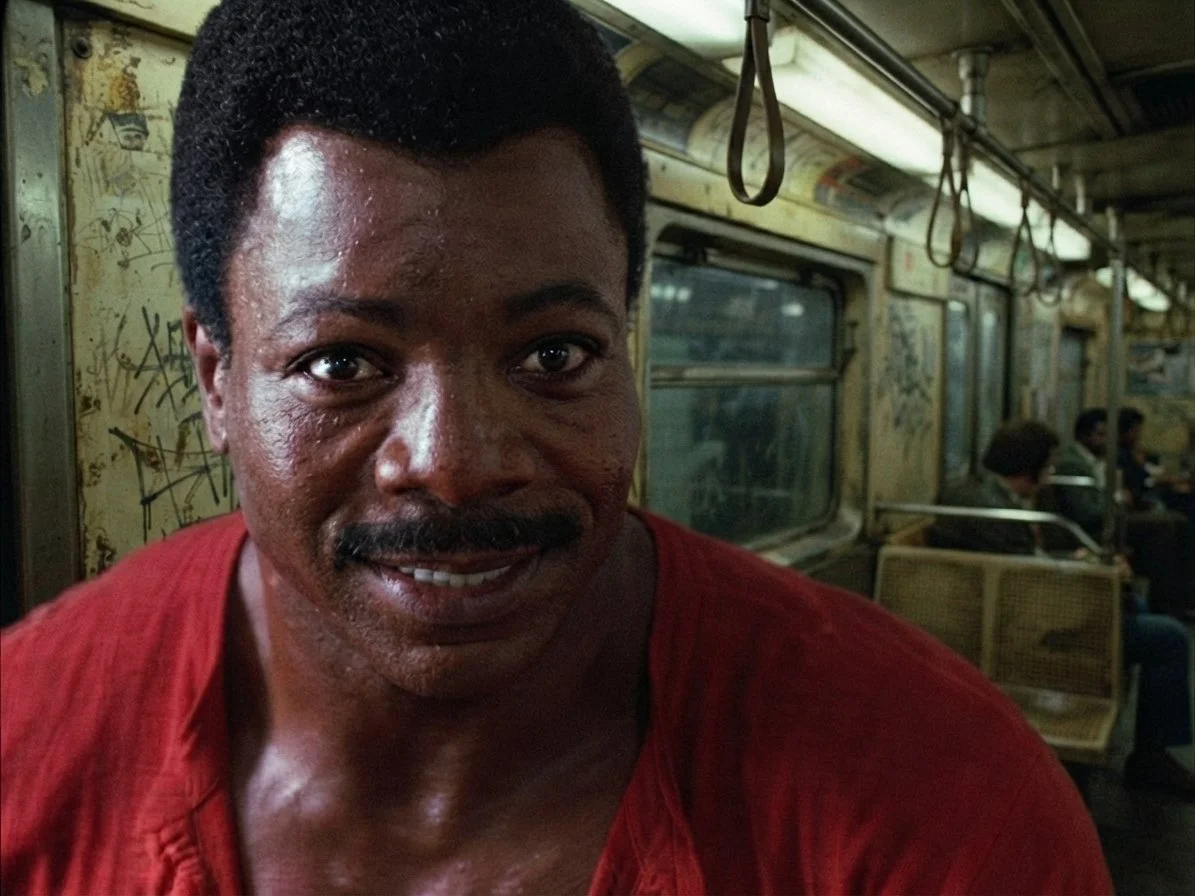
Action Jackson (ROUND 2)
"Action Jackson" is a poem about the social contract of urban public space and the specific mechanism by which that contract is enforced — or rather, by which its enforcement is suspended when enforcement would require acknowledging what is being seen. Its subject is a man having sex with a corpse on a subway car, and the poem's real subject is everyone else in the car. The necrophilia is the occasion; the aversion is the argument.
The title names a type before naming an action. "Action Jackson" is the idiom of the man who acts, who takes what he wants, who is defined by his doing rather than his deliberating. It also carries the register of Blaxploitation-era naming, of the street-tough archetype whose confidence in his own appetites is his defining characteristic. The name does not distance the reader from the subject but places him in a cultural lineage of uninhibited masculine action — and then shows what that action looks like in a subway car with a corpse.
"He humps the hobo corpse / on the subway, natural / as a bunny" — the opening is the poem's most formally daring move, and it achieves its effect through the simile rather than through the act itself. "Natural as a bunny" is the poem's central irony: the bunny comparison imports the register of innocent, instinctive, unself-conscious animal behavior — the bunny does not deliberate, does not weigh consequences, does not perform its sexuality for an audience or against a prohibition. It simply does what its nature does. Applied to subway necrophilia, the simile refuses the register of horror or transgression and instead frames the act as natural comportment, which is not an endorsement but a diagnostic: this man is operating from the same unreflective instinctual register as the bunny, and the poem is interested in what that means for the people around him.
"Except he hooks the leg / to ogle the peekaboo" — the "except" introduces the single modification that distinguishes him from the bunny: the deliberate adjustment, the hooking of the leg to achieve a better viewing angle of the corpse's genitalia. "Peekaboo" is the poem's most unsettling diction choice, importing the register of infant play — the game of appearance and disappearance, of the revealed and the hidden — into an encounter with a dead body. The word makes the act simultaneously more sinister and more absurd, the adult sexual gaze rendered in the language of nursery games.
"Pausing / ('Sshhh') in the wedge before / fresh boarders shuffle past" — the parenthetical "Sshhh" is the poem's most compressed characterization. He pauses. He shushes — whether the corpse, himself, or the situation is deliberately ambiguous. The pause is tactical, the awareness of incoming witnesses producing not cessation but interruption, a brief management of optics before resumption. "The wedge" names the specific geometry of the pause: the transitional space between the act and its witness, the narrow interval in which he adjusts. "Fresh boarders" is exact — "fresh" carrying both its temporal meaning and its suggestion of the newly arrived, the uninitiated, those who do not yet know what they are boarding into.
"Aversion to looking racist / and mumble excuses into cars / free of clobbered-colon stank" — the final tercet is where the poem's actual argument lives, and it is devastating in its precision. The fresh boarders do not intervene. They do not call for help, do not alert authorities, do not acknowledge what they have seen. They mumble excuses and move to other cars. And the poem names the specific mechanism of their non-intervention: aversion to looking racist. The calculation is instantaneous and determinative — the social cost of being perceived as racist outweighs, in the fresh boarder's internal accounting, the social obligation to respond to what is happening in front of them. The prohibition against racial accusation has become more powerful than the prohibition against necrophilia in a public space.
"Clobbered-colon stank" completes the poem with a physiological specificity that forecloses any aestheticization of what has occurred. The smell is the corpse's smell, the smell of death and bodily dissolution, and it is the one thing the fresh boarders are relieved to escape when they find the other car. They have not escaped what they saw. They have escaped the smell of it — which is to say they have traded one form of confrontation for a lesser one and called it resolution.
The poem's formal economy is its ethical argument. Three tercets, nine lines, one act, one mechanism of non-response. The brevity refuses elaboration, refuses the moral processing that would allow the reader to arrive at a comfortable position. The bunny simile refuses horror. The "Sshhh" refuses confrontation. The aversion to looking racist refuses intervention. The poem accumulates these refusals until the final tercet delivers the mechanism that makes all the others possible: the social prohibition that has become, in the contemporary urban public space, more binding than any other. The man with the corpse knows this. The poem suggests he may be counting on it.
"Action Jackson" is ultimately a poem about the hierarchy of contemporary social prohibitions and the specific leverage points that knowledge of that hierarchy provides. The man acts with the natural confidence of the bunny because he has correctly read the social environment: the people who board will see, will calculate, will determine that intervention carries a cost higher than non-intervention, and will find the other car. The corpse cannot object. The boarders will not. The social contract, in this specific configuration of contemporary anxieties, has no enforcement mechanism left. Action Jackson acts accordingly.
Meta Description
A poem about subway necrophilia as the occasion for its real subject: the mechanism by which bystanders calculate that aversion to looking racist outweighs the obligation to intervene, leaving the social contract without an enforcement mechanism in the specific configuration of contemporary urban anxiety.
Keywords
Action Jackson, subway necrophilia, bystander mechanism, social contract, aversion to racism accusation, urban public space, contemporary satire, bunny simile, clobbered colon, peekaboo diction, non-intervention calculus, close reading, Hypocorism, social prohibition hierarchy, contemporary American poetry

Amor Prohibido (ROUND 1)
"Amor Prohibido" is a poem about the rhetoric of seduction as a system — the way that a particular kind of experienced adult male voice assembles, in eight lines, every instrument of persuasion available to it and deploys them in sequence with a fluency that is itself the most revealing thing about the speaker. The title, borrowed from Selena's 1994 hit about a love forbidden by class difference, reframes the prohibition: what is forbidden here is not class-crossing but age-crossing, and the poem's eight lines are a portrait of how such crossings are verbally engineered — not through dominance or presumption but through a practiced, attentive confidence that knows what it wants and has learned to read what others need.
The poem is structured as a direct address — a message, a text, a DM — and its form is its argument. It does not describe seduction; it performs it, in real time, on the reader. This is the poem's most formally daring quality: the reader occupies the position of the recipient, and the speaker's rhetoric lands before it can be analytically processed. By the time one identifies the techniques being deployed, they have already been deployed.
The opening word — "Hey" — is the poem's most precise single choice. Not "Hello," which would be formal. Not the recipient's name, which would be intimate in a different register. "Hey" is the calibrated casualness of someone who has done this before, who knows that the first word sets the temperature of everything that follows, and who has chosen a temperature of relaxed confidence that performs the absence of pressure while being entirely purposeful. The "Hey" is a genre: the opening of a specific kind of message from a specific kind of man.
"I think you should let me spoil you a bit" — the modal "I think" softens without weakening. It performs tentativeness while delivering a directive: you should let me. "Spoil" activates the entire economy of gifts, attention, and resource transfer that structures the appeal — and "a bit" miniaturizes it, making the spoiling sound casual, low-stakes, easily accepted without obligation. The sentence performs the posture of a man who is merely sharing a thought while knowing exactly what thought he is sharing.
"Your semester starts soon, right?" — the question mark is doing enormous work. The speaker almost certainly knows when her semester starts. The "right?" performs uncertainty he may not have, inviting her confirmation, drawing her into the conversation as a participant rather than a recipient. It also deploys the academic calendar as a closing window, a now-or-never pressure that the word "soon" tightens. "So how about / we do a little Airbnb getaway before school / sinks its claws in you?" — "we" absorbs her into a plan already forming. "A little" miniaturizes again, making the getaway sound modest and easily fitted into any schedule. "Before school / sinks its claws in you" is the poem's most rhetorically sophisticated construction: it positions institutional obligation as predatory, as something that will take her, and positions the getaway as a rescue, a gift of freedom before the claws close. The speaker is not taking. He is offering an escape from what will take.
"I know that's forward" — the acknowledgment of forwardness is the seduction's most elegant move. By naming the quality of the proposition himself, the speaker demonstrates self-awareness, performs honesty, and inoculates against the charge before it can be made. The acknowledgment is not an apology but a preemptive disarmament — and it clears the ground for the poem's central declaration.
"But I know what I want. And I know enough / about this world to know what you need." — this is the poem's volta, and the removal of "too" from the final phrase is everything. The line is not claiming to know her better than she knows herself. It is claiming attentiveness: the speaker has been watching, reading, paying the kind of close attention that experience makes possible, and what he has arrived at is not a projection of his own desires onto her but a genuine reading of hers. "I know enough about this world" is the age gap offered not as superiority but as credential for care — the worldliness that allows him to recognize what she needs because he has seen enough to know it when he sees it. The claim is intimate rather than presumptuous: I have been paying attention to you specifically, and what I see is this.
"I promise to be a gentleman — until, of course, / you give me the green light to be otherwise." — the closing couplet delivers the proposition's true content beneath the cover of its entire rhetorical apparatus. The promise of gentlemanliness is conditional and temporary — "until, of course" — and the "of course" performs the inevitability of the green light as something mutually understood, already agreed upon implicitly, a matter of when rather than whether. The green light is genuinely hers to give: the speaker is not assuming he will take what has not been offered. He is expressing his confidence — earned through attention — that the offer will be made. The poem ends on this confidence: quiet, unhurried, the posture of a man who knows what he wants and has made his case and is willing to wait for the light.
What "Amor Prohibido" achieves formally is the complete inhabitation of a rhetorical register without a single word of external commentary. The speaker is never named, the recipient never described, the nature of the prohibition never stated. The title supplies the frame; the eight lines supply the mechanism. The poem is a found object — the DM, the carefully composed message — elevated into a specimen of how desire expresses itself when experience has refined it into something that no longer sounds like seduction at all, but simply like a man who knows what he wants and has been paying close enough attention to know that she might want it too.
Meta Description
A poem structured as a seductive direct address — eight lines performing the instruments of experienced, attentive persuasion in sequence, from calibrated casualness to the quiet confidence of a man who has been paying close enough attention to know what she needs, ending with the green light assumed as inevitable.
Keywords
Amor Prohibido, seduction rhetoric, direct address poem, age gap persuasion, attentive confidence, green light, Airbnb getaway, Selena amor prohibido, forbidden love, rhetorical analysis poetry, desire and attention, close reading, Hypocorism, DM as poem, adult male seduction

Descendants of African Slavers Pay Reputational Reparations (ROUND 1)
"Descendants of African Slavers Pay Reputational Reparations" is a poem about karmic irony operating at civilizational scale. Its title states the irony directly: the descendants of African kingdoms and merchants who participated in selling people into the transatlantic slave trade are now paying a reparations bill they never anticipated, in a currency no one legislated, through a mechanism that is simply the long arc of consequence finding its way home. The payment is reputational. The Black American cultural image — dominant, globally exported, flattened into spectacle by the mechanisms of mass culture and mass tourism — now precedes every African and diasporic Black person who steps onto the world stage, attaching itself to their identity regardless of their individual character, national origin, or distance from American history. The descendants of the sellers are among those paying this tax. The universe, the title declares with the flat confidence of a ledger entry, has its own accounting department.
The historical premise the title rests on is factual and largely suppressed in mainstream discourse: the transatlantic slave trade required African participation. Kingdoms, merchants, and military powers across West and Central Africa captured and sold enslaved people to European traders on a massive scale. The descendants of those participants — Nigerians, Ghanaians, Senegalese, Beninese — now navigate a world in which the product of that historical transaction, Black American culture at its most ungoverned and most visible, has become the global face of Blackness itself. The karma is structural, not personal. No individual descendant chose this. The bill arrived anyway, as bills generated by history tend to do.
The poem proper is a nine-line comic set piece that renders one of the circus rings where the reputational bill is being run up in real time. "Little did Mr. White Dad / anticipate" — the mock-epic construction, the proper-noun-ification of "White Dad" as demographic type — establishes the comic register immediately. Mr. White Dad is the liberal or merely oblivious white consumer of managed multicultural experience: the Groupon is his instrument, the family cruise his chosen vehicle for a controlled encounter with the broader world. The Groupon is the poem's most precise sociological detail: it designates the price point at which the managed multicultural encounter becomes unmanageable, where the demographic mix shifts beyond what the family vacation framework was designed to contain.
"The Groupon cruise / to ratchet down into Popeyes / on the high seas" — "ratchet" clicks through both its mechanical and vernacular registers simultaneously. As mechanism it describes an irreversible downward movement, notch by notch, no going back. As vernacular adjective it designates the specific register of Black American feminine performance — uninhibited, confrontational, sexually expressive, fight-ready — that the poem is about to render. The Groupon cruise ratchets into Popeyes on the high seas: the specific fast food chain chosen for its cultural associations, its status as viral site of the confrontational and exuberantly ungoverned, now floating on international waters where Mr. White Dad's child is present and cannot be retrieved to safer coordinates.
"Thongs / twerking streetball funk / into his child's no-going-back nose" — "streetball funk" is the poem's most compressed cultural-olfactory designation: the atmospheric compound of exertion, close bodies, hair products, and the ambient quality of unsupervised Black social culture, twerked directly into the child's permanent sensory memory. "No-going-back nose" is the poem's most philosophically precise detail. The olfactory sense is the most directly memory-linked and the least amenable to retrospective recontextualization: what the child smells cannot be unsmelled, cannot be reframed. The association is installed. This is the global mechanism in miniature: the image, once encountered, attaches. The Nigerian scholar walking into a London boardroom tomorrow walks in through the door that this cruise has been furnishing.
"Tits flapping in hair-hatted fistfights / with staff dumb enough / to deny a queen her crab" — the fistfight is the poem's comic climax and its most concentrated image of the reputational bill being generated in real time. "Hair-hatted" designates the elaborate protective head coverings surviving the fistfight as structural testament to their construction. "Staff dumb enough / to deny a queen her crab" places the comic weight on the staff member who misread the social dynamics — but the poem's larger point is that this scene, this specific configuration of entitlement and confrontation, is being witnessed, photographed, uploaded, and appended to the global image of Blackness. The queen gets her crab. The reputational invoice goes to Lagos, Accra, Nairobi, Kingston. The Groupon cruise is one of countless such circus rings where the tab accumulates, and the descendants of the people who started the whole chain of events are among those picking it up — not by anyone's design, not by any court's order, but by the patient and indifferent arithmetic of history settling its own accounts.
The poem does not editorialize about whether this is just. It notes that it is happening. The title's declarative flatness is its only evaluative gesture: not outrage, not celebration, not lamentation, but the tone of a ledger being read aloud. The reparations are being paid by someone, through a mechanism that is karma rather than legislation, to recipients who are Mr. White Dad's child's permanently altered olfactory memory rather than any identifiable aggrieved party. The universe runs its own reparations program on its own timeline and consults no one about the terms.
Formally, the poem's three tercets move from setup to escalation to climax with the economy of a well-timed joke whose punchline is also an indictment. The comic surface — the Groupon, the Popeyes, the hair-hatted fistfight over crab — is the poem's delivery mechanism for a historical and karmic argument that the title states and the body illustrates. The specificity of the imagery is the poem's evidence: these are not abstract cultural forces but twerking thongs and flapping tits and a queen who will have her crab, and it is precisely their specificity, their visibility, their exportability as image, that makes them the instrument of the reputational tax the title names. The poem earns its comedy because the comedy is the mechanism: the absurdity of the cruise scene is inseparable from the seriousness of what the cruise scene generates and sends around the world.
Meta Description
A comic poem about karmic irony at civilizational scale: the descendants of African slavers now pay reputational reparations as Black American supercitizen spectacle — rendered in vivid detail aboard a Groupon cruise — flattens global Blackness into a single exported image that precedes every African onto the world stage.
Keywords
Descendants of African Slavers Pay Reputational Reparations, karmic irony, reputational tax, Black American supercitizen, global Blackness, Groupon cruise poem, ratchet culture, African slave trade descendants, cultural image export, comic indictment, contemporary satire, close reading, Hypocorism, transatlantic slave trade karma, reputational reparations

Nymphology (ROUND 2)
Scholarly Essay: "Nymphology"
"Nymphology" is a poem about the collision between principled self-governance and the body's refusal to be governed — specifically, the way that a man's genuine commitment to artistic discipline and reproductive responsibility is overridden, repeatedly and completely, by an erotic compulsion he cannot name without the poem's title doing it for him. The poem does not moralize this collision. It renders it with the precision of natural history, which is exactly what the title's "-ology" suffix demands: not judgment but taxonomy, the study of a phenomenon that has its own laws regardless of whether those laws are convenient.
The title operates on multiple registers simultaneously. "Nymph" carries its classical meaning — the minor female deity associated with natural spaces, wild and ungoverned — and its entomological meaning: the immature form of an insect undergoing incomplete metamorphosis, not yet fully developed but already fully functional in its own mode. "Nymphology" therefore names both the study of these figures and, through the entomological register, a science of the not-yet-fully-formed. The suffix "-ology" imposes the apparatus of systematic inquiry onto what the poem will render as ungovernable compulsion, creating the poem's governing irony: the clinical pretension of the title against the feral reality of the content.
The poem opens with a simile that does the work of a thesis: "He bore like a plant / needing fire to propagate / its seed." The reference is to serotinous plants — species such as certain pines and banksias whose cones are sealed with resin and open only under the extreme heat of a wildfire, releasing their seeds into the ash-cleared ground that follows. The adaptation is one of evolutionary precision: the plant withholds its seed not from failure but from fidelity to the specific conditions under which germination is most likely to succeed. Applied to the man, the simile establishes his reproductive withholding as principled, as a form of biological intelligence rather than mere caution. He is not afraid of consequence; he is adapted to release only under the right conditions, which have not yet obtained.
"Fidelity to art / had him vigilant // about where he came" — the enjambment across the stanza break is the poem's first formal performance of its argument. "Vigilant" hangs at the end of the stanza, suspended, before "about where he came" completes it in the next. The vigilance is real and the object of vigilance is specific: ejaculation as a site of consequence, of responsibility, of the potential creation of a life he cannot sustain alongside the art that requires everything. "How could he raise / a kid?" — the parenthetical question is not rhetorical evasion but genuine reckoning, the man's actual internal calculus made briefly visible. The art is the serotinous cone: sealed, preserving, waiting for conditions that will not be compromised.
"But with feral / teenyboppers snarling // succubi stares" — the adversative "but" is the poem's pivot, and what follows it dismantles the entire architecture of principled vigilance the first two stanzas constructed. "Feral" is the poem's most important adjective, and it reaches back to the title's nymph: these are not socialized, domesticated, or legible-by-ordinary-social-rules figures. They are operating from something prior to socialization, something that the poem aligns with the natural forces — fire, compulsion, the ungovernable — that govern the poem's central simile. "Teenyboppers" is a period term, slightly dated, carrying its own cultural history of condescension toward adolescent female enthusiasm, but the poem deploys it without condescension: these figures are feral, which is not a diminishment but a designation of their power.
"Snarling / succubi stares" — the succubus is the female demon of medieval theology who visits men in sleep and draws their seed from them against or beyond their will, the theological attempt to account for nocturnal emission by externalizing its agency onto a supernatural female figure. The poem uses the succubus not to demonize these young women but to name the specific quality of the compulsion they produce: something that bypasses the man's rational and ethical governance and operates directly on the body's deeper architecture. The stare is doing this work — not touch, not speech, but the look itself, which "dares him / to nigga his strangle / into shat linen."
"Nigga his strangle / into shat linen" is the poem's most compressed and most formally daring phrase, and it requires careful unpacking. "Nigga" functions here as a verb — to nigga something is to do it with a particular uninhibited, ungoverned, fully embodied commitment, to bring to it the specific energy that the word designates in its vernacular use as a term of intense, unqualified action. "His strangle" names the choking that is this poem's erotic signature across the collection — the specific act that the feral stare is daring him to perform. "Into shat linen" completes the image with the physiological consequence of erotic asphyxiation taken to its limit: the involuntary bowel release that the poem's earlier "Diani" approached with "petechial brink of bladder dump." The linen bears the evidence of the body taken past its own governance, which is exactly what the succubi stares are demanding and exactly what his fidelity to art has been trying to prevent.
"He could never pull out" — the final line is the poem's most economical and most devastating. "Pull out" carries its literal sexual meaning — the withdrawal method, the act of responsible reproductive governance that his vigilance about where he came was organized around — and its figurative meaning: the impossibility of extracting himself from the compulsion, of maintaining the discipline the first stanza established against the force the second and third stanzas name. He could never pull out: not from the specific sexual act, not from the category of encounter, not from the compulsion itself. The serotinous cone, adapted over evolutionary time for precise and principled release, is opened by fire every time regardless.
The poem's formal structure enacts its argument through its stanza breaks and enjambments. The three quatrains move from discipline to compulsion to consequence, but the movement is not smooth: the enjambments force the reader to hold incomplete thoughts across white space, to experience the suspension that the man experiences between vigilance and override. "Vigilant // about where he came" makes the reader wait, as the man waits, before the object of vigilance is named. "Feral / teenyboppers" breaks across a line to give "feral" its full weight before the noun arrives. "Snarling // succubi stares" holds the aggression of the snarl before its object and instrument — the stare — is delivered. The poem's syntax and its subject are in the same bind: the completion keeps arriving despite the suspension.
"Nymphology" is ultimately a poem about the limits of self-governance under specific erotic conditions — not the limits of weak or undisciplined men, but the limits of a genuinely disciplined man whose discipline is organized around everything except the compulsion the poem names. The serotinous plant simile is not ironic: the man's fidelity to art is real, his vigilance is real, his reckoning with reproductive responsibility is real. The poem does not undercut these. It simply shows what overrides them, which is a force the title's "-ology" suffix frames as a natural phenomenon with its own laws, as available for systematic study as any other aspect of the natural world, and as indifferent to individual governance as fire.
Meta Description
A poem about the collision between a man's genuine artistic discipline and reproductive vigilance and the erotic compulsion — named by the title's clinical suffix — that overrides both: feral teenyboppers whose succubi stares demand what his principled withholding cannot finally prevent.
Keywords
Nymphology, serotinous plant simile, erotic compulsion poetry, artistic discipline and desire, succubi stare, withdrawal method, feral desire, vernacular verb, choking and erotic asphyxiation, reproductive responsibility, contemporary erotic lyric, close reading, Hypocorism, discipline and override, nymph entomology

Fallen Few (ROUND 1)
The Demystification of Moral Exceptionalism in "Fallen Few"
The title "Fallen Few" sets up a classic puritanical trope—the narrative of sex workers as isolated, morally degraded outcasts—only to dismantle it across three tightly structured tercets. Rooted in a Nietzschean affirmation of physical existence (Amor Fati), the poem frames ascetic moralizing as a pathetic refusal to accept material reality. The opening stanza diagnoses puritanical outrage as "a toupeed disgust for Earth," a metaphor that reduces moral judgment to cosmetic vanity: a flimsy wig worn to hide the underlying mechanics of human nature. To condemn the sex worker is framed not as an act of virtue, but as a cowardly denial of the world we inhabit.
Structural Momentum and Universal Transaction
The poem's enjambment propels the reader across stanza breaks, mirroring the kinetic rhythm of the street. In the second stanza, the speaker collapses social hierarchies by asserting that "every lady / spreads tang in transaction." By establishing transactional exchange as the baseline for human alignment, sex workers cease to be "fallen" anomalies. Instead, the kinetic image of heels "clacking up to the car" grounds economic reality in physical sound, positioning the prostitute as a transparent actor in a world where everyone else merely hides their compromises behind sanitized titles like marriage or status.
The Speculum as Philosophical Dilator
The final stanza reaches its climax through the sharp juxtaposition of "a finger-sniff sample" and "a cranked speculum." The former introduces an unglamorous, tactile audit of the deal, while the latter transforms a cold medical instrument into a philosophical lens.
To "explore our home through a cranked speculum" is to force a clinical dilation of societal pretension. The speculum refuses to permit romanticized illusions or moral self-deception; it forcibly expands our view of "our home" (the Earth) until the true nature of human exchange is laid bare. Ultimately, "Fallen Few" argues that true ethical clarity requires unyielding fidelity to physical reality, revealing that those labeled "fallen" are simply the ones who refuse to wear the toupee.

DIANI (ROUND 3)
"Diani" is a poem about the authenticity of extreme desire — specifically, the refusal to explain away unconventional erotic appetite as imitation, conditioning, or cultural damage. Its title is the speaker's name, establishing from the outset a first-person ownership of what follows: this is not an observation from a safe critical distance but a self-portrait, a declaration of what the speaker draws and what those drawn to her actually want. The poem's entire argumentative weight rests on the distinction between performed desire and real desire, and it makes that distinction in nine lines without hedging or apology.
The opening — "I draw Yes-Daddy blacks" — establishes the speaker's position with a directness that refuses euphemism. "Draw" carries multiple senses simultaneously: to attract, to pull toward oneself, to select. The speaker is not a passive recipient of whoever arrives but someone whose specific character and presence magnetizes a specific type. "Yes-Daddy" is a precise erotic and relational designation: it names a submissive orientation, a desire for enacted authority, without pathologizing it. The appositional phrase that follows — "hood hippies barely twenty, / tar-lipped bluntheads" — characterizes these women through compression rather than explanation. "Hood hippies" names a specific cultural intersection: countercultural freedom and urban formation, spiritual seeking and street-forged identity occupying the same person simultaneously. "Barely twenty" is exact without being clinical — it marks youth without marking victimhood. "Tar-lipped bluntheads" is the poem's most physically intimate compound, the darkened lips of heavy cannabis use rendered as identity marker rather than judgment, the kind of detail that only close attention produces.
The second tercet is where the poem makes its central argumentative move, and it does so through a "far from" that carries the entire philosophical weight of the piece. "Far from just aping porn" — the poem names and preemptively rejects the standard critical framework before the reader can apply it. The "aping porn" thesis is the default ideological account of extreme sexual practice among young people in the era of ubiquitous online pornography: that expressed desires are not authentic but imitative, that the appetite has been installed by exposure rather than generated from within. The poem refuses this account not by arguing against it abstractly but by insisting on what it has actually observed. These women "really do crave" — the adverb is the poem's epistemological stake in the ground. The craving is real. The speaker has been close enough, attentively enough, to know the difference between performance and appetite, and the poem reports that difference as fact.
What they crave is named with precise physiological specificity: "chokes / to the petechial brink of bladder dump." Petechiae are the small hemorrhages in the skin and eyes produced by the pressure of erotic asphyxiation — medical terminology deployed here not for clinical distance but for accuracy, for the insistence that the poem knows exactly what it is describing and will name it exactly. "Bladder dump" extends this precision into territory most erotic discourse declines to enter: the body at the outer limit of consciousness, where voluntary control begins to dissolve. The phrase "petechial brink" names a threshold — not the crossing of it but the approach, the craving for proximity to that edge. The desire is for a specific physiological state, known and sought, not stumbled into.
The final tercet renders that state in purely imagistic terms, and it is the poem's most formally accomplished passage. "Orgiastic irises rolled / into secret spheres" — the eyes turning back in the skull, visible only as white, the iris retreating into a privacy the observer cannot follow. "Secret spheres" is exact: the rolled eye is both a physiological event and a withdrawal into an interior space inaccessible to anyone outside the body experiencing it. "Bullring nostrils / flaring in the closure of light" completes the portrait: the flared nostril of physical extremity, and then "the closure of light" — consciousness narrowing, the visual field compressing as oxygen decreases, the approach to the threshold the second tercet named. The poem ends at the edge of that closure, holding the image without crossing into it.
Formally, the three tercets move from the speaker's self-identification, to the central argumentative claim, to pure image — from the declarative to the philosophical to the phenomenological. The movement enacts the poem's own epistemological confidence: it knows what it draws, it knows the difference between real and performed craving, and it can render the reality of that craving in images precise enough to constitute evidence. The poem does not argue for the legitimacy of this desire. It simply describes it with enough specificity that the question of legitimacy becomes secondary to the question of reality. The desire is real. The poem shows it. That is sufficient.
Meta Description
A self-portrait poem insisting on the authenticity of extreme erotic appetite — against the framework that would reduce choking and erotic asphyxiation to porn imitation — rendered through precise physiological imagery of the body at the threshold of consciousness.
Keywords
Diani, erotic asphyxiation poetry, authentic desire, hood hippies, Yes-Daddy, petechiae, choking and consent, first-person erotic lyric, desire and authenticity, porn imitation thesis, contemporary erotic poetry, close reading, Hypocorism, physiological precision, extreme desire and agency

That Fun Auntie (Round 3)
Digital Surveillance and Carnal Surrender: The Architecture of Desire in "That Fun Auntie"
Introduction
In contemporary digital culture, intimacy is frequently mediated, quantified, and delayed by the very tools designed to connect us. Platforms like Substack and Instagram transform human longing into data points—open rates, view timestamps, and story viewer lists. In the prose narrative "That Fun Auntie," the author constructs a daring literary space that interrogates this modern paradox. By juxtaposing the sterile, corporate architecture of digital analytics with an overwhelmingly visceral, primal erotica, the text presents a meditation on parasocial obsession. Through its relentless use of the conditional tense and a shift from algorithmic tracking to somatic realism, the narrative posits that contemporary fantasy is often more structurally intoxicating than physical reality—until reality violently shatters and consumes it.
The Architecture of Anticipation: The Conditional Mode
The most striking formal characteristic of "That Fun Auntie" is its sustained reliance on the conditional mood. Operating almost entirely through an extended sequence of "Would we..." and "Say I flew..." clauses, the narrative mimics the psychological architecture of rumination. The narrator is not recounting a memory, nor is he merely plotting a future; he is simulating an entire first encounter in real-time within the theater of his own mind.
This sustained hypothesis creates a hypnotic cadence. By keeping the reader suspended in a speculative state across paragraphs of detailed interaction—from the gate at LAX to the eclectic kitchen filled with frankincense—the text mirrors the condition of modern longing. Modern digital desire is, by definition, conditional: it exists in the space between a sent message and a read receipt, between a published poem and its consumption. The narrator’s speculative flight turns this technological distance into a poetic engine, proving that the anticipation of touch can be more thoroughly mapped than touch itself.
The Friction of the Digital and the Carnal
A central tension in the text arises from the collision between high-tech surveillance and raw, unpolished human presence. The modern romance is traditionally stripped of its administrative realities, but "That Fun Auntie" aggressively incorporates them. The narrator notes the contrast between his corporate "newsletter analytics" and her behavioral footprints—his "fat-finger likes" and silent tracking of her Instagram stories.
However, this digital tracking does not remain cold; it is immediately humanized by heavy sensory anchors. The sterile glow of a screen gives way to the vintage, olfactory weight of Joy, Jean Patou, the smell of potted plants, and the low-volume rap heard from the passenger seat. This transition exposes a cultural commentary: technology offers a false sense of ownership over another person through data metrics, yet true possession requires the messy, unquantifiable friction of physical bodies. The digital ciphers—the blog posts and keystroked flight numbers—are merely the scaffolding designed to support an eventual, violent collapse into the physical world.
Somatic Realism and the Subversion of Domesticity
As the narrative progresses, it deliberately sheds its domestic veneer, moving from a whimsical depiction of a "fun auntie" into an ancient, ritualistic space of surrender. The transition is marked by a shift in language from intellectualized literary longing ("loins trying to crack each line") to aggressive, somatic realism ("nutty sebum and yeasty musk," "carotid blood").
This escalation is crucial to the story's thematic weight. The character of the "fun auntie" represents a safe, socially legible domestic archetype—benign, approachable, and contained. The narrative systematically strips away this sanitization. Through the "unconscious grammar of flesh," the encounter transcends polite boundaries, reframing intimacy not as a gentle exchange of affection, but as a mutual obliteration of safety ("protection would amount to blasphemy"). The final image—wrenching her away from the mundane archetype of the auntie into something "more radiant"—completes the thematic arc: the digital fantasy was never about comfort; it was a crucible designed to forge a raw, unsparing truth.
Conclusion
"That Fun Auntie" succeeds because it refuses to separate the digital vectors of modern life from our deepest, most uncensored animal drives. By treating blog posts as ciphers and open rates as modern telemetry, the text maps how contemporary loneliness seeks out its own cure through obsessive projection. Through its daring vocabulary, unyielding structural cadence, and unflinching psychological honesty, the narrative elevates the tension between screen-based longing and physical reality into a striking piece of modern literature.

Wonkyland Muzzle (ROUND 1)
"Wonkyland Muzzle" is a poem about the rhetorical mechanics of ideological self-protection — specifically, the way entrenched cultural power insulates itself from scrutiny by classifying ordinary inquiry as violence. Its subject is not homosexuality per se, nor even the question of its causes, but the epistemological regime that has placed certain questions beyond the boundary of permissible thought by attaching to them a cascade of escalating moral condemnations. The poem traces that cascade with forensic precision, showing how a neutral empirical question becomes, through a sequence of analogical substitutions, an act of evil — and how each substitution in the chain depends on a suppressed premise that the poem's italics hold up for inspection.
The title operates on two registers simultaneously. "Wonkyland" invokes a terrain of policy discourse, academic expertise, and progressive institutional management — the world of the professionally enlightened, where certain questions have been administratively settled and their reopening signals bad faith or worse. "Muzzle" names what this terrain installs: not argument, not refutation, but suppression. The title does not say whose muzzle or who is muzzled. It simply names the device and its location, leaving the reader to recognize both.
The poem's structure is a single extended conditional argument rendered in fragments, its logical connectives — "and so," "and so" — creating a chain of escalating condemnation whose individual links the poem isolates and interrogates through italics. The opening move is the identification of the question itself: "To ask here 'What causes gayness?' threatens / homosexuality's status / as natural." This is the first premise of the ideological argument the poem is anatomizing: that the question of causation implies unnaturalness, that curiosity about etiology is equivalent to pathologizing. The poem does not endorse this equivalence. It states it as the operative assumption of a particular rhetorical regime and then immediately turns to examine what that assumption requires us to believe.
The first italicized parenthetical — "lightning is unnatural" — is the poem's initial reductio. If asking what causes something threatens its status as natural, then asking what causes lightning would threaten lightning's naturalness. The absurdity is immediate and clean. The causal question is ontologically neutral; it applies equally to phenomena no one disputes as natural. The implicit premise — that natural things have no causes, or that seeking causes implies artificiality — is exposed as philosophically untenable the moment it is extended beyond its protected application. The parenthetical does not argue this at length. It simply names the consequence and moves on, trusting the reader to register the reductio.
The second movement escalates: the question is not merely threatening to naturalness but "violent." Here the poem's italics do their most important work: "speech / is a fisty gang rape." The analogy being anatomized is the one that underlies the contemporary equation of harmful speech with physical violence — the claim, increasingly institutionalized in academic and corporate settings, that certain utterances constitute assault rather than expression. The poem's chosen analogy is deliberately extreme: not merely assault but gang rape, and not merely gang rape but "fisty" — a term carrying its own register of graphic sexual violence. The extremity is the point. The poem is not selecting a marginal or uncharitable version of the speech-as-violence claim; it is identifying what the logical structure of that claim actually licenses when its premises are followed to their conclusion. If speech is violence, then asking a question is assault; if asking a question is assault, then the specific character of the assault can be calibrated to the perceived severity of the question — and the poem names the calibration the regime has applied.
The third escalation — from violent to "evil" — completes the chain and introduces the poem's final and most philosophically charged italicized term: "reflection, revealing who we are / even if it offends who / we wish to be, / is Hannible Lecter." The Hannibal Lecter reference is exact. Lecter is not merely a villain but a specific cultural figure of sophisticated, penetrating, almost aestheticized evil — a psychiatrist whose gift for seeing through people to what they actually are is precisely what makes him monstrous in the popular imagination. The analogy the poem is anatomizing holds that reflection — the Socratic activity of examining what we are rather than what we wish to be — is not merely uncomfortable or impolite but evil in this specific, cultivated, predatory sense. To ask the question is to be Lecter: brilliant, penetrating, and wicked for the very penetration.
The italics throughout are the poem's formal argument. They mark the suppressed premises — the claims that must be true for each escalation in the chain to hold — and by marking them, by giving them their own typographic register, the poem separates the ideological argument from its hidden foundations and holds those foundations up for inspection. The reader is being shown the machinery rather than experiencing its effects. This is the poem as epistemological intervention: it does not refute the ideological chain by arguing against it directly but by making visible the analogies it depends on, which refute themselves once stated plainly.
"Wonkyland Muzzle" does not take a position on the causes of homosexuality, nor does it suggest that the question is simple or that its answers would be ideologically neutral. What it argues is prior to and independent of any such position: that the regime of suppression operating around the question is philosophically incoherent, that its incoherence can be demonstrated by following its premises into the territory of lightning and Hannibal Lecter, and that the muzzle it installs is not the product of rigorous argument but of a cascade of analogical substitutions whose hidden premises cannot survive scrutiny. The poem's title names the muzzle and its homeland. The poem's body shows how the muzzle was constructed and what it is made of.
Meta Description
A poem anatomizing the rhetorical chain by which ordinary empirical inquiry is classified as threat, then violence, then evil — isolating through italics the suppressed analogical premises that make each escalation possible, from lightning's naturalness to Hannibal Lecter's penetrating wickedness.
Keywords
Wonkyland Muzzle, speech as violence, ideological suppression, epistemological poetry, rhetorical chain analysis, cancel culture poetry, Hannibal Lecter analogy, homosexuality and causation, free inquiry poetry, institutional muzzling, italics as argument, contemporary political poetry, close reading, Hypocorism, anti-intellectualism critique

Sufficient Reason Beneath the Stutters (ROUND 2)
"Sufficient Reason Beneath the Stutters" is a poem about the persistence of rational order beneath apparent ontological chaos. Its subject is the philosophical principle of sufficient reason — the claim, associated most forcefully with Leibniz, that nothing happens without a reason adequate to explain it — and its argument is that quantum indeterminacy, far from refuting this principle, actually demonstrates it at a deeper level. In nine lines and three tercets, the poem performs a philosophical rescue operation: it takes the most destabilizing finding of twentieth-century physics and shows that the destabilization is local rather than global, and that the very rule governing the instability is itself an expression of the order it appears to threaten.
The title establishes the poem's philosophical coordinates immediately. "Sufficient Reason" names the Leibnizian principle directly — nothing is without a reason sufficient to account for it, including existence itself — and places it in relation to "the Stutters." The plural is significant. Where a single stutter might suggest an anomaly, a glitch in an otherwise continuous system, stutters designates a recurring condition, a structural feature of reality at a particular scale. The quantum foam does not stutter once; it stutters constitutively, perpetually, as its normal mode of operation. The title's spatial claim is therefore more ambitious than it might initially appear: sufficient reason is not merely surviving one exception but persisting beneath a condition of chronic, systemic apparent lawlessness.
The opening tercet establishes the concession the poem is willing to make: "Even if some particles / materialize from and vanish into / literal nothing." The "even if" is the poem's logical hinge. It does not deny the quantum finding; it grants it full force. The particles materialize from literal nothing — not from some pre-existing substrate, not from a field in a different state, but from nothing in the strongest ontological sense the physics warrants. And they vanish back into the same nothing. "Literal" is doing precise philosophical work here: it forecloses the interpretive escape of treating "nothing" as a loose colloquialism for some attenuated form of something. The poem insists on the full ontological weight of the claim before proceeding to complicate it.
The second tercet introduces the poem's crucial qualification through a single word: "seems." Where the opening concedes that space is quantum-frothy at the Planck scale, the second tercet frames this as appearance rather than ultimate ontological description — "seems quantum-frothy rather than / Einstein-smooth." The shift from the first tercet's ontological directness to the second's epistemic qualification is the poem's most compressed philosophical gesture. The quantum foam is real; the indeterminacy is real; but the conclusion that this foam constitutes a fundamental violation of rational order is a matter of interpretation, of how deeply one looks. "Seems" opens the space the poem needs to make its argument: beneath the appearance of smoothlessness, something else is operative.
"Quantum-frothy" and "Einstein-smooth" are the poem's most compressed technical achievements. "Frothy" carries the physical image of the quantum foam — John Wheeler's term for the turbulent, indeterminate structure of spacetime at the Planck scale — while also suggesting the insubstantial and quickly dissipated. "Einstein-smooth" invokes the spacetime of general relativity: continuous, differentiable, deterministic at the macro scale, the universe as a four-dimensional manifold without gaps or discontinuities. The poem places these two descriptions in opposition but does not treat the opposition as absolute. It is scale-dependent: the universe appears frothy at one level of description and smooth at another, and the poem's argument depends on this layering.
"Still / a panoptic smoothness remains" completes the second tercet and delivers the poem's pivot. "Still" performs its characteristic double function: it means nevertheless, and it means motionless, undisturbed — the smoothness is calm in both senses, persisting without agitation through the foam above it. "Panoptic" is exact: all-seeing, all-encompassing, operating across every scale and every instance without exception. The smoothness is total rather than approximate or local. The enjambment across the tercet boundary — "remains / tacit" — is the poem's most formally significant line break. By carrying "tacit" into the final tercet alone, the poem isolates and emphasizes the word: the smoothness does not announce itself, does not surface through the foam to declare its presence. It is operative without being visible, foundational without being conspicuous. The sufficient reason beneath the stutters is tacit in precisely the way that the deepest structural principles always are.
The final tercet delivers the evidence: "in the rule that the greater / the materialized particle's energy / the faster it vanishes." This is the Heisenberg energy-time uncertainty relation — the principle that the more energy a virtual particle borrows from the quantum vacuum, the less time it can exist before that energy must be returned. The rule is a conservation principle, an expression of the universe's fundamental bookkeeping: nothing is gotten for nothing, even at the scale where particles flicker in and out of literal nothing. The higher the loan, the faster the repayment. Existence at the most fundamental level is governed by a principle of strict proportionality — a ratio, a reason, a sufficient reason — that is itself the panoptic smoothness the second tercet announced.
The philosophical force of the final tercet lies in what kind of thing the rule is. It is not indeterminate. It is not itself subject to the foam. It governs the foam with a consistency that no individual particle's behavior exhibits but that the totality of such behavior expresses. This is the poem's Leibnizian move: the sufficient reason is not visible in any single stutter but is tacit in the pattern across all of them. The principle does not operate at the level of the individual particle's appearance or disappearance — those events retain their quantum character, their apparent lawlessness — but at the level of the relationship between energy and duration, which remains fixed, proportional, smooth. The stutters are real; the smoothness beneath them is equally real; and the poem holds both without collapsing one into the other.
Formally, the three tercets correspond to three logical movements: concession, qualification and pivot, evidence. The enjambments are philosophical throughout — "such that space / seems," "still / a panoptic smoothness remains," "tacit in the rule that the greater / the materialized particle's energy" — each line break occurring at a point of maximum logical pressure, where the sentence has committed to a direction but not yet delivered its consequence. The syntax withholds resolution until the final line, which arrives with the flatness of a demonstrated proof rather than a rhetorical flourish: "the faster it vanishes." The poem ends where the argument ends, in the rule itself — plain, proportional, sufficient.
What "Sufficient Reason Beneath the Stutters" refuses is both the naive determinist comfort that quantum mechanics poses no genuine challenge to rational order and the fashionable conclusion that quantum indeterminacy licenses ontological chaos or the abandonment of rational explanation altogether. Its position is more exacting: the stutters are real, chronic, and constitutive of space at the quantum scale; and the sufficient reason for all of it is tacit in the very rule that governs how the stuttering proceeds. Order does not require smoothness at every scale or at every level of description. It requires only that the principle of proportionality — the ratio of energy to duration, the bookkeeping of existence — hold without exception. And it does.
Meta Description
A nine-line philosophical poem arguing that quantum indeterminacy — virtual particles materializing from and vanishing into literal nothing — does not refute the Leibnizian principle of sufficient reason but demonstrates it at a deeper level, the energy-time uncertainty relation constituting the panoptic smoothness tacit beneath the chronic stutters of the quantum foam.
Keywords
Sufficient Reason Beneath the Stutters, Leibniz sufficient reason, quantum indeterminacy poetry, virtual particles, Heisenberg uncertainty principle, quantum foam, Einstein smooth spacetime, philosophical poetry, panoptic smoothness, energy-time uncertainty, contemporary metaphysical verse, close reading, determinism and quantum mechanics, Hypocorism, philosophical lyric

Sufficient Reason Beneath the Stutters (ROUND 1)
Scholarly Essay: "Sufficient Reason Beneath the Stutter"
"Sufficient Reason Beneath the Stutter" is a poem about the persistence of rational order beneath apparent ontological chaos. Its subject is the philosophical principle of sufficient reason — the claim, associated most forcefully with Leibniz, that nothing happens without a reason adequate to explain it — and its argument is that quantum indeterminacy, far from refuting this principle, actually demonstrates it at a deeper level. In nine lines and three tercets, the poem performs a philosophical rescue operation: it takes the most destabilizing finding of twentieth-century physics and shows that the destabilization is local, not global, and that the very rule governing the instability is itself an expression of the order it appears to threaten.
The title establishes the poem's philosophical coordinates before the first line. "Sufficient Reason" names the Leibnizian principle directly — nothing is without a reason sufficient to account for it, including existence itself — and places it in immediate relation to "the Stutter." The stutter is quantum indeterminacy: the apparently lawless materialization and dematerialization of virtual particles in the quantum vacuum, the foam of existence and non-existence at the Planck scale that seems to violate the smooth determinism of classical and relativistic physics. The title's claim is spatial and hierarchical: sufficient reason is not abolished by the stutter but is beneath it, foundational to it, operating at a level the stutter cannot reach.
The opening tercet establishes the concession the poem is willing to make: "Even if some particles / materialize from and vanish into / literal nothing." The "even if" is the poem's logical hinge. It does not deny the quantum finding; it grants it full force. The particles materialize from literal nothing — not from some pre-existing substrate, not from a field in a different state, but from nothing in the strongest ontological sense the physics warrants. And they vanish back into the same nothing. This is the stutter of the title: existence flickering at the boundary of non-existence, the universe quantum-frothy rather than Einstein-smooth.
"Quantum-frothy" and "Einstein-smooth" are the poem's most compressed technical achievements. "Frothy" carries the physical image of the quantum foam — John Wheeler's term for the turbulent, indeterminate structure of spacetime at the Planck scale — while also carrying the suggestion of the insubstantial, the effervescent, the quickly dissipated. "Einstein-smooth" invokes the spacetime of general relativity: continuous, differentiable, deterministic at the macro scale, the universe as a four-dimensional manifold without gaps or discontinuities. The poem places these two descriptions in opposition — "quantum-frothy rather than / Einstein-smooth" — but the "rather than" is not a simple replacement. It is a scale-dependent description: the universe is frothy at one scale and smooth at another. The poem knows this, and its argument depends on it.
"Still / a panoptic smoothness remains tacit" is the poem's pivot and its central philosophical claim. "Still" does double work: it means nevertheless, despite the quantum foam, and it means motionless, calm, undisturbed — the smoothness is still in both senses. "Panoptic" is precise: all-seeing, all-encompassing, operating across every scale and every instance. The smoothness is not local or approximate; it is total. And it is "tacit" — implicit, unstated, operative without being announced. The sufficient reason beneath the stutter does not proclaim itself. It manifests as the rule that governs even the stutter's apparent lawlessness.
The final tercet delivers that rule: "in the very rule that the greater / the materialized particle's energy / the faster it vanishes." This is the Heisenberg uncertainty principle in one of its formulations — specifically the energy-time uncertainty relation, which holds that the more energy a virtual particle borrows from the vacuum, the less time it can exist before returning that energy. The rule is a conservation principle, an expression of the universe's bookkeeping: nothing is gotten for nothing, even at the quantum scale. The higher the loan, the faster the repayment. Existence at the most fundamental level is governed by a principle of proportionality — a ratio, a reason, a sufficient reason — that is itself the panoptic smoothness the poem has been claiming.
The philosophical force of this observation is considerable. The standard presentation of quantum indeterminacy emphasizes the violation of classical causality: particles appear from nothing, the vacuum seethes, determinism breaks down. The poem does not dispute any of this but identifies what remains constant across the indeterminacy: the rule governing the relationship between energy and duration. This rule is not itself indeterminate. It is, in the poem's terms, an expression of sufficient reason operating beneath the stutter — a logos that the foam cannot dissolve because the foam is itself subject to it. The Leibnizian principle is not refuted by quantum mechanics; it is driven deeper, to a level more fundamental than classical causality, where it manifests as the conservation law that governs even virtual existence.
The poem's formal structure enacts its argument. The three tercets correspond to three logical movements: concession, pivot, evidence. The enjambments are philosophical rather than musical — "such that space / is quantum-frothy," "still / a panoptic smoothness," "the greater / the materialized particle's energy" — each line break occurring at a point of maximum logical tension, where the sentence has committed to a direction but not yet delivered its qualification or consequence. The syntax withholds resolution until the final line, which lands with the flatness of a demonstrated proof: "the faster it vanishes." There is no rhetorical inflation at the close, no reaching for sublimity. The poem ends where the argument ends, which is in the rule itself — plain, sufficient, smooth beneath the stutter.
What "Sufficient Reason Beneath the Stutter" refuses is both the naive determinist comfort that quantum mechanics never happened and the fashionable conclusion that quantum indeterminacy licenses wholesale ontological chaos or the abandonment of rational explanation. Its position is more precise and more demanding: the stutter is real, the foam is real, the particles materialize from literal nothing and vanish back into it, and the sufficient reason for all of this is tacit in the very rule that governs how they do so. Order does not require smoothness at every scale. It requires only that the principle of proportionality — the ratio of energy to duration, the bookkeeping of existence — remain intact. And it does.
Meta Description
A nine-line philosophical poem arguing that quantum indeterminacy — virtual particles materializing from and vanishing into literal nothing — does not refute the Leibnizian principle of sufficient reason but demonstrates it at a deeper level, the energy-time uncertainty relation itself constituting the panoptic smoothness beneath the quantum foam.
Keywords
Sufficient Reason Beneath the Stutter, Leibniz sufficient reason, quantum indeterminacy poetry, virtual particles, Heisenberg uncertainty principle, quantum foam, Einstein smooth spacetime, philosophical poetry, panoptic smoothness, energy-time uncertainty, contemporary metaphysical verse, close reading, determinism and quantum mechanics, Hypocorism, philosophical lyric





blog
FAQ



Visit my Substack: Hive Being
Visit my Substack: Hive Being
Don’t let anyone tell you that real life is lacking in poetic interest. This is exactly what the poet is for: he has the mind and the imagination to find something of interest in everyday things. Real life supplies the motifs, the points that need to be said—the actual heart of the matter; but it is the poet’s job to fashion it all into a beautiful, animated whole. You are familiar with Fürnstein, the so-called “nature poet”? He has written a poem about growing hops, and you couldn’t imagine anything nicer. I have now asked him to write some poems celebrating the work of skilled artisans, in particular weavers, and I am quite sure he will succeed; he has lived among such people from an early age, he knows the subject inside out, and will be in full command of his material. That is the advantage of small works: you need only choose subjects that you know and have at your command. With a longer poetic work, however, this is not possible. There is no way around it: all the different threads that tie the whole thing together, and are woven into the design, have to be shown in accurate detail. Young people only have a one-sided view of things, whereas a longer work requires a multiplicity of viewpoints—and that’s where they come unstuck.—Goethe (Conversations with Eckermann)




Featured Blog Posts

have appeared last night—
all those met along the way?
"An Introduction to Chaos Magic(k)" is a character study of extraordinary density that operates simultaneously as social criticism, psychological portrait, spiritual anatomy, and elegy for a generation caught between the wreckage of postmodernity and the human need for enchantment that postmodernity cannot satisfy. Its unnamed protagonist — the brujita, the cyber witch, the self-styled metaverse malvada — is rendered with a specificity that refuses both the condescending dismissal the author's note acknowledges as a temptation and the uncritical celebration that her own self-mythology demands. The piece holds her in the space between these responses, which is where the most honest literary attention lives.
The mirror is the piece's governing formal and philosophical structure, announced in the recurring lead sentences and sustained throughout as both literal object and conceptual frame. The floor mirror the brujita leans toward, the phone selfie, the floor monitor displaying her avatar, the Tumblr manifestation board, the diary, the SpongeBob hat as relic of reflected childhood — everything in her environment functions as a surface in which she attempts to find a stable self and finds instead proliferating versions, none quite coinciding with the original. "Her reflection, close to touching the original, pulses for her like psilocybin" is the piece's most compressed statement of this condition: the reflection approaches but never achieves coincidence with what it reflects, and the gap between them — that millimeter of irreducible distance — is where the brujita lives. Chaos magic, as the piece understands it, is the attempt to close this gap by force of will — to make the reflection become the original through sufficient intensity of self-declaration.
The piece's most significant formal innovation is its deployment of the alternative-world counterpart. The Hagatess comparison is not merely a sociological contrast between urban digital witchcraft and rural embodied witchcraft, though it is that too. It is a philosophical argument about the relationship between metaphor and materiality. The Maine witch's hedge-crossing is literal before it is metaphorical; the brujita's hedge-crossing is metaphorical before it is — possibly, aspirationally — literal. "To be a custodian of hedges is to be a custodian of in-between spaces" is the piece's most generous formulation of what the brujita is genuinely doing, even within and beneath the curation and the shitposting and the manifesting: she is genuinely inhabiting thresholds, genuinely maintaining the border between meat and pixel, genuinely finding in code a practice that is continuous with the older practice of hedge-witchery even as it is entirely discontinuous from it in every material particular. The piece's intelligence is in granting this continuity without pretending the discontinuity doesn't cost something real.
The rapper tape of self-curation that surrounds the brujita — the IG bio, the CashApp handle, the Depop page, the Redbubble shop, the Tumblr manifestation board, the Only Fans, the Twitch stream, the avatar in Afro-Solarpunk GTA — is not rendered as mere vanity but as a genuine, if displaced, spiritual practice. The piece understands curation as the secular form of the same impulse that fills the brujita's dream satchel with garnet and mugwort: the attempt to shape the environment of the self, to arrange the materials of existence into a configuration that will attract what is desired and repel what is feared. That the materials are now Temu neon lichen and Etsy nymph stickers rather than dried hinojo and foraged knotweed is a difference of platform, not of fundamental human activity. The piece does not excuse the shallowness this sometimes produces. It locates the shallowness within a recognizable human hunger.
The rape sequence — rendered in the staccato blackout structure of traumatic memory, each line a flash cut to black — is the piece's formal and emotional center of gravity, and its placement within the longer narrative arc is precise. The brujita's chaos magic, her manifestation practice, her radical self-sovereignty declarations ("I am the programmer. My decisions, my style, / come from me, not from anything beyond me!") are all, the piece suggests, organized in significant part around this event and its aftermath — the attempt to become the author of a self whose authorship was violated. The diary entry's culminating declaration — "Death, rape, war, divorce, dead-beat dads — / I'm the one who lets them be real or not!" — is simultaneously the piece's most delusional and most sympathetic moment: delusional because the God Mode it claims is unavailable to any human being, sympathetic because the need for it is completely legible given what the preceding flashback sequence has shown. Chaos magic, in this reading, is not primarily superstition but a specific psychological response to the experience of having had one's reality determined by someone else's will. The magic is the attempt to reclaim the position of reality's author.
The mother's whiteness and the father's Blackness organize the brujita's identity in ways the piece renders with careful indirection. The mother — "a true queen but whose whiteness, having grown beyond just 1990s 'uncool' and into 2020s 'problematic,' renders such regality unseen" — is present, capable, genuinely loving, and culturally unmarketable in the brujita's ideological environment. The father — "a deadbeat 'King' who gets off on making store clerks stretch to gather his loosie quarters, bops down the block one cop strangle away from becoming, until at least Disney fashion changes, a city-center statue" — is absent, performatively dignified, and culturally hypervaluable in that same environment. The "$blaxicanbruja" handle navigates this inheritance by claiming the Black and the Mexican and letting the white remain implicit and unacknowledged — a dynamic the piece notes with the quiet observation that she "seemingly identify as part Mexican" while the subtle implication is that she is denying her whiteness. Identity here is not simply chosen but strategically curated, assembled from the culturally available materials in ways that maximize belonging and minimize the liability of the unmarketable.
The anime subreddit sequence is among the piece's most formally brilliant passages — the posts reproduced in their actual idiom, their casual nihilism and identity-grievance and erotic longing forming a kind of found poetry of the platform's affective register. "Shinji Ikari is LITERALLY ME. useless bisexual disasters ✅ daddy issues FOR DAYS ✅ depression naps 24/7 ✅" is simultaneously self-aware and self-regarding, genuinely identifying with a character's psychological complexity and reducing that complexity to an identity checklist. The subreddit is the brujita's social mirror — a space where her specific configuration of pain and humor and political feeling finds community — and the piece renders it without contempt while making visible exactly how the platform's idiom shapes what can be felt and said within it.
The author's note is the piece's most unusual formal element, and its inclusion is a significant artistic decision. The author appears in his own text to describe the process of coming to see the character's humanity — moving from the temptation to dismiss her to the recognition of her innocence, her hard work, her dreams, her potential. The Sagan quotations frame this arc: first the critique (the slide into superstition and darkness), then the corrective (the temperance of criticism with kindness toward those whose culture has not given them all the tools they need). The note does not resolve the tension between these positions; it names it as the piece's governing moral challenge, which is also the reader's. We are invited to hold simultaneously the genuine harm of the brujita's worldview — its solipsism, its victimhood economics, its displacement of real understanding with magical substitutes — and the genuine human being constructing that worldview from the available materials of a specific time, place, and wound. The Hitler quotation is the note's most provocative element, placed alongside the Sagan quotation to suggest that the anti-rational turn has a history that predates Gen Z and has produced consequences far worse than any one young woman's crystal collection.
The diary entry that closes the piece is its most formally distinctive element — the shift to verse within the prose, the "bucking motions of erotic greed" of the handwriting enacted in the erratic spacing and pressure of the lines. "Let my delusions be scarecrows. Let them frighten / any so-called 'reality' seeking to devour my crop: ME." is the brujita at her most genuinely poetic — the image precise, the logic coherent within its own terms, the self-protective function of magical thinking rendered not as pathology but as strategy. The final declaration — "I'm the one who lets them be real or not!" — arrives as both triumph and tragedy: the God Mode claimed, the cost of claiming it left for the reader to feel.
What "An Introduction to Chaos Magic(k)" achieves is a portrait of a specific contemporary formation of the human spirit — wounded, creative, politically confused, genuinely searching, embedded in platforms that shape what can be desired and how desire can be expressed, reaching for enchantment in a world that has systematically dismantled the older structures through which enchantment was transmitted and received, and constructing from the available digital materials something that is simultaneously less and more than what it replaces. The piece does not conclude that the brujita is lost. It concludes that she is navigating, as best she can with what she has, the same territory that humans have always navigated: the gap between the self they are and the self they need to become, with whatever tools their culture and their wound have left them.
Meta Description
A novelistic character study of a young mixed-race Los Angeles woman navigating chaos magic, digital curation, racial identity, sexual trauma, and the human hunger for enchantment in a disenchanted world — rendered through mirrors literal and figurative, the alternative-world counterpart of a Maine hedge witch, a rape sequence in blackout staccato, and a diary entry that culminates in the God Mode declaration of a psyche determined to author its own reality against everything that has authored her instead.
Keywords
An Introduction to Chaos Magic, chaos magic poetry, brujita, blaxican witch, digital witchcraft, manifestation culture, Gen Z identity, racial identity curation, trauma and magical thinking, mirror as form, hedge witch comparison, anime subreddit, Hagatess, alternative world counterpart, rape and self-sovereignty, Carl Sagan Demon-Haunted World, author's note as form, diary as verse, God Mode declaration, contemporary American prose poem, character study, superstition and postmodernity, identity and platform, Los Angeles witch